
-
Paper Information
- Paper Submission
-
Journal Information
- About This Journal
- Editorial Board
- Current Issue
- Archive
- Author Guidelines
- Contact Us
Applied Mathematics
p-ISSN: 2163-1409 e-ISSN: 2163-1425
2015; 5(6): 101-110
doi:10.5923/j.am.20150506.01

Mathematical Modeling on the Spread of Awareness Information to Infant Vaccination
 Abstract
 Reference
 Full-Text PDF
 Full-text HTML
Joram Aminiel1, Damian Kajunguri1, Emmanuel A. Mpolya2
1Department of Applied Mathematics and Computational Science, Nelson Mandela African Institution of Science and Technology, Arusha, Tanzania
2Department of Life Science and BioEngineering, Nelson Mandela African Institution of Science and Technology, Arusha, Tanzania
Correspondence to: Joram Aminiel, Department of Applied Mathematics and Computational Science, Nelson Mandela African Institution of Science and Technology, Arusha, Tanzania.
| Email: |  |
Copyright © 2015 Scientific & Academic Publishing. All Rights Reserved.
This work is licensed under the Creative Commons Attribution International License (CC BY).
http://creativecommons.org/licenses/by/4.0/

In this paper, we examine the importance of spreading awareness information about infant vaccination in a population. A mathematical model for the spread of infant vaccination awareness information is proposed and analyzed quantitatively using the stability theory of the differential equations. The basic reproduction number  is obtained and its sensitivity analysis is carried out. The awareness free equilibrium is also proved to be locally and globally stable. Consideration is taken when
  is greater than unity, which indicates that infant vaccination awareness information will invade the population and cause immunization to succeed. It is also proved that the maximum awareness equilibrium is locally stable if
  is greater than unity. Numerical results show that word-of-mouth has a more impact on infant vaccination as compared to mass media, but better results are obtained by a combination of both word-of-mouth and mass media. For a successful infant vaccination programme, there is a need to emphasize both forms of awarenes.
Keywords: Awareness information, Infant vaccination
Cite this paper: Joram Aminiel, Damian Kajunguri, Emmanuel A. Mpolya, Mathematical Modeling on the Spread of Awareness Information to Infant Vaccination, Applied Mathematics, Vol. 5 No. 6, 2015, pp. 101-110. doi: 10.5923/j.am.20150506.01.
Article Outline
1. Introduction
- Vaccination is a powerful tool in the public-health control arsenal, and allows for the mass prevention of infection rather than treating the symptoms of infection [19]. Barriers to immunization are grouped as system of barriers (eg, those involving the organization of the health care system and economics), health care provider barriers (eg, inadequate clinician knowledge about vaccines and contraindications to their use), and parent or patient barriers (eg, fear of immunization related adverse events). These barriers affect immunization rates and increase the burden of preventable disease in our society [20].There can be many reasons for fear of or opposition to vaccination. Some people have religious or philosophic objections. Some see mandatory vaccination as interference by the government into what they believe should be a personal choice.Others are concerned about the safety or efficacy of vaccines, or may believe that vaccine-preventable diseases do not pose a serious health risk [9]. Sufficient references should be provided to sources containing more information about childhood vaccination, especially about the effectiveness of vaccines and vaccine components and the risks, such as possible side effects and benefits of vaccination. This may satisfy parents’ information needs and enable them to make a sufficiently informed choice whether or not to vaccinate their child [8]. The spread of vaccination awareness information in a population can potentially alter individuals’ decisions and hence alter the effectiveness of immunization program. Lack of correct awareness information on vaccinations, result into disease outbreak. The information from public campaigns and mass media reporting can change peoples’ behavior and perception on vaccination hence improve human immunizations. Mathematical models have been helpful decision-making tools for vaccination strategies against infectious diseases, in particular for those sheltered by the expanded program on vaccination [3].Various studies have been done to study the importance of awareness in vaccinations [1, 6, 7, 13, 14, 15]. Most of the studies are based on individual awareness decisions on whether to accept vaccination or not. In this study, we intended to find out the importance of awareness information to parents and guardians for their infants using a mathematical model.
2. Model Formulation
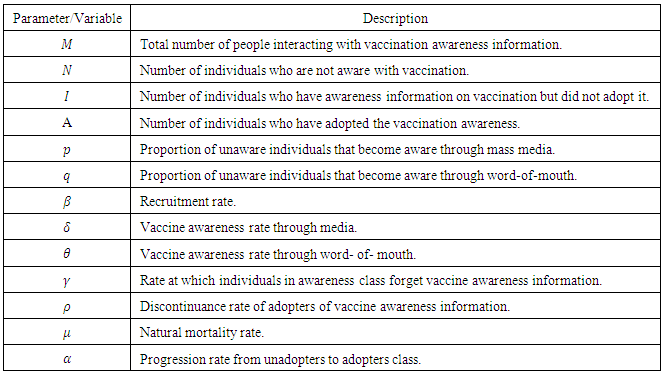
- In this section, we formulate a mathematical model for the spread of infant vaccination awareness information. We incorporate two stages; awareness stage and a decision-making stage in the model. Basically, we modify the Bass model for diffusion of awareness information for a new product presented in [4] by introducing the concept of new vaccination. We extend the model by adding I class (a class of individuals who have awareness information on infant vaccination but did not adopt it) and two forms of awareness; mass media and word-of-mouth. The population is divided into three classes: N, the number of individuals who are not aware with infant vaccination; I, the number of individuals who have awareness information on infant vaccination but did not adopt it; and A, the number of individuals who have adopted the vaccination awareness.We assume a recruitment rate,
 , for the number of individuals who are not aware with infant vaccination (N) which is through birth and immigration. A proportion p of unaware individuals in class N is assumed to become aware and adopt infant vaccination and progress to class A through mass media at a rate
  and the remaining proportion become aware but do not adopt and progresses to class I at the same rate. A proportion q in class N is assumed to progress to class A through the word-of-mouth at a rate
  and the remaining proportion progresses to class I at the same rate. Individuals in class I can progress to the adopters class, A at a rate
  . Adopters can discontinue from the infant awareness vaccination class, A and move to class I at a rate
  . Individuals in the unadopters class, I forget the information and return to the class N at a rate
  . A schematic representation of the model for the spread of infant vaccination awareness information is shown in Figure 1.
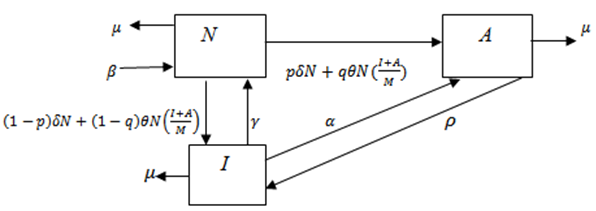 | Figure 1. Compartmental diagram for the infant vaccination awareness information in a population |
|
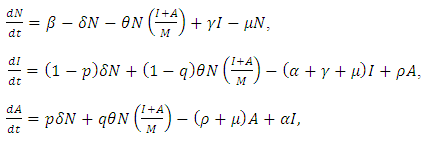 | (1) |
 All variables and parameters in the model (1) are considered to be positive, and the model lies in the region
2.1. Basic Properties
2.1.1. Invariant Region
- Lemma 1. All feasible regions Ω defined by
 with the initial conditions
  are positively invariant for system (1).Proof. Adding the system of three equations of (1), we have
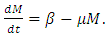 | (2) |
 as an integrating factor we obtain
 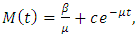 where
where  is a constant of integration. As
 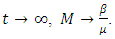 It implies that the region
  , is a positively invariant set for (1). So we consider dynamics of system (1) on the set Ω in this paper.
2.1.2. Positivity of Solutions
- For the system (1), to ensure that the solutions of the system with positive initial conditions remain positive for all
 . It is necessary to prove that all the state variables are nonnegative, so we have the following lemma.Lemma 2. If
  , then the solutions
 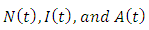 of system (1) are positive for all
  .Proof. Under the given initial conditions, it is easy to prove that the solutions of system (1) are positive; if not, we assume a contradiction that there exists a first time
  such that
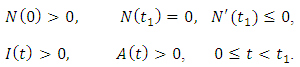 From the first equation of system (1), we have
  which is a contradiction meaning that
 Similarly, it can be shown that the variables
  remain positive for all
  . Thus, the solutions
  of the system (1) remain positive for all
  .
.3. Model Analysis
- The model system (1) is analyzed qualitatively to get insights into its dynamical features which give better understanding of the impact of awareness on infant vaccination.
3.1. Awareness Free Equilibrium Point, E0
- Awareness free equilibrium point is the point at which there is no awareness about infant vaccination in the entire population, i.e when
 .Considering system (1), when there is no awareness, then
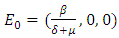
  Then the awareness free equilibrium point E0, is given by
 | (3) |
3.2. The Basic Reproduction Number, R0
- Diekmann et al., [16], define the basic reproduction number denoted by
 , as the average number of secondary infections caused by an infectious individual during the entire period of infectiousness. In this study, a secondary infection will be treated as a secondary awareness acquired by an individual during the period of getting vaccination awareness information. The basic reproduction number will be an important quantity in this study as it sets the threshold in the study of awareness information on infant vaccination for predicting the increase or decrease of number of awared people. Thus, whether the number of awared people increase or decrease in a population depends on the value of the reproduction number. For this study, if
  , it means that every awared individual on infant vaccination will cause less than one secondary awared individual which cause the decrease of the number of awared people; but when
  , every awared individual will cause more than one secondary awared individuals and hence the awareness information on infant vaccination will invade the population. For this study, a large number of
  may indicate the possibility of having more awared people about infant vaccination. We use the method presented in [17] to derive the expression for the basic reproduction number,
  . Let
. Let  be the rate of appearance of new awareness information in compartment i. The information transmission model consists of the equations,
  , where
  . We then compute the matrices F and V which are
  matrices, where m represent the awareness classes, defined by
  and
and  with
with  is nonnegative and V is non-singular m- matrix. We then compute
  , defined as the next generation matrix. The basic reproduction number,
  is then defined by
 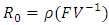 , where
  is the spectral radius of matrix B, (or the maximum modulus of the eigenvalues of B).From system (1) we define
  as
as 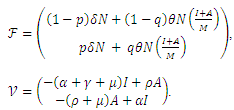 The awareness compartments are I and A, giving
  Differentiating
  with respect to I and A gives
 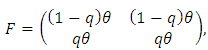 and
and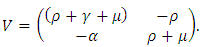 The eigenvalue of equation
  can be computed by the characteristic equation:
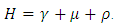
 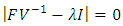 . This gives the basic reproduction number,
 where
where 
 Note:
Note:  does not depends on awareness rate through media,
  .
.3.3. Sensitivity Analysis of Model Parameters
- According to Chitnis at al., [2], sensitivity analysis is the method used to determine the robustness of model predictions to parameter values. We use sensitivity analysis to discover parameters that have a high impact on
 . Sensitivity indices allow us to measure the relative change in a state variable when a parameter changes. The normalized forward sensitivity index of a variable to a parameter is the ratio of the relative change in the variable to the relative change in the parameter. When the variable is a differentiable function of the parameter, the sensitivity index may be alternatively defined using partial derivatives.The normalized forward sensitivity index
  , of a variable, u, that depends differentiably on a parameter, p, is defined as:
  As we have an expression for
  , we derive an analytical expressions for the sensitivity index to
  for each of the six different parameters described in Table 1 that appears in
  . For example; using the set of values of estimated parameters in Table 3, the sensitivity indices for
  with respect to
  and
and  are given by
  and
and 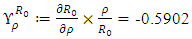 respectively. Other indices
  are obtained following the same method and are shown in table 2.
|
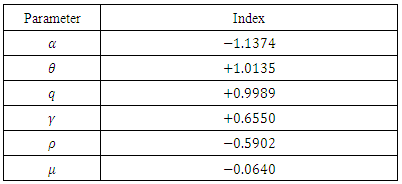
 increase the value of
  as they have positive indices, implying that they maximize the awareness on infant vaccination. The parameters
  decrease the value of
  implying that they minimize the awareness on vaccination as they have negative indices. But individually, the most sensitive parameter is the rate of un-adoptor to adoptors class
  , and the least sensitive parameter is the motality rate
  .
.3.4. Local Stability Analysis of Awareness Free Equilibrium point, E0
- To determine the local stability of awareness free equilibrium, the variation Jacobian matrix at equilibrium point,
 of the model system (1) is obtained as
  | (4) |
 in which for local stability of awareness free equilibrium we seek for all its eigenvalues to have negative real parts. The characteristic function of the matrix (4) with
  being the eigenvalues of
  , is obtained and by using mathematica software, we have the following eigenvalues;
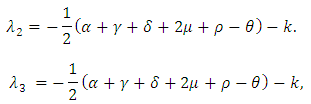 where
where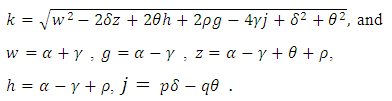 Considering real parts;
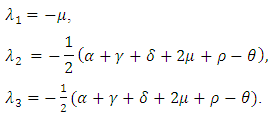 The awareness free equilibrium of system (1) is l.a.s given that
  . Thus for
  the awareness free equilibrium point is locally asymptotically stable.
3.5. Global Stability of Awareness Free Equilibrium
- In this section, we analyze the global stability of awareness free equilibrium. Here we use the method developed in [23]. We rewrite the model system (1) as
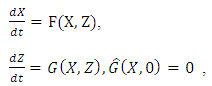 where
where  denotes (its components) the number of unawared individuals and
  denote (its components) the number of individuals who have vaccine awareness information. The awareness free equilibrium is now denoted by E0 = (X0,0). The following conditions, (H1) and (H2) must be met to guarantee a local asymptotic stability:(H1) For
 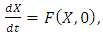 then
then  is globally asymptotically stable (g.a.s),(H2)
  where
where  for
for  where
where 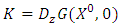 is an M –matrix (the off- diagonal elements of
  are non-negative) and Ω is the region where the model makes sence. Then the following lemma holds:Lemma 1.The fixed point E0 = (X0, 0), is globally asymptotic stable (g.a.s) equilibrium of system (1) provided
  is (l.a.s) and that the assumptions (H1) and (H2) are satisfied.Proof:Consider (H1). Considering the model system (1), we have
 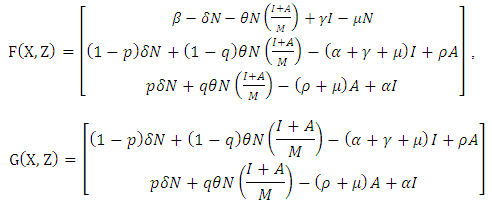 Then
Then  Now,
Now,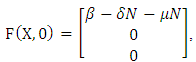 It is clear that
 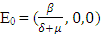 is a g.a.s of
  . Hence condition (H1) is satisfied.Now consider (H2).
 Since
Since  , it is clear that
  .Then we have
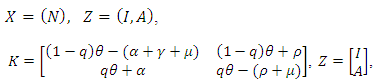 and
and 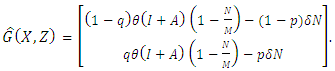 Then on substituting the above values we have
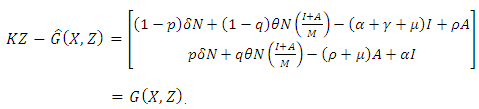 Hence (H2) satisfied.Then
 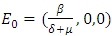 is globally asymptotic stable to our model system (1).Existence of Maximum Awareeness Equilibrium
  .The maximum awareness equilibrium of the system (1) is given by
 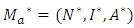 and it is obtained by setting the right hand side of equations equal to zero. In this paper, maximum awareness equilibrium works as for endemic equilibrium in disease model.
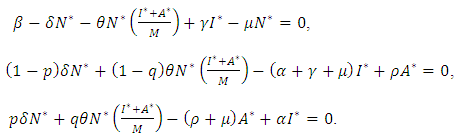 | (5) |
 the conditions
  or
or  , must be satisfied. It was not possible to get analytical solutions of system (5), so we resort to simulations to obtain insight in the dynamics of the model.
 3.5.1. Local Stability of Maximum Awareeness Equilibrium 
- To analyse the stability of maximum awareness equilibrium, the additive compound matrix approach is used using the idea of [5, 25].If
 , then the equation model (5) has a unique maximum awareness equilibrium given by
 in Ω, with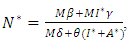

 where
where 
 Local stability of the maximum awareness equilibrium is determined by the variational matrix
  of the nonlinear system
 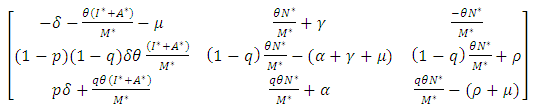 | (6) |
 be the variational matrix corresponding to
  . If
. If  are all negative, then all eigenvalues of
  have negative real parts.Using the above lemma, we will study the stability of the maximum awareness equilibrium.Theorem 2: If
  , the maximum awareness equilibrium
  of the model (6) is locally asymptotically stable in Ω.Proof:From jacobian matrix
  in (6), we have
 Det
Det 


 where
where 
 Hence the trace and determinant of the Jacobian matrix
  are all negative.The second additive compound matrix is obtained from the following lemma.Lemma 2: Let P and Q be subset of {1,2,3}. The (P,Q) entry of
  is the coefficient of Cin the expansion of the determinant of the sub matrix of
  +CI indexed by row in P and column in Q.Proof:The sub matrix of
  is given as
 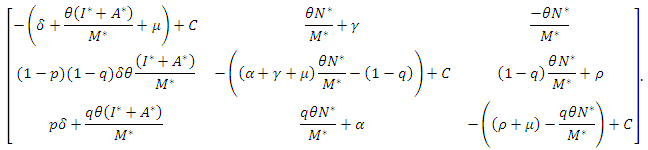 The sub matrix of
  indexed by rows and columns is given by
 The coefficient of C in the determinant of this matrix is
  and thus the (1,1) entry of
  is
is  Other entries were obtained by the same method and the following
  was obtained as




 Where
Where  Therefor
 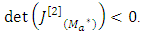 Thus, acording to lemma 1, the maximum awareness equilibrium
  of the model system (1) is locally asymptotically stable in Ω.
|
3.6. Simulation and Discussion
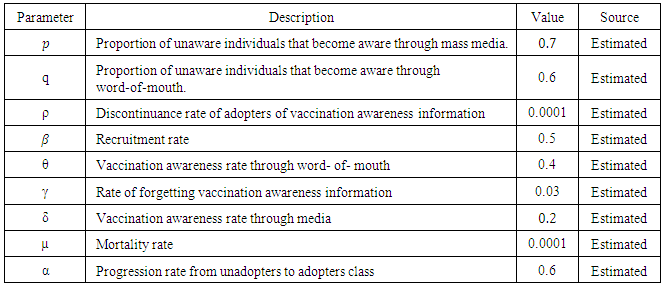
- The main objective of this study is to assess the impact of awareness information to infant vaccination. In order to support the analytical results, graphical representations showing the variations in parameters have been presented in this section. Since, most of the parameters were not readily available; it was found convenient to estimate them just for illustration purposes on how the model would behave in different real situation.
4. Discussion
- In simulations the observation shows that when awareness information through word-of-mouth increases with time keeping awareness rate through media constant, unawared population and awared population without adopting infant vaccination decrease while increasing the number of awared population, figure 2 (a), (b) and (c). The same observations ware obtained when we vary awareness rate through mass media and keep awareness rate through word-of-mouth constant figure 3 (a), (b) and (c). But when we increase both means of information with the same values, we have beter results. That is, unawared population and awared population without adoting infant vaccination decrease more, and getting more awared population, figure 4 (a), (b) and (c). Figure 5 shows the dynamic of the model system that when the time increases, the maximum values approach to their steady-state values, the awareness becomes maximum while minimizing unawared population.Thus, for the infant vaccination programme to succeed, there must be enough awareness information in both word-of-mouth and mass media before the programme starts.
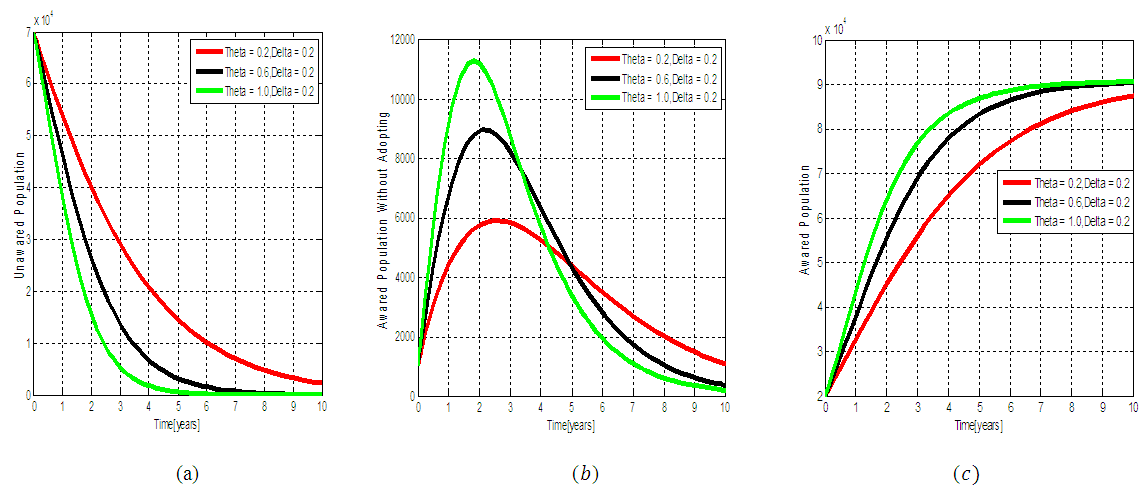 | Figure 2. Variation of awareness information through word-of-mouth with constant value of awareness information through media to (a) unawared population, (b)awared population without adopting, and (c)awared population |
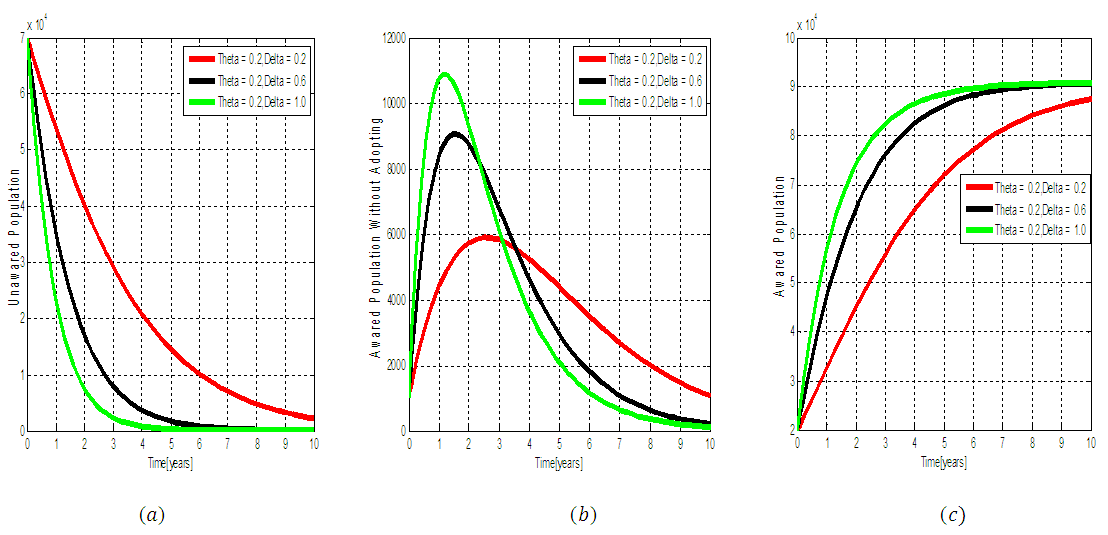 | Figure 3. Variation of awareness information through media with constant value of awareness information through word-of-mouth to (a) unawared population, (b) awared population without adopting, and (c) awared population |
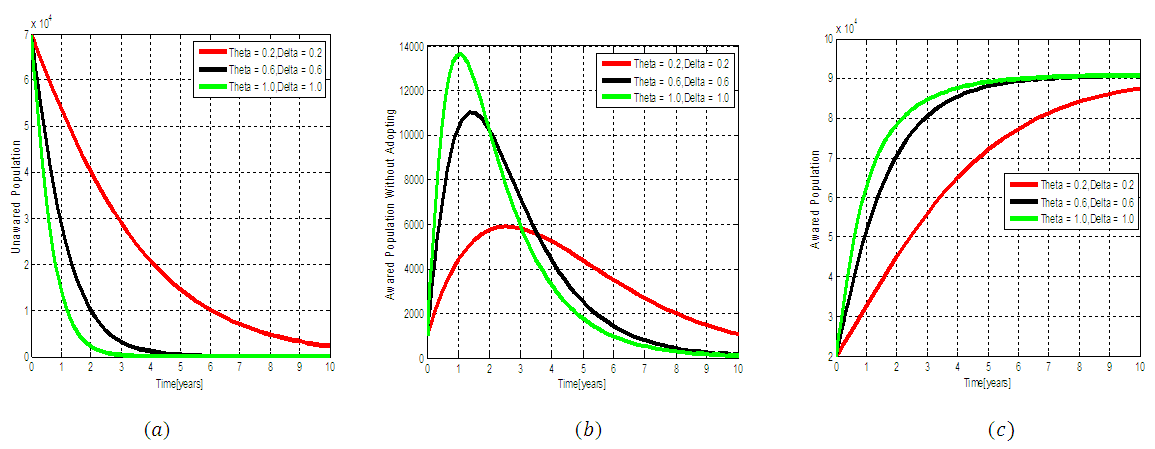 | Figure 4. Variation of both awareness information through media, and awareness information through word-of-mouth, to (a) unawared population, (b) awared population without adopting, and (c) awared population |
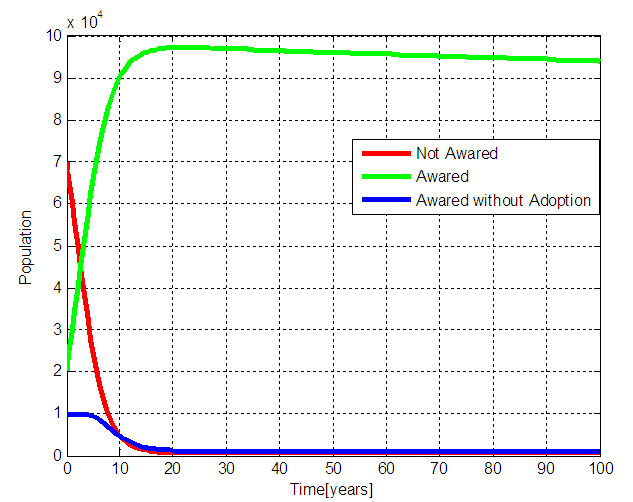 | Figure 5. Dynamic of the model system |
5. Conclusions
- In this paper, we formulated a mathematical model which shows the importance of spreading awareness information on infant vaccination to the population. From the model we derived the basic reproduction number,
 . For this study, we found out that if
  , every awared individual on vaccination will cause less than one secondary awared individual and hence cause the number of people who are awared on infant vaccination to decrease, and when
  , every awared individual on vaccination will cause more than one secondary awared individual and hence the awareness information on vaccination will invade the population. In this study, we were interested with large number of
  , i.e
, i.e  .We found that the maximum awareness equilibrium exists and it is locally and asymptotically stable. We performed sensitivity analysis on the basic reproduction number from which we noted that the parameter
  (awareness rate through word-of-mouth), is the most sensitive index on maximizing the infant vaccination awareness to the population due to its big positive value. From numerical simulations we observed that both awareness information through word-of-mouth and mass media are important in reducing unawared people and increase awared people for beter succesion of infant vaccination.
ACKNOWLEDGEMENTS
- The authors would like to thank the Nelson Mandela African Institution of Science and Technology (NM-AIST) for their financial and material support.