
-
Paper Information
- Previous Paper
- Paper Submission
-
Journal Information
- About This Journal
- Editorial Board
- Current Issue
- Archive
- Author Guidelines
- Contact Us
Applied Mathematics
p-ISSN: 2163-1409 e-ISSN: 2163-1425
2013; 3(2): 61-69
doi:10.5923/j.am.20130302.05
Estimation of Childhood Mortality in Bangladesh: Indirect Approach
 Abstract
 Reference
 Full-Text PDF
 Full-text HTML
Rafiqul Islam1, Mahfuzar Rahman2, Obaidur Rahman2
1Professor and Ex-chairman, Department of Population Science and Human Resource Development, University of Rajshahi Rajshahi-6205, Bangladesh
2Research Fellow, Department of Population Science and Human Resource Development University of Rajshahi-6205 , Rajshahi-6205, Bangladesh
Correspondence to: Rafiqul Islam, Professor and Ex-chairman, Department of Population Science and Human Resource Development, University of Rajshahi Rajshahi-6205, Bangladesh.
| Email: |  |
Copyright © 2012 Scientific & Academic Publishing. All Rights Reserved.
Childhood mortality is one of the sensitive indices of health as well as development which often reveal a country’s image in the world. Moreover, in Bangladesh, it is considered as an interesting topic for academician as well as researcher because of high childhood mortality. The objective of this study is to estimate the childhood mortality through Trussel technique using data classified by duration of marriage of mothers taken from Bangladesh Demographic and Health Survey (BDHS)-2004. From the results of estimated mortality levels for the national level, rural level and urban level, it is seen that the probability of dying (qx) are increasing with increase of marital duration, but for the male of urban level, these probabilities are decreasing from the marital duration 0-4 to 10-14 and then again increasing up to the last marital duration group. In all cases, the probability of dying is higher for male than that of female at each duration. It is observed that age specific average parities per woman for three cases follow simple linear regression model with explaining large proportion of variance.
Keywords: Data Classified by Duration of Marriage of Mothers, Children Ever Born (CEB), Children Dead, Trussel’s Technique, Regression Model, Cross Validity Prediction Power (CVPP), F-Test , Bangladesh
Cite this paper: Rafiqul Islam, Mahfuzar Rahman, Obaidur Rahman, Estimation of Childhood Mortality in Bangladesh: Indirect Approach, Applied Mathematics, Vol. 3 No. 2, 2013, pp. 61-69. doi: 10.5923/j.am.20130302.05.
Article Outline
1. Introduction
- In any country, childhood mortality is a reflection of the nation’s health as well as the nutritional status of children which also indicates the socio-cultural and economic progress. Childhood mortality rates especially infant mortality rate (IMR) in developed countries is swiftly decreased but till now it is a problem in developing nations like Bangladesh during the last fifty years. Tadesse et al. (2009) reported that 29000 children were died in every day before completing their fifth birth day in the world[1]. It was mentioned that in 2007, 9.2 million children born alive all over the world died before their fifth birth day[2] but after one year, it was decreased to 8.8 million[3, 4], of which, 41% of deaths occurred in neonates[4]. In accordance with PRB (2011), IMR is 44, 5 and 76 per 1000 live births in world, more developed and least developed countries in that order[5]. In spite of decreasing childhood mortality, it still remains high in some vulnerable groups and areas. It was indicated that the highest rates of under-five mortality continue to occur in sub-Saharan Africa and South Asia has the second highest rate in this globe[4]. Besides, most of these children live in these regions and died from a disease or a combination of diseases or sickness[6]. Any way, many countries are not on track to reach the target of Millennium Development Goal-4 (MDG-4)[4], but Bangladesh is currently one of the some countries in the world particularly in South Asia and Sub-Saharan Africa, which is on target for reaching the MDG-4 regarding to child mortality. The aim for Bangladesh linked to MDGs is to lessen under five mortality from 151 per 1000 live births in 1990 to 50 in 2015[7]. In recent times, a number of studies reported that IMR is 45 per 1000 live births[5] and under five mortality is 71[8] and 65[9] in this country, which clarify that Bangladesh is on the track to reach MDG-4. Even if, the recent decline in childhood mortality is notable[10], but it still remains high in Bangladesh owing to high prevalence of malnutrition, childhood diseases and illness. UNICEF (2008) reported that one neonate dies in every three to four minutes, making 14 neonates deaths every hour in Bangladesh[11]. Habib et al. (2009) reported that deaths usually occur in the neonatal period[12]. Therefore, it is the topic of interest to population and health researchers to evaluate the causes, levels and trends of mortality in Bangladesh. But, due to lack of vital registration system, it is quite impossible to identify the exact mortality level and their causes. In addition, the contributory relationship and differentials between under-five mortality and its socio-economic, demographic and other characteristics is not well recognized in this country. Therefore, the objective of this study is to estimate the childhood mortality using data classified by duration of marriage group of mothers in Bangladesh through indirect technique.
2. Sources of Data
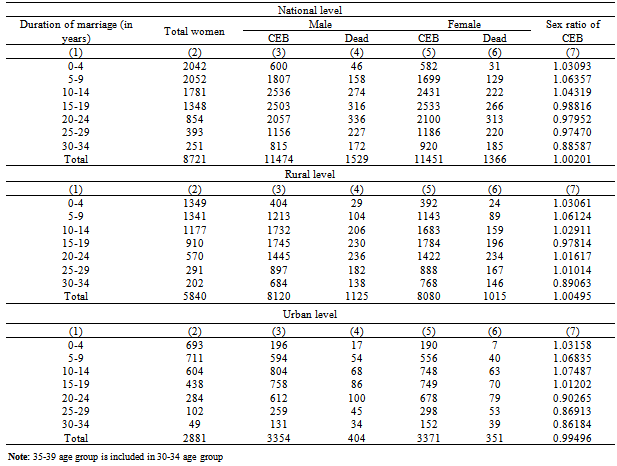
- The data classified by duration of marriage of mothers for fulfilling the aforementioned objective of this study are presented in Table 1 taken from Bangladesh Demographic and Health Survey (BDHS) 2004[13], for the ten year period preceding the survey, having an eligible woman (ever married and aged 10-49) with at least one or more children (with a total sample size 8721, of whom 5840 from rural and 2881 from urban areas), which were conducted by Mitra and Associates under the authority of the National Institute of Population Research and Training (NIPORT), Ministry of Health and Family Welfare, Bangladesh.
3. Methodology
3.1. Trussel Technique
- The well-established Trussel technique (1975)[14] is employed to estimate the childhood mortality in this study when the data are classified by duration of marriage group of mothers. The multipliers, ki, required to adjust the proportion of dead, Di, for the effect of the age pattern of childbearing are calculated from the ratio P1/P2 and P2/P3, by using the following equation:
 It is assumed that the West family of Model Life Tables is an adequate representation of mortality in Bangladesh, so, values of the coefficients, ai, bi and ci, for estimation of child mortality multipliers, Trussell variants are used, when data are classified by duration of marriage of mothers. Each probability of dying before exact age x, denoted by qx is calculated by using the following formula:
 The probability of surviving denoted by lx, from birth to exact age x, for each duration group is obtained by using the following formula:
3.2. Model Fitting
- If marriage specific average parities per woman are plotted in the graph paper, then, it appears from the Fig. 4 to Fig. 6 that these are, more or less, linearly distributed. So, in this case, linear regression model is treated and the model is
 [15]In which, x represents the mid value of marriage duration in years, y represents marriage specific average parities per woman,
  is the constant;
  is the coefficient of x and u is the error term of the model. It is to be noted that these models are built using the software STATISTICA.
3.3. Model Validation Procedure
- To check the legitimacy of these models, the CVPP, , is employed at this juncture. The mathematical formula for CVPP is given below:
 Where in, n is the number of classes, k is the number of explanatory variables in the fitted model and the cross-validated R is the correlation between observed and predicted values of the dependent variable[16]. The shrinkage of the model is the absolute value of (
 - R2); where
  is CVPP and R2 is the proportion of variation of the fitted model. Furthermore, the stability of R2 of the model is (1-shrinkage). The estimated CVPP corresponding to their R2 and information on model fittings are summarized in Table 2. It was informed that CVPP was also employed by Islam (2006)[17], Islam et al. (2003)[18] and Khan and Ali (2004)[19] as model validation method.
 3.4. The F-Test
- To identify the overall assessment of significant level of the formulated model as well as the significance of R2, the F-test is employed in this paper. The formula for F-test is given as
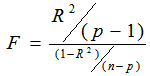 with (p-1, n-p) degrees of freedom (d.f.).Wherein, p = the number of parameters is to be estimated in the fitted model, n is the number of cases and R2 is the coefficient of determination of the model[20].
4. Results and Discussion
4.1. Estimation of Child Mortality for National Level of Bangladesh
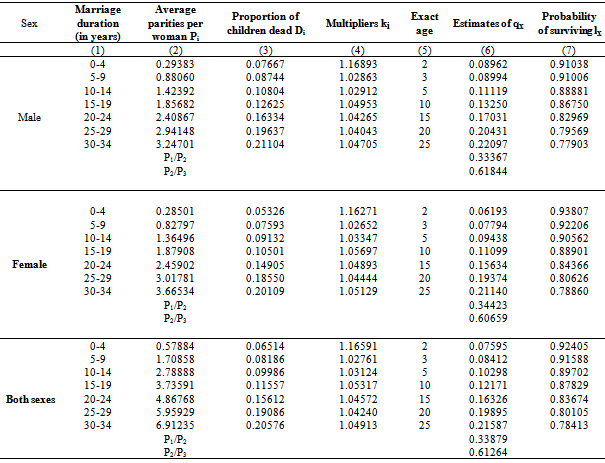
- The required data are summarized in Table 1. The sex ratios of the reported number of children ever born (CEB) are examined for consistency check of the data. A complete set of these sex ratios are presented in the last column of Table 1. The values of these ratios for different marriage durations are expected to reasonably stable and to be close to 1.05.Average parities, Pi, are calculated at national level for male, female and both sexes and these are shown in Table 2. The results indicate that the average parities per woman, i.e., the mean number of male CEB are higher than the female CEB. It is also observed that average parities are increasing with the increase of marriage duration of the mother.The proportion of children dead (Di) for each marriage duration group of mother for male, female and both sexes are shown in Table 2. The values of ki are obtained by substituting the average parities ratios P1/P2 and P2/P3 and the coefficients taken from West families of Model Life Tables in the Coale-Demeny System and presented in Table 2.The estimates of qx values are presented in Table 2 and the results are also presented in Figure 1. From the figure, it is observed that the probability of dying is increasing with the increase of marriage duration and the probability is higher for male than that of female at each duration.
|
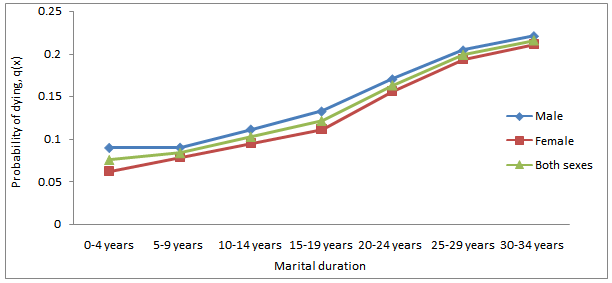 | Figure 1. Patterns of child mortality for national level of Bangladesh |
|
4.2. Estimation of Child Mortality for Rural Level of Bangladesh
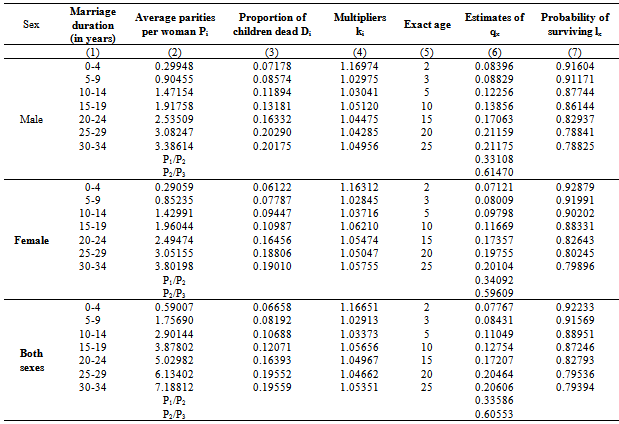
- In the same way, child mortality for rural level of Bangladesh are estimated and presented in Table 3. The probability of dying between birth and exact age x (qx) for male, female and both sexes are presented in Table 3 and the results are plotted in Figure 2. From the Figure, it is indicated that the probability of dying is increasing with the increase of marriage duration and the probability of dying is higher for male than that of female at each duration.
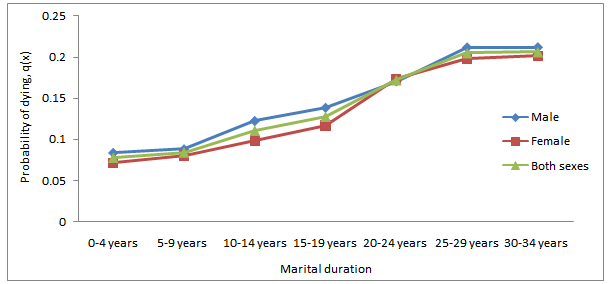 | Figure 2. Patterns of child mortality for rural level of Bangladesh |
|
4.3. Estimation of Child Mortality for Urban Level of Bangladesh
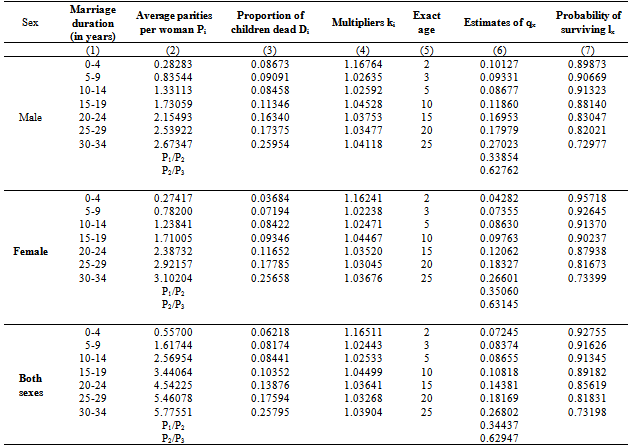
- In the similar process is adopted for the estimation of child mortality for urban level of Bangladesh and presented in Table 3. The estimates of qx values are presented in Table 4. The results indicate that the estimate of the probability of dying increase with the increase of marriage duration for male, female and both sexes but excepting for male in the duration of 0-14 years that are showed in Figure 3. Moreover, the probability of dying is higher for male than that of female at each duration.
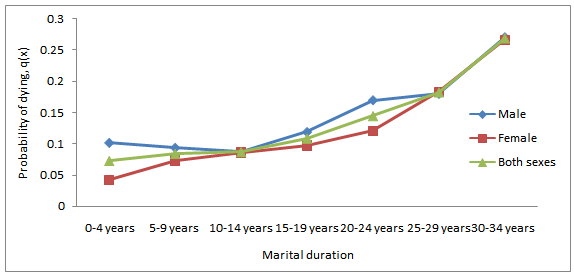 | Figure 3. Patterns of child mortality for urban level of Bangladesh |
|
4.4. Results of Model Fittings
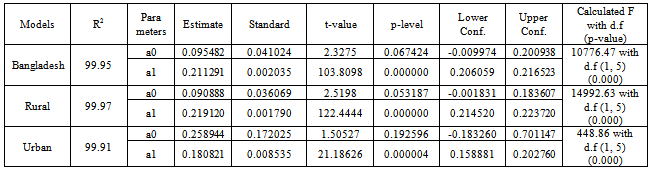
- The simple linear regression model is assumed to fit to age specific average parities per woman by duration of marriage for Bangladesh, rural and urban areas and these fitted models are described below:For Bangladesh, y=0.095482+0.211291x i)For Rural, y=0.090888+0.219120x ii)For Urban, y=0.258944+0.180821x iii)The estimated CVPP and results on model fittings for these models are exposed in Table 5 and Table 6 respectively. It seems from these tables that the fitted models (1) - (3) are highly cross- validated and their shrinkages are very small shown in the same table. These imply that the fitted models (1) - (3) will be stable more than 99% and these are demonstrated in the Table 5. Moreover, it is seen that the parameters of these models are highly significant with more than 99% of variance explained and the stability for R2 of these models is more than 99%. The calculated values of F statistic for these fitted models are displayed in the last column of Table 6 in which from these statistics it is concluded that F-test is highly significant and hence, these models are highly statistically significant. Therefore, the fit of these models are better well.
|

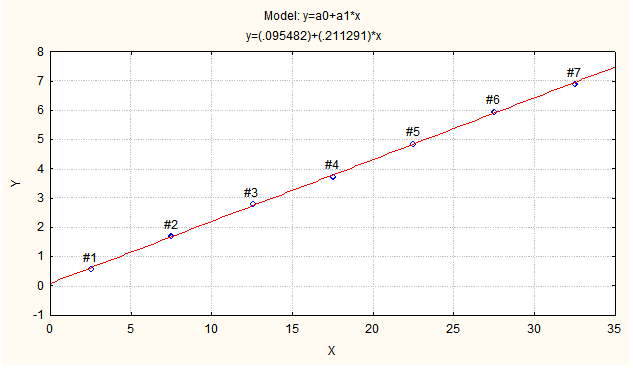 | Figure 4. Observed and fitted marriage specific average parities per woman for Bangladesh. X axis represents duration marriage and Y axis represents average parities per woman |
|
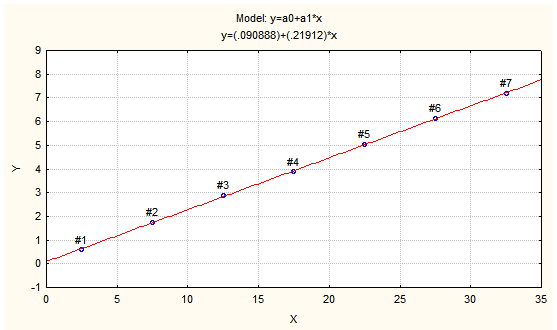 | Figure 5. Observed and fitted marriage specific average parities per woman for Rural level of Bangladesh. X axis represents duration marriage and Y axis represents average parities per woman |
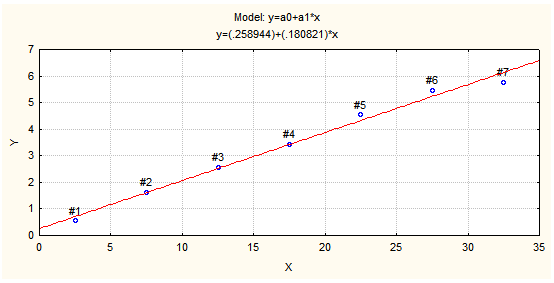 | Figure 6. Observed and fitted marriage specific average parities per woman for Urban level of Bangladesh. X axis represents duration marriage and Y axis represents average parities per woman |
5. Conclusions
- In this study, the average parities are increasing monotonically with the duration of marriage and the proportions of children dead are also increasing with marital duration. From the results of estimated mortality levels for the national level, rural level and urban level, it is observed that the probability of dying is increasing due to increase of marital duration, but for the urban level of male, these probabilities are decreasing in the marital duration 0-14 years and then again increasing up to the last marital duration group. The probability of dying is higher for male than that of female at each duration of marriage. It is investigated that age specific average parities per woman for three cases follow simple regression model with explaining more than 99% variation. In addition, it is expected that this study for measuring the childhood mortality through indirect technique would be very helpful for policy makers, program designers and /or planners to design or redesign program(s) or existing program(s) for lessening under-five mortality and for reaching MDGs. Moreover, for the estimation of adult mortality, these probabilities of surviving in this study may be used for the applications of Widowhood method or any other methods.