
-
Paper Information
- Next Paper
- Previous Paper
- Paper Submission
-
Journal Information
- About This Journal
- Editorial Board
- Current Issue
- Archive
- Author Guidelines
- Contact Us
Applied Mathematics
p-ISSN: 2163-1409 e-ISSN: 2163-1425
2013; 3(2): 56-60
doi:10.5923/j.am.20130302.04
Solutions of a Nonlocal Elliptic Problem Involving p(x)-Kirchhoff-type Equation
 Abstract
 Reference
 Full-Text PDF
 Full-text HTML
Mustafa Avci
Department of Mathematics, Dicle University, 21280-Diyarbakir, Turkey
Correspondence to: Mustafa Avci, Department of Mathematics, Dicle University, 21280-Diyarbakir, Turkey.
| Email: |  |
Copyright © 2012 Scientific & Academic Publishing. All Rights Reserved.
The present paper deals with a Kirchhoff problem under homogeneous Dirichlet boundary conditions, set in a bounded smooth domain Ω of ℝ^{N}. The problem studied is a stationary version of the original Kirchhoff equation, involving the p(x)-Laplacian operator, in the framework of the variable exponent Lebesgue and Sobolev spaces. The question of the existence of weak solutions is treated. Applying the Mountain Pass Theorem of Ambrosetti and Rabinowitz, the existence of a nontrivial weak solution is obtained in the variable exponent Sobolev space W₀^{1,p(x)}(Ω).
Keywords: Variational Method, p(x)-Laplacian, Nonlocal Problem, Mountain-Pass Theorem, Ambrosetti-Rabinowitz’s Condition, Palais-Smale Condition
Cite this paper: Mustafa Avci, Solutions of a Nonlocal Elliptic Problem Involving p(x)-Kirchhoff-type Equation, Applied Mathematics, Vol. 3 No. 2, 2013, pp. 56-60. doi: 10.5923/j.am.20130302.04.
1. Introduction
- In the present paper we are concerned with the following problem
 | (P) |
 Where
Where  is a smooth bounded domain,
  with
with  for any
  is a continuous function and
  is a Carathéodory function.Problem (P) is related to the stationary version of a model, the so-called Kirchhoff equation, introduced by[12]. To be more precise, Kirchhoff established a model given by the equation
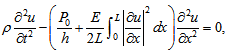 where
where  are constants which extends the classical D'Alambert's wave equation, by considering the effects of the changes in the length of the strings during the vibrations. There are papers[4,11,14] in which the authors give the existence of solutions of Kirchhoff-type and p-Kirchhoff-type equations. Moreover, for p(x)-Kirchhoff-type equations see, for example,[2,5-7].The p(x)-Laplace operator
 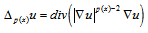 is a natural generalization of the p-Laplacian operator
 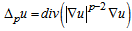 where
where is a real constant. The main difference between them is that p-Laplacian operator is (p-1)-homogenous, but the p(x)-Laplacian operator, when p(x) is not constant, is not homogeneous. This causes many problems, some classical theories and methods, such as the Lagrange multiplier theorem and the theory of Sobolev spaces, are not applicable. For p(x)- Laplacian operator, we refer the readers to[9,10,15,16] and references there in. Moreover, the nonlinear problems involving the p(x)-Laplacian operator are extremely attractive because they can be used to model dynamical phenomenons which arise from the study of electrorheological fluids or elastic mechanics. Problems with variable exponent growth conditions also appear in the modelling of stationary thermo-rheological viscous flows of non-Newtonian fluids and in the mathematical description of the processes filtration of an ideal barotropic gas through a porous medium. The detailed application backgrounds of the p(x)-Laplacian can be found in[1,3,17,19] and the references there in.
2. Preliminaries
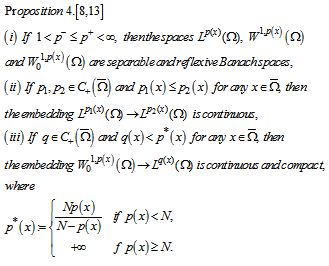
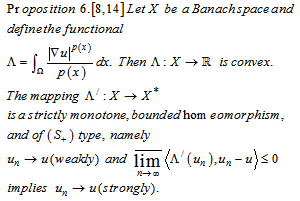
- First, we recall some basic properties of spaces
 and
and  (for details, see e.g.,[8,14]).Set
 For any
  , denote
 and define the variable exponent Lebesgue space by
 We define a norm, the so-called Luxemburg norm, on
  by the formula
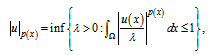 and then
 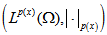 becomes a Banach space.Define the variable exponent Sobolev space by
  then it can be equipped with the norm
 The space
  is defined as the closure of
  with respect to the norm
  . For
. For  , we can define an equivalent norm
  since the well-known Poincaré inequality holds.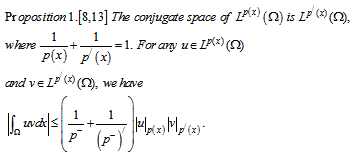
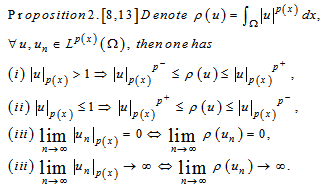
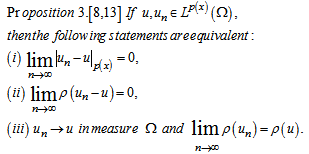
 We say that
  is a weak solution of (P) if
  where
where  We associate to the problem (P) the energy functional, defined as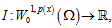
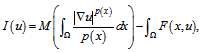 where
where 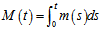 and
and 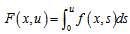 . We know that from (m0) and (f0) (see Section 3)
  is well defined and in a standard way we can prove that
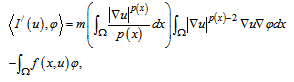
 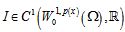 and that the critical points of I are solutions of (P). Moreover, the derivative of
  is given by
 for all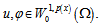
3. The Main Results
- Now, we are ready to set and prove the main result of the present paper.
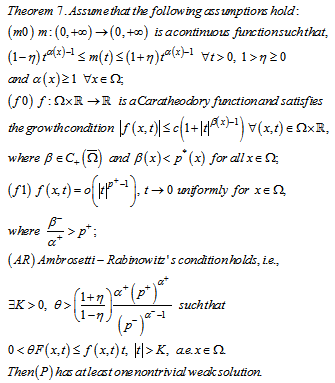 The proof of Theorem 7 follows from the following two Lemmas.
 Proof. Let us assume that there exists a sequence
 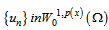 such that
 Therefore,
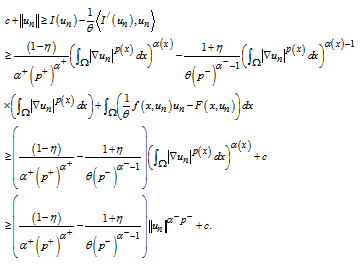 Therefore,
  is bounded in
  . From this bound estimate, going to a subsequence if necessary, there exists a
  in
in  such that
  . Thanks to the compact embedding
  , we get
 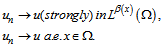 Since,
 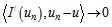 , we have
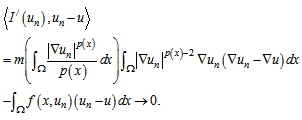 From (f0) and Proposition 1, it follows
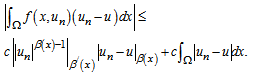 By the embeddings, we get
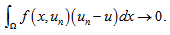 Hence,
 From (m0), it follows
  | (3.1) |
 , we get
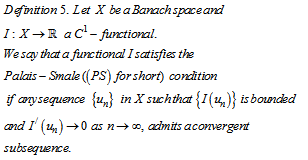
 satisfies (PS) condition.
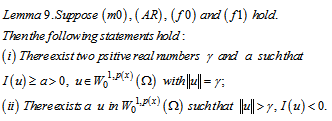 Proof. (i) Let us assume
  . Then by (m0), we have
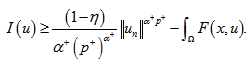 By the continuous embeddings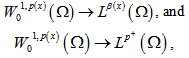
 | (3.2) |
 Therefore,
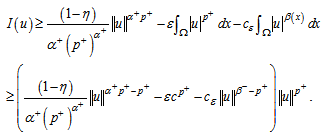 Let us define the function
 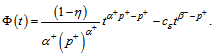 Since
Since  it is clear that there exists a
  such that
  . Hence, for a fixed
  small enough, there exist two positive real numbers
  and
and  such that
  (ii) From (AR), we have
  Hence, for
  and
and  we have
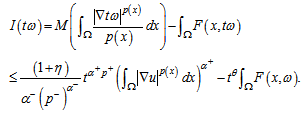 From (AR), it can be obtained that
  . Therefore,
  Proof of Theorem 7. From Lemma 8, Lemma 9 and the fact that
  ,
, satisfies the Mountain Pass theorem (see e.g.,[18]). Therefore,
  has at least one nontrivial critical point, i.e., (P) has a nontrivial weak solution. We are done.