American Journal of Polymer Science

p-ISSN: 2163-1344    e-ISSN: 2163-1352

2026;  15(2): 24-28

doi:10.5923/j.ajps.20261502.02

Received: Sep. 25; Accepted: Oct. 12, 2026; Published: Oct. 16, 2026

 

Obtaining and Physical-Chemical Properties of Polycomplexone

Qoraboyeva N. M.1, Ikramova S. M.1, PhD Qurbonov H. G‘.1, 2, Gafurova D. A.1

1Department of Polymer Chemistry, National University of Uzbekistan, Tashkent, Uzbekistan

2Tashkent State Medical University, Tashkent, Uzbekistan

Correspondence to: Qoraboyeva N. M., Department of Polymer Chemistry, National University of Uzbekistan, Tashkent, Uzbekistan.

Email:

Copyright © 2026 The Author(s). Published by Scientific & Academic Publishing.

This work is licensed under the Creative Commons Attribution International License (CC BY).
http://creativecommons.org/licenses/by/4.0/

Abstract

In this study, a novel polyampholytic polymer complex (SMAF) was successfully synthesized by chemically modifying polyacrylonitrile (PAN) fiber with hexamethylenediamine (HMDA), followed by phosphorylation using phosphite acid (H3PO3) and formaldehyde (CH2O). The reaction conditions were optimized based on static exchange capacity (SEC), reaching a maximum value of 4.3 meq/g at 5–7 hours with 60% phosphite acid. Physicochemical characterization was conducted using FT-IR spectroscopy and potentiometric titration. FT-IR spectra confirmed the incorporation of amine and aminomethylenephosphonate groups (-NH-CH2-PO3H2), showing characteristic bands at 2800-2850 cm-1 and 968-1170 cm-1, alongside a reduced nitrile (-C≡N) band intensity at 2242 cm-1 due to nucleophilic modification. Potentiometric titration curves exhibited differential peaks at [H+] = 1.7 meq/g} and [OH-] = 2.7 meq/g, confirming the amphoteric nature and presence of functional groups with dual basicities and acidic phosphonic groups. The resulting SMAF polyampholyte demonstrates a crosslinked, insoluble matrix, proving highly effective for industrial wastewater treatment and heavy metal ion recovery.

Keywords: Polyacrylonitrile, Hexamethylenediamine, Phosphite acid, Polycomplex, Static exchange capacity

Cite this paper: Qoraboyeva N. M., Ikramova S. M., PhD Qurbonov H. G‘., Gafurova D. A., Obtaining and Physical-Chemical Properties of Polycomplexone, American Journal of Polymer Science, Vol. 15 No. 2, 2026, pp. 24-28. doi: 10.5923/j.ajps.20261502.02.

1. Introduction

Today, ion-exchange materials are widely used in various sectors of the economy, and the demand for them is constantly growing. Ion-exchange polymer materials play a special role in the separation and concentration of colored, rare, heavy, and precious metals, as well as in the preparation and purification of industrial water [1]. In particular, ion-exchange sorbents have been successfully used to solve many environmental problems [2].
In this regard, the synthesis of ion-exchange materials and the study of their sorption properties remain a pressing issue. As is known from the literature, polymer materials that combine complex properties are mainly obtained by chemically modifying polymers bearing various functional groups. In this process, the initial structure of the polymer material is preserved [3].
Polyampholytes containing nitrogen and phosphorus exhibit both ion exchange and chelation processes simultaneously. Such polymer materials have high sorption properties, characterized by high sorption capacity and selectivity for a number of heavy and colored metals, which is also due to the polydentate nature of the polymer chelating agent, both due to the chelating effect of complex formation involving amino and phosphonic groups [4,5].
Ion exchangers are widely used for solving a range of practical problems, including:
• water treatment processes, such as desalination, softening, and complete deionization of water for technological and industrial applications;
• separation, concentration, and recovery of metal ions and other valuable components in the hydrometallurgy of non-ferrous and precious metals;
• removal of chemically active ionic and polar impurities from industrial process streams, including the purification of certain gases and liquid media;
• modification of the ion-exchange properties of soils and controlled delivery of essential micronutrients and fertilizers to improve plant growth and nutrient availability.
Thus, ion-exchange materials have found broad application in water purification, hydrometallurgy, industrial separation processes, and agriculture due to their high selectivity, exchange capacity, and ability to reversibly bind ionic species [6].
With the expansion and development of industrial enterprises, the demand for anion-exchange and chelating sorbents increases. The synthesis of these sorbents is carried out by modifying various chemical reagents to alter the functional groups of the sorbents used in industrial enterprises [7,8]. Therefore, the process of obtaining ion-exchange, complex-forming materials from granular and local polyvinyl raw materials, and the study of their physicochemical properties, is one of the pressing tasks in physical chemistry and the chemistry of macromolecular compounds.
The processes for obtaining ion-exchange sorbents by chemically modifying polyacrylonitrile (nitron) fiber with various amine-containing and hydroxylamine-containing reagents have been thoroughly studied. In the studies, the kinetics of modification reactions of nitron fiber with dimethylhydrazine, hydroxylamine, hexamethylenediamine, and ethylenediamine, the reaction medium conditions, and their sorption properties were investigated in detail [9,10]. In particular, the scientific basis has been established for modifying the nature of modifiers and introducing solvents such as dichlorethane into the reaction medium, thereby attaching various functional groups to the polymer chain and synthesizing anion-exchange materials with high capacity.

2. Method

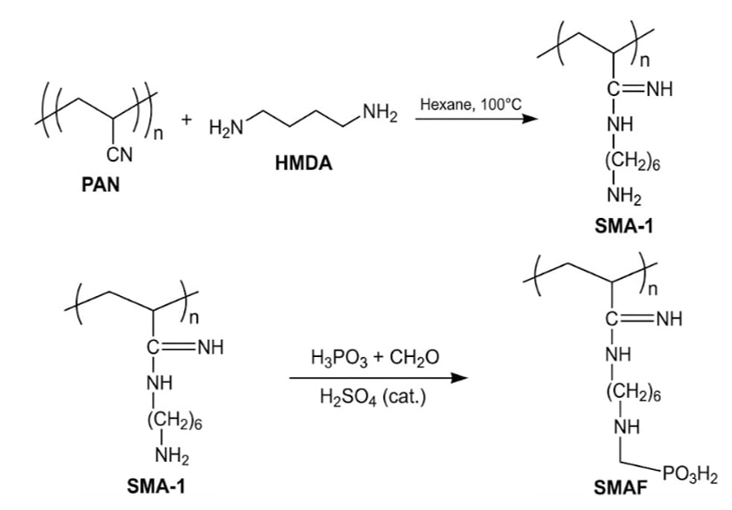
To obtain a strong-base ion-exchange sorbent, PAN fibers were modified with hexamethylenediamine (HMDA) in a reaction, and the SMA-1 sorbent was synthesized [11]. In the next step, the SMA-1 anionite was treated with phosphite acid, and the SMAF polyampholytic sorbent was synthesized.
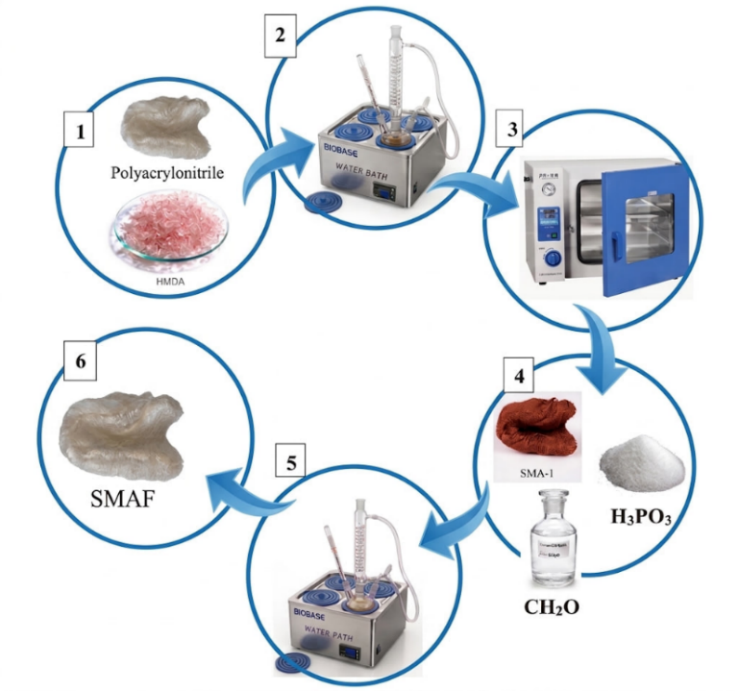
Figure 1. Schematic representation of the step-by-step synthesis of PAN-based SMAF polyampholytic sorbent
As is known from the literature, phosphite acid (by virtue of its structure) is a nucleophile due to the electron pair on the phosphorus atom. In the first stage, the polymer formed undergoes a chemical modification via secondary amine groups, resulting in the formation of –PO3H2 groups.
Identifying the new functional groups in the resulting polymer requires special conditions and presents a number of challenges; therefore, the static exchange capacity (SEC) was determined to characterize the cyan group exchange level of the ion-exchange materials. The SEC value of the synthesized sorbents was determined using 0.1 N HCl and NaOH solutions as the degree of substitution during the chemical modification of the polymers.
To determine the optimal temperature for the chemical modification of SMA-1 fiber with phosphite acid, the kinetics of the modification process were studied at various temperatures.
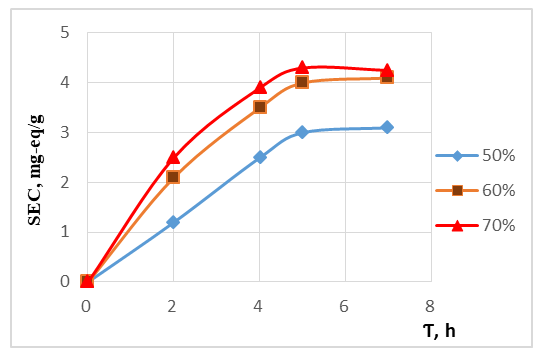
The maximum SEC value was observed when the reaction was carried out for 5–7 hours, and it was determined that SEC increased with increasing phosphite acid concentration. The maximum SEC value (4.3 meq/g) was recorded when the reaction time was 7 hours and the H₃PO₃ concentration was 60%.
The synthesized polyampholyte PAN is insoluble in solvents, organic solvents, and strong acids and bases, which indicates that it has transitioned into a crosslinked state as a result of polymer modification.

3. Results and Discussion

Figure 2. Dependence of the SEC of the polyampholyte on the reaction time at various concentrations of H3PO3
As shown in Figure 2, the kinetic study of the modification process demonstrates the influence of reaction time and phosphite acid concentration on the SEC. The SEC value increases rapidly within the first 4–5 hours of reaction and reaches a plateau after 5–7 hours. Increasing the phosphite acid concentration from 50% to 70% leads to a higher degree of functionalization, yielding a maximum exchange capacity of 4.3 meq/g. This behavior confirms the complete saturation of reactive centers along the polymer chain under optimal conditions.
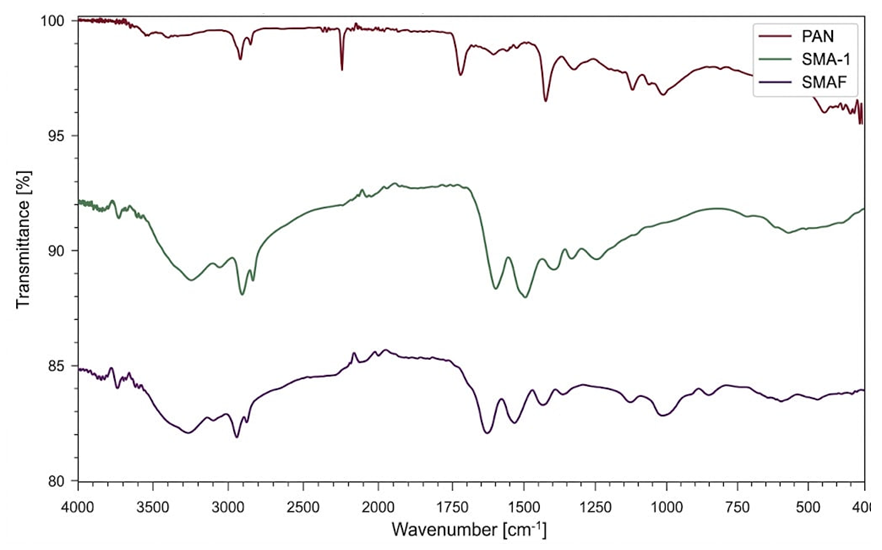
To characterize the chemical structure of the synthesized polymer, its IR spectrum and samples were examined by potentiometric titration to assess the ionic equilibrium between a polyampholytic and an aqueous medium. An IR spectrum was obtained to characterize the chemical structure of the synthesized polymer.
Figure 3. IR spectra of PAN, SMA-1, and SMAF samples
Unlike the spectrum of initial PAN, the intensity of the characteristic absorption band at 2242 cm⁻¹, corresponding to the stretching vibrations of the nitrile (-C≡N) group, decreases significantly in SMA-1 and SMAF [11]. This reduction is attributed to the nucleophilic addition of HMDA to the nitrile groups during modification, leading to the formation of imino (-C=NH) and amine (-NH-) bonds [12,13]. The residual weak absorption at 2242 cm⁻¹ indicates that a fraction of the nitrile groups within the polymer backbone remained unreacted due to steric hindrance [14]. Furthermore, new bands appearing at 1565 cm-1 (>NH bending) and 1658 cm-1 (-NH2 bending and >C=N- stretching) confirm successful amine functionalization [15].
In the FT-IR spectrum of the SMAF polyampholyte, new intense absorption bands observed at 968, 1099, and 1170 cm-1 are assigned to the characteristic vibrations of phosphonic acid groups (-P(O)(OH)2) [16,17]. Additionally, the absorption in the 2800-2850 cm-1 region corresponds to the symmetric and asymmetric stretching vibrations of methylene (-CH2-) groups linked within the aminomethylenephosphonate fragments (-NH-CH2-PO3H2) [18,19]. The presence of adjacent electron-withdrawing phosphonate groups and nitrogen atoms alters the local electron density, causing these characteristic C–H stretching bands to appear clearly in this region [19,20].
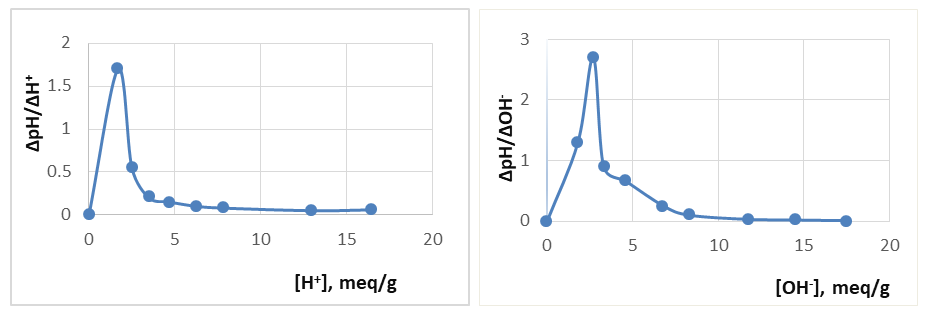
The potentiometric titration curves of the SMAF-1 polyampholyte clearly demonstrate its polyamphoteric nature. The differential anion-exchange titration curve (Figure 4a) exhibits a sharp peak at [H+] = 1.7 meq/g. This data indicates the presence of functional groups with two distinct basicities in the synthesized anionite. Specifically, the stronger basicity is attributed to the primary and secondary aliphatic amine groups (-CH2-NH- and -NH2) originating from the HMDA modifier, whereas the weaker basicity corresponds to the imino/amidin (-C=NH) groups formed during the chemical modification of PAN nitrile bonds. The differing protonation abilities (pKa values) of these two nitrogen-containing groups account for the observed basicity characteristics.
Conversely, the cation-exchange titration curve (Figure 4b) displays a maximum peak at [OH-] = 2.7 meq/g, which confirms the incorporation of acidic phosphonic acid groups (-P(O)(OH)2) attached to the macromolecular backbone. The simultaneous coexistence of these distinct basic amine/imino groups and acidic phosphonic acid groups validates the successful synthesis of a crosslinked polyampholytic sorbent with dual functionality.
Figure 4. Differential curve of the potentiometric titration of the SMAF-1 polyampholyte with HCl (a) and NaOH (b) solutions
Based on the obtained results, the modification of PAN with HMDA and phosphite acid can be explained as proceeding according to the following scheme:
Scheme 1

4. Conclusions

As a result of the conducted research, a new type of polycomplex with ampholytic properties based on PAN was synthesized, and the optimal conditions for the reaction process were determined. The research results indicate that reaction medium parameters, including reagent ratios, temperature, and reaction time, directly affect the sorbent's physicochemical properties. As a result of optimizing these factors, the polyampholite's static exchange capacity increased significantly. The IR spectrum of the obtained polycomplex was recorded and analyzed, and potentiometric titration was carried out to characterize the ionogenic groups. According to the research results, the new polyampholyte obtained can be used as a promising sorbent for purifying industrial wastewater from harmful ions, recovering valuable metal ions from technological solutions, and recycling secondary resources.

ACKNOWLEDGEMENTS

The authors express their gratitude to the Department of Chemistry for providing the facilities and equipment (FT-IR spectroscopy and potentiometric titration devices) to carry out this research work.

DISCLOSURE

The authors declare that there are no conflicts of interest regarding the publication of this paper.

References

[1]  El Ouardi, Y., Virolainen, S., Mouele, E. S. M., Laatikainen, M., Repo, E., & Laatikainen, K. (2023). The recent progress of ion exchange for the separation of rare earths from secondary resources–A review. Hydrometallurgy, 218, Article 106047. https://doi.org/10.1016/j.hydromet.2023.106047.
[2]  SenGupta, A. K. (2017). Ion exchange in environmental processes: Fundamentals, applications and sustainable technology. John Wiley & Sons.
[3]  Hadi, M. K., et al. (2025). Functional polymeric membrane materials: A perspective from versatile methods and modification to potential applications. Polymer Science & Technology, 1(5), 366–412.
[4]  Qurbonov, H., Rustamov, M., Gafurova, D., Toshpulatova, M., & Temirov, N. (2023). Polyacrylonitrile-based ion-exchange material synthesis and combustion properties investigation. E3S Web of Conferences, 458, Article 02008. EDP Sciences. https://doi.org/10.1051/e3sconf/202345802008.
[5]  Orzikulov, B., Gafurova, D., Shakhidova, D., Makhkamov, M., & Khudoyberdiyev, I. (2023). Kinetic models of sorption of copper (II) ions on ionite based on polyacrylonitrile. Journal Name / Publisher.
[6]  Wang, L., et al. (2021). Experimental investigation on gasification of cationic ion exchange resin used in nuclear power plants by supercritical water. Journal of Hazardous Materials, 419, Article 126437. https://doi.org/10.1016/j.jhazmat.2021.126437.
[7]  Rangreez, T. A., Inamuddin, & Luqman, M. (Eds.). (2019). Applications of ion exchange materials in chemical and food industries. Springer. https://doi.org/10.1007/978-3-030-10430-6.
[8]  Jeyakumar, S. S., & Vashishth, R. (2026). Next-generation adsorbents for heavy metal removal: organic, inorganic, and hybrid materials. Environmental Sciences Europe, 38(1), 72.
[9]  Sruthi, P. R., & Anas, S. (2020). An overview of synthetic modification of nitrile group in polymers and applications. Journal of Polymer science, 58(8), 1039-1061.
[10]  Zheng, L., Li, P., Tao, M., & Zhang, W. (2019). Regulation of polar microenvironment on the surface of tertiary amines functionalized polyacrylonitrile fiber and its effect on catalytic activity in Knoevenagel condensation. Catalysis Communications, 118, 19-24.
[11]  Rustamov, M. K., Gafurova, D. A., Karimov, M. M., et al. (2014). Application of ion-exchange materials with high specific surface area for solving environmental problems. Russian Journal of General Chemistry, 84(12), 2545–2551. https://doi.org/10.1134/S107036321412038X.
[12]  Smith, B. C. (2011). Fundamentals of Fourier transform infrared spectroscopy. CRC press.
[13]  Socrates, G. (2004). Infrared and Raman characteristic group frequencies: tables and charts. John Wiley & Sons.
[14]  Silverstein, R. M., Webster, F. X., Kiemle, D. J., & Bryce, D. L. (2015). Spectrometric identification of organic compounds (8th ed.). John Wiley & Sons.
[15]  Popov, K., Rönkkömäki, H., & Lajunen, L. H. J. (2001). Critical evaluation of stability constants of phosphonic acids (IUPAC Technical Report). Pure and Applied Chemistry, 73(10), 1641–1677. https://doi.org/10.1351/pac200173101641.
[16]  Helfferich, F. G. (1995). Ion exchange. Dover Publications.
[17]  Dorfner, K. (Ed.). (1991). Ion exchangers. Walter de Gruyter. https://doi.org/10.1515/9783110862430.
[18]  Alexandratos, S. D. (2009). Ion-selective polymer scaffolds for environmental remediation. Industrial & Engineering Chemistry Research, 48(1), 388–398. https://doi.org/10.1021/ie801048b.
[19]  Rivas, B. L., Pereira, E. D., & Palencia, M. (2008). Water-soluble polymer-metal complexes for the recovery of heavy metal ions from aqueous solutions. Progress in Polymer Science, 33(11), 1031–1057. https://doi.org/10.1016/j.progpolymsci.2008.07.006.
[20]  Kabanov, V. A. (2005). Physico-chemical basis and prospects of using soluble interpolyelectrolyte complexes. Russian Chemical Reviews, 74(1), 3–20. https://doi.org/10.1070/RC2005v074n01ABEH000928.