
-
Paper Information
- Paper Submission
-
Journal Information
- About This Journal
- Editorial Board
- Current Issue
- Archive
- Author Guidelines
- Contact Us
American Journal of Polymer Science
p-ISSN: 2163-1344 e-ISSN: 2163-1352
2026; 15(2): 19-23
doi:10.5923/j.ajps.20261502.01
Received: Aug. 26; Accepted: Sep. 27, 2026; Published: Oct. 10, 2026

Physicochemical Properties of an Inorganic Polymer (Geopolymer) Sorbent Derived from Local Raw Materials
 Abstract
 Reference
 Full-Text PDF
 Full-text HTML
Gulmira Turaliyevna Mustafayeva1, Firuza Gayratovna Rakhmatkarieva2, Mansur Saburovich Khudayberganov3
1Doctoral Researcher, Namangan State Technical University, Namangan, Uzbekistan
2Doctor of Chemical Sciences, Senior Researcher, Institute of General and Inorganic Chemistry, Academy of Sciences of the Republic of Uzbekistan, Tashkent, Uzbekistan
3PhD in Chemistry, Chirchiq State Pedagogical University, Chirchiq, Uzbekistan
Correspondence to: Gulmira Turaliyevna Mustafayeva, Doctoral Researcher, Namangan State Technical University, Namangan, Uzbekistan.
| Email: |  |
Copyright © 2026 The Author(s). Published by Scientific & Academic Publishing.
This work is licensed under the Creative Commons Attribution International License (CC BY).
http://creativecommons.org/licenses/by/4.0/

The development of effective and cost-efficient sorbent materials from locally available natural resources is a priority direction in modern materials chemistry and environmental technology. Aluminosilicate sorbents derived from natural clay minerals are of particular interest owing to their wide availability, low cost, and pronounced ion-exchange properties. In this study, an inorganic polymer aluminosilicate sorbent was synthesized by thermochemical activation of clay soil collected from the Amudarya riverbank (Uzbekistan). The raw material, predominantly composed of quartz, kaolinite, and illite, was calcined at 600–650 °C for 4 hours, followed by sequential treatment with 1 M H₂SO₄ and 3 M NaOH solution under autoclave conditions (48 h). Physicochemical characterization was performed using Fourier-transform infrared (FTIR) spectroscopy (Shimadzu IRAffinity-1S; KBr pellet method; 400–4000 cm⁻¹) and X-ray diffraction (XRD) analysis (Shimadzu XRD-6100; Cu Kα radiation; 2θ = 5–80°). FTIR spectra revealed characteristic absorption bands of the aluminosilicate network in the range 1000–1080 cm⁻¹ (asymmetric Si–O–Si and Si–O–Al stretching vibrations). XRD analysis confirmed the presence of crystalline quartz (2θ = 20.8°, 26.6°, 36.5°, and 50.1°) and layered aluminosilicate mineral phases (kaolinite and illite). The synthesised material exhibits a partially crystalline structure and is promising for application in the purification of aqueous systems from heavy metals and organic pollutants.
Keywords: FTIR spectroscopy, Inorganic polymer, Local clay, Sorbent, XRD analysis
Cite this paper: Gulmira Turaliyevna Mustafayeva, Firuza Gayratovna Rakhmatkarieva, Mansur Saburovich Khudayberganov, Physicochemical Properties of an Inorganic Polymer (Geopolymer) Sorbent Derived from Local Raw Materials, American Journal of Polymer Science, Vol. 15 No. 2, 2026, pp. 19-23. doi: 10.5923/j.ajps.20261502.01.
1. Introduction
- Adsorbents are widely used to remove pollutants from domestic and industrial wastewater. They are also employed in the oil and gas industry as catalysts and in water treatment as adsorbents and ion-exchange materials for softening hard water [1]. Aluminosilicate-based materials have attracted considerable attention because of their chemical stability, porous structure, and adsorption properties. Natural clay minerals provide an abundant, inexpensive feedstock for these sorbents [2,3]. Their structure supports ion exchange and adsorption of pollutants, including heavy metals, dyes, and organic compounds [4,7,8].Rapid industrialization and urbanization have made heavy-metal contamination of water an important environmental concern worldwide. Lead (Pb), copper (Cu), cadmium (Cd), chromium (Cr), zinc (Zn), mercury (Hg), and nickel (Ni) are of concern because they do not biodegrade, may accumulate in organisms, and can be toxic even at low concentrations [9,10,11,12]. Geopolymers, three-dimensional aluminosilicate inorganic polymers, have recently attracted interest because they can be produced at relatively low cost from waste materials, show chemical stability, and have potential for heavy-metal adsorption [13,14,15].The term “geopolymer” was introduced by Joseph Davidovits in the mid-1970s. Davidovits (1991) described geopolymers as inorganic polymers with amorphous or semicrystalline three-dimensional silicoaluminate frameworks and distinguished three principal structural types:Poly(sialate) (PS): –Si–O–Al–O– repeating unit; has a Si/Al ratio of 1.Poly(sialate-siloxo) (PSS): –Si–O–Al–O–Si–O– repeating unit; has a Si/Al ratio of 2.Poly(sialate-disiloxo) (PSDS): –Si–O–Al–O–Si–O–Si–O– repeating unit; has a Si/Al ratio of 3.“Sialate” is an abbreviation of silicon-oxo-aluminate. The framework consists of corner-sharing SiO₄ and AlO₄ tetrahedra. Cations such as Na⁺, K⁺, Li⁺, and Ca²⁺ occupy framework cavities to balance the negative charge associated with tetrahedrally coordinated Al³⁺ [16]. The empirical polysialate formula is Mₙ[–(SiO₂)z–AlO₂]ₙ·wH₂O, where M denotes a cation such as potassium, sodium, or calcium; n is the degree of polycondensation; and z is 1, 2, or 3.Structural features are central to understanding the physicochemical properties of clay-derived sorbents. Fourier-transform infrared (FTIR) spectroscopy and X-ray diffraction (XRD) are widely used to investigate the structural characteristics and crystalline phases of aluminosilicates [5,6]. XRD identifies mineral components and phase changes during synthesis or modification. This study aimed to synthesize an aluminosilicate sorbent from local clay and examine its phase composition and structural features by FTIR and XRD [17,18].
2. Materials and Methods
- The phase composition and crystal structure of the synthesized aluminosilicate sorbent were investigated using a Shimadzu XRD-6100 powder diffractometer (Japan) with a Cu source (Kα₁ = 1.5406 Å; tube current, 30 mA; voltage, 40 kV). Measurements were performed at room temperature in step-scan mode over 2θ = 5°–80° at a step size of 0.007°. The diffractometer was calibrated against an α-Al₂O₃ reference (corundum, NIST SRM 1976), and crystalline phases were identified using the ICDD PDF-2 database [1].FTIR spectroscopy was used to identify functional groups in the synthesized sorbent. Spectra were recorded using a Shimadzu IRAffinity-1S spectrometer over 400–4000 cm⁻¹ at 4 cm⁻¹ resolution with 32 scans. Samples were prepared as KBr pellets at a sample-to-KBr mass ratio of 1:100 [19]. Clay was collected from the bank of the Amu Darya River (41°32′ N, 60°38′ E). The source material was classified as a heavy sandy loam, with a dominant particle-size fraction of 0.05–0.25 mm, and consisted mainly of quartz, kaolinite, and illite. The physicochemical properties of the resulting inorganic polymer sorbent were examined by FTIR and XRD [19].
3. Result and Discussion
- Local natural clay collected from the banks of the Amu Darya River was used as the starting material for the inorganic polymer aluminosilicate sorbent. The elemental composition of the starting material is presented in Table 1.
|

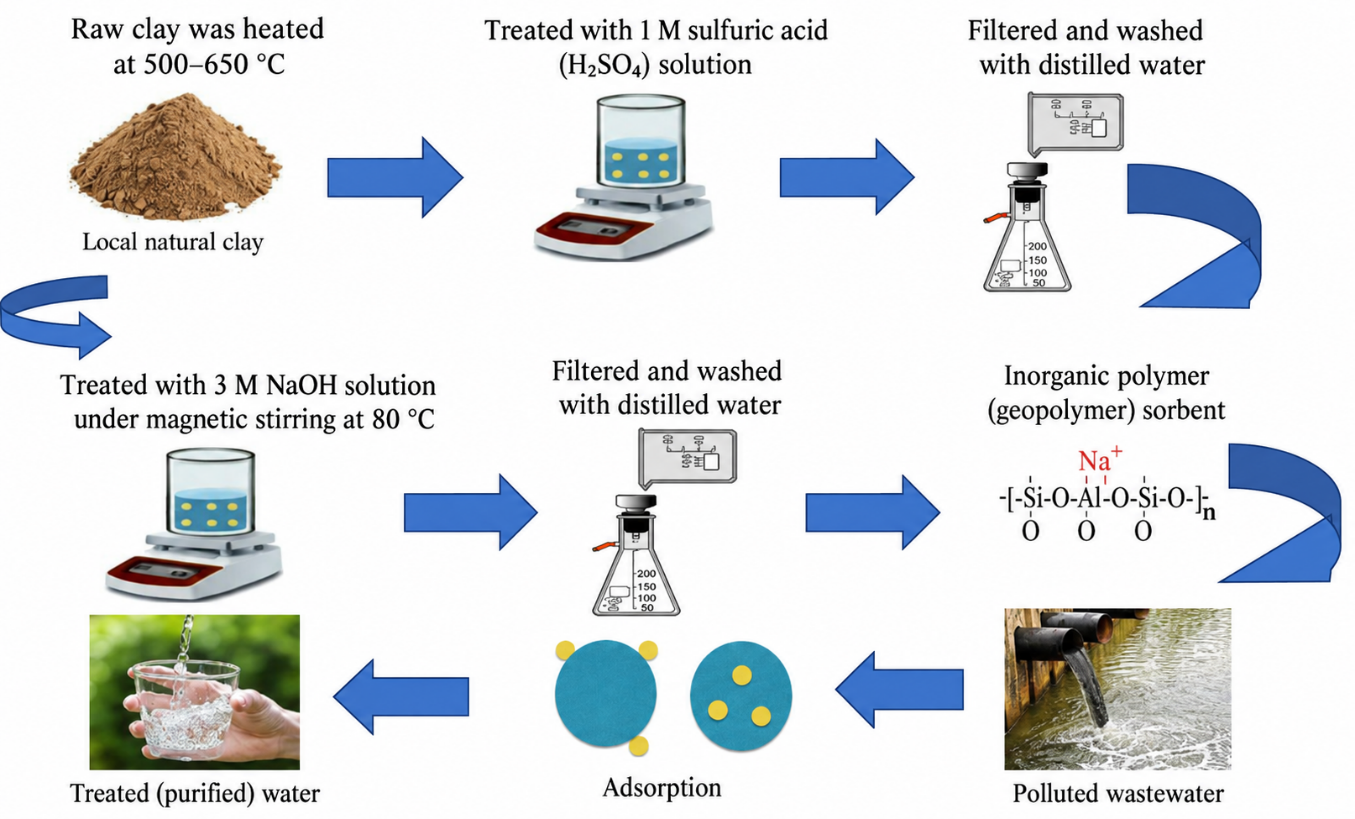 | Figure 1. Schematic representation of the synthesis of the inorganic polymer sorbent |
|

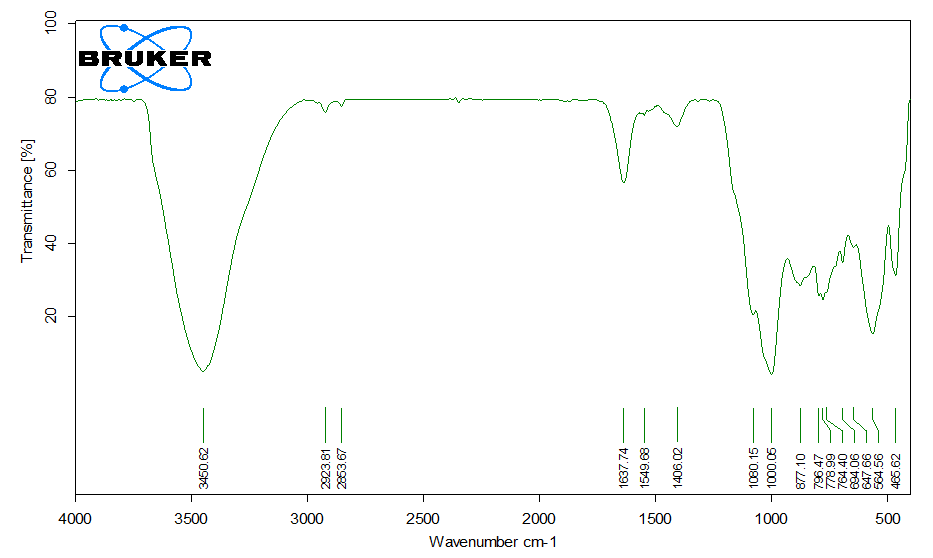 | Figure 2. FTIR spectrum of the clay-derived inorganic polymer sorbent |
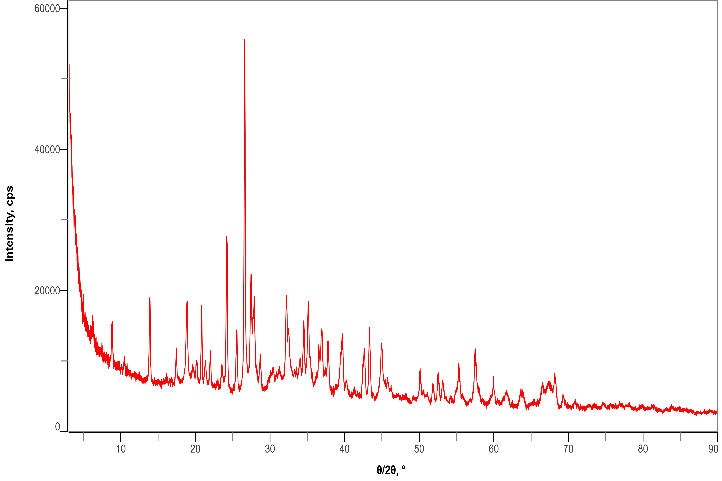 | Figure 3. XRD pattern of the clay-derived inorganic polymer sorbent |
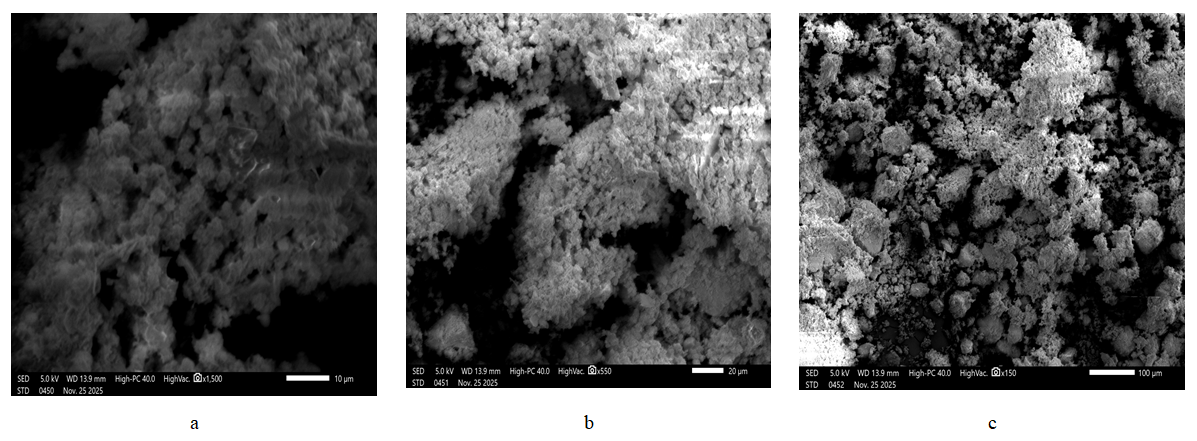 | Figure 4. SEM micrographs of the synthesized inorganic polymer sorbent at different scale bars: (a) 10 µm, (b) 20 µm, and (c) 100 µm |
4. Conclusions
- An inorganic polymer aluminosilicate sorbent was synthesized from local natural clay. Thermal treatment induced partial structural transformation of the clay minerals and produced a mixed crystalline–amorphous aluminosilicate framework. FTIR and XRD findings support formation of a modified aluminosilicate material, while SEM shows an irregular aggregated morphology with interparticle voids. The adsorption performance and mechanisms require direct experimental assessment.These results indicate that local clay can be used as a feedstock for aluminosilicate sorbents with structural features of interest for water-treatment applications.