Avaz Kazakov1, Rano Ismatova2, Mukhtar Amonov3
1Lecturer, Academic Lyceum of Bukhara State Medical Institute, Bukhara, Uzbekistan
2Doctor of Philosophy (PhD) in Technical Sciences, Associate Professor, Bukhara State Medical Institute, Bukhara, Uzbekistan
3Professor, Bukhara State University, Bukhara, Uzbekistan
Copyright © 2026 The Author(s). Published by Scientific & Academic Publishing.
This work is licensed under the Creative Commons Attribution International License (CC BY).
http://creativecommons.org/licenses/by/4.0/

Abstract
This article presents the results of research on the development and optimization of a novel polymer sizing composition for cotton yarn processing. It has been established that the application of the proposed formulation enables a reduction in starch consumption by 25–30% compared to conventional starch–based sizing, while maintaining the same level of adhesion efficiency. The optimal concentration of the polymer composition was determined to be 50 g/kg, which is significantly lower than the standard requirement for starch–based systems (70 g/kg). Experimental studies demonstrated that variation of the composition concentration within the range of 45–50 g/kg considerably affects the overall cost of the sizing process without impairing the adhesive and film–forming properties of the coating. The use of the developed composition improves the physico–mechanical properties of the yarn, reduces yarn breakage during weaving, and enhances loom productivity. These findings confirm the technological, economic, and environmental feasibility of applying the proposed sizing system.
Keywords:
Physical–chemical properties, Mechanical properties, Yarn, Polymer compositions, Consumption, Dressing, Cotton fabric, Preparation, Breakage, Adsorption, Glue, Polyvinyl alcohol, Starch, Humidity
Cite this paper: Avaz Kazakov, Rano Ismatova, Mukhtar Amonov, Physical–Chemical and Mechanical Properties of Yarn Coated with Polymer Compositions, American Journal of Polymer Science, Vol. 15 No. 1, 2026, pp. 1-4. doi: 10.5923/j.ajps.20261501.01.
1. Introduction
The development of chemistry and chemical–technological processes in the textile industry is accompanied by active search for alternative solutions aimed at reducing the use of food starch as a base for sizing. According to modern data, the proportion of starch and its derivatives in textile production operations reaches 70–75%, while synthetic water–soluble polymers account for only 25–30% [1–4].In recent decades, compositions based on synthetic homo– and copolymers have been developed, enabling sizing without involving food–grade products. However, these compounds are characterized by high cost, limited availability, and insufficient versatility for fibers of various chemical natures. Moreover, their removal from textile surfaces is difficult, which significantly increases reagent consumption during desizing, lengthens the process, and consequently reduces production efficiency. It should be noted that the exclusive use of synthetic polymers leads to yarn sticking during drying, which is one of the major drawbacks hindering the stable operation of high–capacity weaving machines [5,7].To partially replace food starch, research into creating sizing systems based on water–soluble polymers such as sodium alginate (NA), tripolyphosphate potassium (TPPK), and hydrolyzed polyacrylonitrile (HPA) has gained particular importance. Despite the high relevance of this direction, the number of fundamental and applied studies in this area remains very limited. Only isolated publications address the development of sizing formulations for cotton yarn using starch in combination with synthetic polymers and the introduction of specialized textile auxiliaries (TTA) [8–14].Based on the above, the aim of this study is to create and physically–chemically substantiate a sizing technology for cotton yarn using NA, TPPK, and HPA, which will significantly reduce the consumption of scarce and valuable food starch.
2. Materials and Methods
The objects of study included rice starch, tripolyphosphate potassium (produced in Uzbekistan), sodium alginate, and hydrolyzed polyacrylonitrile (produced in Russia). Detailed physicochemical characteristics of these substances are provided in sources [15,16].Break load determination was carried out using the single yarn testing method. Elongation at break was recorded simultaneously with the measurement of the breaking load. Single yarn strength tests were performed using a RM–30 tensile testing machine, designed for analyzing the mechanical properties of fibers.To assess relative strength, or the relative breaking load of individual yarns, a calculation method based on the ratio of the breaking load to the linear density was used. The corresponding values were calculated using the formula: where, Pp is the breaking load at tension (cN),T is the linear density of the yarn (tex).It should be noted that the yarn sizing process is accompanied by a complex, multi–stage physicochemical interaction between the sizing compounds and the fibers. The mechanism of these interactions is largely determined by the chemical nature of the substances used, their supramolecular organization, and the structural and morphological state of the thread surface. The influence of these factors can be partially analyzed by studying the adsorption processes occurring between the sizing components and the yarn fibers, the results of which are shown in Figure 1.
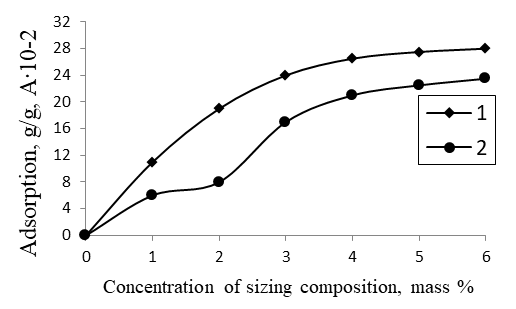 | Figure 1. Adsorption isotherms of the composition from aqueous solutions at 25°C; 1–Composition based on starch, NAC, and GIPAN; 2–Composition based on starch, NAC, TPFK, and GIPAN |
From the data in Figure 1, it follows that the adsorption isotherm on a hydrophobic surface corresponds to typical monomolecular adsorption according to the Langmuir model. In contrast, the isotherm for a hydrophilic surface (curve 2) is S–shaped and reflects a polymolecular adsorption mechanism described by the Polanyi and BET theories. In this case, the adsorbate binding process does not end at the stage of monomolecular layer formation, but continues with the sequential formation of additional adsorption structures [17–18].Nevertheless, it has been established that the adsorption value on a hydrophobic surface is higher than on a hydrophilic one. Obviously, in the mechanism of composition adsorption by fibers, the decisive role is played not so much by the presence of functional groups as by the main carbon chain of the molecules. This very factor determines the higher degree of adsorption of compositions based on starch, NAC, TPFK, and GIPAN compared to systems containing only starch, NAC, and GIPAN.As can be seen from the data in Figure 1, the kinetics of the composition adsorption process on cotton yarn are determined by the physicochemical characteristics of the sizing agent, the structural features of the fiber, as well as the parameters of the technological regime. Experimental studies have shown that NAC and GIPAN, like starch, possess pronounced film–forming properties. Therefore, their combination with starch in sizing formulations is scientifically and technologically justified.Adhesive compositions based on starch, NAC, and GIPAN retain high adhesive capacity for a long period of time, which indicates their kinetic stability. In addition, such systems demonstrate resistance in aqueous media of various hardness levels and within a fairly wide pH range (7–8).The calculation of the metrological characteristics of the applied methods was carried out in accordance with the requirements of [19].
3. Results and Discussion
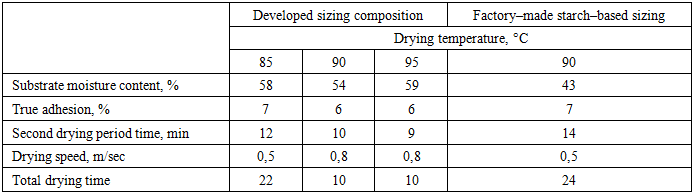
It should be emphasized that under certain physicochemical conditions for preparing sizing compositions, interactions may occur between the functional groups of polymers and the reactive centers of NAC and GIPAN. As a result of such interactions, compounds containing amide (–CONH–), carbamide (–NHCONH–), carbamate (–OCONH₂), ester (–OCO–), and other structural fragments are formed. The presence of these groups in the macromolecules of the polymer composition contributes to increased elasticity and structural–mechanical strength, as well as reduces the electrostatic charge of the adhesive film formed on the surface of the yarn during sizing [20–23].An important technological factor in the sizing of cotton yarn is the drying process. For this purpose, to determine the optimal temperature–time parameters of the drying of sized yarn, as well as to establish the relationship between the speed of the warp movement during sizing, the drying kinetics of samples treated with various compositions were studied (Table 1).Table 1. Kinetic parameters of the drying process of yarn sized with a composite based on starch, NAC, TPPA, and GIPAN at a ratio of 1:0.02:0.05:0.01, respectively
 |
| |
|
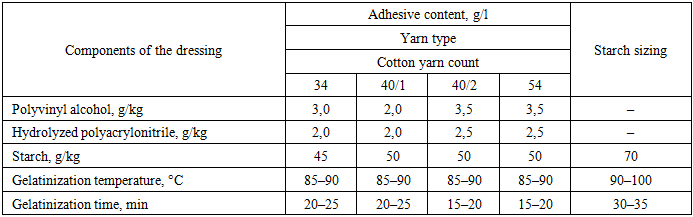
Based on an analysis of the kinetic parameters of the sizing process for the developed compositions, the optimal concentrations of the components included in the sizing composition were determined (Table 2). As can be seen from the table, the consumption of the polymer composition is 50 g/kg, whereas when using a starch sizing, this figure reaches 70 g/kg. Thus, using the proposed composition allows for a 25–30% reduction in starch consumption.Table 2. Optimal technological parameters for the preparation of sizing based on the developed composition
 |
| |
|
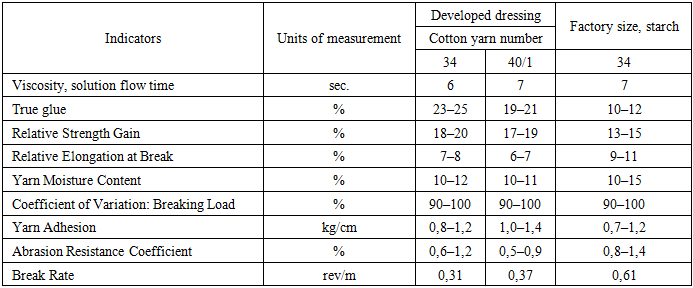
It was established that the drying rate is determined by both the chemical nature of the preparation used and the fiber composition of the yarn, as well as the time and temperature conditions of the process. The ability of the sized yarn to lose moisture depends significantly on the type of composition used. The relatively low capacity for retaining water molecules is explained by the presence of hydrophobic cyclic fragments in the NAC and GIPAN macromolecules.Analysis of the obtained data revealed that the specific breaking load is one of the key physical and mechanical parameters of cotton yarn. It was found that using the proposed sizing composition, this indicator is 13–15% higher than with traditional starch sizing, while maintaining the same coefficient of variation.Table 3 presents comparative results for cotton yarn sizing using the developed composition and traditional starch sizing, obtained under the production conditions of TSK LLC.Table 3. Physical and mechanical properties of yarn treated with sizing obtained under optimal preparation parameters
 |
| |
|
As can be seen from Table 3, the sizing concentration, which has a significant impact on cost, is 45–50 g/kg when using the developed composition, compared to 70 g/kg for traditional starch sizing. The true adhesion level remains unchanged. Experimental results showed that starch consumption is reduced by 25–30% when sizing cotton yarn using the developed compositions. This confirms the economic and environmental feasibility of using the proposed composition.
4. Conclusions
Thus, it has been established that the viscosity of aqueous solutions of the developed sizing composition, depending on the concentration, temperature, and pH of the medium, obeys a first–order equation. Moreover, its value is 2–3 times lower than that of traditional starch–based sizing agents. Using this composition ensures a higher speed and degree of yarn impregnation during sizing, which promotes the formation of a strong adhesive film on the fiber surface and positively impacts the weaving process.It has been experimentally confirmed that cotton yarn treated with the proposed polymer compositions can be effectively processed on various types of weaving equipment. This results in a 35–40% reduction in thread breakage and a 5–10% increase in machine productivity compared to yarn treated with starch–based sizing.
References
| [1] | Amonova X.I., Ravshanov K.A., Amonov M.R. Evaluation of the possibility of using seritsin to increase the efficiency of cotton–paper yarn sizing // Composite materials. – Tashkent, 2008. – №4. – p. 66–68. |
| [2] | Amonova X.I. Rheological properties of aqueous solutions of polymer composites and their influence on the sizing effect // Composite materials. – Tashkent, 2008. – № 2. – p. 32–36. |
| [3] | Amonov M.R., Ravshanov K.A., Khayrullaev Ch.K., Amonova X.I. Study of the process of de–sanding cotton paper yarn, sanded with starch composition // Reports of the Academy of Sciences of the Republic of Uzbekistan. – Tashkent, 2008. –No. 4. – p. 68–69. |
| [4] | Amonov M.R., Razzokov X.K., Ravshanov K.A., Majidov A.A., Nazarov I.I., Amonova X.I. Study of relaxation properties of cotton–paper yarn coated with polymer composites // Uzbek chemical journal. – Tashkent, 2007. – No. 2, – p. 27–30. |
| [5] | Yariev O.M., Amonov M.R., Amonova X.I., Majidov A.A. Evaluation of rheological properties of polymer composites based on natural and synthetic polymers // Composite materials. – Tashkent, 2007. – №1. – p. 6–10. |
| [6] | Majidov A.A., Amonov M.R, Razzokov, X.K., Nazarov I.I. Study of thermodynamic characteristics and surface–active properties of a polymer composite based on starch and polyacrylamide // Composite materials. – Tashkent, 2007. – No. 2. – p. 24–27. |
| [7] | Ismatova R.A., Ibragimova F.B., Amonov M.R., Sharafutdinova R.I. Development of a new composition for sizing cotton paper yarn // Scientific journal “Universum: Technical Sciences”. – No. 11 (68). Part 3. M., 2019. – p. 82–85. |
| [8] | Ishmatov A.B., Yaminova Z.A., Rudovsky P.N. Justification of modes for obtaining sericin in the form of powder for the preparation of sizing // News of the University. Technology of the textile industry. – 2015. – No. 6 (360), – p. 79–83. |
| [9] | Ishmatov A.B., Rudovsky P.N., Yaminova Z.A. Applications of sericin for sizing bases. // Universities Technology of textile industry. 2012, – No. 6, – p. 76–79. |
| [10] | Yaminova Z.A. Development of a recipe for sizing from silk waste for sizing cotton warps // Bulletin of the Tajik Technical University named after academician M.S. Osimi, No. 2 (22), 2013. – p. 64–69. |
| [11] | Kochkina N.E., Vashurina I.Yu., Kalinnikov Yu.A. Humic acids as a means of modifying starch sizing compositions // Textile Chemistry, No. 1 (24), 2004. |
| [12] | Vashurina I.Yu., Kochkina N.E., Kalinnikov Yu.A. Influence of humic acids on the properties of starch sizing compositions // News of universities. Textual technology of industry. 2004, No. 1, – pp. 41–43. |
| [13] | Vashurina I.Yu., Kochkina N.E., Kalinnikov Yu.A. Features of the influence of peat humic acids on the structure of starch sizing gels // Journal of Applied Chemistry, 2006, Vol. 79, Issue 2, – pp. 322–325. |
| [14] | Zakharchenko A.S., Aleshina A.A., Kozlova O.V. Study of the properties of film–forming polymers used in finishing textile materials // News of the universities. “Chemistry and Chemical Technology”, 2012. – Vol. 55, No. 3, – pp. 87–91. |
| [15] | Yaminova Z.A. Physical and chemical aspects of obtaining of sericin from silk waste to size cotton yarn // Austrian Journal of Technical and Natural Sciences. – Vienna, 2015. №1–2, – р. 121–123. |
| [16] | Shagina N.A. New technologies in the textile industry. Bulletin of the Dagestan State Technical University. Technical sciences. 2008. – No. 10. – pp. 100–101. |
| [17] | Kozlova O.V., Melenchuk E.V. Use of domestic polymers in the creation of retroreflective textile materials // Bulletin of higher educational institutions. Chemistry and chemical technology. 2013. – Vol. 56. – No. 2. – pp. 121–123. |
| [18] | T.P. Bondareva, V.V. Nevskikh. Fabric production technology: textbook // Minsk, 2011. – p. 335. |
| [19] | Accuracy (trueness and precision) of measurement methods and results. Part 2: Basic method for determining the repeatability and reproducibility of a standard measurement method. ISO 5725. 1–6. |
| [20] | Yarn from bast fibers and their blends with chemical fibers. General specifications. GOST 10078–85. |
| [21] | Stepanova T.Yu., Sakharova S.G. Modification of frictional properties of complex threads by their emulsification // News of the University. Technology of the textile industry, 2010. (No. 8 (239). – p. 12–14. |
| [22] | Stepanova T. Yu., Talanova V. A., Sakharova S. G. Static model of the influence of surfactant solutions properties on the wear resistance of polyester fibers // News of Higher Education Institutions. Chemistry and Chemical Technology. 2010. – Vol. 53. – Issue 6. – pp. 76–78. |
| [23] | Stepanova T. Yu., Sakharova S. G., Romanychev N. K. Influence of high–molecular alcohols on the mechanical and tribological properties of polyester yarn // Factory laboratory. Diagnostics of materials. Vol. 74. – No. 4. – p. 62–63, 2008. |


 Abstract
 Reference
 Full-Text PDF
 Full-text HTML