American Journal of Polymer Science

p-ISSN: 2163-1344    e-ISSN: 2163-1352

2013;  3(1): 1-5

doi:10.5923/j.ajps.20130301.01

Water Repellent Polymer Coating Based on Oligopiperillenestryrene and Alkoxysilane

V. Yu. Chukhlanov, M. Ionova

Department of Chemistry and Ecology, Vladimir State University, Vladimir, 600000, Russia

Correspondence to: V. Yu. Chukhlanov, Department of Chemistry and Ecology, Vladimir State University, Vladimir, 600000, Russia.

Email:

Copyright © 2012 Scientific & Academic Publishing. All Rights Reserved.

Abstract

In the present article a creation of new water repellent materials based on oligopiperillenestyrene modified by tetraethoxysilane is considered. A nanostructure of coating surface and influence of polymer material component's staff and nature on polymer properties are researched. The materials are dedicated for protection of buildings from negative factors.

Keywords: Oligopiperillenestyrene, Organosilicone, Tetraethoxysilane, Protecting Coating, Water Repellent

Cite this paper: V. Yu. Chukhlanov, M. Ionova, Water Repellent Polymer Coating Based on Oligopiperillenestryrene and Alkoxysilane, American Journal of Polymer Science, Vol. 3 No. 1, 2013, pp. 1-5. doi: 10.5923/j.ajps.20130301.01.

1. Introduction

At present time polymer water repellent coatings have found the widest application in absolutely different fields of industry. A special interest is to apply polymer coatings as a boarder to protect building’s construction elements against negative natural and anthropogenic factors, such as a damage of contraction materials due to a freezing of moisture inside of material at negative temperature, acid rains, UV-light, fire and so on.
The most of hydrophobic polymer materials that are produced in industrial amounts doesn’t have enough resistance to above mentioned factors. Organosilicone materials are resistant to these working conditions but have very bad physical and mechanical properties. Due to this fact the great interest is to apply organic polymers modified by organosilicones with forming block-co-polymers or interpenetrating nets as a result[1-4]. These materials have both good physical and mechanical properties and a high resistance to atmosphere moisture and UV-lights. It can be explained by the fact that at such modification it appears a very strong hydrophobic effect. In earlier published articles[5-11] it was considered protective compounds possessed hydrophobic effect based on polyurethane modified by alkoxysilane and polyorganosilicones created in Vladimir State University. As matrix it’s a copolymer of styrene – oligopiperillenestyrene, as an alkoxysilane it’s tetraethoxysilane in the present work.

2. Objects and Methods of Research

At work we used chemical productsoligopiperillene–styrene and alkoxysilane, which are manufactured serially in Russia.
Oligopiperillenestyrene is a product that is produced on synthetic rubber’s factories and that is used as polymer binding material. It’s made as oligomer PS-70 trademark as 50% solution of oligomer in white-spirit.
Tetraethoxysilane is a product of interacting a silicon tetrachloride and ethanol. Tetraethoxysilane is applied in organic synthesis very often.
In order to research a surface’s nanostructure of repellent coating it was used an atomic force probe microscopy with scanning probe device Integra Aura, made by NT-MDT, Zelenograd, Russia. The scanning was made by polysilicon probes HA_NC at intermittent contact method. At using of this method the pressure of cantilever on prototype surface is less and that allows to work with soft and fragile materials such as polymer films and biomaterials.
To determine possible forming of chemical bonds we used Fourier infrared spectrophotometer Avatar 360 FT-IR ESP and samples for these investigations as thin films at polished surface of discs made from cesium iodide.
Moisture absorption of polymer films in saturated environment by moisture vapors (relative humidity 95%). The method is concluded in determination of moisture mass that is adsorpted by polymer film with mass 0.2 grams and that is put in desiccator over Glauber's salt during 24 hours.
In order to define a wetting angle it were used a way of micro photographies of distilled water drop on the polymer film surface and sequential measuring of wetting angle with protractor.
Adhesion was defined by tearing off steel discs with diameter 1.5 cm from covered by polymer film surface. The tearing was made by using of digital adhesiometer PSO – MG4, which is an electronic dynamometer with processor and is able to calculate the force in tensile strength. The discs were glued to polymer film by cianacrylate.
Relative hardness was determined by comparing of the number of oscillations of a pendulum and of ball joints on glass and polymer film by pendulum ASTM D4366-95 (ISO1522:2001).
Compositions were laid on surface for followingexperiments at standard environment conditions: temperature 20°С, relative air humidity 75%. The work viscosity was got by addition of solvent.
At investigation of relative hardness and adhesion we used special die hole with adjustable gap to lay the coating on surface.

3. Results and Discussion

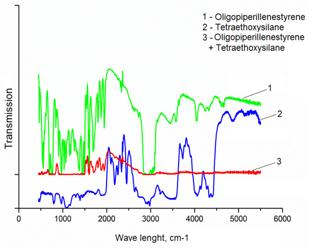
At first step of research it was studied a possible way of interaction oligopiperillenestyrene and tetraethoxysilane. In this case it’s possible to have both physical interaction and forming of chemical bonds between these substances due to reactive groups in tetraethoxysilane and double bonds in oligopiperillenestyrene. To confirm or to refuse our suggestions about chemical interaction of components, researches were done on Fourier infrared spectrophotometer. According to figure 1, forming hydrophobic film based on oligopiperillenestyrene and tetraethoxysilane possesses strong absorption of infrared rays. Besides of it, on spectrogram in diapason 500-2500cm3 there are picks which are matched to picks of spectrogram of original oligomer. There are no any new forms or displacements of existing picks. That fact confirms, perhaps, lacks of some chemical interactions between original parts. However, why does hydrophobic polymer film absorb IR-rays intensively? Probably, due to not only partial hydrolysis of tetraethoxysilane but complete also, which goes by the form of colloidal silicon dioxide.
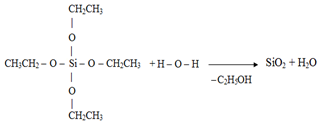
Figure 1. Complete hydrolysis of tetraethoxysilane
Silicon dioxide absorbs IR-rays intensively in range 500-4000cm-1.
Thereby, interaction of oligopiperillenestyrene and tetraethoxysilane goes due to modification of co-polymer by products of alkoxysilane’s polycondensation and hydrolysis. However, it’s possible to have chemical interaction of these components at high temperatures due to high reactivity of tetraethoxysilane and existing of double bonds in oligopiperillenestyrene[3, 5].
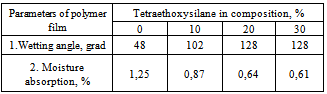
At modification of oligopiperillenestyrene by products of hydrolysis of alkoxysilane it will be changed as well physical as mechanical properties of polymer film undoubtedly. The most important change of physical properties at modification by alkoxysilanes is the strongest hydrophobic effect.
Figure 2. IR-spectrum of modified polymer
Table 1. Hydrophobic properties of film
     
The effect appears already at containing of 4% alkoxysilane in matrix. It can be explained by functional groups at silica atom of products of hydrolysis of tetraethoxysilane because of which the film forms bonds with surface of processed material. The molecules are directed so way that non-polar, for example hydrocarbon, parts are routed to outside, and polar are to processed surface. As result, the surface is protected by repellent hydrocarbon groups and loses a possibility to be wetted[12]. At processed surface it’s formed a polymer film with very branched surface, what increases a gas permeability of film[13, 14].
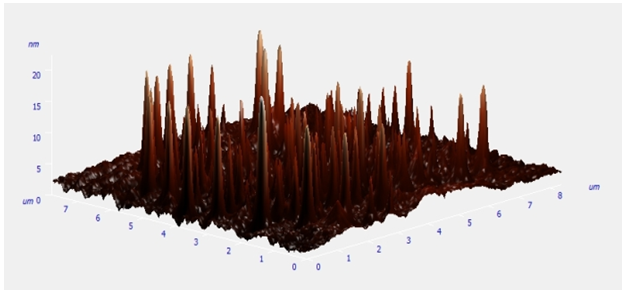
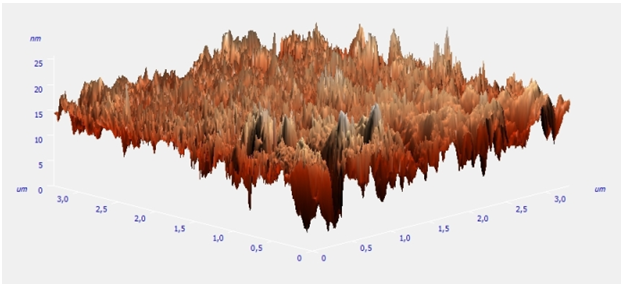
Experimentally above mentioned suggestions confirm made researches by the atomic force probe microscopy. On figure 3 it is 3D surfaces of oligopiperillenestyrene film (a) and oligopiperillenestyrene film modified by alkoxysilane in quantity 10%(b). As it’s shown, non-modified oligopiperillenestyrene has some spherical impurities with diameter 700-800nm.
Figure 3a. Oligopiperillenestyrene surface
Figure 3b. Oligopiperillenestyrene modified by tetraethoxysilane
Probably, it’s oligopiperillenestyrene’s globules. Such structure pertains to co-polymers of styrene with diene oligomers. However, at addition alkoxysilane almost entire surface consists of many (100 per 1µm2), not deep impurities that are located perpendicular to a plane of coating. Due to effective diameter of impurities (approximately 2-5nm) they are polarized elongated fragments of supermolecular structure which is formed at interaction tetraethoxysilane and oligopiperillenestyrene[14-15].Similar structure is formed also at modification of polyurethane by organosiloxane[6]. Some researchers suggest that hydrophobic effect appears due to micro relief of surface which is formed by nanoparticles of silica oxide[4].
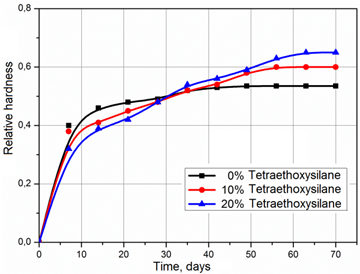
Relative hardness was determinated on pendulum. According to experiments hardness is defined both content of tetraethoxysilane and curing time. Results are shown on a figure 4.
Figure 4. Depending relative hardness on tetraethoxysilane content and curing time
The made experiments show that relative hardness increases slowly. In first 30 days in coatings contained tetraethoxysilane it’s observed decrease if relative hardness comparing with non-modified coating. However, at longer keeping it begins to be seen an increasing of relative hardness of modified examples. The maximum of relative hardness is achieved at modification by 20% tetraethoxysilane.
Hardness of coating at modification by tetraethoxysilane increases due to forming intermolecular crosslinking. Holes, which confirm a hardness reducing, can be explained by plasticizing effect, which appears after adding of some quantity of modifier. The process of composition’s curing has a competitive character and depend on degree of coating drying, quantity of forming bonds and many other factors. However, the highest parameters are noticed at addition of galvanic sludge. The galvanic sludge, which was taken from dirt pile, consists of high-silica sand that causes to increase of coating hardness.
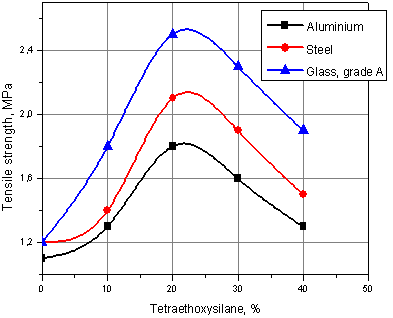
The life period of protective coating depend on adhesion to construction material, on which it’s spreaded. Adhesion of coating can be explained by complex interaction (physical, chemical, electrical) of polymer reactive groups and active center points of substratum. Formed bonds prevent to interaction of this material and parts of environment (to corrosion process). With increasing of adhesion, of quantity of substratum-polymer’s bonds and of bond’s strength it’s less quantity of possible places where it could be a corrosion process.
Figure 5. Tensile strength
The maximum of tensile strength is achieved on glass surface. It’s due to, probably, location silanol groups (Si-OH) on surface. At this fact it appears strong intermolecular bonds between silanol groups and products of partial hydrolysis of tetraethoxysilane. Besides, it’s possible a chemical interaction between these active groups. According to investigations a maximal tensile strength can be achieved at 20% of tetraethoxysilane. Further its increasing of tetraethoxysilane reduces parameters of adhesion, perhaps, due to strong impairment physical and mechanical properties of material and particularly plasticizing effect. So, high adhesion of film-forming polymer – oligopiperillenestyrene – can be achieved due to its modification by tetraethoxysilane. Macromolecules of such composition are polar and have big quantity of chemical reactive groups what causes to form the orientated adsorption layer by tetraethoxysilane. This layer binds the film and surface strongly[12]. Founding on these researches, the adhesion is determinated in this case by the force of possible physical or chemical interaction oftetraethoxysilane and hydroxyl groups on the surface of steel plate.
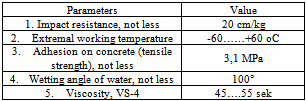
Main parameters of made coating based on composition with 10 parts of tetraethoxysilane and 40 parts of galvanic sludge are shown in the table 2.
Table 2. Main parameters of made coating
     
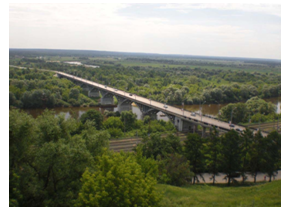
Figure 6. Town across river Klyazma (Vladimir)
The bridge on the figure 6 is covered after repairing (it’s covered 16000m2) by repellent coating based on compound Tetraethoxysilane – Oligopiperillenestyrene, which was created by us. Other analog project is a bridge across river Techa (Mordovia region). Application of such compounds as part of complex coatings gives high effect of protection.

4. Conclusions

Made experiments with repellent coating show a possibility of creation new polymer materials to protect buildings against negative natural and anthropogenic factors.
Modification by tetraethoxysilane allows to form a repellent coating as regular organosiloxane liquids applying more available and cheaper components.
Repellent coating in contrast to regular silicone coatings is characterized higher adhesive properties to surface of constructional materials containing silanol groups.
Using of such coatings solves a problem of application of piperillene, which is synthesized in big quantities at manufacturing of synthetic rubber and can be applied in other fields on industry very seldom.

References

[1]  Aziz M. Muzafarov, “Silicon Polymers”, Springer-Verlag Berlin Heidelberg, p. 100, 2011.
[2]  V. Yu. Chukhlanov, N. Yu. Nikonova, A. N. Alekseenko, “Hydrophobic liquid for бетонных и железобетонных construction”, Stroitelnie materiali, No. 12, pp. 28-29, 2003.
[3]  V. Yu. Chukhlanov, I. S. Sklyarov, “ Mathematic model of tetraethoxysilane and three-ethanolamine interaction”, Compilation of scientific works Sworld according to materials of international scientific and practical conference, Odessa, Ukraine, Vol. 18 No. 4, pp. 68-69, 2007.
[4]  A. S. Starostin, V. A. Valtsefer, I. V. Valtsefer, V. N. Strelnikov, „ Creation of hydrophobic coating on glass surface”, Butlerovskie soobscheniya, Vol. 25, No. 7, pp. 35-38, 2011.
[5]  V. Yu. Chuklanov, N.A. Kolysheva, “New polymer binders based on oligopiperylene styrene and alkoxysilanes”, Polymer Science and Technology.England, Vol. 35 №6, 2008.
[6]  V. Yu. Chukhlanov, M. Ionova, “Modification of One-Component Polyurethane by Organosilicone”, American Journal of Polymer Science, Vol. 2, No. 5, pp.129-134, 2012.
[7]  V. Yu. Chukhlanov, M. Ionova, “Polyurethane coating modified by alkoxysilane with improved working properties”, Stroitelnie materiali, No. 4, pp. 60-61, 2012.
[8]  V. Yu. Chukhlanov, M. Ionova, “One-component polyurethane composition modified by tetraethoxysilane”, Plasticheskie massi, No. 7, pp. 10-13, 2012.
[9]  V. Yu. Chukhlanov, M. Ionova, “Influence of sludge as a waste of galvanic production on adhesion of polyurethane coating to metal”, Russian scientific and practical conference “Actual engineering problems of chemical and oil manufactures and ways of its solving”, Nizhnekamsk, pp.100-103, 2012.
[10]  V. Yu. Chukhlanov, M. Ionova, “Modification of protective polyurethane coating by tetraethoxysilane”, V International Conference on students and post-graduated students “Chemistry in the modern world”, Sankt-Peterburg, pp. 325-326, 2010.
[11]  V. Yu. Chukhlanov, S. S. Mukhin, “Polymer matrix based on oligopiperillenstryrene and alkoxysilane for construction materials”, Compilation of scientific works Sworld according to materials of international scientific and practical conference, Odessa, Ukraine, Vol. 22, No. 4, pp. 67-68, 2008.
[12]  V. Yu. Chukhlanov, Yu. V. Usacheva, “New repellent compounds”, Compilation of scientific works Sworld according to materials of international scientific and practical conference, Odessa, Ukraine, Vol. 24, No. 1, pp. 55-56, 2012.
[13]  M. G. Voronkov, N. V. Shorohov, “Repellent coatings in construction”, AN Latvia, Riga, pp. 174, 1963.
[14]  O. Ya. Tschipkina, “Hydroinsulation and anticorrosion protection of reinforced-concrete constructions”, Budivelnik, Kiev, pp. 80, 1977.
[15]  V. Bagant, “Silicones. Silicone materials, its synthesis, properties and application”, State scientific and technical publishing house of chemical literature, Moscow, pp. 710, 1960.