
-
Paper Information
- Paper Submission
-
Journal Information
- About This Journal
- Editorial Board
- Current Issue
- Archive
- Author Guidelines
- Contact Us
American Journal of Operational Research
p-ISSN: 2324-6537 e-ISSN: 2324-6545
2013; 3(1): 1-12
doi:10.5923/j.ajor.20130301.01
Maximum Entropy Analysis of MX/(G1,G2)/1 Retrial Queueing Model with Second Phase Optional Service and Bernoulli Vacation Schedule
 Abstract
 Reference
 Full-Text PDF
 Full-text HTML
Vishwa Nath Maurya
Department of Applied Mathematics, Shekhawati Engineering College(Rajasthan Technical University, Kota), Dundlod- 333702, India
Correspondence to: Vishwa Nath Maurya, Department of Applied Mathematics, Shekhawati Engineering College(Rajasthan Technical University, Kota), Dundlod- 333702, India.
| Email: |  |
Copyright © 2012 Scientific & Academic Publishing. All Rights Reserved.
In this paper, a bulk arrival retrial queueing model with two phases of service symbolically denoted by MX/(G1,G2)/1 has been discussed under Bernoulli vacation schedule to explore mainly its steady state behaviour using maximum entropy principle (MEP). We consider that customers arrive in batches according to Poisson distribution and a single server of the system provides his services in two phases-first phase essential service (FPES) and the next second phase optional service (SPOS) with different service rates. As per classical retrial service policy,the server has an option to avail vacations to complete some additional work under Bernoulli schedule when the second phase optional service (SPOS) is not demanded by arriving customers and such type of vacation is referred as working vacation.By employing the maximum entropy approach, we have derivedthe approximate expected waiting time in the orbit.Moreover, a comparative study between the exact waiting time and the approximate waiting time based on maximum entropy analysis has been carried out to validate the investigative results by way of numerical illustrations and sensitivity analysis.
Keywords: Bulk Arrival Retrial Queue, Probability Generating Function, BernoulliVacation Schedule, Gamma Distribution, Performance Measures, Maximum Entropy Principle
Cite this paper: Vishwa Nath Maurya, Maximum Entropy Analysis of MX/(G1,G2)/1 Retrial Queueing Model with Second Phase Optional Service and Bernoulli Vacation Schedule, American Journal of Operational Research, Vol. 3 No. 1, 2013, pp. 1-12. doi: 10.5923/j.ajor.20130301.01.
Article Outline
1. Introduction
- Queueing system with retrial phenomenon is widely used to model stochastically many congestion situations encountered in manufacturing systems, operating systems, communication networks and transportation networks, distribution and service sectors and many daily life situations.In recentyears, computer networks and data communication systems are the fastestgrowing technologies, which lead to glorious development in many applications. For more details, we refer to see Arivudainambi and Godhandaraman[4] and Boualem et al.[6]Retrial queueing models with server vacations are characterized by the fact that the idle period of the server may be used for doing some other secondary work. Allowing the server to avail vacations enables the queueing models more realistic and versatile for analysing the real-world congestion problems. In the queueing literature, a variety of works has been done indifferent frameworks of queueing model with server vacation. In this connection, we refer the noble book by Tian and Zhang[33]. A comprehensive survey on this topic can be found in Doshi[13-14]. Later,Artalejo[1], Kulkarni[25] and Templeton[32] have also given categorical survey on retrial queueing systems.Takacs[31] studied a single server queueing systemwith Bernoulli feedback. Krishnakumar and Arivudainambi[23] have analysed a single server retrialqueue with Bernoulli vacation schedules and general retrial times. Krishnakumar et al.[24] have introduced an M/G/1 retrial queueing systems with twophase service and pre-emptive resume. Choudhury and Madan[10] considered a batch arrival queueing system, where the server provides two phases of heterogeneous service and they successfully derived the queue size distribution at random epochs of the system states and some important performance measures. Atencia and Moreno[5] explored an M/G/1 retrial queue with general retrial times with Bernoulli schedule in order to investigate the generating function of the system size distribution and they established explicitlythe stochastic decomposition law.Further, Artalejo and Lopez Herrero[3] have investigatedan information theoretic approach for the estimation of the main performancecharacteristics of the M/G/1 retrial queue. Gomez-Corral[18] broadly discussedabout a single server retrial queueing system with general retrial times. Thereafter, Artalejo and Gomez-Corral[2] have developed an M/G/1 retrial queue with finitecapacity of the retrial group.However, Choudhury and Deka[8] considered a bulk arrival MX/G/1 queue with two phases of heterogeneous service under Bernoulli vacation schedule and classical retrial policy to obtain the steady state distribution of the server state and the number of the customers in the retrial groupby using the embedded Markov chain technique. Of late, Choudhury and Deka[9]analysed the steady state behaviour of an MX/G/1 unreliable retrial queue with Bernoulli admission mechanism. Ke et al.[20] have analysed thecharacteristics of an M[X]/G/1 queueing system with N policy and almost Jvacations.In these sequential works, recently,Arivudainambi and Godhandaraman[4] examined abatch arrival retrial queue with two phases of service, feedback and K optional vacations and succeeded to establish the steady state distribution of the server state and the number of customers in the orbit as well as to analyse numerically the effects of various parameters on the system performance.Very recently, Maurya[28-29] examined the bulk arrival retrial queueing MX/(G1,G2)/1 model incorporating with second phase optional service and Bernoulli vacation schedule and by using supplementary variable technique and succeeded to explore the Chapman Kolmogorov equations governing different states of the model including probability generating functions for first phase essential service (FPES), second phase optional service (SPOS) and working vacation and for the number of the customers in the retrial group (orbit) at an arbitrary epoch as well as long run probabilities for which the server is in different states of idle state (IS), first phase essential service (FPES), second phase optional service (SPOS) and in working vacation state (WVS). Besides, some numerical illustrations for verifying the validity of analytical results for an
 ,
,  and
and  modelsas special cases of bulk arrival retrial queueingMX/(G1,G2)/1 model have also been performed for varying parameters by Maurya[28-29].Furthermore, Maurya[29] has keenly observed that the investigative results for different type of
 ,
,  and
and  modelsas special cases agree with results obtained by Falin[16] and Kumar and Arumuganathan[26].Maximum entropy approach is generally used to facilitate the explicit results for probabilities associated with the system states. Sequential work done in the queueing literature based on maximum entropy principle (MEP) is also summarized here. Ke and Lin[21] examined the MX/G/1queueing system with server vacations and they investigated a comparative analysis between the approximate results with established exact results for vacation time, service time and repair time distributions by using the principle of maximum entropy. Moreover, the maximum entropy approach has also been used by some other researchers in the area of queueing theory to provide a reasonable and general approximation to the complex queueing systems. Among them, Wang et al.[34] examined an MX/M/1 queueing system with multiple vacations and they developed the approximate formulas for the probability distributions of the number of customers in the system by using the maximum entropy approach. Ke and Lin[22]considered the MX/G/1 queueing system in which the server operates under N policy and takes the single vacation and they derived the approximate formulas for the steady state probability distributions of the queue length by using the maximum entropy principle. Recently, Wang and Huang[35] analysed a single removable and unreliable server M/G/1queueing model under (p,N)-policy to develop the approximate formulas for the probability distributions of the number of customers and the expected waiting time in the systemthrough maximum entropy analysis.Although, a lot of work has been done by some other noteworthy researchers[7, 11-12, 15-17, 19, 26-27, 30, 36-37] among in retrial queueing systems, yet no one has confined to attempt a bulk arrival retrial queueing MX/(G1,G2)/1 model with Bernoulli vacation schedules and general retrial times to examine the steady state behavior of the system and comparative study between the exact waiting time and the approximate waiting time based on maximum entropy principle (MEP). This motivates the researchers to fill this gap. Therefore,our keen interest lies in the same direction in this paper. The present paper deals with state dependent MX/(G1, G2)/1 retrial queueing system under Bernoulli vacation schedule with second optional service to explorethe steady state behaviour of the system and comparative study between the exact waiting time and the approximate waiting time using maximum entropy principle (MEP). The remainder of the paper is structured as follows. Section 2 presents a mathematical description of the model. In section 3, some preliminary ideas of the model are presented to use for comparative study between the exact waiting time and the approximate waiting time based on maximum entropy principle (MEP). In section 4, the MEP is employed to investigate theprobability generating function (PGF) of the number of customers in the orbit; which has been used to explore some significant performance measures of the model taken into consideration. In section 5, some special cases have been discussed numerically by setting appropriate parameters involved therein and to validate the analytic results, numerical experiments and sensitivity analysis have been done by way of presentation of tables. Finally, the conclusion of the inspective results is drawn in section 6.
 2. Description of the MX/(G1,G2)/1 Model
- In the present paper, we envisage a single server retrial queueing system with first phase essential and second phase optional service. We assume that the server provides his services in two phases, where service of the first phase is essential; however, service of second phase is optional. We note that all the arriving customers have to get the first phase essential service (FPES) whereas second phase optional service (SPOS) is provided only to those customers who demand for the same. As soon as the FPES/SPOS of the customers is completed, the server may go for vacation with probability p (q) or may continue to serve the next customer, if any with probability
 . During his vacation period, the server may do some spare work with a different service rate and such type of vacation of server is assumed as working vacation. After the completion of FPES if the customer demands for the SPOS, then server may provide the SPOS with probability
  or becomes idle with probability
  . We assume that the customers arrive in batches with a fixed batch size according to Poisson process with batch size distribution
  and service times of FPES, SPOS and working vacation are distributed according to general service time distribution with mean service rates
 respectively. In the retrial group, the time between the two successive attempts of each customer is considered to be exponentially distributed with rate
 . For the sake of presentation and mathematical formulation of the model, Let us consider a set of following assumptions:X; the random variable denoting the batch size with batch size distribution as defined by
 and the generating function for the batch size distribution is given by
 whichpossess its mean and variance respectively
  = E[X] and
 ; the number of customers present in the system at time t
 ; the random variable denoting the server’s state at time t; where
  is defined as following for different states:
 Moreover, we denote the state dependent arrival rates of the customers by symbol
  ; given as follows:
 In addition to these, we use following notations for cumulative distribution function (CDF), probability distribution function (PDF), Laplace-Stieltijes transformation (LST) and the remaining service time (RST) or remaining working vacation time (RVT), respectively of FPES, SPOS and working vacation.
 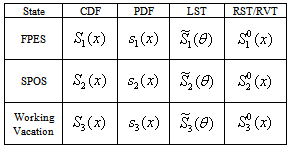 The steady state probabilities to construct the governing equations are defined as following:
 The rth moment in different states of FPES, SPOS and WVS are denoted by
  , where
  . Thus, we have following expressions to obtain
  ;
; 


 The Laplace transforms of probabilities
 ,
,  and
and  are denoted by
 ,
,  and
and  respectively, so that
 ;
;  can be expressed as follows
 ,
,
 We define the probability generating functions (PGF)



3. Preliminary Ideas of the Model
- In this section, some performance measures such as the long run probabilities for which the server is in FPES state, SPOS state and in working vacation state (WVS) and the probability generating function of the number of customers in the orbit are presented in the form of following theorems 3.1- 3.4 in view of Maurya[29]; which we shall use here to further explore some useful performance measures of the bulk arrival retrial queueing
 model.Theorem 3.1: The long run probabilities for which the server is in FPES state, SPOS state and in working vacation state (WVS) are denoted by P(E), P(S) and P(V); are as following respectively
  | (3.1) |
 | (3.2) |
 | (3.3) |
 model is expressed by following equation:
 | (3.4) |
 | (3.5) |
 | (3.6) |
 | (3.7) |
 | (3.8) |
 | (3.9) |
 model is given by following expression
 | (3.10) |
 is given by
 | (3.11) |
4. Maximum Entropy Analysis
- In this section, maximum entropy approach is used to obtain the steady state probabilities of MX/(G1,G2)/1 retrial queueing system with second optional service under Bernoulli vacation schedule. Firstly, we provide the maximum entropy formalism by using several well-known constraints. Further, by applying the method of Lagrange’s multipliers we evaluate the Lagrange’s function. Then the partial derivatives of the Lagrange’s function with respect to
 ,
, ,
,  ,
,  respectively are put equal to zero to obtain Lagrange’s multipliers. Now we formulate the maximum entropy model in order to obtain the steady state probabilities
  ,
, ,
,  and
and  in the following way:
4.1. The Maximum Entropy Model
- Following El-Affendi and Kouvatsos (1983), the entropy function H can be expressed as
 | (4.1) |
 | (4.2) |
 | (4.3) |
 | (4.4) |
 | (4.5) |
 | (4.6) |
 are known as these can be determined by using equations (3.1), (3.2), (3.3) and (3.4) respectively.After introducing Lagrange’s multipliers corresponding to the constraints (4.2)-(4.6), Lagrange’s function is given by
 | (4.7) |
 are the Lagrange’s multipliers corresponding to the constraints (4.2)-(4.6) respectively.
4.2. The Maximum Entropy Solutions
- The maximum entropy solutions are obtained by taking the partial derivatives of H with respect to
 ,
, ,
,  ,
,  respectively and setting the results equal to zero. Thus,it is fairly easy to get following partial differential equations:
 | (4.8) |
 | (4.9) |
 | (4.10) |
 | (4.11) |
 | (4.12) |
 | (4.13) |
 | (4.14) |
 | (4.15) |
 then equations (4.12)-(4.15) reduce to following equations respectively
 | (4.16) |
 | (4.17) |
 | (4.18) |
 | (4.19) |
 ,
, ,
,  and
and  from equations (4.16)-(4.19) into equations (4.2)-(4.5), we have
 | (4.20) |
 | (4.21) |
 | (4.22) |
 | (4.23) |
 | (4.24) |
 | (4.25) |
 | (4.26) |
 | (4.27) |
 On substituting the values of
  from equations (4.24)-(4.27) into equation (4.6) and after doing some algebraic manipulations, we obtain the maximum entropy approximate solutions. Now
 | (4.28) |
 from equations (4.24)-(4.27) into equations (4.16)-(4.19) and using equation (4.28), we finally get
 | (4.29) |
 | (4.30) |
 | (4.31) |
 | (4.32) |
 | (4.33) |
 | (4.34) |
 | (4.35) |
 | (4.36) |
 and
and  are given in equations (4.29)-(4.32) respectively.
5. Numerical Illustration
|
 models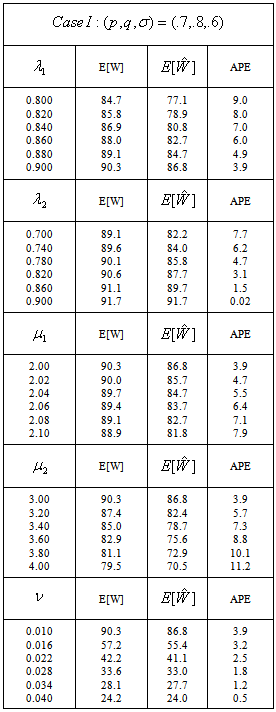
|
 model
model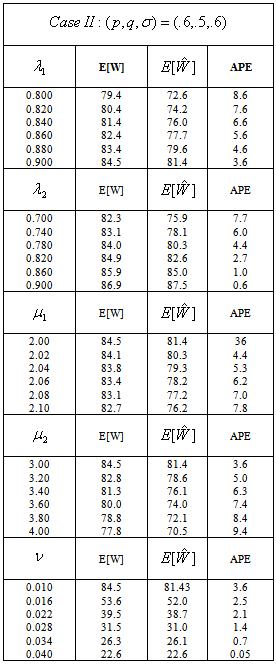


 for tables 1(a-b)-3(a-b). Tables 1(a-b)-3(a-b) show that E[W] and
  increase as we increase
 . The decreasing trends of E[W] and
 with the increasing values of
  for
for ,
,  and
and  models can also be seen. The absolute percentage error (APE) in
  is calculated which varies from 0%-11% as noticed in tables 1(a-b)-3(a-b).
|
 model
model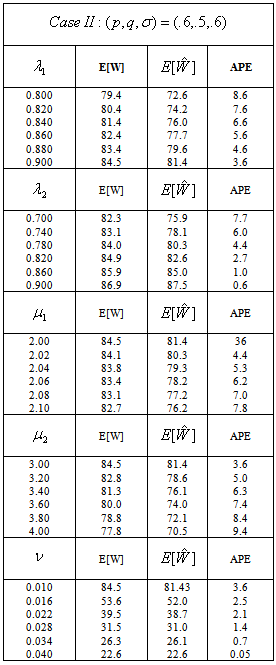
|
 model
model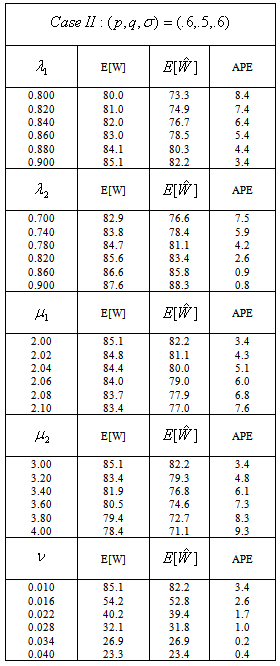
 on the system performance measures, tables 1(a-b)-3(a-b) have been prepared for chosen three special cases of service time distributions-Erlangian, deterministic and Gamma distribution. Tables 4-6 demonstrate a comparison between the exact E[W] and the approximate
  results of average waiting time for different special models ofthe MX/(G1,G2)/1queueingmodel for
  and
and .
.
|
 model
model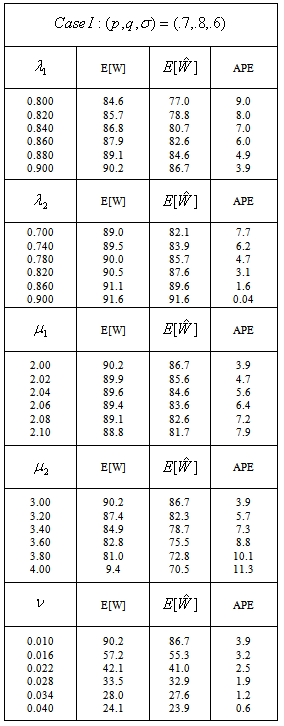
|
 model
model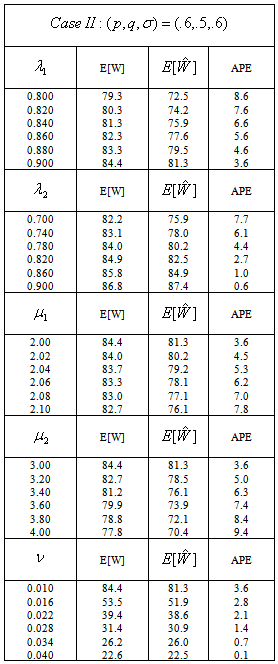
6. Conclusions
- In the present paper, some significant performance measures of a bulk arrival retrial queueing MX/(G1,G2)/1model with essential and optional services under Bernoulli vacation schedule have been presented successfully by way of using the maximum entropy principle (MEP). Specifically,the approximate expected waiting time in the orbit based on maximum entropy principle (MEP) has been derived in equation (4.33) as a theorem 4.1. In addition to this, some useful performance measures such as the mean waiting times of customer ‘C’ when the server is in different statesof IS, BS and WVS are carried out in equations (4.34)-(4.36) in a novel way. Comparative study between the exact waiting time and the approximate waiting time based on maximum entropy analysis for three different types of service time distributions such as Deterministic, Exponential and Gamma distributions has also been examined by way of taking the numerical illustrations to validate the investigative results. In our sensitivity analysis, the effects of various parameters on the performance measures are illustrated numerically in tables 1(a-b)-3(a-b).Through numerical results based on MEP analysis, we have proved that the MEP approach provides a reasonable good approximation. Moreover, we remark here that the exploratory results of the present paper are useful for the researchers, network design and software engineers to design various computer communication systems. Finally with passing remarks, we suggest here that the present investigation can be further extended by incorporating the concept of server breakdown and multi-optional services.
ACKNOWLEDGEMENTS
- Dr. V. N. Maurya;author of the present paper is currently working as Professor & Head, Department of Applied Mathematics atShekhawati EngineeringCollege, Dundlod, (Rajasthan Technical University, Kota).Prof. V. N. Mauryais one of the leading experts in Applied Mathematics and Operations Research in India and he has made significant contributions to many mathematical, statistical, computer science and industrial engineering related areas basic as well as application oriented. Formerly he has served as Founder Director at Vision Institute of Technology, Aligarh (U. P. Technical University, Lucknow) and as Principal/Director at Shekhawati College of Engineering, Dundlod, Rajasthan (Rajasthan Technical University, Kota) and also as Selected Professor & Dean Academics at Institute of Engineering & Technology, Sitapur, UP, India. He obtained his M.Sc. and Ph.D. Degree in Mathematics & Statistics with specialization in Operations Research from Dr. Ram ManoharLohiaAvadh University, Faizabad, UP, India in the year 1996 and 2000 respectively and thereafter he accomplished another two years Master’s Professional Degree-MBA with specialization in Computer Science from NU, California, USA in 2003. Since his primary education to higher education, he has been a meritorious scholar and recipient of meritorious scholarship. He started his teaching career as Lecturer in 1996 to teach post-graduate courses MBA, MCA and M.Sc. and later he was appointed as Professor & Head, Department of Applied Sciences and Engineering at Singhania University, Rajasthan in the year 2004. Since then,Prof. V. N. Mauryahas spent his entire scientific and professional career in teaching as Professor & Head/Dean as well as keen Researcher for Post-Doctoral research at various premier technical institutions of the country such as at Haryana College of Technology & Management, Kaithal (Kuruchhetra University, Kuruchhetra); Institute of Engineering & Technology, Sitapur andUnited College of Engineering & Research, Allahabad. On the basis of significant research work carried out by him in the last 17 years of his professional career, Prof. V. N. Maurya has published more than 45 scientific and academic research papers including his Ph.D. and D.Sc. Thesis in leading refereed National and International Journals and Seminars in the field of Mathematical and Management Sciences, Industrial Engineering & Technology. Some of his published research papers in India, USA, Algeria and Malaysia are recognized as landmark contributions in the field of Mathematical Sciences, Engineering & Technology. Prof. V. N. Maurya is an approved Supervisor of UGC recognized various Indian Universities for Research Programs leading to M. Phil. & Ph.D. such as Shridhar University, Pilani (Rajasthan), Singhania University, Rajasthan and CMJ University, Sillong, Meghalaya and JJTU Jhunjhunu, Rajasthan and U.P. Technical University Lucknow etc. andsince last 7 years,he is actively engaged as Research Supervisor of M. Phil. & Ph.D. Scholars in wide fields of Operations Research, Optimization Techniques, Statistical Inference, Applied Mathematics, Operations Management and Computer Science. He has guided independently to several Scholars of M. Phil. and Ph.D. Apart from this, in the course of his distinguished professional career, Dr. V.N.Maurya has been appointed as Head- Examiner by leading Indian Universities-U.P. Technical University, Lucknow during 2005-06 and ChhatrapatiShahuJiMaharaj University, Kanpur for three terms during 2000-2004 for Theory Examinations of UG and PG Programs for significant contribution of his supervision in Central Evaluation. On the basis and recognition of his knowledge and significant scientific and academic research contributions in diversified fields of Mathematical and Management Sciences as well as Engineering & Technology, Prof. Maurya has been the recipient of Editorial Member and Reviewer of many leading International Journals of India, USA and Italy such as World Journal of Applied Engineering Research, Academic & Scientific Publishing, New York, USA;American Journal of Engineering Technology, New York, USA;Open Journal of Optimization, Scientific Publishing, Irvine, California, USA;International Journal of Operations Research, Academic &Scientific Publishing, New York, USA;International Journal of Industrial Engineering & Technology, USA;International Journal of Operations Research, USA;International Journal of Statistics and Mathematics, USA;International Journal of Information Technology &Operations Management, USA;International Journal of Advanced Mathematics & Physics, USA;International Journal of Applications of Discrete Mathematics, New York, USA;Science Journal Publications, Nigeriaand World Academy of Science, Engineering & Technology, (Scientific Committee and Editorial Board on Engineering & Physical Sciences), Italyetc. and also Fellow/Senior /Life Member of various reputed National and International professional bodies of India and abroad including Operations Research Society of India, Kolkata; Indian Society for Technical Education, New Delhi; Indian Association for Productivity, Quality & Reliability, Kolkata; Indian Society for Congress Association, Kolkata; International Indian Statistical Association, Kolkata; All India Management Association, New Delhi; Rajasthan GanitaParishad, Ajmer and International Association of Computer Science & Information Technology, Singapore etc.
 queueing model with second phase optional service and Bernoulli vacation schedule,” Communicated for publication, 2012
 model with second phase optional service and Bernoulli vacation schedule,” Communicated for publication, 2012