
-
Paper Information
- Paper Submission
-
Journal Information
- About This Journal
- Editorial Board
- Current Issue
- Archive
- Author Guidelines
- Contact Us
American Journal of Mathematics and Statistics
p-ISSN: 2162-948X e-ISSN: 2162-8475
2026; 15(1): 3-9
doi:10.5923/j.ajms.20261501.02
Received: Feb. 13, 2026; Accepted: Mar. 6, 2026; Published: Apr. 11, 2026

An Investigative Approach for Solving Cost Minimizing Transportation Problem with Mixed Constraints
 Abstract
 Reference
 Full-Text PDF
 Full-text HTML
Farhana Rashid
Department of Mathematics, Jagannath University, Dhaka, Bangladesh
Correspondence to: Farhana Rashid, Department of Mathematics, Jagannath University, Dhaka, Bangladesh.
| Email: |  |
Copyright © 2026 The Author(s). Published by Scientific & Academic Publishing.
This work is licensed under the Creative Commons Attribution International License (CC BY).
http://creativecommons.org/licenses/by/4.0/

A transportation problem is figuring out the best way to fulfill demand from multiple supply sources while keeping transportation costs as low as possible. This research presents an innovative approach to addressing transportation issues characterized by mixed constraints (TPMC). The approach produces new minimum and maximum supply and demand values based on the combined limits. Then, it changes the original TPMC into a balanced transportation problem that is the same as the previous one. The innovative method makes it possible to optimize the transfer of several units at the same time while lowering transportation expenses. The suggested solution is shown with numbers and put into action with Excel Solver and Python programming. Though maximum transportation problems in real life have mixed constraints, these problems are not be solved by using general method. The proposed method builds on the initial solution of the transportation problem, which is very simple, easy to understand and apply.
Keywords: Transportation problem, Transportation problem with Mixed constraints, Maximize transported units, Minimize transportation cost
Cite this paper: Farhana Rashid, An Investigative Approach for Solving Cost Minimizing Transportation Problem with Mixed Constraints, American Journal of Mathematics and Statistics, Vol. 15 No. 1, 2026, pp. 3-9. doi: 10.5923/j.ajms.20261501.02.
1. Introduction
- Linear Programming that deals with the best uses of limited resources, are one of the most important branches of operation management. The branch of LPP in which a single homogeneous product is transported from several sources to numerous localities in such a way to minimize the total transportation cost while satisfying all supply and demand restrictions is Transportation Problem (TP). If the capacity of a source is extensively increased/decreased and the requirement of a destination is also extensively increased/decreased, then the overall transportation system is converted to unequal transportation problems with mixed constraints. Due to the sources and destinations having mixed nature, the problem is said to be a transportation problem with mixed constraints (TPMC). A lot of real-world transportation systems have to deal with limits on both supply and demand. A lot of the time, these kinds of challenges come up when it comes to setting up industrial distribution, information networks, logistical management, and disaster relief. The main goal of emergency logistics is to move as many critical products as rapidly and cheaply as possible when there is an emergency, such an earthquake that needs help. This is what makes people think of good ways to tackle transportation problems that have a lot of rules. The technique of linear programming was formulated by a Russian mathematician Hitchcock [1]. But in 1947 the present version of simplex method was developed by Geoge B. Dantzig [2]. Linear programming (LP) is an important technique of operations research developed for optimum utilization of resources. There are different types of transportation problems and the simplest of them that is now standard in literature was first presented by Hitchcock [1] Charnes and Cooper [3] presented a straightforward method for obtaining an initial basic feasible solution of a transportation problem which is named as North West Corner Method. Balakrishnan [4] proposed Extremum Difference Method (EDM) suggests the revised VAM procedure. Aminur Rahman Khan [5,6,7] presented Highest Cost Difference Method (HCDM). Sudhakar et al. [8] developed a new direction for searching the optimal solution of the transportation problem. Stephen Akpan et al. [9] improved VAM algorithm. Klingman et al. [10] in the transportation problem with mixed constraints interpret generalization of the standard transportation model. Isermann, H.et al. [11] in their paper show that to each transportation problem with mixed constraints a standard transportation problem with two additional cost can be related. Adlakha et al. [12] heuristic algorithm for shipping more for less in distribution-related problems is proposed. Adlakha et al. [13,14] provided a heuristic algorithm for solving transportation problems with mixed constraints and extend the algorithm to find a more-for-less (MFL) solution. Pandian [15] introduced a method named Zero-point Method. Based on Zero-point method he discussed a new algorithm [16,17] for finding an optimal more-for-less solution. He also provided another method [18] named Fourier transportation algorithm based on Modified Fourier Elimination method. In path method [19] he discussed more-for-less optimal solutions to transportation problems with equality / mixed constraints. Mondal et al. [20,21] and Juman and Hoque [22] created algorithms to solve transportation issues with a combination of constraints. Rashid et al. [23,24] suggested approaches mostly aimed at reducing transportation expenses. However, most current methods focus on lowering costs and don't expressly try to maximize the total number of units delivered when there are mixed supply and demand limitations. In many real-world emergency logistics circumstances, such disaster relief efforts, it is very important to get as many people as possible to their destination while keeping transportation costs low. Consequently, this work introduces a transformation-based approach that establishes new minimum and maximum supply and demand values to reformulate the transportation issue with mixed constraints into an analogous balanced transportation model.The standard form of the transportation problem is generally given as:
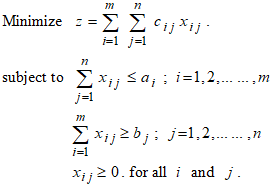 Where, Total supply ai units,
  , Total demand bj units,
  unit transportation cost from source i to destination j is cijtransported unit from source i to destination j is xij The general transportation problem can be represented by the network and in a matrix form as in the following Figure 1 and Figure 2 respectively.
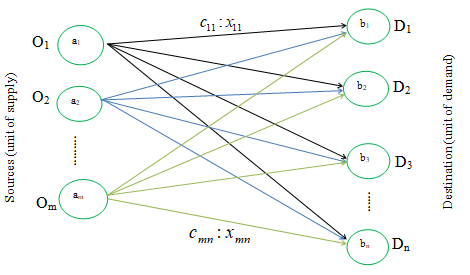 | Figure 1. Network Representation of Transportation Problem |
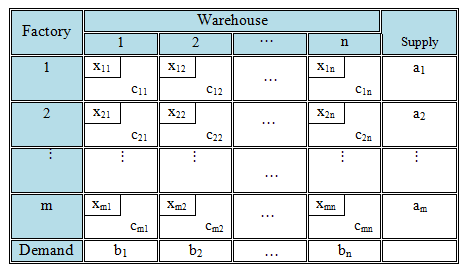 | Figure 2. Matrix Representation of Transportation Problem |
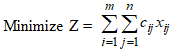
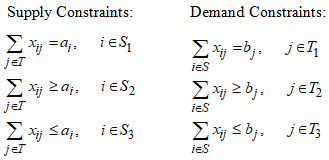 And
And  Theoretical Development of the Proposed MethodWhen there are mixed constraints in transportation problems, the factors of supply and demand may include minimum, maximum, or similar limits. The suggested method turns the TPMC into a similar balanced transportation problem by creating new minimum and maximum values for supply and demand. This makes the solution process easier.Proposition: The transformation preserves feasibility of the original transportation problem with mixed constraints because the newly constructed supply and demand values satisfy all original lower and upper bound restrictions. This transformation allows the TPMC to be solved using standard linear programming techniques.Step-1: Formulation of Transportation Problem with Mixed Constraints (TP-MC) where per unit shipping cost is available.Step-2: For identifying total minimum supply and total minimum demand we set the condition below:
 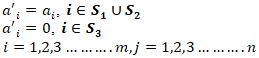 And also
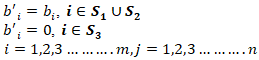 and form a new Transportation Problem with Mixed Constraints.Step-3: Calculate total minimum supply
 and total minimum demand
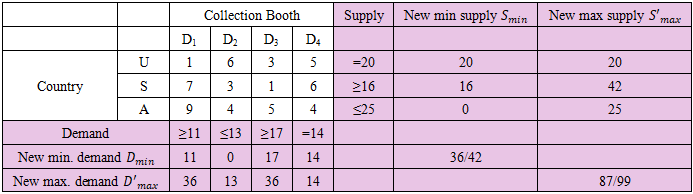
 Step-4: According to our assumption the supply and demand constraints will be
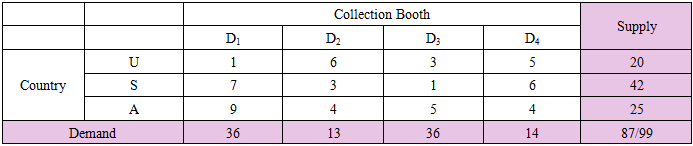
 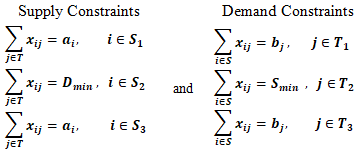 Finally, get the new supply
  and new demand
  The numbers
  and
and  represent the highest supply and demand levels after the original supply capacity and the lowest demand needs were combined and the order of the figures was changed. This update makes sure that the final transportation model passes the balancing requirement for using regular transit options.
 Step-5: If necessarily make it balance adding zero row or column.Step-6: Solve it by using Excel Solver and Python Programming.Step-7: Find total maximum transported unit
  and total minimum required cost.Numerical Illustration:Think about what would happen if there was an emergency, like an earthquake, and the Turkish government set up a lot of emergency relief collection points at airports all throughout the nation. Turkey gets important items from three different countries. The letters U, S, and A stand for these nations, which are all at different distances from Turkey. These countries send us food, medication, and other things we need. The production capacity of U is exactly 80 units, S has at least 120 units and that of A at most 140 units. Likewise, collection booth-1 having a capacity of demand exact 11-unit, booth-2 having a capacity of demand at least 13-unit, booth-3 having a capacity of demand exact 60 units, booth-4 having a capacity of demand at most 80 units and collection booth-5 having a capacity of demand at least 80 units. Unit transportation cost from source to collection booth are given below by this matrix. From this type of TP with mixed constraints and we conclude the maximun transported unit with minimum transportation cost:Step-1: Table 1 shows the Formulation of Transportation Problem with Mixed Constraints (TP-MC).
|
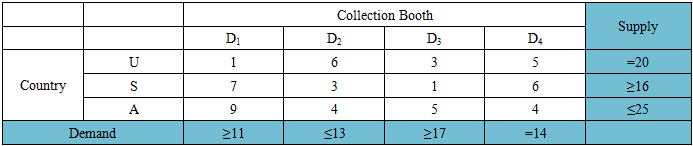
|
|
|
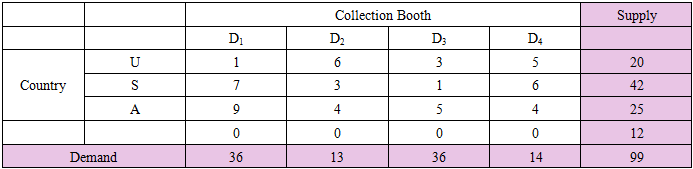
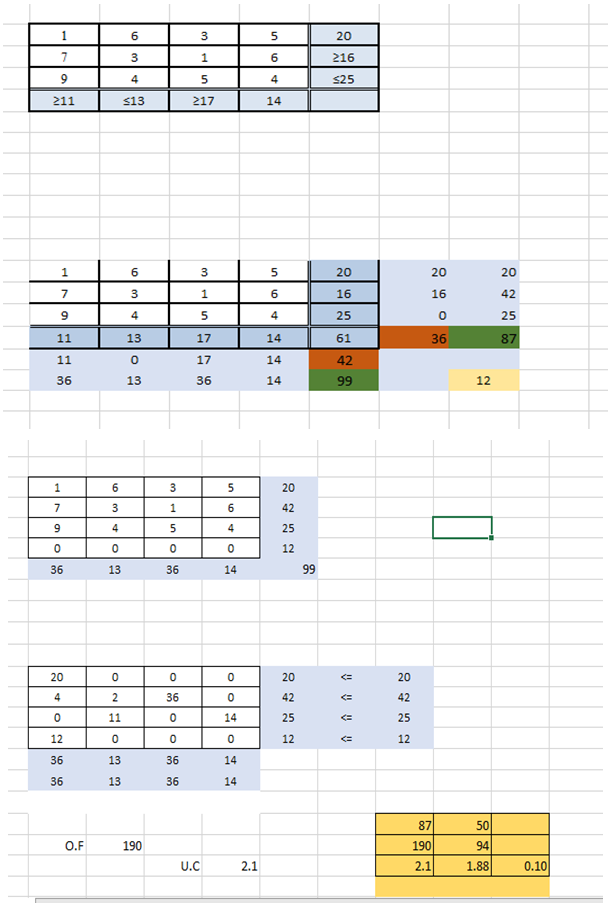 Solved by using Python Programming: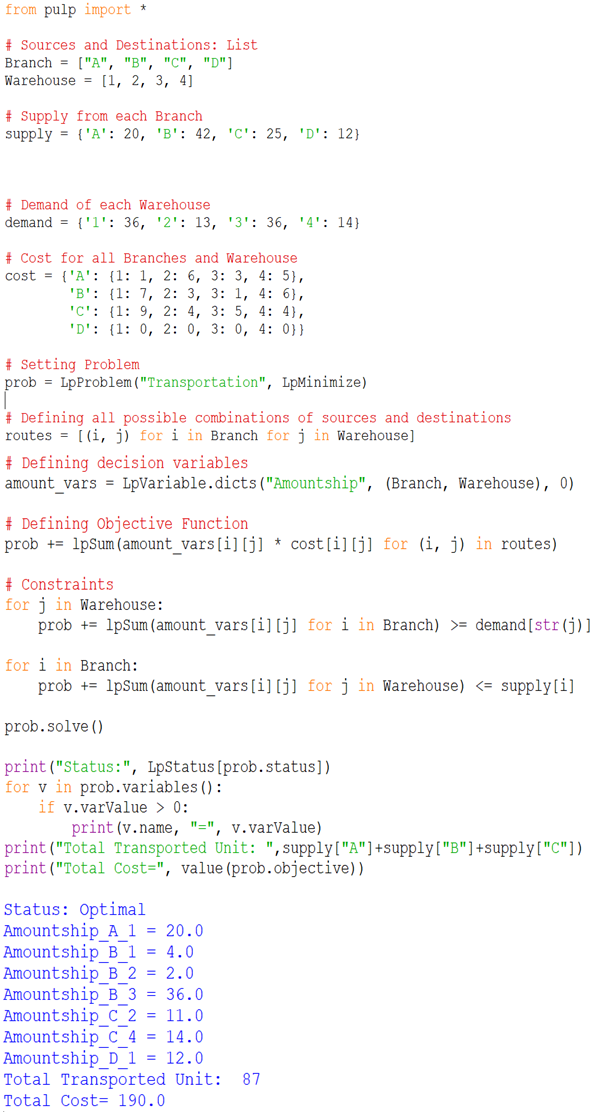
2. Result Analysis
- In my research work Rashid, F. [24], I proposed an algorithm for cost minimization. I got the total cost 94 units and total transported unit is 50. In that method I consider only the cost for minimized, total transported unit does not consider. But in this research work I consider cost for minimize as well as transported unit for maximized. And I get the total cost 190 units and total transported unit is 87. Per unit shipping cost for previous method is 1.88 unit and this method is 2.1. The results show that while the per-unit shipping cost experiences a small increase (around 0.10%), the total quantity transported sees a remarkable boost (about 40%). This shows that the proposed method shines in emergency logistics situations, where the focus on maximizing the transported quantity brings significant benefits over simply minimizing costs. So, this method is applicable where the total transported unit is more important with minimized total transported cost.
3. Conclusions
- At the time of transporting urgent materials, the transported amount is more significant than the transportation cost. We developed an algorithm that will ship the maximum unit satisfying all supply and demand requirements while minimizing total transported cost as well as exceeding the transportation cost. The method proposed in this paper is very simple and easily understandable. To the best of the author’s knowledge, limited research has addressed the simultaneous maximization of transported units and minimization of cost in transportation problems with mixed constraints. The proposed transformation method provides an efficient solution framework and has been validated using Excel Solver and Python programming. It provides solutions in a simple manner, and analysis could be useful for managers in making strategic decisions to deal with the crisis circumstance. I trust these new ideas will help individuals who are working in this field. Still, there exists a rich opportunity for further research on this subject.
ACKNOWLEDGEMENTS
- I would like to Acknowledge the financial support from the JAGANNATH UNIVERSITY RESEARCH AND DEVELOPMENT PROJECT (2022-2023). I also thankful to my supervisor Dr. Aminur Rahman Khan. His valuable suggestions helped me to improve the quality of this paper.