Amnah E. Shammaky
Department of Mathematics, Faculty of Science, Jazan University, Jazan, Saudi Arabia
Correspondence to: Amnah E. Shammaky , Department of Mathematics, Faculty of Science, Jazan University, Jazan, Saudi Arabia.
| Email: |  |
Copyright © 2016 Scientific & Academic Publishing. All Rights Reserved.
This work is licensed under the Creative Commons Attribution International License (CC BY).
http://creativecommons.org/licenses/by/4.0/

Abstract
In this paper, we investigate the majorization problem of certain classes of meromorphic multivalent functions defined by differential operator.
Keywords:
Meromorphic, Multivalent functions, Majorization problem, Complex order and differential operator
Cite this paper: Amnah E. Shammaky , Majorization Problem for Certain Classes of Meromorphic Multivalent Functions Defined by Differential Operator, American Journal of Mathematics and Statistics, Vol. 6 No. 2, 2016, pp. 86-88. doi: 10.5923/j.ajms.20160602.03.
1. Introduction
If  and
and  are analytic in
  we say that
  subordinate to
  written
 | (1) |
if there exist a Schwarz function  which is analytic in
  with
with  and
and  for all
  such that
 | (2) |
Furthermore, if the function  is univalent in
  then we have the following equivalence (see [7]):
 and
and 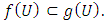 The pioneering work of [9], we say that
  is majorized by
  in
in  and write
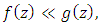 | (3) |
If there exists a function  analytic in
  such that
 Let
Let  denote the class of function
  of the form
  | (4) |
which are analytic and multivalent in the punctured unit disc  For
For  and
and  we have (see [10])
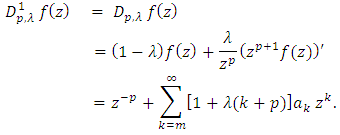 In general, we have
 | (5) |
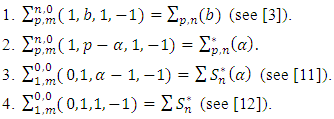
Note that for  we have the operator
  studied by Aouf and Hossen [5], Aouf and Al-Ashwah [4], Liu and Srivastava [8] and Srivastava and patel [13]. Also when
  and
and  we have the operator
  studied by Urafegaddi and Somaatha [14].The following relation for the operator
  can be obtained by Simple Calculation (see [10])
  | (6) |
By making use of the operator 
 we define the following class.Let
 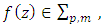 then
then  if and only if
  | (7) |
where 

 The majorization (3) is closely related to the concept of quasi-subordination between analytic functions in
  which was considered by Altinatas and Owa [2]. Recently, Ali [1] results investigated some majorization results for some classes of meromorphic multivalent functions defined by integral operator.In the present paper, as a sequel to the work of [1] and [6], we investigate majorization problem for the class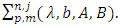
2. Majorization Problem for the Class ∑p,m
We shall assume throughout the paper that where 
 Theorem 2.1. Let the function
  and suppose that
  If
If in
in  then
then where
where  is the smallest positive root of the equation
 | (8) |
Proof. Since  from (7), we get
 | (9) |
where  is analytic function in
  with
with  and
and  then we have
 | (10) |
Since  therefore
  | (11) |
where  differentiating it with respect to
  and multiplying by
  we get
 | (12) |
Thus, by noting that  satisfies the inequality (see [1])
 | (13) |
Using equations (11) and (12) and inequality (13), we obtain | (14) |
which upon setting  and
and  in (14) leads to the inequality
 | (15) |
where  | (16) |
Takes its maximum value at  with
with  is the smallest positive root of (8). Therefore, the function
  defined by
 | (17) |
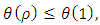
is an increasing function for  so that
 where
where  Hence, upon setting
  in (17), we conclude that (8) holds true for
  which complete the proof.Putting
  and
and  in Theorem 2.1, we obtain the following corollary: Corollary 2.2. Let the function
  and suppose that
  If
If  in
in  then
then where
where | (18) |
and  Putting
  in corollary 2.2, we obtain the following corollary:Corollary 2.3. Let the function
  and suppose that
  If
If 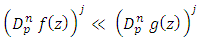 in
in  then
then Where
Where  given by (18) with
 Putting
  in corollary 2.3, we obtain the following corollary: Corollary 2.4. Let the function
  and suppose that
  If
If 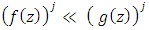 in
in  then
then Where
Where 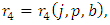 given by (18) with
 Remark 2.5. Putting
  in corollary 2.4, we obtain the result of Ali ([1], Corollary 3).
ACKNOWLEDGEMENTS
The author would like to thank the referee(s) for his/her helpful comments.
References
| [1] | Ali E.E., 2013, Majorization properties for certain classes of meromorphic p-valent functions defined by integral operator, J.F.C. and Appl. 4(3S) N.5, 1-6. [http://www.facj.webs.com/]. |
| [2] | Altintas O. and Owa S., 1992, Majorization and quassi-subordination for certain analytic functions, Proc. Japan. Acad. SerA.Math.Sci 68, 181-185. |
| [3] | Aouf M.K., 1993, New criterion for multivalent meromorphic starlike function of Alpha, Proc.Japon Acad.SerA.Math.sci 69, 66-70. |
| [4] | Aouf M.K. and El-Ashwah R.M., 2009, Subclasses of meromorphically p-valent functions with negative coefficients associated with a linear operator, Bull. Instiute Math., 4, N.1, 97-118. |
| [5] | Aouf M.K and Hossen H.M., 1993, New criteria for meromorphic p-valent starlike functions, Tsukuba J. Math., 17, 481-486. |
| [6] | Dhuria K. and Mathur R., 2013, Majorization for certain classes of meromorphic functions defined by integral operator, Int. J. Open Problems Complex Analysis 5, N.3, 50-56. [http://www.i-csrs.org]. |
| [7] | Goodman A.W.: Univalent Functions, Vol. I, Mariner Publishing Company, Tamps, Florida. 1983. |
| [8] | Liu J.L. and Srivastava H.M., 2004, Subclasses of meromorphic multivalent functions associated with acertain linear operator, Math, compd. Modeling, 39, 35-44. [http://www.Science direct.com]/Science/article/pii/S089571770490543. “PDCA12-70 data sheet,” Opto Speed SA, Mezzovico, Switzerland. |
| [9] | Macgregor T.H., 1967, Majorization by univalent functions, Duke Math. J., 34, 95-102. |
| [10] | Mohammed A. and Darus M., 2014, On new p-valent meromrphic function involving certain differential and integral operator, Abstract and Applied Analysis 2014, Article ID208530, 7pages.[http:dx.doi.org/10.1155/2014/208530]. |
| [11] | Owa S., Nunokawa M. and Saitoh H., 1989, Generalization of certain subclasses of meromorphic univalent functions, J.Fac.Sci, Tach. Kinki. Univ., 25, 21-27. |
| [12] | Pommerenke C., 1963, On meromorphic starlike functions, Pacific J. Math. 13, 221-235. |
| [13] | Srivastava H.M. and Patel J., 2005, Applications of differential snbordination to certain subclasses of meromorphicalty multivalent functions, J.Ineq. Pure and Appl. Math., 6, N. 3, Art 88.[http://jipam.vu.edu.au/article.php?sid=561]. |
| [14] | Uralegaddi B.A. and Somanatha C., 1991, New critera for meromorphic starlike univalent functions, Bull. Austral. Math. Sci. 43, 137-140. |


 Abstract
 Reference
 Full-Text PDF
 Full-text HTML