
-
Paper Information
- Paper Submission
-
Journal Information
- About This Journal
- Editorial Board
- Current Issue
- Archive
- Author Guidelines
- Contact Us
American Journal of Mathematics and Statistics
p-ISSN: 2162-948X e-ISSN: 2162-8475
2016; 6(1): 57-70
doi:10.5923/j.ajms.20160601.06

Common Hypercyclic Functions for Translation Operators with Large Gaps II
 Abstract
 Reference
 Full-Text PDF
 Full-text HTML
Nikos Tsirivas
University of Crete, Department of Mathematics and Applied Mathematics, Crete, Greece
Correspondence to: Nikos Tsirivas , University of Crete, Department of Mathematics and Applied Mathematics, Crete, Greece.
| Email: |  |
Copyright © 2016 Scientific & Academic Publishing. All Rights Reserved.
This work is licensed under the Creative Commons Attribution International License (CC BY).
http://creativecommons.org/licenses/by/4.0/

Let H(C) be the set of entire functions endowed with the topology of local uniform convergence. Fix a sequence of complex numbers (λn), which satisfies the following property: for every M > 0 there exists a subsequence (µn) of (λn) such that: (i) µ1 ≠ 0; (ii)  ; (iii)
 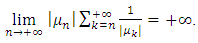 An example of such a sequence is
  We prove that there exists an entire function f such that for every complex number a with |a| = 1 the set {f (z + λn a): n = 1, 2, . . .} is dense in H(C). This largely extends a Theorem of Costakis.
Keywords: Hypercyclic operator, Common hypercyclic vectors, Translation operator
Cite this paper: Nikos Tsirivas , Common Hypercyclic Functions for Translation Operators with Large Gaps II, American Journal of Mathematics and Statistics, Vol. 6 No. 1, 2016, pp. 57-70. doi: 10.5923/j.ajms.20160601.06.
Article Outline
1. Introduction
- This paper is the fourth one in a series of papers, [24], [34], [35], which aims to a better understanding of the phenomenon of common hypercyclic vectors for uncountable many families of hypercyclic operators of translation type. The notion of hypercyclicity has been studied intensively the last 30 years and there is by now a well developed theory on this subject, see for instance the two important recent books [9], [27] and the survey of Gross-Erdmann [26]. Let us recall the relevant definitions. A sequence (Tn) of continuous and linear operators acting on a real or complex topological vector space X is called hypercyclic, if there exists a vector x∈X so that the set {Tnx : n = 1, 2, . . .} is dense in X; in this case x is called hypercyclic for (Tn) and the symbol H C (Tn) stands for the set of all hypercyclic vectors for (Tn). Let T: X → X be a linear and continuous operator. We define the iterates of T inductively as follows: T1:= T and T n+1= Tno T , n = 1, 2, . . . where with Tno T we mean the usual composition of the operators T n and T for n = 1, 2, . . . . If in the previous definition, the sequence (Tn) comes from the iterates of a single operator T, i.e. Tn = T n, n = 1, 2, . . . then T is called hypercyclic, x is called hypercyclic for T and H C (T) denotes the set of hypercyclic vectors for T. Observe that, in the above situation the topological vector space X is necessarily separable. For several examples of hypercyclic operators including many classical operators, such as weighted shifts, differential operators, adjoints of multipliers and so on, we refer to [9], [27]. We denote C, the set of complex numbers and H(C) the set of entire functions that is supposed endowed with the topology Tu of local uniform convergence from now on.Our interest here lies on a particular operator, the translation operator acting on the space H(C). Let a ∈ C. For obvious reasons, the operator Ta: H(C) → H(C) defined by Ta (f)(z):= f (z + a), for f ∈ H(C), z ∈ C, is called translation. A classical result due to Birkhoff [13] says that T1 is hypercyclic. This means, that there exists an entire function f whose positive integer translates approximate every entire function, i.e. the set {f (z + n): n = 1, 2, . . .} is dense in (H(C), Tu). Actually for every a∈C∖{0} the translation operator Tα is hypercyclic. As an easy application of Baire’s category theorem we have the following dichotomy: if X is a separable topological vector space and T is a linear and continuous operator on X then either H C (T ) = ∅ or H C (T) is Gδ and dense set in X, see [9], [27]. Recall that a subset A of X is called Gδ if it can be written as countable intersection of open sets. Therefore, for every α ∈ C \{0} the set H C (Tα) is Gδ and dense set in (H (C)Tu) and as an immediate consequence of Baire’s category theorem, we have that the set
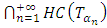 is non-empty for every sequence
  of non-zero complex numbers. Our point of departure is the following extension of Birkhoff ’s theorem due to Costakis and Sambarino [23]:
  The difficulty of proving such a result is, of course, the uncountable range of a. Subsequently Costakis, in an attempt to generalize the previous result established the following:Theorem 1.1. [20] Let (λn) be a sequence of non-zero complex numbers with|λn | → +∞ which also satisfies the following condition (Σ):Condition (Σ). For every M > 0 there exists a subsequence (µn) of (λn) such that
 The purpose of the present work is to extend the above theorem by allowing a strictly wider class of sequences (λn). However, it is necessary to impose certain restrictions on (λn) so that the conclusion of the above theorem holds, as the following result from [24] shows: if (λn) is a sequence of non-zero complex numbers with
 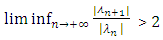 then
then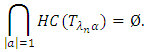 Frederic Bayart improved this result by proving that
  We consider a sequence (λn) of complex numbers that satisfies the following condition which we call it condition (Σ1) from now on.Condition (Σ1). For every M > 0 there exists a subsequence (µn) of (λn) such that (i) µ1 ≠ 0(ii) |µn+1 | − |µn| > M for every n = 1, 2, . . . and(iii)
  We denote A2 the sequences that satisfy the previous condition (Σ1). At this point it is instructive to observe that the sequences (n2), (n3), . . ., satisfy condition (Σ1) but not condition (Σ) of Theorem 1.1.We denote by
  the circle with center 0 and radius r, for some r > 0.Theorem 1.2. Fix a sequence of complex numbers Λ=(λn) that satisfies the above condition (Σ1). Then for every r ∈ (0, +∞) the set
 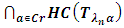 is a Gδ and dense set in (H(C), Tu). In particular,
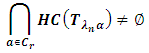 It is clear that property (iii) of condition (Σ1) relaxes the corresponding condition (ii) of (Σ). This differentiate Condition (Σ1) from condition (Σ) because for a sequence |µn | from non-zero complex numbers the series
 has always a unique limit, finite or + infinity. This does not hold for a sequence of the form
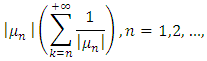 as someone can see, using elementary calculus because such a sequence can have many limit points.We note that Frederic Bayart examined in [2] similar problems in Rn generally in his significant paper.One may also wonder if property (iii) of (Σ1) in Theorem 1.2 can be relaxed by replacing the lim with lim sup. We prove now that this has no sense.More specifically:We denote N, the set of natural numbers.We consider the set A3 of sequences (λn) of complex numbers that satisfy the following condition which we call it Condition (Σ2) from now on.Condition (Σ2). For every M>0 there exists a subsequence (µn) of (λn) such that:(i) µ1 ≠ 0(ii) |µn+1 | − |µn| > M for every n = 1, 2, . . . and(iii)
  Lemma 1.3. It holds: A2 = A3.Proof. It is obvious that
 | (1.1) |
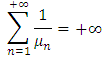 then the sequence (µn) satisfies of course property (iii) of condition (Σ1).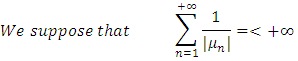
 Of course an →0, as n→ + ∞.By property (iii) of (Σ2) there exists n1 ∊ N such that:
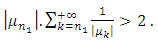 | (1.2) |
 there exists
 | (1.3) |
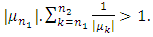 | (1.4) |
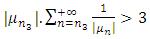 | (1.5) |
 there exists n4 ∊ N, n4 > n3 such that
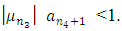 | (1.6) |
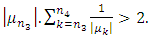 | (1.7) |
 such that:
 Of course the subsequence
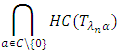
  satisfies the properties (i), (ii) and (iii) of (Σ1). This shows that A3 ⊂ A2, that completes the proof. It is important to mention that in [35] we obtain a full strength of the conclusion of Theorem 1.1, namely we show that under the assumptions of Theorem 1.1 the set
 is Gδ and dense set in (H(C), Tu). On the other hand, relaxing condition (iii) of Theorem 1.1 as above, the price we pay, at least for now, is the “thin”, but still uncountable, range of a in the conclusion of Theorem 1.2. A further connection of the present work with our main result from [34] will be discussed in Section 5.There are several recent results concerning either the existence or the non-existence of common hypercyclic vectors for uncountable families of operators, see for instance, [1]-[12], [14]-[25], [27]-[29], [31]-[35].The paper is organized as follows. Sections 2-4 contain the proof of Theorem 1.2. In the last section, Section 5, we connect our work with the main results from [34], [35].
2. Three Basic Lemmas
- We fix a positive number r0.Let us now describe the main steps for the proof of Theorem 1.2. Defining the arcs
 and using Baire’s category theorem we easily see that Theorem 1.2 reduces to the followingProposition 2.1. Fix a sequence (λn) of complex numbers that satisfies the above condition (Σ1). Fix three real numbers r0, θ0, θT such that r0 ∈ (0,+∞),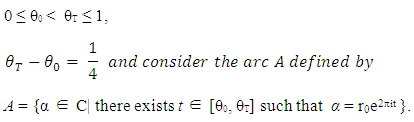
 For the proof of Proposition 2.1 we introduce some notation which will be carried out throughout this paper. Let (pj), j = 1, 2, . . . be a dense sequence of (H(C), Tu), (for instance, all the polynomials in one complex variable with coefficients in (Q + iQ) where Q is the set of rational number. For every m, j, s, k ∈ N we consider the set
 Clearly, Baire’s category theorem and the three lemmas stated below imply Proposition 2.1.Lemma 2.1
 Lemma 2.2. For every m,j,s,k ∊ N the set E (m,j,s,k) is open set in (H(C), Tu).Lemma 2.3.
  The proof of Lemma 2.1 is in [34]. The proof of Lemma 2.2 is similar to that of Lemma 9 in [22] and it is omitted. It remains to prove Lemma 2.3. This will be done in Sections 3 and 4 [23].
3. Construction of the Partition and the Disks
- Our main task is to prove Lemma 2.3. This means of course to find a natural number m and an entire function f such that the inequality that is described in the set E(m, j, s, k) is satisfied for every α ∊ A. If the set A is finite this can be done easily if we take different terms from the sequence (λn) that are far away each-other. However, if A is uncountable as an arc we cannot apply the previous method. We remark that if the inequality
 is satisfied for some value α ∈Α, then the same inequality is satisfied for values of a that are close to a. So the basic idea is to choose a suitable partition from finite many values of a that satisfy the desired inequality and wait that all the others satisfy the some inequality with the same term of the sequence (λn) of some of the finite many prescribed values.In a point of the proof it is needed, for technical reasons to have that the

 example for the sequence λn = n2, , n = 1, 2, ….For this reason the method in [20] and [23] cannot be applied here. However, if it is permitted to
 to become large enough. This exactly is the key point of our proof here. After we choose suitable terms of the sequence (λn) and some partition from values a∈A and we apply Runge’s Theorem on convenient discs with center in the point λna and the same radius R that is assigned by the problem.More specifically:Let Λ = (λn) be a sequence of non-zero complex numbers such that satisfies condition (Σ1). Let three real numbers θ0, θT , r0 be as in Proposition 2.1. For the sequel we fix four positive numbers c1, c2, c3, c4 such that c2 ∊ (0, 1), c3 > 1, c4 > 1, where
 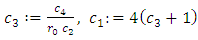 . After the definition of the above numbers we fix a subsequence (μn) of (λn) such that:



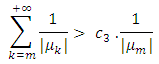 Throughout Section 3 the positive integer m0 will appear frequently and it is fixed from now on.
3.1. Step 1. Partitions of the Interval [θ0, θT]
- For every sufficiently large positive integer m (actually m ≥ m0) we shall construct a corresponding partition ∆m of [θ0, θT]. For every m ≥ m0 let m1(m) be the minimum positive integer such that
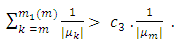 | (3.1) |
 .We define the numbers
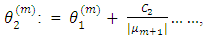

 or in a more compact form
 | (3.2) |
 Now let some positive integer
  Then there exists a unique pair
  , where
 such that:ν = k(m1(m) − m + 1) + j.Define
 with respect to ν. So there exists the maximum natural number νm ∈ N such that
  We set
3.2. Step 2. A Lower Bound for the Stopping Time νm
- Lemma 3.1.
 In particular νm ≥ m1(m) − m + 1.Proof. By the definition of the numbers θj(m) j = 0, 1, . . ., m1(m) − m+ 1 we have
 | (3.3) |
 | (3.4) |
 | (3.5) |

3.3. Step 3. Partitions of the Arc 
- Consider the function
 given by
 and for r0 > 0 we define the corresponding curve
  by
by For any given positive integer
 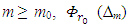 defines a partition of the
 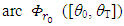 , where m0 is the positive integer defined above in Step 1 and ∆m is the partition of the interval [θ0, θT] constructed in Step 1. For every m ∈ N with m ≥ m0 define
 which we call partition of the
3.4. Step 4. Construction of the Disks
- Our task in this subsection is to assign to each point w of the partition Pm for m≥ m0 a suitable closed disk with center wµ(w) and radius c4 (the radius will be the same for every member of the family of the disks), where µ(w) will be chosen from the sequence (µn). We shall see that, the construction of the partition Pm ensures on the one hand that the points of the partition are close enough to each other on the arc A and on the other hand that the disks centered at the points wµ(w) for w ∈Pm with fixed radius c4 are pairwise disjoint.We setΒ:= {z ϵ C/|z| ≤ c4}and fix any positive integer m with m ≥ m0. Let w be an arbitrary point in Pm. There exists unique n ∈ {0, 1, . . ., νm} such that
 . Now there exists unique k ∈N ∪ {0}, and j ∈ {0, 1, . . ., m1 (m) − m} such that n = k (m1 (m) − m + 1) + j and defineµ (w) := µm+j.Thus we assign, in a unique way, a term of the sequence (µn) to every point of Pm and more specifically a term of the finite set
  and we introduce the notationBw:= B + wµ(w),to take our construction. The desired disks are the disks B and Bw, w ∈ Pm. Denote byDm := {B} ∪ {Bw : w ∈ Pm }the collection of the above disks.Remark. Since µ(w) = µm+j does not depend on K, this means that several centers wµ(w) are on the same disk centered in 0.
3.5. Step 5. The Disks are Pairwise Disjoint
- Lemma 3.2. Let
 with m≥ m0. Then
  for every
  Proof.
  account c1 = 4 (c3+1) > 2c3 we get
 | (3.6) |
 Observe now that, by the definition of µ (w) in the previous subsection,
 | (3.7) |
 | (3.8) |
 the proof of the lemma.Lemma 3.3. Let m ∈ N with m ≥ m0 and w1, w2 ∈ Pm with w1 ≠ w2. Then
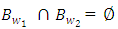 Proof. We distinguish two cases: (i) |µ (w1)| < |µ (w2)|.Our hypothesis implies|w2µ(w2)−w1 µ(w1)| ≥ ||w2 µ(w2)|−|w1µ(w1 )|| = r0(|µ(w2)|−|µ(w1 )|) ≥ r0 c1 > 2c4 ,where the last inequality above follows by (3.6).
 (ii) |µ (w1)| = |µ (w2)|.
 for some n1 , n2 ∈{0, 1, . . ., νm} and n1 ≠ n2 because w1 ≠ w2. Without loss of generality we suppose that n1 < n2.Now there exists a unique pair (k1, j1), where k1 ∈ N ∪ { 0}, j1∈ { 0, 1, . . ., m1(m) − m} and a unique pair (k2, j2) where k2 ∈ N ∪ {0} and j2 ∈ {0, 1, . . ., m1(m) − m} such that
 | (3.9) |
 | (3.10) |
 and the hypothesis yields|µ(w1)| = |µ(w2)| ⇔ µ(w1) = µ(w2).So we have j1 = j2. Thus
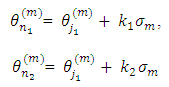 and
and | (3.11) |
 | (3.12) |
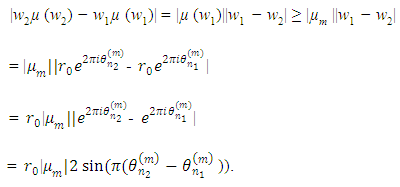 | (3.13) |

 The last inequality implies the last equality of (3.13).Consider Jordan’s inequality
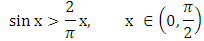 We have

 | (3.14) |
 | (3.15) |
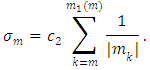 The last equality, inequality (3.15) and the definition of the number m1(m) give
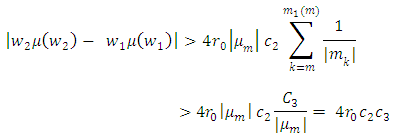 and the properties of our fixed numbers imply 4r0c2c3 > 2c4.It follows that Bw1 ∩ Bw2 = ∅ and the proof of this lemma is complete. By Lemmas 3.2, 3.3 we conclude the following.Corollary 3.1. For every positive integer m with m ≥ m0 the family Dm := {B}∪{Bw : w ∈Pm} consists of pairwise disjoint disks.
 4. Proof of Lemma 2.3
 dense in (H(C), Tu). For simplicity we write
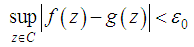
  . Consider fixed g ∈ H(C), a compact set K ⊆ C and
  . We seek f ∈ H(C) and a positive integer
  such that
 | (4.1) |
 | (4.2) |
 | (4.3) |
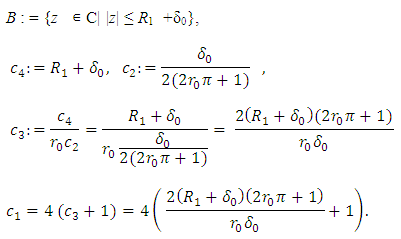 Observe that c3, c4 ∈ (1, +∞) and c2 ∈ (0, 1).After the definition of the above numbers we choose a subsequence (µn) of (λn) such that |µn |, |µn+1 | − |µn | > c1 for n = 1, 2, . . .and
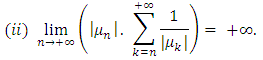 By condition (ii), there exists a positive integer m0 such that for every m ≥ m0
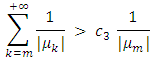 After that, on the basis of the fixed numbers r0, θ0, θT , c1, c2 , c3, c4 and m0, for every positive integer m with m ≥ m0 we define the corresponding partition Pm (see section 3). From now on till the end of the proof of the lemma we fix a positive integer m ≥ m0 with its corresponding partition Pm. For simplicity we writeP := Pm .Then, we define the set L as follows:
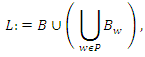 where the discs Bw , w ∈ P, are constructed in Section 3. By Corollary 3.1, the family D : = {B } ∪ {Bw: w ∈ P } consists of pairwise disjoint disks. Therefore the compact set L has connected complement. This property is needed in order to apply Mergelyan’s theorem [30]. We now define the function h on the compact set L, by
 By Mergelyan’s theorem [29] there exists an entire function f (in fact a polynomial) such that
 | (4.4) |
 which implies the desired inequality (4.2).It remains to show (4.1). Let α ∈ A. There exists a unique θ ∈ [θ0, θT ] such that α = r0 e2πiθ . Now there exists unique ρ ∈ {0, 1, . . ., νm − 1} such that:
 and we then define
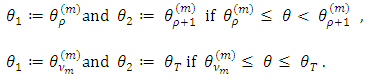 For the above, recall that the definitions of νm and
  ,
,  are defined in Section 3. Set w0: = r0e2πiθ1 ∈ P. We shall prove that for every z ∈ C, |z | ≤ R1 we have z + αµ (w0 ) ∈ Bw0 .
 | (4.5) |
 | (4.6) |
 | (4.7) |
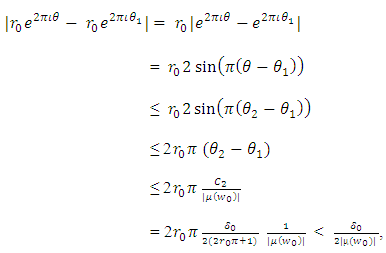 which implies (4.7). So, for every z ∈ C, |z | ≤ R1
  | (4.8) |
 | (4.9) |
 | (4.10) |
 | (4.11) |
 where f ∈ H (C), since f is a polynomial. This implies (4.1) and the proof of the lemma is complete.
 5. Examples of Sequences Λ: = (λn) Satisfying Condition (Σ1)
- In this section we show that our main theorem is not covered by our recent results in [34], [35]. Recall that a sequence of non-zero complex numbers (λn) with |λn| → ∞ satisfies condition (Σ) if:for every M > 0 there exists a subsequence (µn ) of (λn) such that
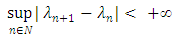

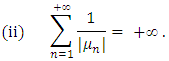 For instance, sequences of linear growth i.e. λn = αn + b, α, b ∈ C, α ≠ 0, n = 1, 2, . . ., satisfy condition (Σ), or sequences (λn), such that
 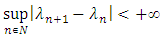 We introduce the following definitions.
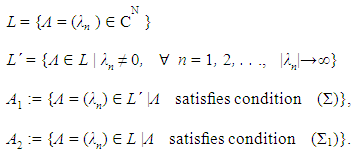 For Λ ∈ L’ , define
 andi(Λ):= inf B (Λ)Clearly,i (Λ) ∈ [1, +∞] for every Λ ∈ L′.Our main results in [34], [35] are the following
 a Gδ and dense subset of (H(C), Tu).
 dense subset of (H(C), Tu).In order to come closer to a complete picture of our investigations we introduce one last class of sequences. SetA4 := {Λ = (λn) ∈ L′|i (Λ) = 1}.Proposition 5.1. A4 ⊂ A2 Proof. Let Λ = (λn ) ∈ A4 and fix a positive number M. By Lemma 7.1 in [34] there exists a subsequence (µn) of (λn) such that |µn+1| − |µn | > M for every n = 1, 2, . . . and |µn+1|/|µn |→1 as n→ + ∞.
 . To this end, let A >0 and consider any positive number ε so that ε < 1/A. Since |µn+1 |/|µn|→1 as n→ + ∞ there exists a positive integer N such that |µn /µn+1 | > 1/(1 + ε) for every n ≥N. Repeated using of the previous inequality gives
 and upon summation we get
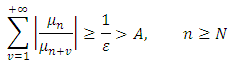 and this completes the proof. From the above we have A1 ∪ A4 ⊂ A2.In view of Theorem 5.1 and in order to completely characterize the sequences
 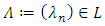 such that the set
  (H(C), Tu) one has to deal with sequences Λ ∈ L for which i (Λ) > 1. This is one of the reasons we introduced the classes A1, A2. Indeed, it is established in [35] that the class A1 contains sequences Λ ∈ L with i (Λ) > 1. On the other hand, there exist sequences Λ ∈ L′ with i (Λ) = 1 and Λ ∉ A1, see [35]. Since,A1 ⊂ A2we conclude that the class A2 contains sequences Λ ∈ L′ with i (Λ) > 1. The above inclusion is strict; for instance, the sequence λn = n2, n = 1, 2, . . ., belongs to A2 but not in A1 . However i ((n2 )) = 1, therefore for this sequence the conclusion of Theorem 5.1 holds and of course in this case the conclusion of Theorem 1.2 is covered by the much stronger Theorem 5.1. So the interest here is to show that there exists Λ ∈ A2\A1 with i (Λ) = M for some positive real number M > 1, and this in turn shows that our main result, Theorem 1.2, is not covered by Theorems 5.1, 5.2. This is the content of the followingProposition 5.2. Fix some M > 1. There exists Λ ∈ A2\A1 such that i (Λ) = M.Proof. We construct inductively a countable family {Fn }, n = 1, 2, . . . of finite sets Fn ⊂ [1, +∞) according to the following rules. Firstly, we fix the sequence


 where with [αn ] we mean the integer part of the real number αn .(i) F1 = {1}.(ii) Fm = {(αm + ν )2| ν = 0, 1, . . ., [αm] + 1} m = 1, 2, . . ..(iii) min Fm+1 = M · max Fm for each m = 1, 2, . . .,
 Fm1 ∩ Fm2 = 0. Set
 We define the sequence Λ = (λn) to be the enumeration of
  by its natural order.
 strictly increasing sequence of positive numbers. We divide the proof into several claims.Claim 1. For every subsequence (µn) of Λ we have
 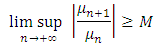 Proof. Let (µn) be a fixed subsequence of Λ. We prove that for every natural number n1 ∈ N, there exists N ∈ N with N ≥ n1 such that
 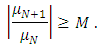 So, fix n1 ∈ N. Let m2 be the unique positive integer such that
  . We set
  . It is obvious that
  . We set
 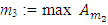 . Then
 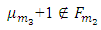 and so
  .
.
 So we proved that for every n ∈ N, there exists some N ≥ n such that

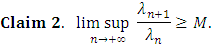

 then by the construction of
  we remark by definition of
  that
that  for some
  ; thus
 | (5.1) |


 | (5.2) |
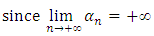 the conclusion follows. This completes the proof of Claim 2.Claims 1 and 2 imply that i(Λ)=M. We now show the following claim.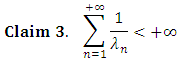

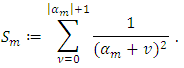

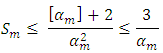 and by noticing that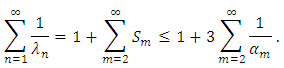
 The above claim shows that
  . We now show our last claimClaim 4.
  Proof. Since previously, we have trivially

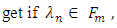
 Finally, since
 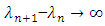 we can deduce that the sequence
  satisfies condition (C). Hence
  and the proof of this proposition is complete. Proposition 5.2 shows that the previous inclusion A1 ∪ A4 ⊂ A2 is strict. So, at the level of a circle the main result of this paper is “strictly” stronger than the union of the main results in [34], [35].
ACKNOWLEDGEMENTS
- I am grateful to George Costakis for his helpful comments and remarks and for all the help he offered me concerning the presentation of this work.