P. N. Habu, I. G. Bassi, F. Attah
Department of Mathematics, Federal University Lafia, Lafia, Nigeria
Correspondence to: P. N. Habu, Department of Mathematics, Federal University Lafia, Lafia, Nigeria.
| Email: |  |
Copyright © 2015 Scientific & Academic Publishing. All Rights Reserved.
Abstract
In the present study, we have attempted to examine various aspects of blood flow in different segments of the circulatory system in a situation where the system has been subjected to an external transverse magnetic field. The equation of motion of the tube, accounted for the elastic response of the arteries of various sizes. The investigation shows that the model considered here is also capable of taking into account the properties affecting the blood flow and hemodynamic features, which may be important for medical doctors to predict diseases for individuals on the basis of the pattern of flow for an elastic artery in the presence of a transverse magnetic field. We derived the “frequency equation” of the flow. It was observed that the roots of the frequency equation also depend on  which is the effect of the applied transverse magnetic field on the entire flow. Therefore, the results presented show that the flow of blood and pressure can be controlled by the application of an external magnetic field across the direction of blood flow.
Keywords:
Magnetic Field, Frequency Equation, Oscillatory flow, Particle-fluid suspension, Periodic function, Artery, Motion of the tube, Hemoglobin, Particle Phase, Fluid Phase
Cite this paper: P. N. Habu, I. G. Bassi, F. Attah, Effect of Magnetic Field in an Oscillatory Flow in Particle-Fluid Suspension through an Elastic Tube: - An Application to Blood Flow in Arteries, American Journal of Mathematics and Statistics, Vol. 5 No. 5, 2015, pp. 306-310. doi: 10.5923/j.ajms.20150505.11.
1. Introduction
Recently, the study of blood flow through arteries has gained serious attention of Mathematicians, Physiologists, and Clinical Persons because blood and blood vessels are substantial health risk factors and can substantially contribute to morbidity and mortality. Blood flow in the human circulatory system depends upon the pumping action of the heart which in turns produces a pressure gradient throughout the system. The rheological properties of blood and the motion of the arterial wall play an important role in the physiology of the cardiovascular system [13].The importance to atherogenesis of arterial flow phenomena such as flow separation, recirculation and stagnation, secondary flow motion, low and oscillatory wall shear stress, and long particle residence times have become more and more evident during the past decades. The hemodynamics of flows through atherosclerotic vessels is of great interest, because these vessels present a substantial health risk and are a major cause of mortality and morbidity in the industrialized world [13]. Since blood consists of a suspension of red blood cells containing haemoglobin which contains iron oxide, it is quite apparent that blood is electrically conducting and exhibits magnetohydrodynamic flow characteristics. Many investigators, have investigated the flow of blood through arteries in the presence of magnetic field under different conditions. The Lorentz force arising out of the flow across the magnetic lines of force acts on the constituent particles of blood and alters the hemodynamic indicators of blood flow. The potential use of such MHD principles in prevention and rational therapy of arterial hypertension was explored by Vardanyan [13], who showed that for steady flow of blood in an artery of circular cross-section, a uniform transverse magnetic field alters the flow rate of blood.Misra. J. C and Chakravarty. S [2], investigated the flow in arteries in the presence of stenosis. The theory of non-Newtonian viscosity of red cell deformation was reported by Murata. T. [4] Flow in tubes and arteries, using a comparison, was investigated by Liepsch D.W. and McDonald D.A [5] and [6], studied blood flow in arteries. Pontrelli G [8], was able to investigate blood flow through an axisymmetric stenosis. Influence of non Newtonian behavior of blood on flow in an elastic artery model was investigated by Dutta A and Torbel J. M. [9]. On the application of a constitutive equation for whole human blood, was reported by Rodkiewicz [10].A constitutive equation for whole human blood was the work done by [11] and [2], they studied the hydromagnetic flow of a second-grade fluid in a channel with some application to physiological systems. In the present study we investigated the effect of magnetic field in an oscillatory flow in particle fluid suspension through an elastic tube. The study pertains to a situation where a magnetic field is applied in a direction transverse to the direction of blood flow in an artery. Such a field has a more pronounced effect on the flow than that in the case of an axial magnetic field. Of specific interest is to determine the roots of the “frequency equation” of the flow and how the magnetic field affects these roots.
2. The Governing Equations
Using [1] and [13], the equations governing conservation of mass and linear momentum for both the fluid and particle phase, and applying a continuum approach, can be expressed as:For the fluid phase, | (1) |
 | (2) |
and with the equation of mass conservation at the fluid phase as | (3) |
For the particulate phase:- | (4) |
 | (5) |
With the mass conservation equation at the particulate phase as  | (6) |
The equations of motion of the tube are [14]  | (7) |
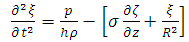 | (8) |
with boundary conditions of (7) and (8) as | (9) |
From equations (1) to (9), we have  as the radial and axial velocities of the fluid phase,
 as the densities of the fluid and particle phases respectively,
 as the dynamic viscosity of the fluid,
 as the volume particle fraction,
 as the electrical conductivity,
 as poisson ratio,
 as the applied magnetic field, S is the drag, ζ is the axial displacement of the tube,
 is the radial displacement of the tube, R is the radius of the tube,
 is the density of the material, h is the thickness of the tube, and
 as the kinematic viscosity.In order to study the oscillatory flow along the axis of the tube we assume [14] that the pressure wave is harmonic in time,
 , having frequency n and wave velocity c. Therefore we also assume that
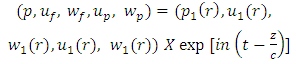 | (10) |
Using eqn (10) and neglecting the inertia terms in eqn (1), (2), (4) and (5) we write eqn (1) as | (11) |
which simplifies to | (12) |
Now, let  | (13) |
and substitute (13) into (12) we get | (14) |
From [1],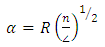 | (15) |
Substitute (15) into (14), we get | (16) |
Similarly using eqn (10) and neglecting inertia terms in eqn (2), eqn (2) simplifies to | (17) |
For equations (16) and (17) the equation of mass conservation (3) now transforms to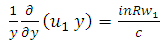 | (18) |
Equations of motion of the fluid (1), (2) and the equation of continuity (3) can now be written as | (19) |
 | (20) |
With the equation of mass conservation as 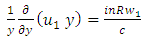 | (21) |
Again equation (4), using (10) gives | (22) |
Using (10) and (5), we get | (23) |
With the mass conservation equation for the particulate phase as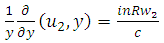 | (24) |
From equations (22) and (23) we can simplify equation (19) and (20). Using (22) and (23), equation (19) becomes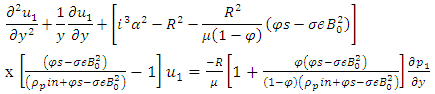 | (25) |
Let | (25a) |
 | (26) |
 equation (25) can be written as
 | (27) |
Equation (27) becomes | (28) |
where  | (29) |
Recall that 
 and

 replace
 with
 in LHS of equation (28), we get
 | (30) |
To solve equation (30), let 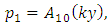 where k is to be determined.
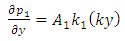 | (31) |
Therefore, equation (30) can be written as | (32) |
Let the particular solution,  , of (32), then
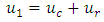 | (33) |
where  is the complementary solution,
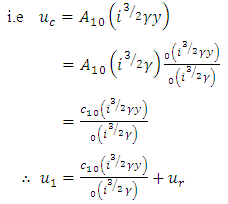 | (34) |
As in [1], where 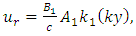 and c will be determined, we have
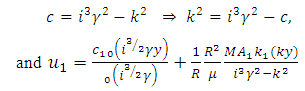 | (35) |
Substitute 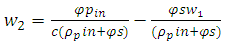 into eqn (20) and simplify, we get
 | (36) |
Equation (36) can be written as 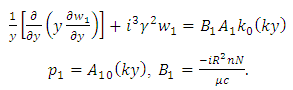 | (37) |
The general solution of (37) is 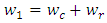 where
 and
 are the complementary and particular solutions respectively.The solution of (32) is
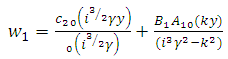 | (38) |
where 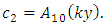 Therefore we have
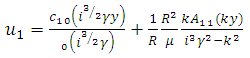 | (39) |
and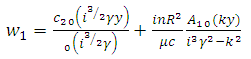 | (40) |
Substitute  and
 into (18) and
 and
 into (23) then
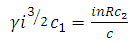 | (41) |
and 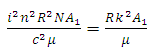 | (42) |
 , so that using
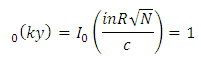 and
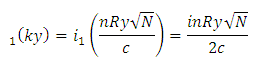 In the expression for the velocity components we get
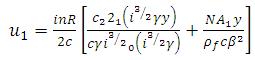 | (42a) |
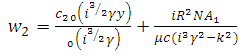 | (43) |
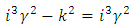 , we have
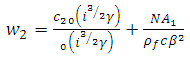 | (44) |
At the inner surface of the tube, equation (42a) can be written as  | (45) |
And eqn (44) as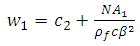 | (46) |
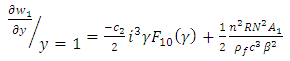 | (47) |
From eqn (7) to (9), let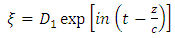 | (48) |
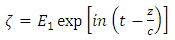 | (49) |
where in (48) and (49)  and
 are arbitrary constants respectively, the boundary conditions
 and
 becomes
 | (50) |
 | (51) |
and 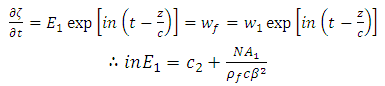 | (52) |
Using eqns (51) and (52), the equations of motion of the tube can be written as | (53) |
and | (54) |
Eqns (51), (52), (53) and (54) are four homogeneous equations in the arbitrary constants  and
 From these four equations we have
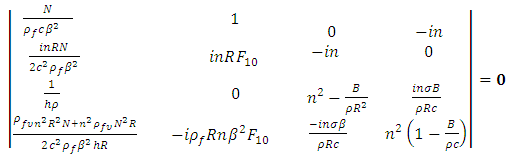 | (55) |
Operating on the columns and row of equation (55) several times we obtain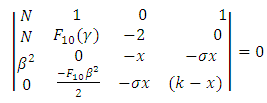 | (56) |
where | (57) |
The solution of (56) is  | (58) |
The roots of (58) are given by where
 | (59) |
and | (60) |
which shows that the roots of the frequency equation, depend on  , the magnetic field of the applied transverse magnetic field across the direction of the blood flow.
3. Conclusions
From the solution, the frequency equation, where the roots are determined by quantities that are also determined by  , which is the effect of the introduced transverse magnetic field. This result clearly demonstrates that the magnetic field has an effect on the flow under consideration. The investigation therefore shows that the instantaneous flow characteristics,
 and
 are significantly affected by the magnetic parameter,
 . The result presented, show that the flow of blood and pressure can be controlled by the application of an external magnetic field. The investigation therefore shows light towards the therapeutic use of the application of external transverse magnetic field in the clinical treatment of homodynamic disease, for example, like hypertension.
ACKNOWLEDGMENTS
The first author is greatful to Dr. Absalom E. Ezugwu of the Department of Computer Science, Federal University Lafia, Nigeria, for introducing the idea of this research.
References
| [1] | Habu, P.N, Mbah, M.A; Oscillatory Flow and Particle Suspension in a Fluid through an Elastic Tube; Journal of Mathematical Theory and Modeling 2013, vol 3, num 11, p 109-114. |
| [2] | Misra. J C; Chakravarty. S; Flow in arteries in the presence of stenosis, J. Biomech, 1986 Vol 19 p907-918. |
| [3] | Copley A. L, Fliud Mechanics and Rheology 1990 Vol 27 p 3-19. |
| [4] | Murata T; Theory of non-Newtonian viscosity of red cell deformation; Biorheology 1983 vol 20 p 471-483. |
| [5] | Liepsch D.W; Flow in tube and arteries: A comparison; Biorheology 1986 Vol. 23 p 395-433. |
| [6] | McDonald D.A; Blood flow in arteries, 2nd ed; London Arnold Publishers, 1974. |
| [7] | Pedley T. J; The fluid mechanics of large blood vessels; Cambrdge University Press, 1980. |
| [8] | Ponrelli G; Blood flow through an axisymmetric stenosis; Proc. Inst. Mech. Eng J. Eng in Medicine 2001 Vol. 215, p 1-10. |
| [9] | Dutta A; Torbel J. M; Influence of non Newtonian behavior of blood on flow in an elastic artery model; J. Biomech Egg 1996, Vol. 118, p 111-119. |
| [10] | Rodkiewicz C. M; Sinha P; Kennedy J. S; On the application of a constitutive equation for whole human blood; J. Biomech Engg 1990, Vol. 112, p 198-206. |
| [11] | Walburn F.J; Schneck D.J; A constitutive equation for whole human blood; Biorheology 1970, Vol. 13, p 201. |
| [12] | Misra J. C, PalB; Gupta A.S; Hydromagnetic flow of a second-grade fluid in a channel:-some application to physiological systems; Math. Models and Methods in Appl. Sci, 1998 Vol 8, p1323-1342. |
| [13] | Misra J.C; Shit G.C; Center for Theoritical studies, Indian Institute of Technology, Kharagpur, India, 2007. |
| [14] | Wormersley, J.R; Oscillatory motion of a viscous liquid in a thin-walled elastic-tube. The linear approximation for long waves, philos. Mag vol46, pp199, 1955. |

 Abstract
 Reference
 Full-Text PDF
 Full-text HTML