
-
Paper Information
- Next Paper
- Previous Paper
- Paper Submission
-
Journal Information
- About This Journal
- Editorial Board
- Current Issue
- Archive
- Author Guidelines
- Contact Us
American Journal of Mathematics and Statistics
p-ISSN: 2162-948X e-ISSN: 2162-8475
2015; 5(5): 272-284
doi:10.5923/j.ajms.20150505.08
Influence of Hall Current and Viscous Dissipation on MHD Convective Heat and Mass Transfer in a Rotating Porous Channel with Joule Heating
 Abstract
 Reference
 Full-Text PDF
 Full-text HTML
Khaled K. Jaber
Department of Mathematics, Faculty of Science and information technology, Zarqa University, Zarqa, Jordan
Correspondence to: Khaled K. Jaber, Department of Mathematics, Faculty of Science and information technology, Zarqa University, Zarqa, Jordan.
| Email: |  |
Copyright © 2015 Scientific & Academic Publishing. All Rights Reserved.
In this paper magneto hydrodynamics free-convective fluid flow in a vertical porous channel rotates with a uniform angular velocity Ω about the axis normal to the plates in the presence of Hall current, viscous dissipation and Joule heating is investigated. The flow is subjected to a strong transverse magnetic field. A constant suction and injection is applied to the two insulating porous plates. The Boussinesq approximation is neglected due to the large temperature differences between the plate and the ambient fluid. Suitable transformations are used to convert the governing system into dimensionless nonlinear partial differential equations that are solved numerically. The effects of magnetic parameter, Grashof number, Eckert number and other involved parameters on the velocity and temperature functions have been studied parametrically. All parameters involved in the problem affect the flow and thermal distributions. Numerical values of the local, skin-friction and the local Nusselt numbers for various parametric conditions have been tabulated.
Keywords: Free convective, Porous channel, Hall current, Viscous dissipation, Joule heating
Cite this paper: Khaled K. Jaber, Influence of Hall Current and Viscous Dissipation on MHD Convective Heat and Mass Transfer in a Rotating Porous Channel with Joule Heating, American Journal of Mathematics and Statistics, Vol. 5 No. 5, 2015, pp. 272-284. doi: 10.5923/j.ajms.20150505.08.
Article Outline
1. Introduction
- Free convection in channel flow has many important applications in designing ventilating and heating of buildings, cooling of electronic components of a nuclear reactor, bed thermal storage, and heat sink in the turbine blades. Convective flows driven by temperature difference of the bounding walls of channels are important in industrial applications. El-Hakiem [1] studied the unsteady MHD oscillatory flow on free convection radiation through a porous medium with a vertical infinite surface that absorbs the fluid with a constant velocity. Jaiswal and Soundalgekar [2] analyzed the effects of suction with oscillating temperature on a flow past an infinite porous plate. Singh et al. [3] studied the unsteady free convective flow in a porous medium bounded by an infinite vertical porous plate in the presence of rotation. Pal and Shivakumara [4] studied the mixed convection heat transfer from a vertical plate in a porous medium.Hydro magnetic convection with heat transfer in a rotating medium has important applications in MHD generators and accelerators design, geophysics, and nuclear power reactors. MHD free convection and mass transfer flows in a rotating system have diverse applications. The effects of Hall currents cannot be neglected as the conducting fluid when it is an ionized gas, and applied field strength is strong then the electron cyclotron frequency (where, and denote the electron charge, the applied magnetic field, and mass of an electron, resp.) exceeds the collision frequency so that the electron makes cyclotron orbit between the collisions which will divert in a direction perpendicular to the magnetic and electric fields directions. Thus, if an electric field is applied perpendicular to the magnetic field then whole current will not pass along the electric field. This phenomena of flow of the electric current across an electric field with magnetic field is known as Hall Effect, and accordingly this current is known as Hall current [5]. The effect of Hall current on MHD flow and heat transfer in rotating channels have many engineering applications in flows of laboratory plasmas, in MHD power generation, in MHD accelerators, and in several astrophysical and geophysical situations. Thus, Hall current effect in parallel plate channels has been investigated by many researchers. Mandal and Mandal [6] and Ghosh [7] investigated effects of Hall current on MHD Couette flow between parallel plates in a rotating system, Gupta [8] has studied the influence of Hall current on steady MHD flow in a viscous fluid. Jana et al. [9] analyzed the Hall Effect in steady flow past an infinite porous flat plate. Makinde and Mhone [10] studied hydro magnetic oscillatory flow through a channel having porous medium. Zhang and Wang [11] analyzed the effect of magnetic field in a power-law fluid over a vertical stretching sheet.The study of heat and mass transfer due to chemical reaction is also very importantsince it occurs in most of the branches of science and technology. The processes involving mass transfer effects are important in chemical processing equipment's which are designed to draw high value products from cheaper raw materials with the involvement of chemical reaction. In many industrial processes, the species undergo some kind of chemical reaction with the ambient fluid which may affect the flow behavior and the production quality of final products. Aboeldahab and Elbarbary [12] examined heat and mass transfer over a vertical plate in the presence of magnetic field and Hall Effect. Abo-Eldahab and El Aziz [13] investigated the Hall current and Joule heating effects on electrically conducting fluid past a semi-infinite plate with strong magnetic field and heat generation/ absorption. Jaber [14] studied the effect of Hall currents, radiation and variable viscosity on free convective flow past a semi-infinite continuously stretching plate, Jaber [15] studied the effect of Hall currents and variable fluid properties on MHD flow past a continuously stretching vertical plate in the presence of radiation. Jaber [16] examined the effects of viscous dissipation and joule heating on MHD flow of a fluid with variable properties past a stretching vertical plate. Viscous dissipation effects plays an important role in natural convection in various devices which are subjected to large variations of gravitational force or which operate at high speeds.The present work is presented to study the viscous dissipation, Joule heating and chemical reaction on the oscillatory heat and mass transfer in a rotating vertical porous channel. The results are tabulated and presented in figures.
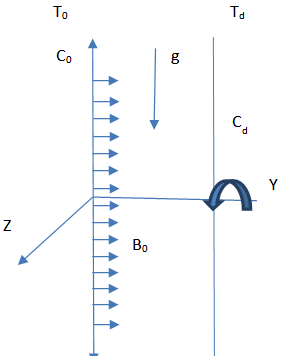 | Figure 1. Physical configuration of the problem |
2. Mathematical Formulation
- Let us consider the steady, two-dimensional, laminar free convective boundary layer flow of an incompressible, electrically conducting, non-gray gas near equilibrium in the optical thin limit, in a porous channel rotates with uniform angular velocity Ω about anaxis normal to the plates, the channel consists of two infinite permeable vertical plates separated by a distance d. A uniform strong magnetic field B0 is applied transverse to the flow. The fluid is injecting at the stationary plate at z = 0 and sucking at the plate z = d with a constant velocity w0. The plate z = d oscillates in its own plate with a velocity U0. Chemical reaction is assumed to be first order. The magnetic Reynolds number is taken to be small enough so that the induced magnetic field can be neglected. The viscous and joule heating are taken into account. The generalized Ohm's law including Hall current is given in the form
 | (1) |
 is the electric current density vector, V is the velocity vector, E is the intensity vector of the electric field, B is the induced magnetic vector, m is the Hall parameter and e is the charge of an electron, ne is the number density of electrons. We also assume that E = 0. The equation of conservation of electric charge is
  , which gives that Jy=constant, this constant is zero since the plate is electrically non-conducting i. e. Jz=0 at the plates. The current density components Jx and Jy are given by
 | (2) |
 | (3) |
 | (4) |
 | (5) |
 | (6) |
 | (7) |
 | (8) |
 and
and  are the coefficients of thermal and solute expansion, Here u and v are the velocity component associated with x and y directions measured along and normal to the vertical plate, respectively; T is the temperature of the fluid in the boundary layer; Td is the temperature far away from the sheet; g is the acceleration due to gravity; CP is the specific heat at constant pressure,
  is the fluid kinematics viscosity;
  is the density; σ is the electrical conductivity; K is the thermal conductivity; and Q is heat generation and(or) absorption coefficient, Dm is the molecular diffusivity.The physical problem suggests the following boundary conditions:
  | (9) |
 | (10) |
 | (11) |
 | (12) |
 | (13) |
 | (14) |
 | (15) |
 | (16) |
 is the Schmidt number,
  is the reaction parameter,
  is the Grashof number,
  is the modified solute Grashof number,
  is the Eckert number,
 is the Hartmann number,
  is the magnetic number,
 is the heat generation parameter,
  is the Prandtl number.The numerical values of
  ,
,  ,
,  ,
,  for Pr=0.72, and several values of the magnetic, Hartmnn, Eckert and others parameters are tabulated in table 1.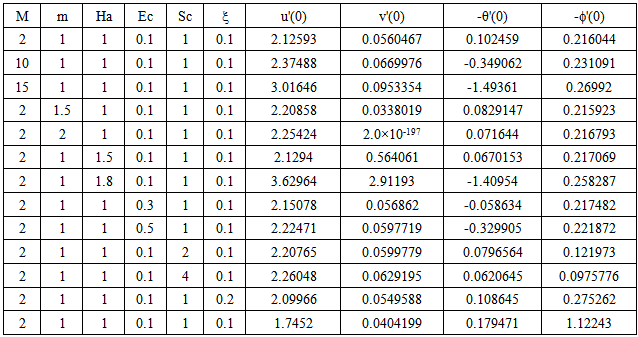
3. Results and Discussion
- The governing boundary layer equations (12)-(15) with boundary conditions (16) are coupled non-linear partial differential equations, which possess no similarity or closed form solution. Therefore, a numerical solution of the problem under consideration using the fourth-order Runge-Kutta method is needed. Numerical results which illustrate the effects of all involved physical parameters of the present problem on the flow and heat and masstransfer aspects within the boundary layer for Pr = 0.72 and Gr = 0.5 are presented in figures.Figs. 2 and 3 express that the increasing of the Eckert no. decreases the primary and secondary flow velocities while fig. 4 shows that the increases the temperature profile adjacent to the boundary layer of the lower plate. The increasing in the Grashof no. Gr and modified Grashof no. Gm tends to increase the primary and secondary flow velocities and temperature as shown in figs. 5 – 10. The change in Hall parameter values slightly affect the heat and mass transfer so no figs. for this variable is presented herein, on the other hand fig. 11 illustrates that the increasing in Hall parameter increases the primary flow velocity while fig 12 shows that the Hall parameter has a strong opposite effect on secondary flow velocity. The increasing in the Hartmann no. increases the primary and secondary flow velocity as shown in figs. 13 and 14, also increases the temperature as shown in fig. 15. Figs. 16-18 show the effects of the magnetic parameter M on the velocity and temperature profiles within the boundary layer. It is noticed that the increasing of the magnetic field parameter M decreases the velocities and increases the temperature. In general, application of a transverse magnetic field normal to the flow direction has a tendency to induce a flow-resistive force in the x-direction. This force tends to slow down the motion of the fluid upwards along the plate. Accordingly, increases the temperature in the boundary layer. Figures 19 -21 demonstrate that the increasing in the Schmidt number tends to increase the temperature and velocities of the fluid. The increasing in the reaction parameter has a clear impact in increasing velocities and mass transfer profiles as shown in Figures 22- 24.
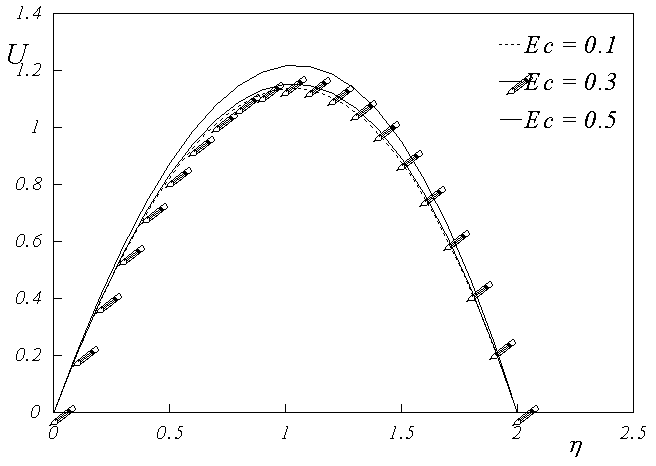 | Figure 2. Effect of Ec on the primary flow velocity profiles U with M = 2, m = Ha = Sc = 1, ξ = Qh =0.1, and G r = Gm = 2 |
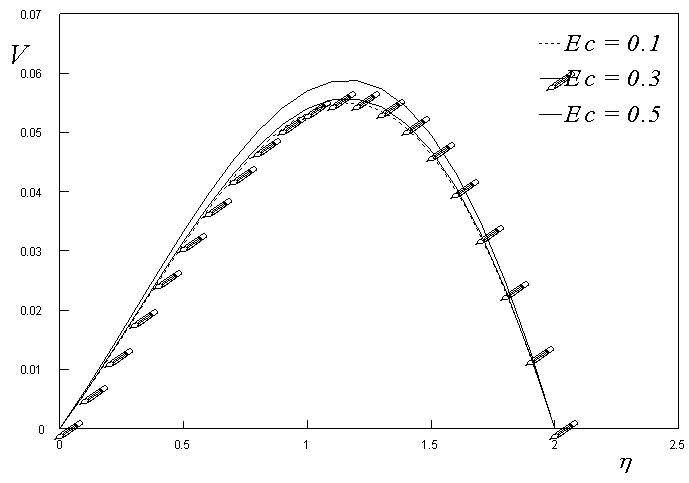 | Figure 3. Effect of Ec on the secondary flow velocity profiles V with M = 2, m = Ha = Sc=1, ξ = Qh =0.1, and G r = Gm = 2 |
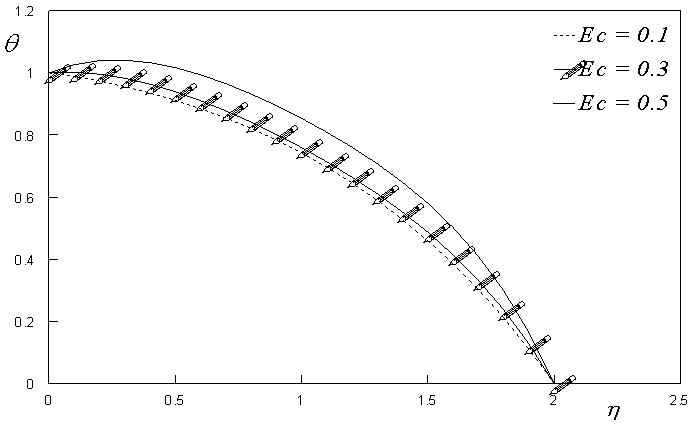 | Figure 4. Effect of Ec on the temperature transfer profiles with M = 2, m = Ha =Sc=1, ξ = Qh =0.1, and G r= Gm = 2 |
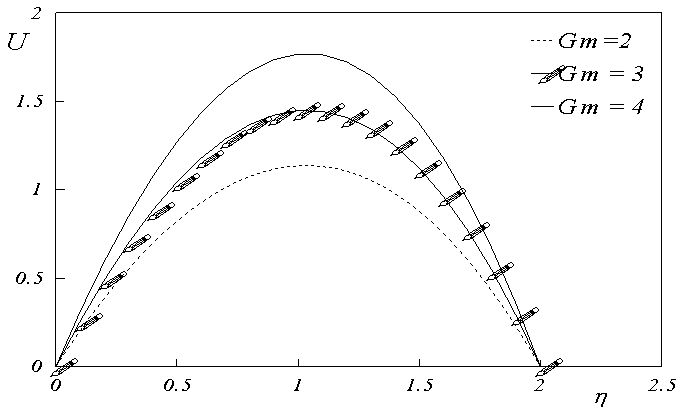 | Figure 5. Effect of Gm on the primary flow velocity profiles U with M = 2, m = Ha= Ec =Sc=1, ξ = Qh =0.1, and G r = 2 |
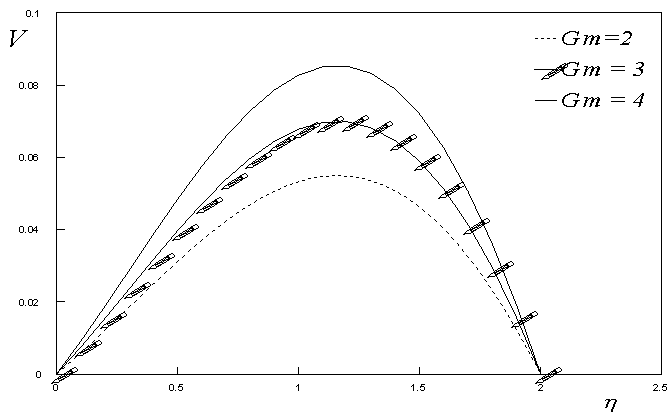 | Figure 6. Effect of Gm on the secondary flow velocity profiles V with M = 2, m = Ha = Ec = Sc=1, ξ = Qh =0.1, and G r = 2 |
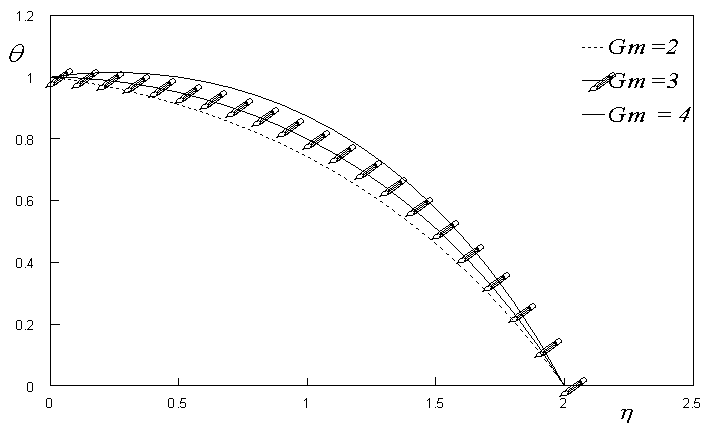 | Figure 7. Effect of Gm on the temperature profile M = 2, m = Ha= Ec = Sc = 1, ξ = Qh = 0.1, and G r = 2 |
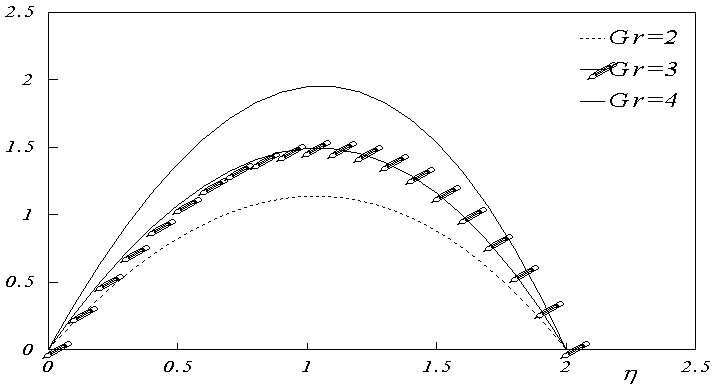 | Figure 8. Effect of Gr on the primary flow velocity profiles U with M = 2, m = Ha= Ec =Sc=1, ξ = Qh =0.1, and G m = 2 |
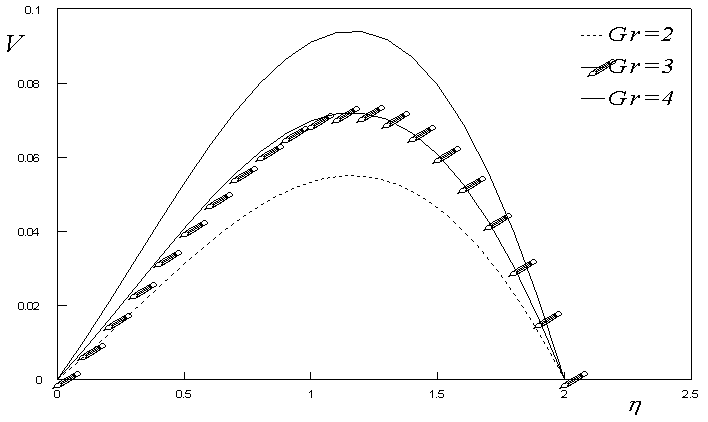 | Figure 9. Effect of Gr on the secondary flow velocity profiles V with M = 2, m = Ha= Ec =Sc=1, ξ = Qh =0.1, and G m = 2 |
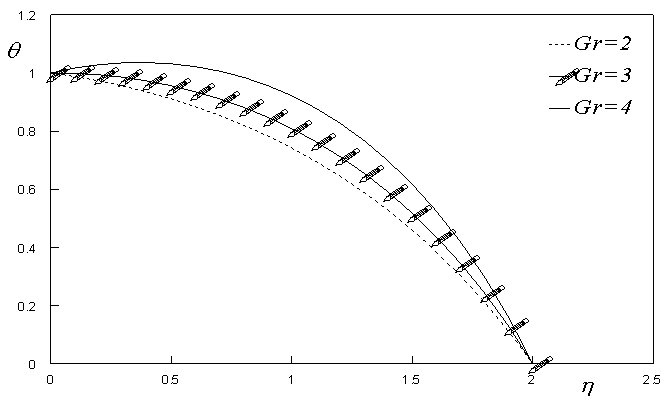 | Figure 10. Effect of Gr on the temperature transfer profiles with M = 2, m = Ha= Ec =Sc=1, ξ = Qh =0.1, and G m = 2 |
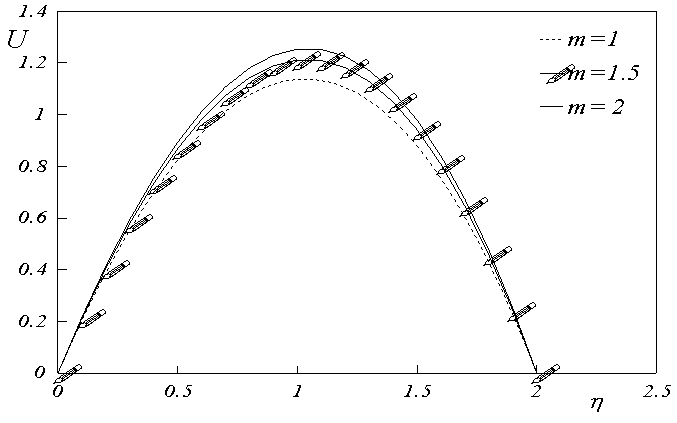 | Figure 11. Effect of m on the primary flow velocity profiles U with M = 2, Ha =Sc=1, ξ = Qh = Ec =0.1, and G r= Gm = 2 |
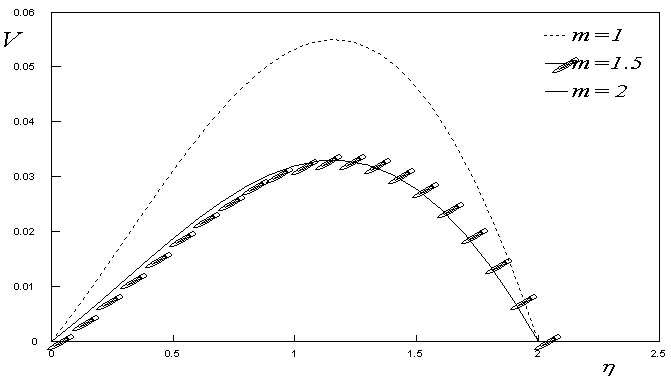 | Figure 12. Effect of m on the secondary flow velocity profiles V with M = 2, Ha =Sc=1, ξ = Qh = Ec =0.1, and G r= Gm = 2 |
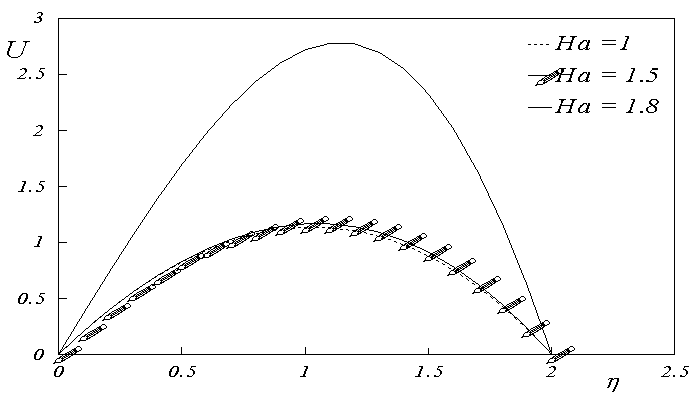 | Figure 13. Effect of Ha on the primary flow velocity profiles U with M = 2, m = Sc=1, ξ = Qh = Ec =0.1, and G r= Gm = 2 |
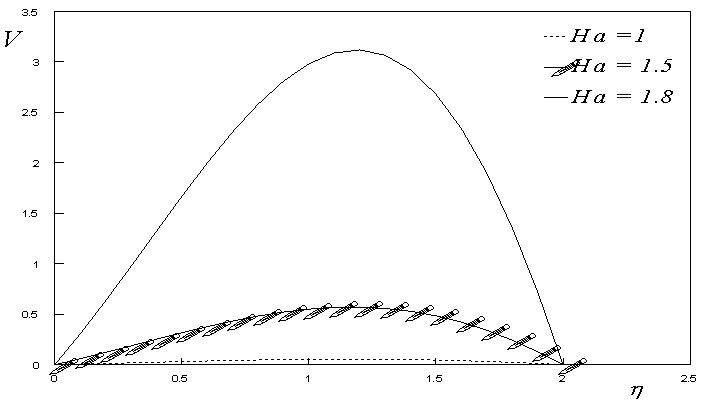 | Figure 14. Effect of Ha on the secondary flow velocity profiles V with M = 2, m = Sc=1, ξ = Qh = Ec =0.1, and G r= Gm = 2 |
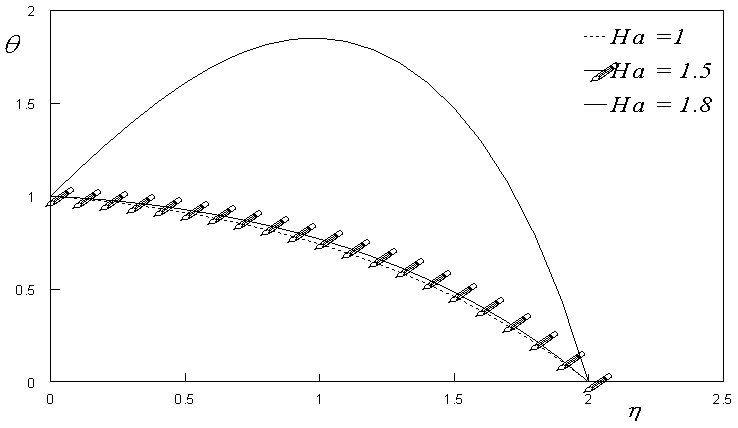 | Figure 15. Effect of Ha on the temperature transfer profiles with M = 2, m = Sc=1, ξ = Qh = Ec =0.1, and G r= Gm = 2 |
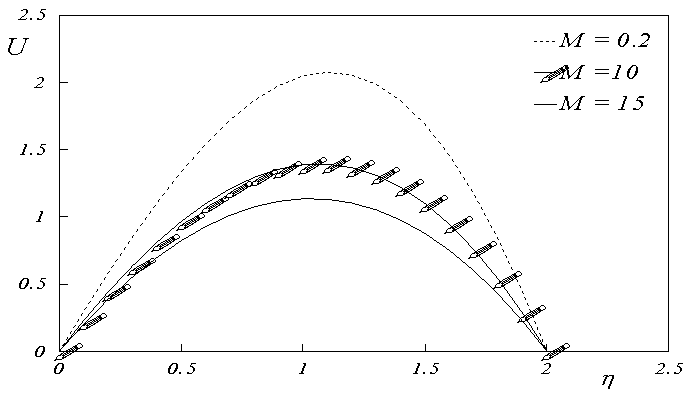 | Figure 16. Effect of M on the primary flow velocity profiles U with Ha = m = Sc =1, ξ = Qh = Ec =0.1, and G r= Gm = 2 |
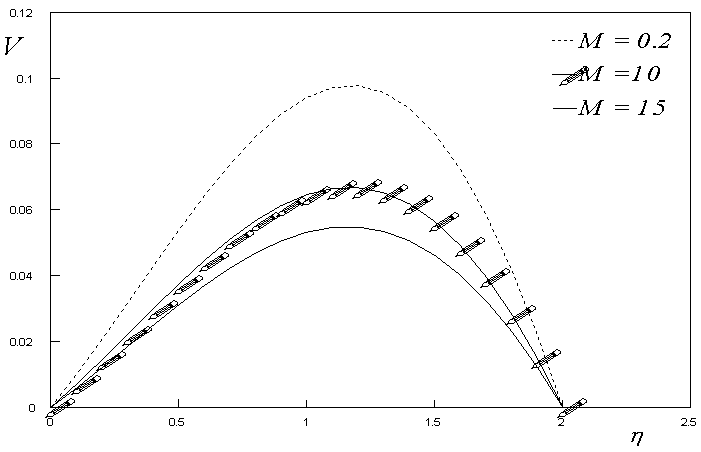 | Figure 17. Effect of M on the secondary flow velocity profiles V with Ha = m = Sc =1, ξ = Qh = Ec =0.1, and G r= Gm = 2 |
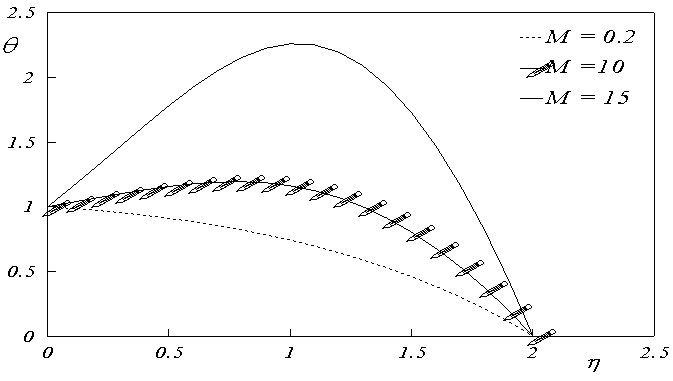 | Figure 18. Effect of M on the temperature transfer profiles with Ha = m = Sc =1, ξ = Qh = Ec =0.1, and G r= Gm = 2 |
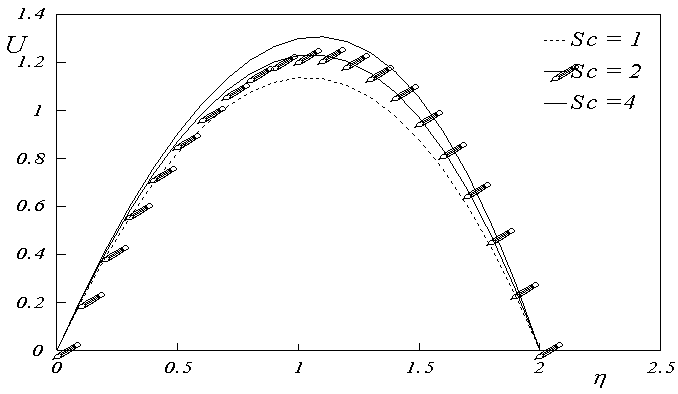 | Figure 19. Effect of Sc on the primary flow velocity profiles U with M = 2, Ha = m =1, ξ = Ec = Qh = 0.1, and G r= Gm = 2 |
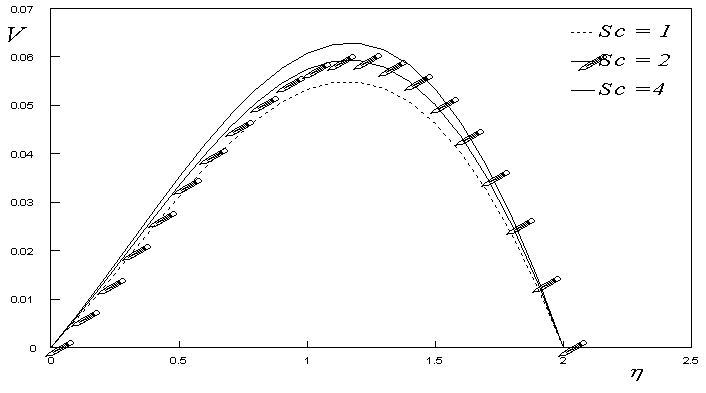 | Figure 20. Effect of Sc on the secondary flow velocity profiles V with M = 2, Ha = m =1, ξ = Ec = Qh = 0.1, and G r= Gm = 2 |
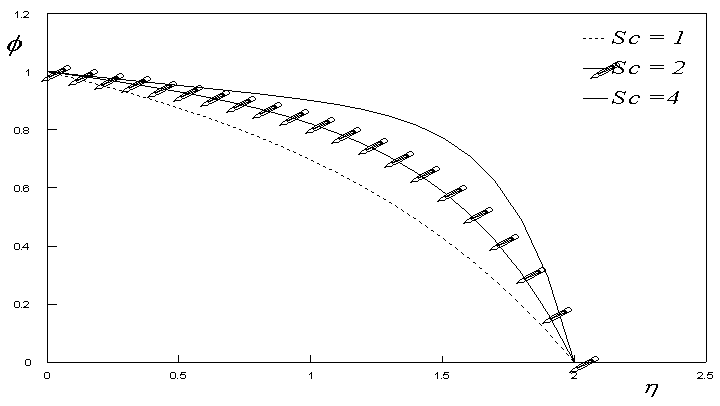 | Figure 21. Effect of Sc on the mass transfer profiles with M = 2, Ha = m =1, ξ = Ec = Qh = 0.1, and G r= Gm = 2 |
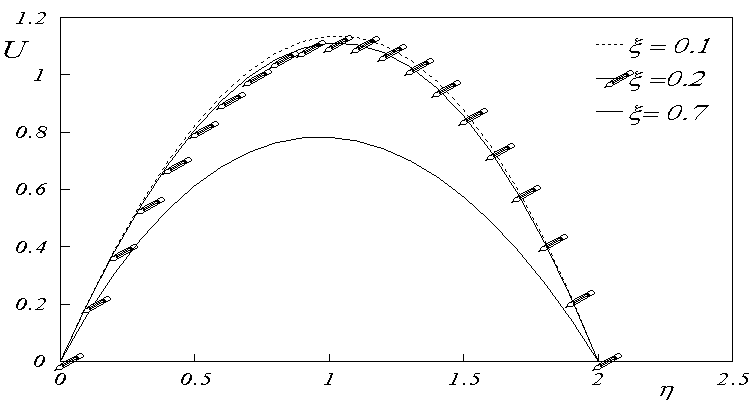 | Figure 22. Effect of on the primary flow velocity profiles U with M = 2, Ec = Ha = m =1, Ec = Qh = 0.1, and G r= Gm = 2 |
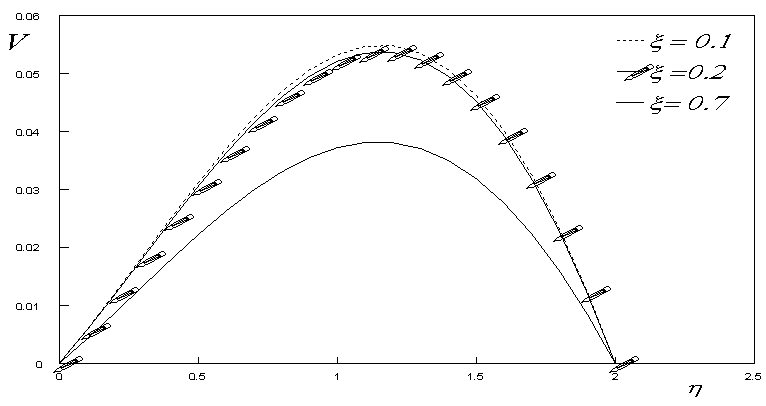 | Figure 23. Effect of on the secondary flow velocity profiles V with M = 2, Ec = Ha = m =1, Ec = Qh = 0.1, and G r= Gm = 2 |
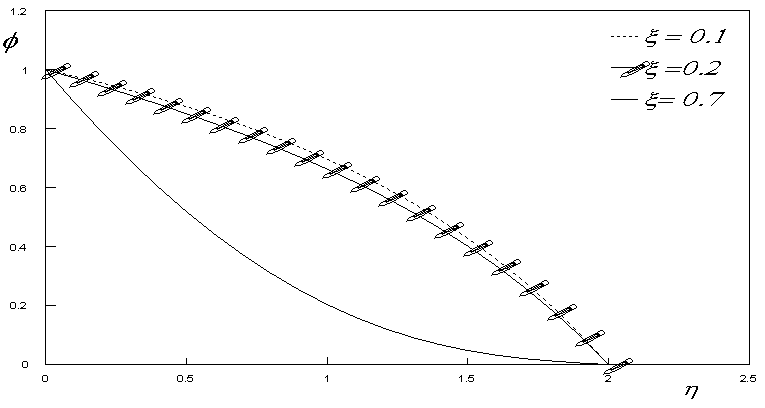 | Figure 24. Effect of on the mass transfer profiles with M = 2, Ec = Ha = m =1, Ec = Qh = 0.1, and G r= Gm = 2 |
4. Concluding Remarks
- In the present research the influence of Hall currentand Viscous dissipation on MHD free-convective heat and mass transfer in a rotating porous Channel with Joule Heating for high temperature differences is investigated. The fluid is assumed to be electrically conducting flowing in a rotating channel consists of two isothermal infinite parallel plates where the distance between the two plates is d. The governing equations are transformed into non-similar partial differential equations that solved numerically. Results are presented graphically for various values of the magnetic field M, Hall parameter m, Hatmann no. Ha, the Eckert no. Ec, Schmidt no. Sc, Grashof no. Gr, modified Grashof no. Gm and reaction parameter .The present study shows that:The local skin friction in the secondary flow has its absolute maximum value at m = 1 vanishes as m = 0 and approaches zero as m → ∞ 1. Increasing the magnetic no., Eckert no., Grashof no., modified Grashof no., Hartmann no. and Schmidt no. increase the velocity components u and v, shear stress components and wall-temperature and wall- mass gradients.2. Increasing in the distance between the two plates decreases the primary and secondary flow velocities.3. Increasing the reaction parameter decreases both components of velocity, wall temperature gradient and wall mass gradient.4. The shear stress in the secondary flow has its absolute maximum value at m = 1 vanishes as m = 0 and approaches zero as m → ∞, also increasing of Hall parameter m tends to increase the primary velocity component and to decrease the secondary velocity component.5. Both components of the shear stress are decreased while the wall-temperature and wall- mass gradients are decreased by increasing the reaction parameter .6. As M, m, Ha and Scnumbers increased, the wall-temperature gradient increased.7. The wall – mass gradient increased as Schmidt no. increased, while M, m, Ha, Ec and reaction parameter have an opposite effect.
ACKNOWLEDGMENTS
- The authors is grateful to Zarqa University, Zarqa, Jordan for providing financial support.
References
| [1] | M. A. El-Hakiem, “MHD oscillatory flow on free convectionradiation through a porous medium with constant suction velocity,” Journal of Magnetism and Magnetic Materials, vol. 220, no. 2-3, pp. 271–276, 2000. |
| [2] | B. S. Jaiswal and V. M. Soundalgekar, “Oscillating plate temperature effects on a flow past an infinite vertical porous plate with constant suction and embedded in a porous medium,” Heat and Mass Transfer, vol. 37, no. 2-3, pp. 125–131, 2001. |
| [3] | K. D. Singh, M. G. Gorla, and H. Raj, “A periodic solution of oscillatory couette flow through porous medium in rotating system,” Indian Journal of Pure and Applied Mathematics, vol. 36, no. 3, pp. 151–159, 2005. |
| [4] | D. Pal and I. S. Shivakumara, “Mixed convection heat transfer from a vertical heated plate embedded in a sparsely packed porous medium,” International Journal of Applied Mechanics and Engineering, vol. 11, no. 4, pp. 929–939, 2006. |
| [5] | T. G. Cowling, Magnetohydrodynamics, Interscience Publishers, New York, NY, USA, 1957. |
| [6] | Mandal, G. and Mandal, K.K., “Effect of Hall Current on MHD Couette Flow between Thick Arbitrarily Conducting Plates in a Rotating System”, J. Physical Soc. Japan, 52, 470-477, 1983. |
| [7] | Ghosh, S.K., B´eg, O.A. and Narahari, M., “Hall Effects on MHD Flow in a Rotating System with Heat Transfer Characteristics”, Meccanica, DOI10.1007/s11012-009-9210-6, Published Online: 2009. |
| [8] | A. S. Gupta, “Hydromagnetic flow past a porous flat plate with hall effects,” Acta Mechanica, vol. 22, no. 3-4, pp. 281–287, 1975. |
| [9] | R. N. Jana, A. S. Gupta, and N. Datta, “Hall effects on the hydro magnetic flow past an infinite porous flat plate,” Journal of the Physical Society of Japan, vol. 43, no. 5, pp. 1767–1772, 1977. |
| [10] | O. D. Makinde and P. Y. Mhone, “Heat transfer to MHD oscillatory flow in a channel filled with porous medium,” Romanian Journal of Physics, vol. 50, pp. 931–938, 2005. |
| [11] | Z. Zhang and J. Wang, “On the similarity solutions of magnetohydrodynamic flows of power-law fluids over a stretching sheet,” Journal of Mathematical Analysis and Applications, vol. 330, no. 1, pp. 207–220, 2007. |
| [12] | E. M. Aboeldahab and E. M. E. Elbarbary, “Hall current effect on magnetohydrodynamic free-convection flow past a semi-infinite vertical plate with mass transfer,” International Journal of Engineering Science, vol. 39, no. 14, pp. 1641–1652, 2001. |
| [13] | E. M. Abo-Eldahab and M. A. El Aziz, “Viscous dissipation and Joule heating effects on MHD-free convection from a vertical plate with power-law variation in surface temperature in the presence of Hall and ion-slip currents,” Applied Mathematical Modelling, vol. 29, no. 6, pp. 579–595, 2005. |
| [14] | Jaber K. K., “Combined effects of Hall current and variable Viscosity on Non-Newtonian MHD flow past a stretching vertical plate”, Journal of Advances in Mathematics, Vol. 7, No.3 (2014). |
| [15] | Jaber K. K., “Effect of Hall currents and variable fluid properties on MHD flow past stretching vertical plate by the presence of radiation”, Journal of Applied Mathematics and Physics, 2, 888-902 (2014). |
| [16] | Jaber K. K.,” Effect of viscous dissipation and Joule heating on MHD flow of a fluid with variable properties past a stretching vertical plate” European Scientific Journal , vol.10, No.33, (2014). |