S. K. Chhillar, A. K. Barak, S. C. Malik
Department of Statistics, M. D. University, Rohtak, 124001, Haryana, India
Correspondence to: A. K. Barak, Department of Statistics, M. D. University, Rohtak, 124001, Haryana, India.
| Email: |  |
Copyright © 2012 Scientific & Academic Publishing. All Rights Reserved.
Abstract
This paper has been designed with an object to determine reliability measures of a parallel system of two identical units with priority to maintenance over repair subject to random shocks. The unit has a direct failure from normal mode. There is a single server who visits the system immediately to perform maintenance and repair of the system. The unit undergoes for maintenance if it is affected by the impact of shocks while repair of the unit is done if it fails due to the reasons other than shocks. The unit works as new after maintenance and repair. Priority is given to maintenance of the shocked unit over repair of the failed unit. All random variables are statistically independent. The shock and failure times of the unit are exponentially distributed where as the distributions of maintenance and repair times are taken as arbitrary with different probability density functions. The expressions for some important measures of system effectiveness are obtained in steady state using semi-Markov process and regenerative point technique. Giving particular values to various parameters and costs, the results for MTSF, availability and profit function are obtained to depict their graphical behavior with respect to shock rate.
Keywords:
Parallel System, Random Shocks, Maintenance, Repair, Priority and Reliability Measures
Cite this paper: S. K. Chhillar, A. K. Barak, S. C. Malik, Analysis of a Parallel System with Priority to Maintenance over Repair Subject to Random Shocks, American Journal of Mathematics and Statistics, Vol. 3 No. 5, 2013, pp. 258-264. doi: 10.5923/j.ajms.20130305.02.
1. Introduction
It is a common knowledge that frequency of failure of repairable systems can be reduced up to a desired extent by the method of redundancy. Therefore, parallel unit systems have attracted the attention of many researchers and reliability engineers due to their wide applications in modern appliances. Kishan and Kumar[1] and Kadyan et al.[2] discussed two unit parallel systems with different repair policies. They assumed that failures in the system occur only due to wear out and mechanical reasons. But there are many systems which may fail due to random shock attacking during service life. The performance of such systems can be improved by providing proper repair facilities, method of redundancy and giving priority in repair disciplines. Chhillar and Malik[3] analyzed a cold standby system with priority to maintenance over repair subject to random shocks. The effect of priority in repair disciplines on the performance measures of parallel systems operating under random shocks have not been examined by the researchers so far in the subject of reliability. The focus of the present study is on the reliability modeling of a parallel system of two identical units with priority in repair disciplines subject to random shocks. Each unit fails completely directly from normal mode. There is a single server who visits the system immediately to perform maintenance and repair of the system. The unit undergoes for maintenance if it is affected by the impact of shocks while repair of the unit is done if it fails due to the reasons other than shocks. The maintenance and repair of the unit are perfect. Priority is given to maintenance of the shocked unit over repair of the failed unit. The shock and failure times of the unit are exponentially distributed where as the distributions of maintenance and repair times are taken as arbitrary. Various reliability indices including transition probabilities, mean sojourn times, mean time to system failure (MTSF), availability, busy period of the server due to repair and maintenance, expected number of maintenance and repair and profit function are evaluated in steady state using semi-Markov process and regenerative point technique. The graphical behavior of MTSF, availability and profit has been observed with respect to shock rate for fixed values of other parameters.
2. Notations
E : Set of regenerative states. O : The unit is operative and in normal mode. p0 : The probability that shock is effective.q0 : The probability that shock is not effective.µ : Constant rate of the occurrence of a shock.λ : Constant failure rate of the unit.m(t)/M(t) : pdf / cdf of maintenance time of the unit after the effect of a shock. FUr/FWr/FUR : The Unit is completely failed and under repair / waiting for repair/ under continuous repair from previous state SUm/SUM : Shocked unit under maintenance and under maintenance continuously from previous state SWm : Shocked unit waiting for maintenanceg (t) / G (t) : pdf / cdf of repair time of the completely failed unitqij(t) / Qij(t) : pdf and cdf of direct transition time from a regenerative state i to a regenerative state j without visiting any other regenerative state qij.k(t) / Qij.k(t) : pdf and cdf of first passage time from a regenerative state i to a regenerative state j or to a failed state j visiting state k once in (0,t]. Mi(t) : Probability that the system is up initially in state Si E is up at time t without visiting to any other regenerative state.Wi(t) : Probability that the server is busy in state Si up to time t without making transition to any other regenerative state or returning to the same via one or more non regenerative states.mij : Contribution to mean sojourn time in state Si when system transits directly to state Sj (Si,Sj E) so that  Where
Where 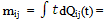 - qij*/(0) and µi is the mean sojourn time in state Si E (s) / © : Symbol for Stieltjes convolution / Laplace convolution. ~ / * : Symbol for Laplace Stieltjes Transform (LST) / Laplace Transform (LT)./ (desh) : Symbol for derivative of the function.The following are the possible transition states of the system S0 = (O, O), S1 = (O,SUm), S2 = (SUM, SWm), S3=(O,FUr) S4 =(FWr, SUm), S5= (FUR, FWr) and S6= (SUM, FWr), The transition states S0 , S1, S3 and S4 are regenerative and states S2, S5 and S6 are non regenerative as shown in figure 1.
 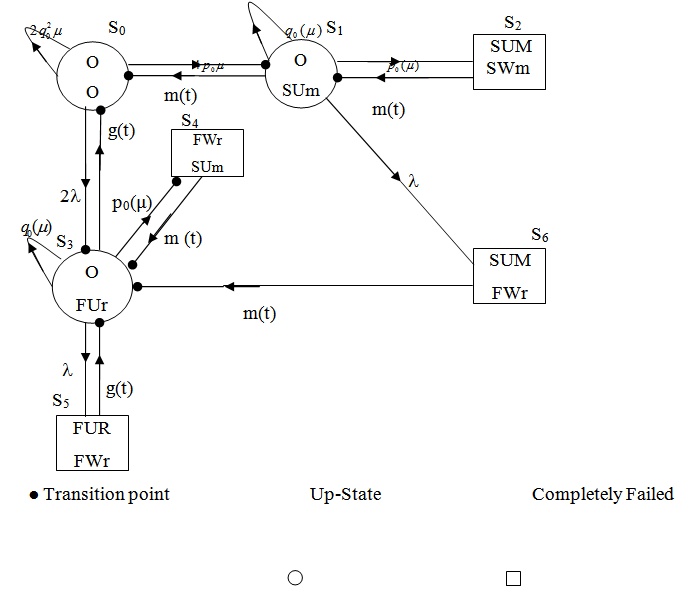 | Figure 1. Transition State Diagram |
3. Transition Probabilities and Mean Sojourn Times
Simple probabilistic considerations yield the following expressions for the non-zero elements as
as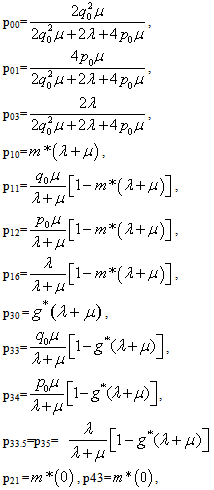
 | (1) |
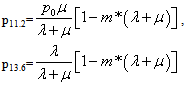 It can be easily verified that
 | (2) |
The mean sojourn times (i) in the state Si are 
 and
and | (3) |


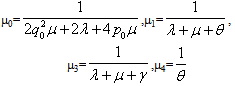 | (4) |
and  | (5) |
4. Reliability and Mean Time to System Faliure (Mtsf)
Let  i(t) be the cdf of first passage time from regenerative state i to a failed state. Regarding the failed state as absorbing state, we have the following recursive relations for
  i(t):
i(t): | (6) |
Taking L.S.T of above relations (5.6) and solving for 
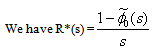 | (7) |
The reliability of the system model can be obtained by taking Laplace inverse transform of (7). The mean time to system failure (MTSF) is given by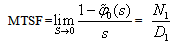 | (8) |
WhereN1 = μ0 (1-p11) (1-p33) + μ1p01(1-p33) + μ3p03(1-p11)andD1 = (1-p00)(1-p11)(1-p33)-p01 p10(1-p33)-p03 p30(1-p11)
5. Steady State Availability
Let Ai (t) be the probability that the system is in up-state at instant‘t’ given that the system entered regenerative state i at t = 0.The recursive relations for Ai (t) are given as  | (9) |
Where Mi(t) is the probability that the system is up initially in state  is up at time t without visiting to any other regenerative state, we have
 | (10) |
Taking L.T. of above relations (10) and solving for . The steady state availability is given by
 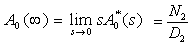 Where
Where and
and | (11) |
6. Busy Period Analysis of the Server
6.1. Due to Repair
Let BRi(t) be the probability that the server is busy in repair of failed system at instant t given that the system entered regenerative state i at t = 0. The recursive relations for BRi(t) are as follows:
 | (12) |
Where  Now taking L.T. of relations (12) and obtain the value of BR0*(s). The time for which server is busy in steady state is given by
 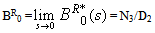 WhereN3 =[p01 p13.6+p03(1-p11.2-p11)]
  and D2 is already defined.
6.2. Due to Maintenance
Let BMi(t) be the probability that the server is busy in maintenance of the system at instant t given that the system entered regenerative state i at t = 0.The recursive relation for BMi(t) are as follows: | (13) |
Where  Now taking L.T. of relations (13) and solving for BM0*(s). The time for which server is busy in steady state is given by
  Where
Where and D2 is already defined.
7. Expected Number of Maintenance of the Shocked Unit
Let NMi(t) be the expected number of maintenance by the server in (0,t] given that the system entered in the regenerative state i at t=0. The recursive relations for NMi(t) are given as  | (14) |
Now taking L.S.T. of relations (14) and solving for NM0*(s). 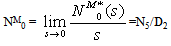 WhereN5=-p01(p10+p11.2+p13.6)[p34p43-(1-p33-p33.5)]+p34p43[p01p13.6+p03(1-p11.2-p11)] and D2 is already defined.
8. Expected Number of Repairs
Let NRi(t) be the expected number of repairs by the server in (0,t] given that the system entered in the regenerative state i at t=0. The recursive relations for NRi(t) are given as  | (15) |
Now taking L.S.T. of relations (15) and solving for NR0*(s). 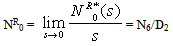 WhereN6 = (p30+p33.5)[p03(1- p11- p11.2)+p10p13.6] and D2 is already defined.
9. Profit Analisis
The profit incurred to the system model in steady state can be obtained as | (16) |
WhereK0 = Revenue per unit up-time of the systemK1 = Cost per unit time for which server is busy due to maintenance.K2 = Cost per unit time for which server is busy due to repair.K3 = Cost per unit maintenance. K4 = Cost per unit repair. K5 = Fixed cost of the server and  are already defined.
10. Particular Case
 We can obtain the following results
  Busy period due to repair
  Busy period due to maintenance
  Expected number of maintenance
 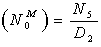 Expected number of repair
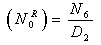 | (17) |
Where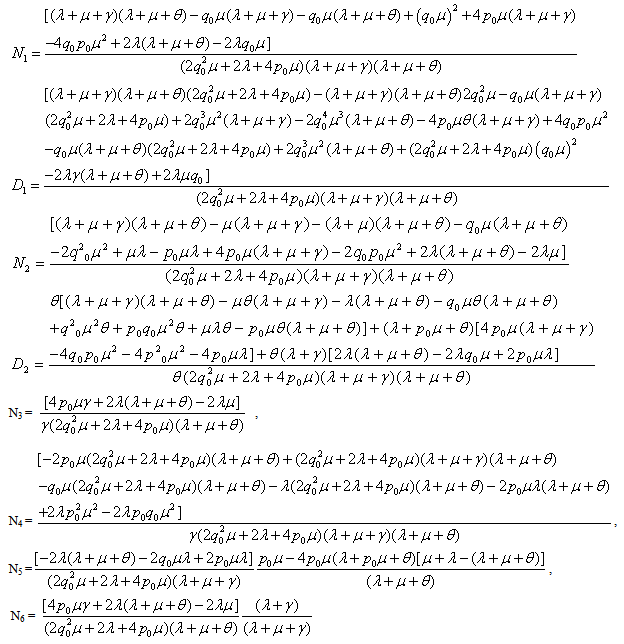
11. Conclusions
 | Figure 2. MTSF Vs. Shock Rate |
 | Figure 3. Availability Vs. Shock Rate |
 | Figure 4. Profit Vs. Shock Rate |
For the particular case 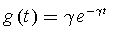 and
and 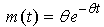 some important reliability measures are obtained giving particular values to various parameters and costs. The behavior of MTSF, availability and profit with respect to shock rate (µ) have been observed as shown respectively in figures 2, 3 and 4. It is observed that MTSF declines rapidly with the increase of shock rate (µ) and failure rate (λ). Again, if we increase repair and maintenance rates, the value of MTSF becomes more. Figures 3 and 4, highlight that availability and profit go on decreasing with the increase of shock rate (µ) and failure rate (λ). But, their values become more with the increase of maintenance and repair rates. Finally, it is concluded that the concept of priority to maintenance of the shocked unit over repair of the failed unit is not much economically beneficial in a parallel system. However, this concept is useful in case of a cold stand by system Chhillar and Malik[2].
References
| [1] | Kishan, R. and Kumar, M. (2009) : Stochastic analysis of a two-unit parallel system with preventive maintenance. Journal of Reliability and Statistical Studies, Vol. 2(2),pp. 31-38. |
| [2] | Kadyan, M.S., Malik, S.C. and Kumar, J. (2010): Stochastic analysis of a two-unit parallel system subject to degradation and inspection for feasibility of repair. Journal of Mathematics and System Sciences, vol. 6(1), pp. 5-13. |
| [3] | Chhillar, S.K. and Malik, S.C. (2013): Reliability measures of a standby system with priority to maintenance over repair subject to random shocks. International Journal of Mathematical Science and Engg. Applications, Vol. 7(III), pp.89-100. |

 Abstract
 Reference
 Full-Text PDF
 Full-text HTML