
-
Paper Information
- Next Paper
- Paper Submission
-
Journal Information
- About This Journal
- Editorial Board
- Current Issue
- Archive
- Author Guidelines
- Contact Us
American Journal of Mathematics and Statistics
p-ISSN: 2162-948X e-ISSN: 2162-8475
2013; 3(5): 253-257
doi:10.5923/j.ajms.20130305.01
New Sequence Spaces of Fuzzy Numbers Defined by a Orlicz Function
 Abstract
 Reference
 Full-Text PDF
 Full-text HTML
Kuldip Raj, Sunil K. Sharma, Ajay K. Sharma
School of Mathematics Shri Mata Vaishno Devi University Katra-182320, J&k, India
Correspondence to: Ajay K. Sharma, School of Mathematics Shri Mata Vaishno Devi University Katra-182320, J&k, India.
| Email: |  |
Copyright © 2012 Scientific & Academic Publishing. All Rights Reserved.
In the present paper we introduce new sequence spaces of fuzzy numbers defined by a Orlicz function. We also make an effort to study some topological properties and some inclusion relation beween these spaces.
Keywords: Fuzzy Number, Orlicz Function, Sequence Space
Cite this paper: Kuldip Raj, Sunil K. Sharma, Ajay K. Sharma, New Sequence Spaces of Fuzzy Numbers Defined by a Orlicz Function, American Journal of Mathematics and Statistics, Vol. 3 No. 5, 2013, pp. 253-257. doi: 10.5923/j.ajms.20130305.01.
1. Introduction and Preliminaries
- Fuzzy sets theory compared to other mathematical theories, is perhaps the most easily adaptable theory to practice. The main reason is that a fuzzy set has the property of relativity, variability and inexactness in the definition of its elements. Instead of defining an entity in calculus by assuming that its role is exactly known, we can use fuzzy sets to define the same entity by allowing possible deviations and inexactness in its role. This representation suits well the uncertainities encountered in practical life, which make fuzzy sets a valuable mathematical tool. The concepts of fuzzy sets and fuzzy set operations were first introduced by Zadeh [17] and subsequently several authors have discussed various aspects of the theory and applications of fuzzy sets such as fuzzy topological spaces, similarity relations and fuzzy orderings, fuzzy measures of fuzzy events, fuzzy mathematical programming etc. Matloka [5] introduced bounded and convergent sequences of fuzzy numbers and studied some of their properties. For details about sequence spaces (see [1], [2], [3], [9], [10], [11], [12], [13], [15], [16]) and references therein.An Orlicz function
 is a function, which is continuous, non-decreasing and convex with
  for
for  and
and  .Lindenstrauss and Tzafriri [4] used the idea of Orlicz function to define the following sequence space. Let
  be the space of all real or complex sequences
  thenWhich is called as an Orlicz sequence space. The space
  is a Banach space with the norm
 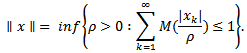 It is shown in [4] that every Orlicz sequence space
  contains a subspace isomorphic to
  . The
. The  -condition is equivalent to
  for all values of
  and for
  An Orlicz function
  can always be represented in the following integral form
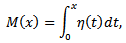 Where
Where  is known as the kernel of
  , is right differentiable for
  is non-decreasing and
  A fuzzy number is a fuzzy set on the real axis, i.e., a mapping
  which satisfies the following four conditions:(1)
  is normal, i.e., there exist an
  such that
  (2)
(2)  is fuzzy convex, i.e., for
  and
and  (3)
(3)  is upper semi-continuous;(4) the closure of
  denoted by
  is compact. Let
  is compact and convex }. The space
  has a linear structure induced by the operations
 and
and for
for  and
and  The Hausdorff distance between
  and
and  of
of  is defined as
 where
where  denotes the usual Euclidean norm in
  . It is well known that
  is a complete (non separable) metric space. For
  the
the  -level set
 is a non-empty compact convex, subset of
  , as is the support
  Let
Let  denote the set of all fuzzy numbers. The linear structure of
  induces addition
  and scalar multiplication
  in terms of
  -level sets, by
 and
and for each
  Define for each
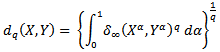 and
and  Clearly
  with
with 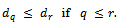 Moreover
  is a complete, separable and locally compact metric space. We denote by
  the set of all sequences
  of fuzzy numbers.Let
  be the set of all complex sequences
  normed by
  where
where  the set of positive integers. Let
  denote the space whose elements are the sets of distinct positive integers. Given any elements
  we denote by
  the sequence
  which is such that
  otherwise. Further
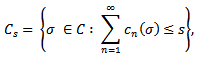 the set of those
  whose support has cardinality at most
  and
and  Where
Where 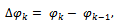 where
where  are real sequences see [5]. For
  Sargent [14] define the following sequence space
 In [14], Sargent studied some of its properties and obtained its relationship with the space
  In [7], Nurray and Savas introduced the classes of sequences of fuzzy numbers,
 where
where  is a bounded sequence of positive real numbers. They proved that
  is a complete metric space with the metric defined by
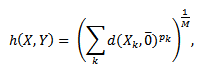 where
where 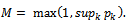 Let
Let  be a one-to-one mapping of the set of positive integers into itself such that
 be an Orlicz function and
  be a bounded sequence of positive real numbers. In this paper we define the following classes of sequences of fuzzy numbers:
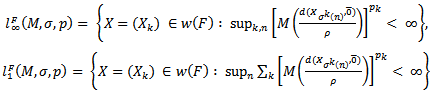 and
and When
When  we obtain the classes of sequences of fuzzy numbers as follows:
 and
and If we take
  we obtain the classes of sequences of fuzzy numbers as follows:
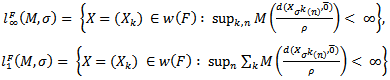 and
and The following inequality will be used throughout the paper. Let
  be a bounded sequence of positive real numbers with
  and let
  Then for the factorable sequences
  and
and  in the complex plane, we have
 | (1) |
2. Main Results
- Theorem 2.1. Let
 be an Orlicz function and
 be a bounded sequence of positive real numbers, then the spaces
  are linear spaces over the field of complex numbers ℂ.Proof. Let
  and
and  then there exist positive numbers
  such that
 and
and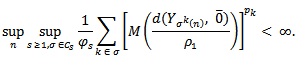 Define
  Since
Since  is non-decreasing, convex and so by using inequality (1), we have
 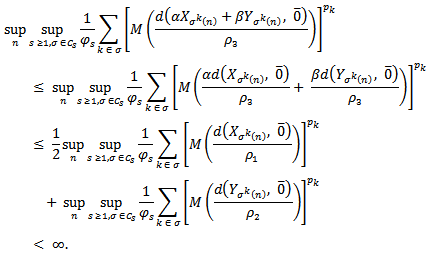 This proves that
  is a linear space. Similarly, we can prove that
  and
and  are linear spaces.Theorem 2.2. Let
  be an Orlicz function and
  be a bounded sequence of positive real numbers, then the space
  is a complete metric space, with the metric defined by
 Proof. Let
  be a Cauchy sequence in
  . Then,
 Hence
Hence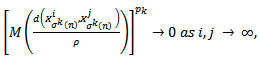 for all
  Therefore
  is a Cauchy sequence in
  Since
Since  is complete, it is convergent so that
  for each
  Since
Since  is a Cauchy sequence for each
  there exists
  such that
 So, we have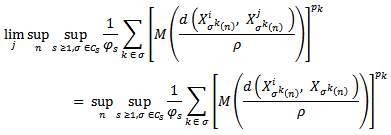
 This implies that
  Since
Since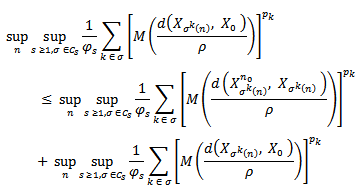 then we obtain
  Therefore
  is a complete metric space. This completes the proof of the theorem.Theorem 2.3. Let
  be an Orlicz function and
  be a bounded sequence of positive real numbers, then we have the following(ⅰ) the space
  is a complete metric space, with the metric defined by
 (ⅱ) the space
  is a complete metric space, with the metric defined by
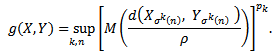 Proof. It is easy to prove in view of Theorem 2.2, so we omit the details.Theorem 2.4. Let
  be an Orlicz function and
  be a bounded sequence of positive real numbers, then
  if and only if
  Proof. Let
  and
and  Then
Then 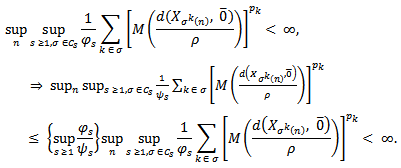 Therefore
  Hence
Hence  Conversely, let
  Suppose that
  then there exists a sequence of natural numbers
  such that
  Let
Let 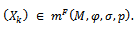 Then,
Then, Now, we have
 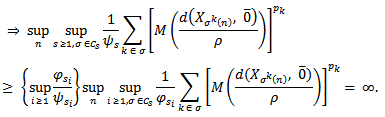 Therefore
  which is a contradiction. Therefore
  This completes the proof of the theorem.Theorem 2.5. Let
  be an Orlicz function and
  be a bounded sequence of positive real numbers, then
  if and only if
  and
and  Proof. The proof directly follows from Theorem 2.4.Theorem 2.6. Let
  be an Orlicz function and
  be a bounded sequence of positive real numbers, then
  Proof. Let
  then we have
 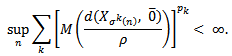 Since
Since  is monotone increasing, so we have
 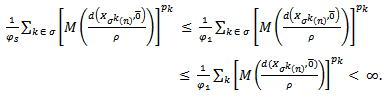 Hence
Hence  Thus
Thus  Therefore
  Next, let
  Then, we have
 Thus
Thus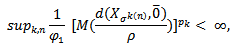 (on taking cardinality of
  to be 1). Thus
  Hence
Hence This completes the proof of the theorem.Theorem 2.7. Let
  be an orlicz function and
  be a bounded sequence of positive real numbers, then
  if and only if
  Proof. It is clear that
  when
when  for all
  By Theorem 2.4,
 if and only if
  Therefore by Theorem 2.6,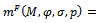
 if and only if
3. Conclusions
- In this paper we have introduce some new sequence spaces defined by a Orlicz function. We have also studied some topological properties like linearity, completeness and interested inclusion relations between the spaces. According to our opinion these results are new and interesting and beneficial for young researchers those working in this area.