
-
Paper Information
- Next Paper
- Paper Submission
-
Journal Information
- About This Journal
- Editorial Board
- Current Issue
- Archive
- Author Guidelines
- Contact Us
American Journal of Medicine and Medical Sciences
p-ISSN: 2165-901X e-ISSN: 2165-9036
2026; 16(6): 2769-2772
doi:10.5923/j.ajmms.20261606.01
Received: May 13, 2026; Accepted: May 29, 2026; Published: Jun. 1, 2026

The Importance and Practical Application of the HACCP System in Ensuring Food Safety in the Production and Distribution of In-Flight Meals for Air Passengers
 Abstract
 Reference
 Full-Text PDF
 Full-text HTML
Babakulova Shakhlo Khamidullaevna1, Khudayberganov Anatoliy Sagatbayevich2, Babakulov Sharaf Khamrokulovich3
1Assistant, Department of Children’s, Adolescents’ Hygiene and Nutrition Hygiene, Tashkent State Medical University, Tashkent, Uzbekistan
2Professor, Department of Hygiene and Radiation Safety at the Center for the Development of Professional Skills of Medical Workers under the Ministry of Health of the Republic of Uzbekistan, Tashkent, Uzbekistan
3Head of the Internal Control and Accreditation Department, Tashkent State Medical University, Tashkent, Uzbekistan
Correspondence to: Babakulova Shakhlo Khamidullaevna, Assistant, Department of Children’s, Adolescents’ Hygiene and Nutrition Hygiene, Tashkent State Medical University, Tashkent, Uzbekistan.
| Email: |  |
Copyright © 2026 The Author(s). Published by Scientific & Academic Publishing.
This work is licensed under the Creative Commons Attribution International License (CC BY).
http://creativecommons.org/licenses/by/4.0/

The aim of this study was to identify new technologies that ensure the safety, health, and dietary needs of air passengers during the provision of in-flight catering services. The objects of the study included the in-flight meal production facility of the “Uzbekistan Airways” company and passengers of the Islam Karimov Tashkent International Airport. According to the results, the in-flight meal products provided by “Uzbekistan Airways comply with established standards in terms of composition and targeted nutritional purpose and are considered attractive by passengers. Survey data show that more than 30% of passengers expressed a desire to choose special dietary meals, as approximately 65% of the passengers were elderly, many of whom suffer from chronic diseases requiring specialized dietary foods and meals. Although strict sanitary and epidemiological rules consistent with Codex Alimentarius standards are followed in the preparation and distribution of in-flight meals, it is still necessary to identify critical control points and normative criteria throughout the entire production chain — “from farm to fork.” This underscores the relevance of implementing the HACCP (Hazard Analysis and Critical Control Point) system.
Keywords: In-flight catering, Air passengers, Safety system, Dietary meals, HACCP, Codex Alimentarius, Food standards, Risk management
Cite this paper: Babakulova Shakhlo Khamidullaevna, Khudayberganov Anatoliy Sagatbayevich, Babakulov Sharaf Khamrokulovich, The Importance and Practical Application of the HACCP System in Ensuring Food Safety in the Production and Distribution of In-Flight Meals for Air Passengers, American Journal of Medicine and Medical Sciences, Vol. 16 No. 6, 2026, pp. 2769-2772. doi: 10.5923/j.ajmms.20261606.01.
1. Introduction
- Today, improving the passenger service system in the aviation sector, particularly ensuring that passengers are provided with safe and nutritious in-flight meals, is of special importance. The annual increase in the number of air passengers, the impact of in-flight nutrition on human health, and the need to take dietary requirements into account make scientific research in this field even more relevant. From this standpoint, the Rome Declaration adopted at the World Food Summit in 1996 affirmed every person’s right to access safe and nutritious food products, regardless of the conditions under which services are provided [2]. As emphasized in the World Food Summit’s “Plan of Action,” food security is ensured when every individual consistently has physical and economic access to sufficient quantities of safe and nutritious food products, thereby meeting their dietary needs and preferences and maintaining an active and healthy lifestyle [1]. Ensuring the quality and safety of in-flight food products affects not only passenger satisfaction but also the reputation of airlines and their ability to operate in compliance with international standards. Moreover, the implementation of international standards such as Codex Alimentarius and HACCP in practice is becoming an integral part of modern food production processes aimed at ensuring food safety. Therefore, guaranteeing high quality and safety of food products is considered an essential component of any food supply program.
2. Purpose
- The purpose is to improve the system of providing air passengers with safe, nutritious, and diet-compliant products during in-flight catering, as well as to develop effective methods for assessing and managing risks in enterprises involved in the production and distribution of in-flight meals. In addition, the study examines the importance of implementing the HACCP system, identifying control points that ensure safety at every stage of production, and applying modern approaches to food safety within airline operations.As the object of the study, the in-flight meal production enterprise of the “Uzbekistan Airways” airline and the passengers of the Islam Karimov International Airport located in Tashkent were selected. The research was conducted during the months of January–March. During this period, more than 300 air passengers were surveyed, and numerous in-flight menu samples belonging to airlines operating on international routes were analyzed.
3. Results and Discussion
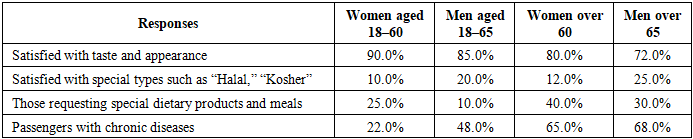
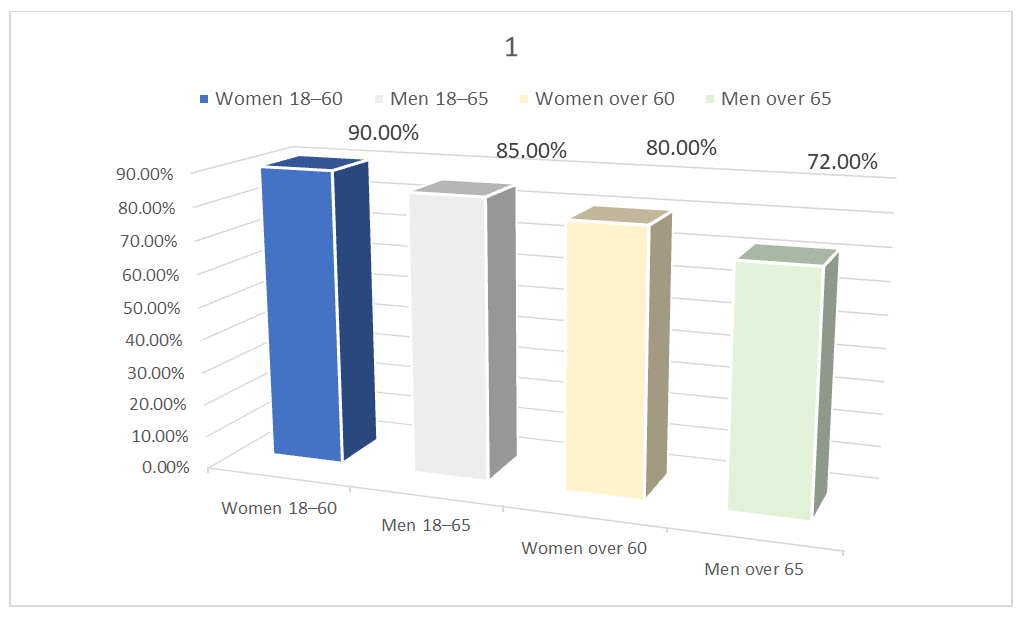
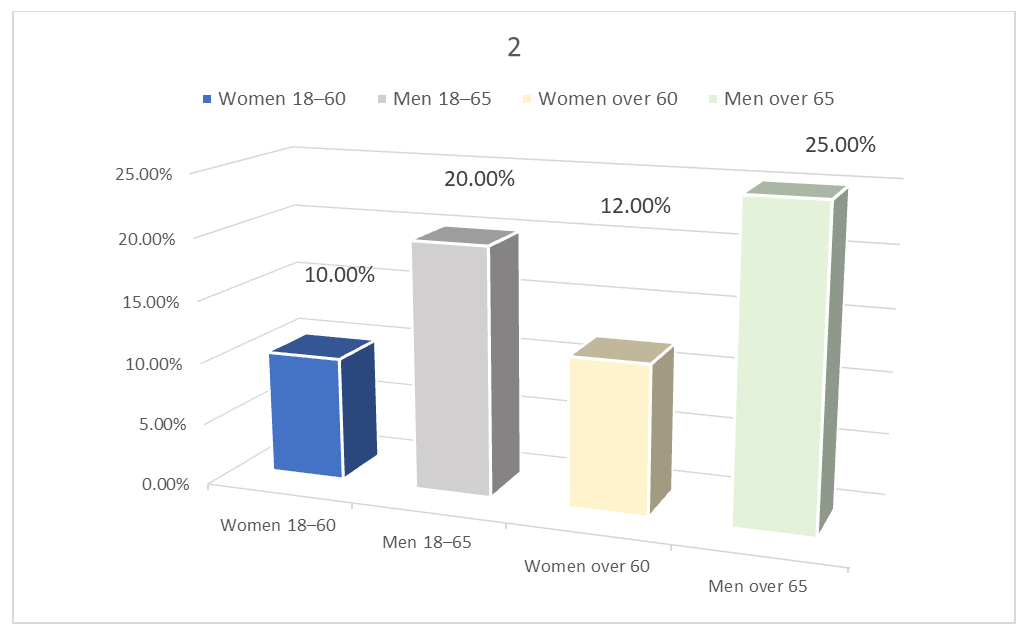
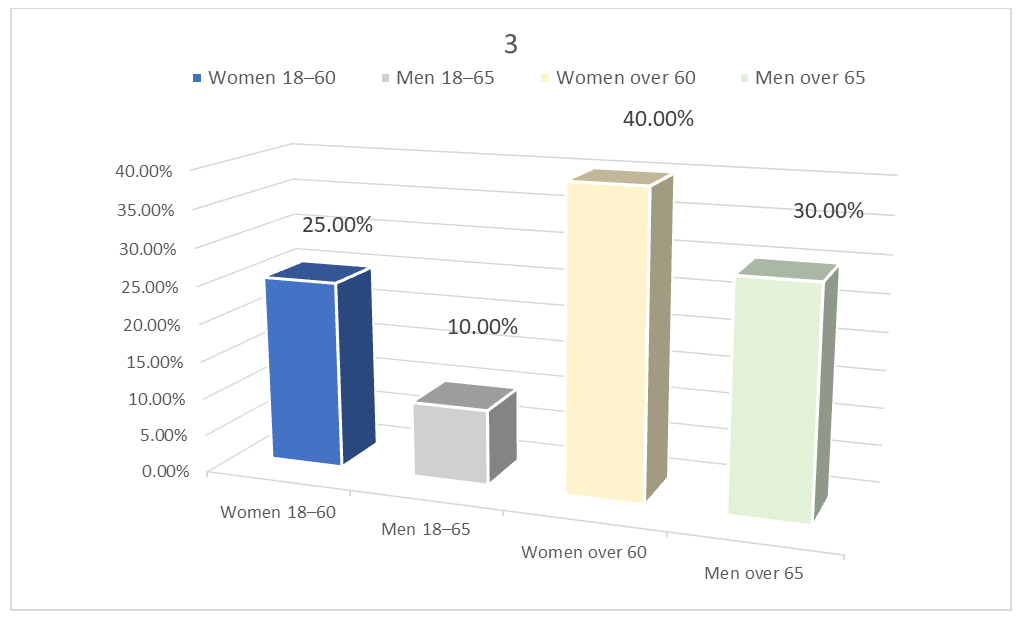
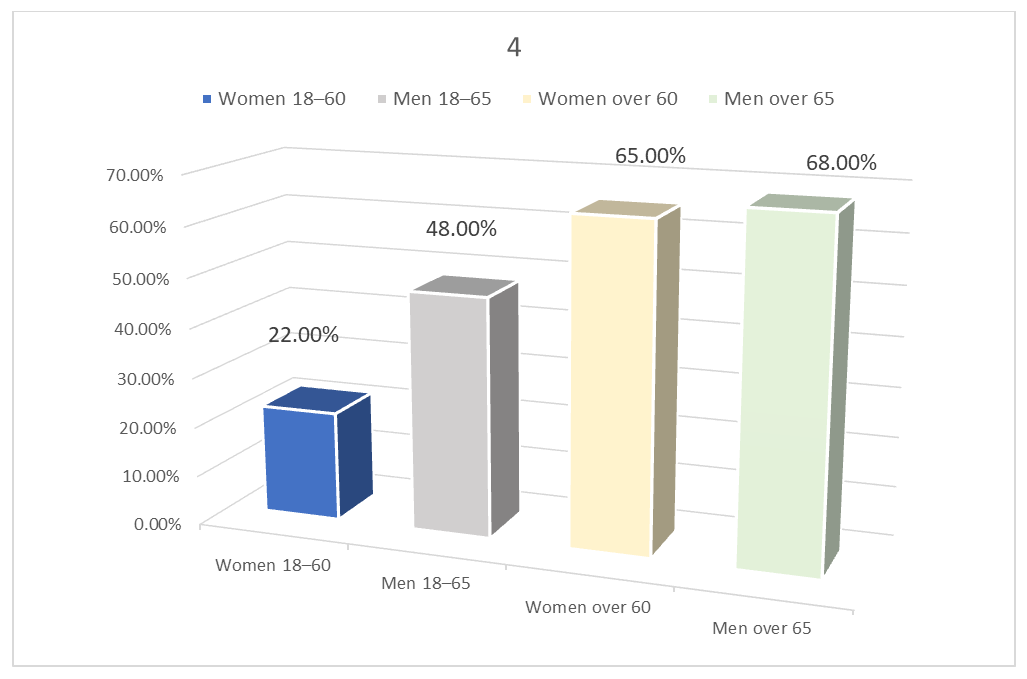
- The analysis shows that the meals offered to passengers and served on trays — “Halal,” “Kosher,” “Regular,” and “Children’s” types — fully comply with the established standards and are considered interesting and appealing to passengers.Each menu is mainly prepared using poultry or lamb/beef. At the same time, the results of the survey (Table 1) indicated that more than 30 percent of passengers expressed a desire for special dietary meals. The reason for this is that approximately 55 percent of air passengers are elderly, many of whom suffer from chronic illnesses, and such passengers require specially prepared dietary meals. Accordingly, there is a possibility that the in-flight meal products currently provided to passengers with special dietary needs may have adverse effects, and this factor is assessed as an important risk that requires precautionary measures.
|
 | Figure 1 |
 | Figure 2 |
 | Figure 3 |
 | Figure 4 |
4. Conclusions
- 1. It was determined that the “Halal,” “Kosher,” “Regular,” and “Children’s” meal types offered to passengers as selectable options and distributed on trays comply with the established standards.2. According to the conducted survey, more than 30% of passengers request special dietary meals because 65.0% of elderly passengers have chronic diseases and therefore require special diet-specific products and meals. This factor is considered one of the potential risk elements that may adversely affect the in-flight catering provided to passengers with medical conditions.3. Even when strict sanitary and epidemiological measures are followed during the preparation and serving of in-flight meals, the need arises to establish critical control points and safety criteria throughout the “from farm to fork” chain in order to guarantee the safety of in-flight meals. This is implemented in accordance with the HACCP (Hazard Analysis and Critical Control Point) system.