
-
Paper Information
- Next Paper
- Previous Paper
- Paper Submission
-
Journal Information
- About This Journal
- Editorial Board
- Current Issue
- Archive
- Author Guidelines
- Contact Us
American Journal of Medicine and Medical Sciences
p-ISSN: 2165-901X e-ISSN: 2165-9036
2026; 16(5): 2605-2608
doi:10.5923/j.ajmms.20261605.71
Received: Apr. 22, 2026; Accepted: May 12, 2026; Published: May 25, 2026

Modern Approaches to Differential Diagnosis of Vomitation Syndrome in Infants with Congenital Pilorostenosis and Functional Disorders
 Abstract
 Reference
 Full-Text PDF
 Full-text HTML
Shamsiev Azamat Mukhitdinovich1, Mamutova Evelina Sergeyevna2, Shamsieva Laylo Alisherovna3
1Professor, Department of Children's Surgery No. 1, Samarkand State Medical University, Samarkand, Uzbekistan
2Assistant of the Department of Propedeutics of Childhood Diseases, Samarkand State Medical University, Samarkand, Uzbekistan
3Pediatrician at the Specialized Pediatric Surgery Clinic, Samarkand State Medical University, Samarkand, Uzbekistan
Copyright © 2026 The Author(s). Published by Scientific & Academic Publishing.
This work is licensed under the Creative Commons Attribution International License (CC BY).
http://creativecommons.org/licenses/by/4.0/

Vomiting syndrome in infants is one of the most frequent reasons for parents seeking emergency medical assistance during the first months of a child's life. The most complex task in clinical practice remains the timely differential diagnosis of congenital hypertrophic pylorostenosis and functional disorders of the gastrointestinal tract accompanied by vomiting and vomiting. Errors in diagnosis lead to delayed surgical intervention, the development of dehydration, electrolyte imbalance, and the deterioration of the child's general condition. This work provides a comparative analysis of modern methods for diagnosing vomiting syndrome in infants based on clinical, laboratory, and instrumental criteria. The study is based on a retrospective analysis of data from 128 infants under 6 months of age who were hospitalized with symptoms of vomiting and vomiting. An assessment of the diagnostic significance of ultrasound examination, biochemical indicators, clinical symptoms, and machine learning algorithms was performed. The results showed that the combination of ultrasound parameters of the muscular layer thickness, symptom duration, and metabolic disorders ensures high diagnostic accuracy. The most effective classification model was Random Forest with an accuracy of 96.1%, a sensitivity of 95.3%, and a specificity of 94.8%. The results obtained confirm the prospects for integrating intelligent systems to support medical decision-making into pediatric practice.
Keywords: Congenital pylorostenosis, Vomiting syndrome, Infants, Differential diagnosis, Ultrasound diagnosis, Functional disorders, Machine learning, Random Forest, Pediatrics
Cite this paper: Shamsiev Azamat Mukhitdinovich, Mamutova Evelina Sergeyevna, Shamsieva Laylo Alisherovna, Modern Approaches to Differential Diagnosis of Vomitation Syndrome in Infants with Congenital Pilorostenosis and Functional Disorders, American Journal of Medicine and Medical Sciences, Vol. 16 No. 5, 2026, pp. 2605-2608. doi: 10.5923/j.ajmms.20261605.71.
Article Outline
1. Introduction
- Vomiting syndrome in infants remains one of the most pressing and complex issues in modern pediatrics, pediatric surgery, and neonatology. In the first months of a child's life, even relatively minor disorders in the functions of the gastrointestinal tract can quickly lead to serious metabolic changes, dehydration, and deterioration of the body's general condition [1]. This is why early and accurate diagnosis of the causes of vomiting in infants is of not only clinical but also social importance. In practice, doctors often face difficulties in distinguishing between functional disorders of the digestive system and organic pathologies of the gastrointestinal tract. Congenital hypertrophic pylorostenosis, a disease characterized by hypertrophy of the muscular layer of the gastric portal and impaired passage of food into the duodenum, poses a particular diagnostic challenge. Despite the development of modern imaging methods, the clinical symptoms of pylorostenosis in the early stages can resemble functional conditions such as gastroesophageal reflux, pylorospasm, or functional vomiting [2,4].According to international research, congenital pylorostenosis occurs in an average of 2–5 children per 1000 newborns, with the disease developing significantly more frequently in boys. The most typical signs are gushing vomiting, weight loss, signs of dehydration, and disturbances in the body's acid-base state [3]. However, in some patients, the clinical picture may be blurred, which causes late diagnosis and an increased risk of complications. Functional disorders of the gastrointestinal tract, on the contrary, occur significantly more frequently and, in most cases, have a benign course. Nevertheless, the similarity of clinical manifestations leads to the overdiagnosis of surgical pathology or, conversely, to the late detection of pilorostenosis. As a result, a child may receive ineffective conservative treatment for a long time, while the disease requires surgical correction [4,8].In recent years, special attention has been paid to the implementation of intelligent methods for analyzing medical data. The development of artificial intelligence and machine learning technologies opens up new opportunities for the early diagnosis of diseases in children [5]. Modern algorithms are capable of identifying hidden patterns between clinical, laboratory, and instrumental signs, ensuring high precision in patient classification. The use of machine learning methods in pediatrics is particularly relevant in conditions of high variability in the clinical manifestations of diseases in young children [6,9]. The integration of intelligent systems to support medical decision-making allows for minimizing the influence of subjective factors and increasing diagnostic efficiency [7]. It should be noted that most existing studies are primarily dedicated to the clinical description of pylorostenosis or the evaluation of individual diagnostic methods. At the same time, a comparative analysis of the comprehensive application of clinical, ultrasound, laboratory, and intelligent diagnostic methods remains insufficiently studied. In this regard, this study aims to develop modern approaches to the differential diagnosis of vomiting syndrome in infants based on the integration of traditional medical methods and intelligent data analysis technologies [10,11].
2. Setting the Task
- The aim of the study is to develop and analyze modern approaches to the differential diagnosis of vomiting syndrome in infants with congenital pylorostenosis and functional disorders.To achieve the set goal, the following tasks were formulated:To conduct a comparative analysis of the clinical manifestations of congenital pylorostenosis and functional disorders; to evaluate the diagnostic informativeness of ultrasound and laboratory indicators; to investigate the capabilities of machine learning algorithms for automated patient classification; to develop an integrated model for differential diagnosis; to identify the most significant predictors of congenital pylorostenosis; the object of the study was infants with vomiting syndrome under the age of 6 months [12,13].The subject of the study is the methods of clinical, instrumental, and intellectual diagnosis of congenital pylorostenosis.
3. Research Methodology
- This study was conducted in a retrospective cohort analysis format with elements of intelligent modeling of medical data. The analysis was conducted based on depersonalized clinical data from infants hospitalized with vomiting syndrome in specialized pediatric and surgical departments between 2021 and 2025. The primary objective of the methodological approach was to determine the most informative criteria for the differential diagnosis of congenital hypertrophic pylorostenosis and functional disorders of the gastrointestinal tract.Selection characteristicThe study included 128 infants aged 2 weeks to 6 months.62 children with a confirmed diagnosis of congenital hypertrophic pylorostenosis;66 children with functional disorders of the gastrointestinal tract.The average age of the patients was 2.3 ± 0.8 months.Among children with pylorostenosis, boys predominated at 71.0%, which corresponds to modern epidemiological data.Patients were included in the study if they met the following criteria: age less than 6 months; repeated vomiting or pathological regurgitation; presence of abdominal ultrasound results; presence of laboratory electrolyte metabolism indicators; and sufficient clinical information.The study excluded patients with: severe congenital abnormalities of the gastrointestinal tract; intestinal obstruction of other etiologies; infectious diseases; severe neurological pathologies; and the absence of a complete set of medical data [14].All patients were assessed for the main clinical manifestations of the disease: frequency of vomiting episodes; nature of vomiting; presence of "fountain" vomiting; duration of symptoms; body weight indicators; dehydration signs; appetite level; and the child's general condition. To assess the degree of dehydration, standard pediatric criteria were used, including skin condition, tissue turgor, urination frequency, and hemoconcentration indicators [15].Ultrasound examination was performed in real-time using high-frequency linear sensors [1,16].The following parameters were evaluated: the thickness of the muscular layer of the portal vein; the length of the pyloric canal; the diameter of the portal vein; the passage rate of gastric contents; and the presence of food evacuation delay.The following were considered diagnostically significant signs of pilorostenosis:muscle layer thickness greater than 4 mm;the length of the pyloric canal is more than 16 mm;lack of normal passage of the stomach contents.All patients were examined: sodium level; potassium level; chloride level; blood acid-base state; hematocrit indicators; and hemoglobin level.Particular attention was paid to the diagnosis of hypochloremic metabolic alkalosis, which is a characteristic complication of the long-term course of pilorostenosis [2,17].
4. Research Results
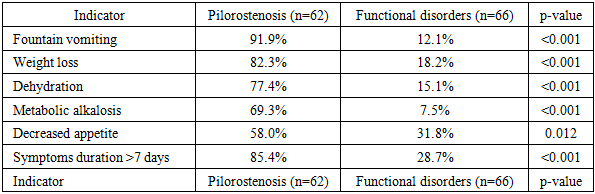
- Comparative analysis of clinical signsTable 1 demonstrates the comparative characteristics of clinical manifestations in patients of the study groups.
|
|

 | Figure 1. Clinical dynamics and treatment results |
5. Discussion
- At the same time, the research results indicate that using only ultrasound criteria does not always allow for maximum diagnostic accuracy, especially in borderline clinical cases. Laboratory indicators are an important component of comprehensive diagnostics. In most patients with pylorostenosis, signs of hypochloremic metabolic alkalosis were identified, due to prolonged loss of gastric contents. These disorders were significantly less common in patients with functional disorders [19,4].Despite the high informativeness of the obtained results, the research has certain limitations.First, the analysis was conducted on a relatively limited sample of patients.Secondly, the study was retrospective in nature, which may affect the completeness and standardization of the initial medical data.Thirdly, data from one medical center were used, which limits the possibility of full extrapolation of results to a broader population of patients.In the future, it is advisable to conduct multicenter research using larger sets of medical data and modern deep learning neural network architectures [20,3].
6. Conclusions
- Modern differential diagnosis of vomiting syndrome in infants requires a comprehensive analysis of clinical, laboratory, and instrumental data. The most significant diagnostic criteria for congenital pilorostenosis are ultrasound indicators of the thickness of the muscular layer of the portal vein and the length of the pyloric canal. An additional promising direction is the integration of ultrasound imaging into computer vision systems for the automated recognition of pilorostenosis signs.Thus, the comprehensive use of clinical, laboratory, instrumental, and intelligent analysis methods significantly increases the effectiveness of differential diagnosis of vomiting syndrome in infants.