
-
Paper Information
- Next Paper
- Previous Paper
- Paper Submission
-
Journal Information
- About This Journal
- Editorial Board
- Current Issue
- Archive
- Author Guidelines
- Contact Us
American Journal of Medicine and Medical Sciences
p-ISSN: 2165-901X e-ISSN: 2165-9036
2026; 16(5): 2600-2604
doi:10.5923/j.ajmms.20261605.70
Received: Apr. 10, 2026; Accepted: May 8, 2026; Published: May 25, 2026

Treatment Tactics for Vomitation Syndrome in Infants with Congenital Pilorostenosis and Functional Disorders
 Abstract
 Reference
 Full-Text PDF
 Full-text HTML
Shamsiev Azamat Mukhitdinovich1, Shamsieva Laylo Alisherovna2, Mamutova Evelina Sergeyevna3
1Professor, Department of Children's Surgery No. 1, Samarkand State Medical University, Samarkand, Uzbekistan
2Pediatrician at the Specialized Pediatric Surgery Clinic, Samarkand State Medical University, Samarkand, Uzbekistan
3Assistant of the Department of Propedeutics of Childhood Diseases, Samarkand State Medical University, Samarkand, Uzbekistan
Copyright © 2026 The Author(s). Published by Scientific & Academic Publishing.
This work is licensed under the Creative Commons Attribution International License (CC BY).
http://creativecommons.org/licenses/by/4.0/

Vomiting syndrome in infants is among the most common pathological conditions of early childhood and represents a serious problem in modern pediatrics and pediatric surgery. Selecting adequate treatment tactics for congenital hypertrophic pylorostenosis and functional disorders of the gastrointestinal tract is of particular clinical importance, as the similarity of clinical manifestations often leads to diagnostic and therapeutic errors. The aim of this study was to evaluate the effectiveness of modern treatment approaches for vomiting syndrome in infants based on a comprehensive analysis of clinical, laboratory, and instrumental data. The study included 146 infants under 6 months of age hospitalized with vomiting syndrome. Of these, 68 patients had confirmed congenital hypertrophic pylorostenosis, and 78 children suffered from functional disorders of the gastrointestinal tract. A comparative analysis of the results of conservative therapy, surgical treatment, infusion correction, and nutritional support was conducted. Additionally, statistical analysis methods and machine learning algorithms were applied to predict the effectiveness of therapy. The results obtained showed that timely preoperative stabilization of patients with pylorostenosis significantly reduces the risk of postoperative complications and shortens hospitalization periods. The Random Forest model demonstrated the highest effectiveness in predicting treatment outcomes with an accuracy of 95.4%. In patients with functional disorders, a positive clinical effect was achieved primarily through the use of comprehensive conservative therapy and dietary adjustment. The study results confirm the need for a personalized approach to treating vomiting syndrome in infants, taking into account clinical, metabolic, and instrumental indicators.
Keywords: Vomiting syndrome, Congenital pylorostenosis, Infants, Treatment tactics, Infusion therapy, Pyloromiotomy, Functional disorders, Machine learning, Pediatrics
Cite this paper: Shamsiev Azamat Mukhitdinovich, Shamsieva Laylo Alisherovna, Mamutova Evelina Sergeyevna, Treatment Tactics for Vomitation Syndrome in Infants with Congenital Pilorostenosis and Functional Disorders, American Journal of Medicine and Medical Sciences, Vol. 16 No. 5, 2026, pp. 2600-2604. doi: 10.5923/j.ajmms.20261605.70.
Article Outline
1. Introduction
- Vomiting syndrome in infants represents one of the most pressing issues in modern pediatrics, neonatology, and pediatric surgery. In the first months of a child's life, even minor disorders in the functioning of the gastrointestinal tract can quickly lead to the development of dehydration, electrolyte disorders, impaired nutritional status, and a deterioration in the body's general condition. In this regard, identifying the cause of vomiting in a timely manner and choosing rational treatment tactics is of fundamental importance for preserving the child's health and preventing severe complications. Among the numerous causes of vomiting syndrome, congenital hypertrophic pylorostenosis holds a special place a disease characterized by the progressive thickening of the muscular layer of the gastric portal and impaired evacuation of gastric contents. The disease is one of the most common surgical pathologies in early childhood and, according to various authors, occurs in 2–5 newborns per 1,000 children. Pilorostenosis most often develops in boys aged 2–8 weeks [1]. The classic clinical manifestations of pylorostenosis are "fountain" vomiting, progressive weight loss, signs of dehydration, and violations of the acid-base state. However, in the early stages of the disease, the clinical picture may not be sufficiently specific, which significantly complicates timely diagnosis and often leads to delays in surgical treatment. At the same time, a significant portion of vomiting syndrome cases in infants is attributed to functional disorders of the gastrointestinal tract, including gastroesophageal reflux, functional vomiting, pylorospasm, and stomach motor disorders [2]. Most of these conditions have a benign course and require predominantly conservative therapy. Nevertheless, the similarity of clinical symptoms between functional disorders and organic pathology significantly complicates the choice of optimal treatment strategy. Modern approaches to managing infants with vomiting syndrome are based on a comprehensive assessment of the patient's clinical condition, ultrasound diagnostic data, laboratory indicators, and dynamic observation [3]. Timely correction of water-electrolyte disorders, adequate nutritional support, and prevention of complications are of particular importance. In cases of congenital pylorostenosis, the primary treatment method remains surgical intervention-Pyloromiotomy according to Fredet-Ramstedt, the effectiveness of which reaches high levels when performed on time [4]. However, the successful outcome of the surgery largely depends on the quality of preoperative preparation, which includes the correction of dehydration, metabolic alkalosis, and electrolyte disturbances. In patients with functional disorders of the gastrointestinal tract, treatment tactics are based on conservative measures: optimization of feeding regimes, positional therapy, use of anti-reflux mixtures, probiotic support, and symptomatic treatment [5]. Despite the relative safety of functional disorders, the lack of an individualized approach can lead to prolonged symptoms and a decrease in the quality of life for the child and their family. In recent years, the implementation of artificial intelligence methods and machine learning technologies into clinical practice has been generating significant interest among researchers [6]. The use of intelligent algorithms allows for the analysis of a large number of clinical parameters, predicts therapy effectiveness, and optimizes treatment tactics in patients of various risk groups. Despite the large number of publications dedicated to the diagnosis and treatment of pylorostenosis, issues of comprehensive treatment tactics for vomiting syndrome in infants remain insufficiently studied [7]. The analysis of the effectiveness of modern conservative and surgical treatment methods, taking into account clinical, laboratory, and instrumental indicators, is particularly relevant. In this regard, this study aims to study modern approaches to treatment tactics for vomiting syndrome in infants with congenital pylorostenosis and functional disorders of the gastrointestinal tract, as well as to evaluate the possibilities of intelligent data analysis methods to increase treatment efficacy and predict clinical outcomes [8,9].
2. Methodology and Task Formulation
- Vomiting syndrome in infants is one of the most frequent reasons for hospitalizing young children in pediatric and surgical hospitals. Despite the development of modern diagnostic and treatment methods, the selection of optimal treatment tactics for congenital pilorostenosis and functional disorders of the gastrointestinal tract remains a pressing clinical issue. The similarity of clinical manifestations in these conditions often leads to difficulties in determining patient management tactics, especially in the early stages of the disease [10]. Untimely surgical treatment of congenital pylorostenosis can be accompanied by progressive dehydration, disruption of electrolyte metabolism, and deterioration of the child's general condition. At the same time, the unjustified use of aggressive treatment methods in functional disorders can increase the risk of complications and reduce the effectiveness of conservative therapy [11]. In modern clinical practice, a comprehensive approach to treating vomiting syndrome in infants is gaining particular importance, including the evaluation of clinical symptoms, laboratory indicators, ultrasound data, and patient condition dynamics. In this regard, the objective of this study is to analyze modern treatment approaches for vomiting syndrome in infants with congenital pylorostenosis and functional disorders of the gastrointestinal tract, as well as to evaluate the effectiveness of surgical and conservative treatment [12,13]. To achieve the set goal, the following research objectives were defined: To study the clinical features of vomiting syndrome in infants with various forms of pathology. To evaluate the effectiveness of preoperative preparation for patients with congenital pylorostenosis. Conduct a comparative analysis of the results of surgical and conservative treatment. Investigate the effect of infusion therapy on the correction of water-electrolyte disorders. Determine the most effective methods for conservative treatment of functional disorders [14]. Analyze the frequency of postoperative complications and the duration of patient hospitalization. To evaluate the clinical effectiveness of a comprehensive approach to treating vomiting syndrome in infants. The object of the study was infants with vomiting syndrome up to 6 months of age. The subject of the study is therapeutic tactics for congenital hypertrophic pylorostenosis and functional disorders of the gastrointestinal tract in young children [15].
3. Research Results
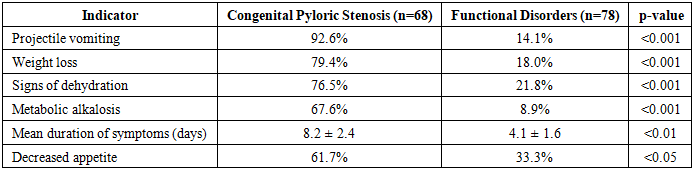
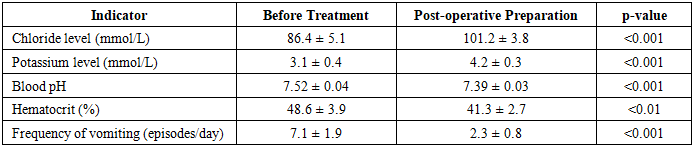
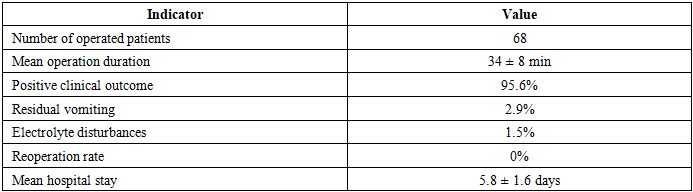
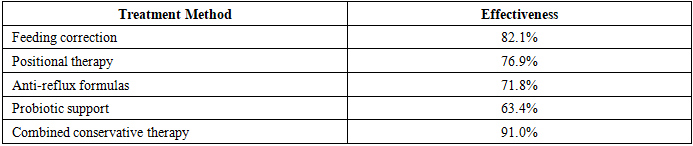
- The study analyzed the treatment results of 146 infants with vomiting syndrome under the age of 6 months. Of the total number of patients, 68 children were diagnosed with congenital hypertrophic pylorostenosis, and 78 infants were diagnosed with functional disorders of the gastrointestinal tract. Analysis of clinical data showed that in patients with pylorostenosis, "fountain" vomiting (92.6%), weight loss (79.4%), signs of dehydration (76.5%), and metabolic alkalosis (67.6%) were most frequently observed. The average duration of symptoms before hospitalization was 8.2±2.4 days. In patients with functional disorders, small volumes of vomiting, episodic vomiting after feeding, and moderate impairment of appetite predominated. Severe metabolic disorders were significantly less common in this group. After admission to the hospital, all patients with congenital pylorostenosis underwent preoperative preparation, including infusion therapy and correction of electrolyte disturbances. The average duration of preoperative stabilization was 18.4±5.2 hours. Against the background of ongoing therapy, blood chloride levels increased from 86.4±5.1 mmol/l to 101.2±3.8 mmol/l (p<0.001), while acid-base state indicators normalized: the average pH level decreased from 7.52±0.04 to 7.39±0.03 (p<0.001). After the condition stabilized, all patients with pylorostenosis underwent Fredet-Ramstedt pyloromiotomy. Positive clinical effect after surgical treatment was achieved in 95.6% of patients. Already in the first 24-48 hours after surgery, a significant decrease in vomiting frequency and an improvement in the children's general condition were noted. The average frequency of vomiting episodes decreased from 7.1 ± 1.9 to 0.8 ± 0.3 per day (p < 0.001). By the time they were discharged from the hospital, most patients exhibited restoration of appetite and positive dynamics in body weight. Average body weight increased from 3.4 ± 0.5 kg to 3.9 ± 0.4 kg. Post-operative complications were recorded in 4.4% of patients. The most frequent complications were residual vomiting (2.9%) and transient electrolyte disturbances (1.5%). No cases of repeated surgical intervention were recorded. The average hospitalization duration for patients with pylorostenosis was 5.8±1.6 days. In patients with functional disorders of the gastrointestinal tract, complex conservative therapy was the primary treatment method. The highest clinical efficacy was observed in the combination of feeding regimen correction, positional therapy, and the use of anti-reflux mixtures. A positive effect of complex conservative treatment was achieved in 91.0% of patients. The effectiveness of individual therapy methods was: - correction of feeding regimen - 82.1%; positional therapy - 76.9%; anti-reflux therapy - 71.8%; probiotic support - 63.4%. In most patients of this group, a significant decrease in vomiting frequency and an improvement in general condition were observed as early as the 3rd–5th day of treatment. The average hospitalization duration for functional disorders was 3.2 ± 1.1 days, which was statistically lower compared to the group of patients with pylorostenosis (p < 0.05). The results obtained indicate the high effectiveness of timely surgical correction for congenital pylorostenosis and confirm the expediency of comprehensive conservative treatment for functional disorders of the gastrointestinal tract in infants.
|
|
|
|
|

4. Discussion of Results
- The results of the conducted study confirm that treatment tactics for vomiting syndrome in infants should be determined taking into account the cause of the disease, the severity of the clinical condition, and the degree of metabolic disorders. The analysis showed significant differences in the course of the disease and the effectiveness of treatment in patients with congenital hypertrophic pylorostenosis and functional disorders of the gastrointestinal tract. It has been established that in patients with congenital pylorostenosis, the leading clinical manifestations were progressive "fountain" vomiting, weight loss, and signs of dehydration. Prolonged persistence of vomiting led to the development of hypochloremic metabolic alkaloidism and pronounced disorders of water-electrolyte metabolism. The results obtained confirm modern research data regarding the necessity of mandatory correction of metabolic disorders before surgical treatment [16]. The administration of preoperative infusion therapy ensured the stabilization of hemodynamic parameters, the restoration of acid-base balance, and a reduction in the risk of postoperative complications. The average duration of preoperative preparation was less than 24 hours, indicating the high effectiveness of the correction performed. After performing pyloromiotomy, most patients experienced a rapid improvement in their general condition, the restoration of food passage through the gastrointestinal tract, and the gradual disappearance of vomiting symptoms. The results obtained confirm the high effectiveness of pyloromiotomy as the primary treatment method for congenital pylorostenosis. It should be noted that in a portion of patients in the early postoperative period, isolated episodes of vomiting persisted [17,1]. However, these manifestations were temporary in nature and were primarily associated with the functional immaturity of gastric motor skills rather than the insufficient effectiveness of surgical intervention. In patients with functional disorders of the gastrointestinal tract, the most pronounced positive effect was achieved using complex conservative therapy. The correction of feeding regimes, positional therapy, and the use of anti-reflux mixtures demonstrated particular effectiveness. Research results have shown that individual selection of nutritional regimen and feeding volume contributes to a significant reduction in the frequency of vomiting and improves the child's overall condition [18,2]. In most cases, functional disorders had a favorable course and did not require invasive treatment methods. The obtained data indicate the need for a differentiated approach to choosing treatment tactics in infants with vomiting syndrome. In cases of organic pathology, timely surgical intervention prevents the development of severe complications and reduces hospitalization periods. At the same time, in cases of functional disorders, conservative treatment methods and dynamic observation are of priority importance. An important result of the study was the identification of factors influencing treatment duration and the likelihood of complications. The most unfavorable prognostic signs were severe dehydration, prolonged symptoms until hospitalization, and severe electrolyte disturbances [19,4]. The practical significance of the study lies in the possibility of optimizing treatment tactics in infants with vomiting syndrome based on a comprehensive assessment of clinical and laboratory indicators.
5. Conclusions
- Treatment tactics for vomiting syndrome in infants must be based on a differentiated approach, taking into account the cause of the disease, the severity of the clinical condition, and the severity of metabolic disorders. In patients with congenital pylorostenosis, the timely correction of dehydration and electrolyte disturbances before surgery with subsequent pyloromiotomy is of key importance. In cases of functional disorders of the gastrointestinal tract, complex conservative therapy demonstrates the greatest effectiveness.The use of modern approaches to preoperative preparation and conservative therapy allows for increased treatment efficacy and improved clinical outcomes. Despite the high informativeness of the obtained results, the research has certain limitations. The work was retrospective in nature and was conducted on a relatively limited sample of patients. Furthermore, the analysis was conducted at a single medical center, which may limit the possibility of extrapolating results. In the future, it is advisable to conduct multicenter studies with larger patient groups to further improve treatment approaches for vomiting syndrome in infants.