
-
Paper Information
- Next Paper
- Previous Paper
- Paper Submission
-
Journal Information
- About This Journal
- Editorial Board
- Current Issue
- Archive
- Author Guidelines
- Contact Us
American Journal of Medicine and Medical Sciences
p-ISSN: 2165-901X e-ISSN: 2165-9036
2026; 16(5): 2584-2587
doi:10.5923/j.ajmms.20261605.66
Received: Mar. 22, 2026; Accepted: Apr. 16, 2026; Published: May 25, 2026

The Influence of Cultural Characteristics of Eating Behavior on the Consequences of Psychogenic Overeating in Children in the Republic of Uzbekistan
 Abstract
 Reference
 Full-Text PDF
 Full-text HTML
Lyudmila Tursunkhodjaeva1, Dilbar Azizova2, Luiza Baymirova3
1MD, Professor, Department of Narcology and Adolescent Psychopathology, Center for the Development of Professional Qualifications of Medical Workers, Tashkent, Uzbekistan
2Assistant, Department of Narcology and Adolescent Psychopathology, Center for the Development of Professional Qualifications of Medical Workers, Tashkent, Uzbekistan
3PhD, Assistant, Department of Narcology and Adolescent Psychopathology, Center for the Development of Professional Qualifications of Medical Workers, Tashkent, Uzbekistan
Correspondence to: Dilbar Azizova, Assistant, Department of Narcology and Adolescent Psychopathology, Center for the Development of Professional Qualifications of Medical Workers, Tashkent, Uzbekistan.
| Email: |  |
Copyright © 2026 The Author(s). Published by Scientific & Academic Publishing.
This work is licensed under the Creative Commons Attribution International License (CC BY).
http://creativecommons.org/licenses/by/4.0/

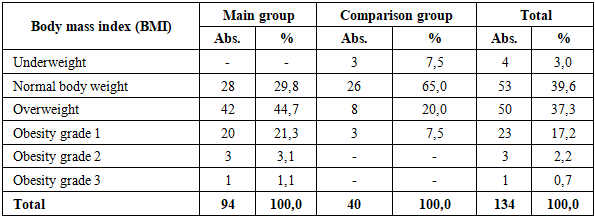
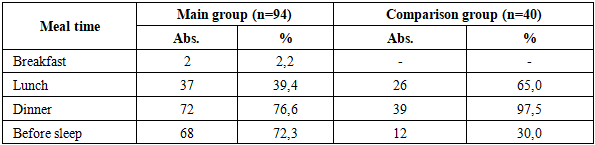
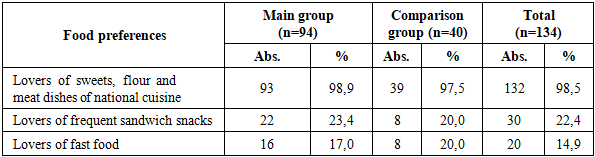
The development of a biopsychosocial concept of eating disorders in children and adolescents is accompanied by a significant increase in attention to the influence of parental dietary patterns, as well as the dietary traditions of different ethnic groups. The article contains the results of a comparative study of two groups of children suffering from (94 children - the main group) and not suffering from (40 children - the comparison group) psychogenic overeating. The aim of the study was to investigate the influence of the eating behavior of the parental family on the occurrence of such consequences of psychogenic overeating in children as overweight and obesity. Research methods: a clinical examination of children to determine the Body Mass Index, testing children using the EAT-26 (Eating Attitudes Test) food preference questionnaire, interviews with parents. Results. It was found that the overwhelming majority of parental families of children in both groups adhered to the traditional Uzbek dietary style with a predominance of high-calorie national dishes rich in meat and flour products, animal fats and carbohydrates. The children's eating pattern was characterized mainly by two meals a day, refusing breakfast, snacking outside at lunchtime, and eating the main food load in the evening. Children suffering from psychogenic overeating were significantly more likely than children in the comparison group to eat large meals before bedtime, in addition to dinner. Compared to the control group, the study group had a higher proportion of overweight (44.7% vs. 20%) and obese (25.5% vs. 7.5%) children. Only 29.8% of the study group members were of optimal weight, compared to 65% of the comparison group.
Keywords: Eating behavior, Psychogenic overeating, Childhood, Cultural characteristics, Uzbekistan
Cite this paper: Lyudmila Tursunkhodjaeva, Dilbar Azizova, Luiza Baymirova, The Influence of Cultural Characteristics of Eating Behavior on the Consequences of Psychogenic Overeating in Children in the Republic of Uzbekistan, American Journal of Medicine and Medical Sciences, Vol. 16 No. 5, 2026, pp. 2584-2587. doi: 10.5923/j.ajmms.20261605.66.
1. Introduction
- According to the World Health Organization, 14 million people (1.4% of the world's population), including 3 million children and adolescents, suffer from eating disorders [1]. Over the past ten years, the prevalence of these disorders worldwide has increased by 25%, occurring in approximately 1-3% of young women, 0.1% of individuals aged 10-14 years, and 0.4% of individuals aged 15-19 years [2]. The increased incidence of eating disorders entails the risk of obesity, cardiovascular and endocrine diseases, gastrointestinal diseases, metabolic disorders, certain types of neoplasms, depression, insomnia, and alcohol or drug addiction [3]. Up to 10% of the population suffers from psychogenic overeating (hyperphagic reactions to stress), which remains the least studied in children and adolescents.The development of maladaptive eating behaviors under the influence of stress can begin as early as 8–9 years of age [4]. An important task is to clarify its diagnostic boundaries, clinical criteria, causes, relationships with numerous biological, psychological, and social factors, and age-related and cultural characteristics. This will open up new opportunities for the development of more effective measures for the correction and prevention of eating disorders.The involvement of numerous biological, psychological, and sociocultural [5] factors in the etiopathogenesis of eating disorders [6] has been proven. Among these, particular importance has been attached to the dietary traditions of different ethnic groups. Food, its composition, and the methods of preparing everyday, festive, and ritual dishes of any nation constitute an ethnic tradition that develops over the course of historical development. In Uzbekistan, historically established national dietary preferences favor meat, dairy, and plant-based foods and animal fats, with many dishes combined with flour products and cereals, primarily rice. National dishes are distinguished by their high calorie content and excellent taste [7].It has been established that in childhood, the parental family, with its lifestyle, values, customs, and traditions, plays a key role in the formation of eating patterns. Parental eating style and family eating preferences influence the development of overweight and obesity in children [8,9]. It's natural to assume that the dietary preferences, compositional characteristics of national dishes, and traditional attitudes toward food intake characteristic of the Uzbek ethnic population inevitably influence the development of psychogenic overeating and its consequences. This study examines the influence of cultural characteristics of parental eating behavior on the development of overweight and obesity in children suffering from psychogenic overeating.
2. Materials and Methods
- A total of 134 children (55 boys and 79 girls) aged 8 to 17 years (mean age 13.6 ± 2.5 years) whose parents sought consultation at the Republican Specialized Scientific and Practical Medical Center of Endocrinology were examined. Clinical examination (questioning, anamnesis collection, observation) and testing with the EAT-26 (Eating Attitudes Test) questionnaire allowed us to diagnose psychogenic overeating (ICD-10 code F50.4, ICD-11 code 6B82) in 94 children (40 boys and 54 girls). The remaining 40 children (15 boys and 25 girls) did not suffer from psychogenic overeating and formed the comparison group. Children under 14 years of age were examined with parental consent; children aged 14 and older were examined with the consent of the adolescent. To assess the consequences of psychogenic overeating (hyperphagic reactions to stress), the body mass index (BMI) was calculated using the formula: BMI = body weight (kg)/height (m²) and assessed according to WHO recommendations: 16 or less is severely underweight, 16-18.5 is underweight, 19-24.99 is optimal weight (normal), 25-29.99 is overweight, 30-34.99 is grade 1 obesity, 35-39.99 is grade 2 obesity, and 40 or more is grade 3 obesity.The eating behavior of the parental family was studied using interviews with the parents of the children studied to clarify the family's food preferences, eating style, attitudes toward food, and feeding practices.The chi-square test was used to assess differences between the identified groups. Differences were considered significant at p < 0.05.
3. Results
- Calculation of BMI showed that the majority of children suffering from psychogenic overeating are overweight or have some degree of obesity (Table 1).
|
|
|
|
|
4. Discussion
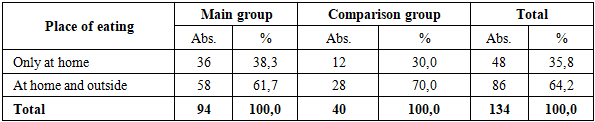
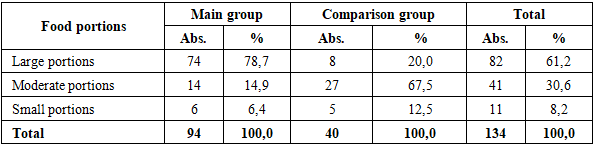
- The results suggest that the dietary preferences, customs, and mealtime traditions typical of the Uzbek ethnic group had a strong influence on the development of the children's eating patterns, which developed under the direct influence of their parents. The eating patterns of children suffering from psychogenic overeating were characterized by a preference for high-calorie Uzbek dishes and the traditional consumption of the main meal in the evening with the family, while forgoing breakfast and a full lunch. Unlike the comparison group, children with psychogenic overeating preferred larger portions of food and ate significantly more often at night. The highly palatable nature of Uzbek national dishes induced a pleasurable response to food, which the child used to compensate for feelings of anxiety, discomfort, depression, and fear arising in response to stressors. This established eating pattern contributed to the accumulation of excess weight and obesity as its negative consequences. It is worth noting that 52.1% of children with psychogenic overeating had one or both overweight parents.
5. Conclusions
- Since children internalize the attitudes toward food that characterize their parental family, parents' eating behavior should be an important target for psychological interventions aimed at changing eating habits and preventing obesity in children. Furthermore, it is clear that ethnocultural factors must be considered when assessing the role of the parental family in eating disorders and developing effective treatment and prevention programs aimed at protecting the health of children.