
-
Paper Information
- Next Paper
- Paper Submission
-
Journal Information
- About This Journal
- Editorial Board
- Current Issue
- Archive
- Author Guidelines
- Contact Us
American Journal of Medicine and Medical Sciences
p-ISSN: 2165-901X e-ISSN: 2165-9036
2026; 16(5): 2511-2515
doi:10.5923/j.ajmms.20261605.51
Received: Apr. 22, 2026; Accepted: May 16, 2026; Published: May 21, 2026

Clinical, Metabolic, Immunological and Estrogen Axis Features in Different Phenotypes of Autoimmune Thyroiditis
 Abstract
 Reference
 Full-Text PDF
 Full-text HTML
Urunbayeva M. N.1, Ziyadullayev Sh. Kh.2, Ibragimov Kh. I.1
1Samarkand State Medical University, Samarkand, Uzbekistan
2Kimyo University in Tashkent, Samarkand Branch, Samarkand, Uzbekistan
Correspondence to: Urunbayeva M. N., Samarkand State Medical University, Samarkand, Uzbekistan.
| Email: |  |
Copyright © 2026 The Author(s). Published by Scientific & Academic Publishing.
This work is licensed under the Creative Commons Attribution International License (CC BY).
http://creativecommons.org/licenses/by/4.0/

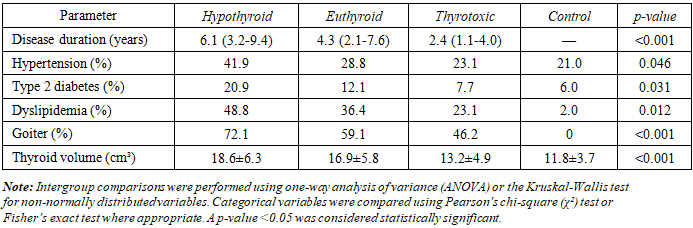
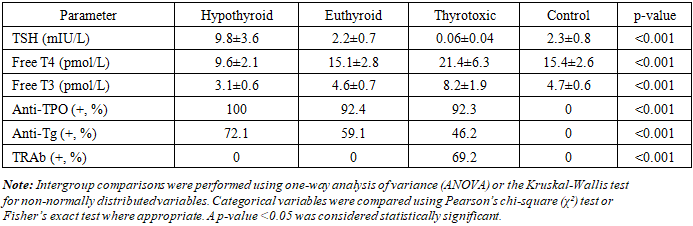
Autoimmune thyroiditis (AIT) is a heterogeneous endocrine disorder characterized by diverse clinical phenotypes and complex interactions between hormonal, immunological, and genetic factors. This study aimed to evaluate the clinical, metabolic, immunological, and estrogen-related characteristics of different AIT phenotypes and to assess the role of estrogen receptor gene (ESR1) polymorphism in disease expression. A total of 122 patients with confirmed AIT were included and stratified into hypothyroid (n=43), euthyroid (n=66), and thyrotoxic (n=13) forms, alongside a control group of 100 healthy individuals. Comprehensive assessment involved clinical and anthropometric evaluation, thyroid function testing (TSH, free T3, free T4), immunological markers (anti-TPO, anti-thyroglobulin, TRAb), ultrasound parameters, and estrogen axis indicators (estradiol, sex hormone-binding globulin [SHBG], and free estradiol index). ESR1 genotyping was performed to explore genetic associations. Significant intergroup differences were observed. The hypothyroid phenotype was associated with higher body mass index, increased prevalence of arterial hypertension, type 2 diabetes, and dyslipidemia. Hormonal profiles differed markedly across phenotypes, with elevated TSH and reduced thyroid hormones in hypothyroid patients and inverse patterns in thyrotoxicosis. Immunological markers were significantly elevated in all AIT groups compared to controls. Estrogen axis analysis revealed reduced estradiol levels and free estradiol index in hypothyroid patients, whereas thyrotoxic patients demonstrated increased estrogen bioavailability and lower SHBG levels. ESR1 polymorphism was significantly associated with variations in SHBG and free estradiol index, indicating its role in regulating estrogen bioavailability. These findings underscore the importance of endocrine-genetic interactions in AIT pathogenesis and support the potential for personalized approaches in disease management.
Keywords: Autoimmune thyroiditis, ESR1 polymorphism, Estrogen axis, Thyroid hormones, Immunogenetics
Cite this paper: Urunbayeva M. N., Ziyadullayev Sh. Kh., Ibragimov Kh. I., Clinical, Metabolic, Immunological and Estrogen Axis Features in Different Phenotypes of Autoimmune Thyroiditis, American Journal of Medicine and Medical Sciences, Vol. 16 No. 5, 2026, pp. 2511-2515. doi: 10.5923/j.ajmms.20261605.51.
1. Introduction
- One of the most widespread organ-specific autoimmune disorders is autoimmune thyroiditis (AIT) which is a major problem in contemporary endocrinology because of its heterogeneous clinical symptoms and complicated pathogenesis [1,2]. The disease has a range of functional phenotypes; hypothyroid, euthyroid, and thyrotoxic with different hormonal, immunological, and metabolic profiles [3]. According to epidemiological research, the prevalence of AIT is about 510% of the population with a clear female bias, pointing to the possible involvement of sex гормonal factors in the predisposition and development of the disease [4,5].The current ideas of the AIT pathogenesis are based on the multifactorial model of genetic predisposition, immune dysregulation, and environmental triggers [6]. One of the central processes is the breakdown of immune tolerance to thyroid-specific antigens that causes lymphocytic infiltration of the gland and the formation of autoantibodies, especially against thyroid peroxidase (TPO) and thyroglobulin [7,8]. These immunological mechanisms result in gradual tissue and functional damage to the thyroid. Moreover, the importance of endocrineimmune interactions, especially the effects of estrogen signaling on immune modulation and autoimmunity, are growingly emphasized [9,10].Estrogens have their biological activity mainly on estrogen receptors such as estrogen receptor alpha encoded by the ESR1 gene. It has been demonstrated that genetic polymorphisms of ESR1 can affect receptor activity and can potentially modify estrogen bioavailability and immune responses [11,12]. It has been proposed by several studies that ESR1 variants can be a cause of susceptibility to autoimmune diseases through their influence on the production of cytokine and activation of immune cells [13]. Nevertheless, the interaction of polymorphic ESR1 with estrogen metabolism and the clinical phenotypes of AIT is not well studied.In addition, metabolic disruptions including obesity, dyslipidemia, and insulin resistance are a common occurrence in patients with AIT, especially in hypothyroid forms, and are linked to a higher risk of cardiovascular risk [14,15]. These results reveal that thyroid dysfunction, metabolic regulation, and systemic inflammation interact in a complex manner.Considering the clinical heterogeneity of AIT and the possibility of genetic and hormonal influences, it is necessary to thoroughly characterize phenotypes. Clinical, immunological, hormonal, and genetic information can be integrated to enhance an insight into the disease mechanisms and assist in the personalized approaches to management.Thus, the objective of the current research was to examine the clinical, metabolic, immunologic, and estrogen-dependent features of various phenotypes of autoimmune thyroiditis and to determine the contribution of ESR1 gene polymorphism in regulating hormonal homeostasis and clinical manifestations.
2. Materials and Methods
- Population and study design. The study was a prospective observational study carried out at Samarkand city endocrinology dispensary between 2023 to 2025. First, 194 suspected patients of autoimmune thyroid pathology were screened. The enrolled patients were 122 individuals who had known autoimmune thyroiditis (AIT). A control group comprised 100 age- and sex-matched seemingly healthy persons without a history of thyroid or autoimmune disease.Inclusion and exclusion criteria. The inclusion criteria included clinically and laboratory-confirmed AIT of thyroid function tests and positive thyroid autoantibodies in adults. The exclusion criteria were pregnancy or lactation, taking of medications that influence thyroid functioning (e.g., amiodarone, lithium), recent exposure to iodinated contrast agents (within 3 months), thyroid surgery or radioiodine therapy, other autoimmune diseases, non-autoimmune thyroiditis.Anthropometric and clinical evaluation. Each participant was thoroughly clinically assessed, with medical history, duration of the disease, and comorbidities. Body mass index (BMI) was measured. Blood pressure and metabolic parameters (type 2 diabetes and dyslipidemia) were also measured.Phenotype classification. Thyroid functional status was used to stratify patients with AIT into three phenotypes; hypothyroid (n=43), euthyroid (n=66), and thyrotoxic (n=13), based on the levels of serum thyroid-stimulating hormone (TSH) and free thyroid hormone.Lab and immunologic testing. Venous blood samples were taken under the standard conditions. Thyroid performance was determined through tests of serum TSH, free triiodothyronine (fT3) and free thyroxine (fT4). The immunological parameters were anti-TPO antibodies, anti-Tg antibodies and TSH receptor antibodies (TRAb). Evaluation of estrogen axis involved serum estradiol, sex hormone-binding globulin (SHBG) and calculated free estradiol index.Ultrasound examination. Thyroid ultrasonography was done to all patients to evaluate the volume, echogenicity, and vascularization of the glands. Hypoechogenicity and increased vascular patterns were identified by standardized criteria.Genetic analysis. The genetic analysis focused on the ESR1 gene polymorphism related to estrogen receptor α signaling. Genotyping was performed using PCR-based methods. ESR1 genotypes were classified as AA, AG, and GG, and genotype/allele frequencies were compared between hypothyroid, euthyroid, thyrotoxic AIT groups and healthy controls. Associations between ESR1 genotype and estrogen-axis parameters, including estradiol, SHBG, and free estradiol index, were assessed using appropriate comparative and regression analyses. Where applicable, age, sex, BMI, and thyroid functional status were considered as potential confounding factors.Statistical analysis. Statistical analysis was done using standard software packages. Quantitative variables were given in terms of mean and standard deviation or median (interquartile range), depending on distribution. ANOVA or Kruskal-Wallis test was used to carry out intergroup comparisons. The chi-square (X2) test or the Fisher exact test was used to compare categorical variables. A p<0.05 was taken as significant.
3. Results
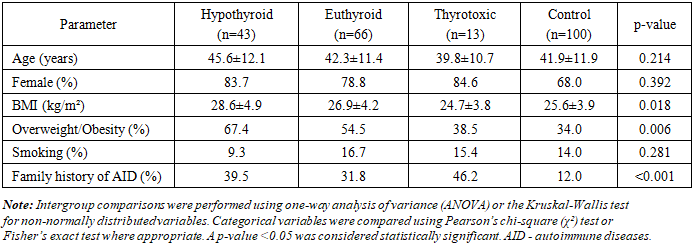
- Basic demographic and anthropometric data.The patients (n=122) and the healthy controls (n=100) were analyzed. Table 1 illustrates that the study groups were similar in terms of age (p=0.214) and sex distribution (p=0.392) hence sufficient matching and reduction of confounding effects of these factors on future comparisons.
|
|
|
|

4. Conclusions
- Autoimmune thyroiditis demonstrates marked clinical, metabolic, immunological, and endocrine heterogeneity. ESR1 polymorphism was associated with SHBG and free estradiol index, suggesting a possible role in estrogen bioavailability. Nevertheless, these findings are associative and require confirmation in larger studies with detailed hormonal stratification and functional genetic analysis.