
-
Paper Information
- Next Paper
- Previous Paper
- Paper Submission
-
Journal Information
- About This Journal
- Editorial Board
- Current Issue
- Archive
- Author Guidelines
- Contact Us
American Journal of Medicine and Medical Sciences
p-ISSN: 2165-901X e-ISSN: 2165-9036
2026; 16(5): 2449-2453
doi:10.5923/j.ajmms.20261605.42
Received: Apr. 28, 2026; Accepted: May 15, 2026; Published: May 19, 2026

Diagnostic Criteria for Lactobacillus spp. in Ejaculate in the Investigation of Causes of Male Reproductive Dysfunction and Endocrine Infertility
 Abstract
 Reference
 Full-Text PDF
 Full-text HTML
Mirsaidova M. A., Murodov J. T., Nurova G. U.
Republican Specialized Scientific and Practical Medical Center of Dermatovenereology and Cosmetology, Tashkent, Uzbekistan
Copyright © 2026 The Author(s). Published by Scientific & Academic Publishing.
This work is licensed under the Creative Commons Attribution International License (CC BY).
http://creativecommons.org/licenses/by/4.0/

Male infertility remains a significant global health problem, with infectious and hormonal factors playing an important role in its development. In recent years, increasing attention has been paid to the role of the urogenital microbiota in the pathogenesis of reproductive disorders in men. This study evaluates the relationship between the presence of Lactobacillus spp. in the male urogenital tract, semen parameters, and hormonal status in men with infertility. A total of 100 men aged 20–40 years with primary and secondary infertility were included in the study. Microbiota was assessed using quantitative polymerase chain reaction (PCR), and serum levels of testosterone, progesterone, and estradiol were determined by enzyme-linked immunosorbent assay (ELISA). The results showed that the presence of Lactobacillus spp. is associated with a significant deterioration of semen parameters, including decreased sperm concentration, total sperm count, and motility. In addition, infertile men demonstrated reduced serum levels of testosterone, progesterone, and estradiol compared with the control group, with the most pronounced changes observed in patients with the presence of Lactobacillus spp. and longer disease duration. Thus, Lactobacillus spp. may play a role in the pathogenesis of male infertility and can be considered a potential biomarker of hormonal imbalance. These findings highlight the importance of comprehensive assessment of microbiota and hormonal status in the diagnosis and treatment of male infertility.
Keywords: Male infertility, Lactobacillus spp., Urogenital microbiota, Semen parameters, Hormonal imbalance, Testosterone, Estradiol, Progesterone, PCR, ELISA
Cite this paper: Mirsaidova M. A., Murodov J. T., Nurova G. U., Diagnostic Criteria for Lactobacillus spp. in Ejaculate in the Investigation of Causes of Male Reproductive Dysfunction and Endocrine Infertility, American Journal of Medicine and Medical Sciences, Vol. 16 No. 5, 2026, pp. 2449-2453. doi: 10.5923/j.ajmms.20261605.42.
1. Introduction
- According to the World Health Organization (WHO), approximately 48 million couples and 186 million individuals worldwide are unable to conceive without medical assistance, accounting for 15–20% of the reproductive-age population [29]. The prevalence of male infertility varies across regions and is estimated to range from 20% to 70% [13].Over the past four decades, a significant decline in sperm concentration among men of reproductive age has been reported, highlighting the importance of identifying the underlying causes of male infertility [24]. Among the factors associated with pathospermia, infections of the male accessory sex glands (male accessory gland infection, MAGI) are considered particularly important, accounting for 6.6% to 50% of urogenital infections [19].However, the etiology of many latent and recurrent forms of MAGI, as well as infertility in couples, remains unclear in 30–50% of cases due to limited diagnostic capabilities [13].Lactobacillus spp. detected in the male urogenital tract remain insufficiently studied. Although they are generally considered transient microflora, emerging evidence suggests that they may contribute to the development and persistence of chronic inflammatory processes in the prostate gland [9,28].In recent years, increasing attention has been paid to the role of hormonal factors, particularly the influence of testosterone levels on bacterial colonization of prostatic secretions [3]. However, the relationship between Lactobacillus spp. and hormonal status in men with infertility remains insufficiently studied [2,28].Therefore, the aim of this study was to assess the relationship between Lactobacillus spp. and serum levels of key reproductive hormones in men with primary and secondary infertility.
2. Materials and Methods
- A total of 100 men with infertility aged 20–40 years were included in the study. Of these, 75 (75%) were aged 20–30 years and 25 (25%) were aged 31–40 years. Forty-four patients (44%) were urban residents, while 56 (56%) were from rural areas.The majority of patients (62%) had a duration of infertility of up to 5 years. Among the patients, 63 (63%) had primary infertility and 37 (37%) had secondary infertility.Urethral scrapings, prostatic secretions, and ejaculate samples were used as biological materials in the study.The method of quantitative polymerase chain reaction (PCR) with real-time detection of results enables quantitative assessment of microorganisms, including those that are not amenable to cultivation. Quantitative determination of a broad spectrum of microorganisms allows both qualitative and quantitative characterization of the microbiota structure of a given biotope, thereby facilitating evaluation of the pathogenetic role of each group of microorganisms in a particular patient.The influence of the presence of Lactobacillus spp. in urethral discharge on semen analysis parameters was of particular interest.Quantitative determination of sex hormone concentrations in blood serum was carried out using a solid-phase enzyme-linked immunosorbent assay (ELISA). The hormones assessed included testosterone, progesterone, and estradiol, as disturbances in these parameters play a role in the development of male infertility.
3. Results
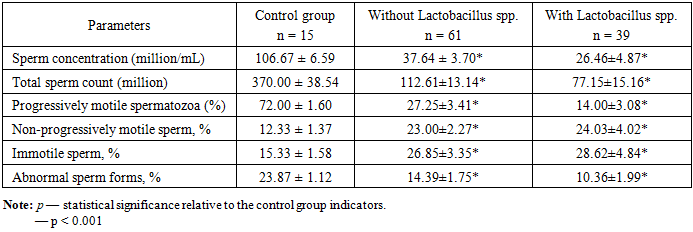
- The presence of Lactobacillus spp. in urethral discharge was associated with the most pronounced impairment of semen parameters compared to patients without Lactobacillus spp.All examined groups demonstrated a statistically significant decrease in sperm concentration per 1 mL and total sperm count compared with the control group (p < 0.001). The most pronounced reduction in these parameters was observed in patients with the presence of Lactobacillus spp. (26.46 ± 4.87 million/mL and 77.15 ± 15.16 million/ejaculate, respectively), compared to healthy individuals (106.67 ± 6.59 million/mL and 370.00 ± 38.54 million/ejaculate, respectively).
|
|
|
|
|
4. Discussion
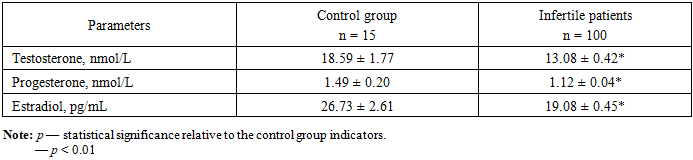
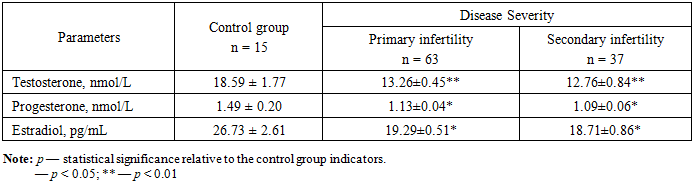
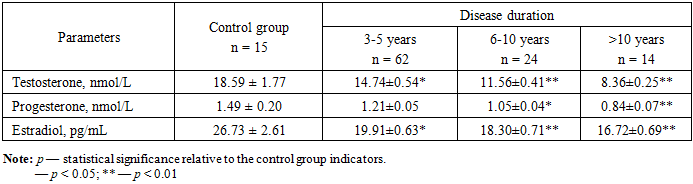
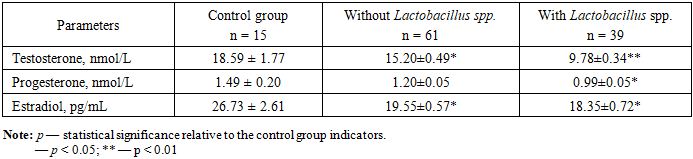
- The present study demonstrated that the presence of Lactobacillus spp. in the male urogenital tract is associated with significant impairment of semen parameters and disturbances in hormonal status. These findings are consistent with previous studies indicating that alterations in the microbiota composition may negatively affect male reproductive function [2,28].The observed decrease in sperm concentration, total sperm count, and motility suggests a detrimental effect of Lactobacillus spp. on spermatogenesis and sperm function. Similar associations between microbial colonization and impaired semen quality have been reported in earlier studies [9,28]. One possible mechanism underlying these changes may involve chronic inflammatory processes in the prostate and accessory glands, leading to disruption of the microenvironment necessary for normal sperm maturation [7,11]. In addition, inflammatory mediators and oxidative stress may further contribute to sperm damage and reduced motility.In addition to changes in semen parameters, the present study demonstrated a significant decrease in serum levels of testosterone, progesterone, and estradiol in infertile men. These findings support the concept that hormonal imbalance plays a key role in the pathogenesis of male infertility, as previously described [3]. The interaction between microbiota alterations and endocrine regulation may represent an important but still insufficiently understood pathway in the development of reproductive dysfunction.Particularly noteworthy is that the most pronounced hormonal and spermatogenic disturbances were observed in patients with the presence of Lactobacillus spp. and longer disease duration. This may indicate a cumulative effect of microbial, inflammatory, and endocrine factors on reproductive function.Furthermore, the progression of hormonal disturbances with increasing disease duration suggests that a prolonged pathological process contributes to worsening endocrine dysfunction. These results are in line with previous reports emphasizing the role of chronic inflammation and long-term exposure to adverse factors in the development of reproductive disorders [11].However, the present study has certain limitations. In particular, the lack of longitudinal follow-up limits the ability to establish causal relationships between microbiota alterations and hormonal changes. In addition, the sample size and single-center design may restrict the generalizability of the findings. Further multicenter and longitudinal studies are required to clarify the underlying mechanisms and clinical significance of these associations.Overall, the findings highlight the importance of considering microbiota composition and hormonal status in the comprehensive assessment of male infertility and may contribute to the development of more effective diagnostic and therapeutic approaches. These findings may also have important clinical implications for the diagnostic evaluation and management of male infertility.
5. Conclusions
- The results of the study indicate that in both primary and secondary infertility, there is a deterioration in the quantitative and qualitative parameters of semen. The identified disturbances do not depend on the severity or duration of infertility. Notably, in infertile men with the presence of Lactobacillus spp. in urethral discharge, the most pronounced abnormalities in semen parameters are observed.Furthermore, it was demonstrated that male infertility is associated with hormonal imbalance, characterized by decreased serum levels of testosterone, progesterone, and estradiol.Thus, Lactobacillus spp. are more frequently detected in the semen of men with decreased estradiol levels and more pronounced combined abnormalities in semen parameters.These findings suggest that Lactobacillus spp. may serve as a potential biomarker for hormonal imbalance in men with infertility.