
-
Paper Information
- Previous Paper
- Paper Submission
-
Journal Information
- About This Journal
- Editorial Board
- Current Issue
- Archive
- Author Guidelines
- Contact Us
American Journal of Medicine and Medical Sciences
p-ISSN: 2165-901X e-ISSN: 2165-9036
2026; 16(5): 2438-2440
doi:10.5923/j.ajmms.20261605.40
Received: Apr. 17, 2026; Accepted: Apr. 28, 2026; Published: May 18, 2026

Expression of HSP90 in Brain Tissue in Paracetamol-Induced Toxic Hepatitis
 Abstract
 Reference
 Full-Text PDF
 Full-text HTML
Khonnazarov Utkir Khujamshukurovich1, Akhmedov Kamoliddin Khakimovich2
1Researcher, Department of Normal and Pathological Physiology, Termez Branch of Tashkent State Medical University, Surkhandarya, Uzbekistan
2Associate Professor, Department of Normal and Pathological Physiology, Termez Branch of Tashkent State Medical University, Surkhandarya, Uzbekistan
Copyright © 2026 The Author(s). Published by Scientific & Academic Publishing.
This work is licensed under the Creative Commons Attribution International License (CC BY).
http://creativecommons.org/licenses/by/4.0/

In an experimental model of paracetamol-induced toxic hepatitis in rats, activation of the systemic stress response was identified, accompanied by increased expression of the molecular chaperone HSP90 in brain tissue. The most pronounced changes were observed on day 7 of the experiment, followed by a partial decrease by day 14. The obtained data indicate the involvement of the central nervous system in the pathogenesis of drug-induced liver injury and confirm the diagnostic significance of HSP90 as a marker of neurostress.
Keywords: Experiment, HSP90, Brain, Paracetamol, Hepatitis
Cite this paper: Khonnazarov Utkir Khujamshukurovich, Akhmedov Kamoliddin Khakimovich, Expression of HSP90 in Brain Tissue in Paracetamol-Induced Toxic Hepatitis, American Journal of Medicine and Medical Sciences, Vol. 16 No. 5, 2026, pp. 2438-2440. doi: 10.5923/j.ajmms.20261605.40.
Article Outline
1. Introduction
- Paracetamol (acetaminophen) remains one of the leading causes of drug-induced liver injury and acute liver failure, with key pathogenetic mechanisms including the formation of a toxic metabolite, mitochondrial dysfunction, oxidative and nitrosative stress, and sterile inflammation [6]. At the same time, accumulating evidence indicates that liver injury triggers a systemic stress response and may involve the central nervous system through inflammatory mediators and impaired metabolic detoxification, forming a “liver–brain” axis and prerequisites for neuroinflammatory reactions. Of particular interest is the role of molecular chaperones, primarily HSP90, as markers and regulators of cellular adaptation. It has been shown that HSP90 may reflect early and subclinical variants of drug-induced liver injury and act as a potential bioindicator of toxic exposure [7]. Contemporary reviews emphasize the multilevel nature of signaling pathways in APAP hepatotoxicity and the need to identify new targets that complement standard therapy [3]. One promising direction is the pharmacological modulation of antioxidant cascades (Nrf2) and the stress proteome, which has demonstrated experimental efficacy in models of APAP-induced injury [4,5]. In this context, studying the dynamics of HSP90 expression in the brain during paracetamol-induced hepatitis is justified both for clarifying systemic pathogenesis and for developing criteria to assess the neurostress component.Objective of the study: To investigate the role of HSP90 in the pathogenesis of central nervous system dysfunction in experimental toxic hepatitis.
2. Materials and Methods
- The study was conducted in accordance with generally accepted methodologies at a center accredited to perform testing in compliance with GLP standards [1,2]. The experiment included 24 rats weighing 180–240 g, divided into four groups of six animals each. Before the start of the experiment, all animals were provided with an acclimatization period of at least one week. Experimental modeling of toxic liver injury was carried out by repeated administration of paracetamol. Paracetamol was administered orally as a 4% solution at a dose of 400 mg/kg once daily for 4 consecutive days. Biological material was collected on days 7 and 14 of the experiment.The animals were distributed into groups as follows. Intact group (n = 6): Animals did not receive paracetamol. Brain tissue was collected on day 5. Group 1 (n = 6): Animals received paracetamol at a dose of 400 mg/kg daily for 4 days. Group 2 (n = 6): Animals received paracetamol according to the same regimen (400 mg/kg for 4 days). After completion of drug administration, the animals were maintained without exposure for 1 week, and brain tissue was collected on day 7. Group 3 (n = 6): Animals received paracetamol according to the same regimen (400 mg/kg for 4 days). After completion of drug administration, the animals were maintained without exposure for 2 weeks, and brain tissue was collected on day 14.
3. Results and Discussion
- To assess the cellular stress response under experimental stress in rats, the expression of the heat shock protein HSP90 in brain tissues was analyzed using Western blotting.Analysis of HSP90 expression in rat brain tissue revealed pronounced time-dependent changes under conditions of paracetamol-induced hepatitis. In the control group, HSP90 levels remained consistently low and showed minimal variability between biological replicates. Seven days after paracetamol administration, a marked increase in HSP90 expression was observed in all three samples: the bands became more intense compared with the control, indicating activation of stress-associated mechanisms in brain tissue at the early stage of toxic injury. On day 14, HSP90 expression remained elevated; however, its intensity was somewhat reduced compared with the 7-day group. This may reflect a partial attenuation of the stress response, the initiation of recovery processes, or a transition to a later phase of cellular adaptation. Overall, the maximal expression of HSP90 was observed on day 7, whereas by day 14 a moderate decrease was noted, although the levels remained higher than those in the control group. β-Actin expression remained stable across all experimental groups and biological replicates, confirming equal protein loading and the validity of subsequent normalization of HSP90 levels.
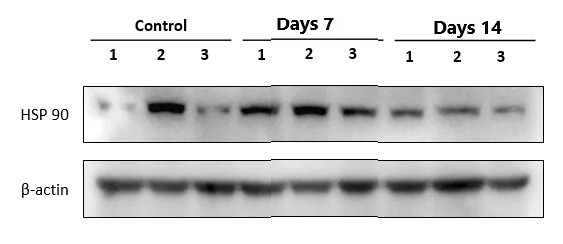 | Figure 1. Western blot analysis of the heat shock protein HSP90 and the loading control β-actin in rat brain tissues in a model of paracetamol-induced hepatitis |
4. Summary of Findings
- The conducted experimental study demonstrated that paracetamol-induced toxic liver injury is accompanied by pronounced activation of the stress response in rat brain tissues, manifested by increased expression of HSP90. The maximal level of HSP90 was observed on day 7 of the experiment, whereas by day 14 a moderate decrease was noted, which may reflect partial adaptation and the activation of recovery mechanisms. The obtained data confirm the involvement of the central nervous system in the pathogenesis of toxic hepatitis.
5. Conclusions
- 1. Paracetamol-induced toxic hepatitis results in a significant upregulation of HSP90 in brain tissue, indicating the development of a systemic cellular stress response.2. The most pronounced HSP90 expression is observed on day 7, followed by a partial decrease by day 14, reflecting the dynamics of adaptive and recovery processes.