
-
Paper Information
- Next Paper
- Previous Paper
- Paper Submission
-
Journal Information
- About This Journal
- Editorial Board
- Current Issue
- Archive
- Author Guidelines
- Contact Us
American Journal of Medicine and Medical Sciences
p-ISSN: 2165-901X e-ISSN: 2165-9036
2026; 16(5): 2388-2393
doi:10.5923/j.ajmms.20261605.32
Received: Apr. 12, 2026; Accepted: Apr. 26, 2026; Published: May 15, 2026

Patient Rights, Dental Records, and Dispute Prevention in Modern Dental Practice
 Abstract
 Reference
 Full-Text PDF
 Full-text HTML
Shukurov Akobir Furkatovich1, Inoyatov Amrillo Shodiyevich2, Shukurova Nodira Tillayevna3
1Researcher, Bukhara State Medical Institute, Bukhara, Uzbekistan
2Professor, Bukhara State Medical Institute, Bukhara, Uzbekistan
3Samarkand State Medical University, Samarkand, Uzbekistan
Correspondence to: Shukurov Akobir Furkatovich, Researcher, Bukhara State Medical Institute, Bukhara, Uzbekistan.
| Email: |  |
Copyright © 2026 The Author(s). Published by Scientific & Academic Publishing.
This work is licensed under the Creative Commons Attribution International License (CC BY).
http://creativecommons.org/licenses/by/4.0/

According to the World Health Organization, oral diseases remain one of the most widespread chronic pathologies worldwide, affecting approximately 3.7 billion people. The most common condition is untreated caries in permanent teeth, and severe forms of periodontal disease account for a significant portion of the population's need for long-term treatment and rehabilitation. The economic burden of poor oral health is estimated to be comparable to that of the most costly noncommunicable diseases, reaching approximately $545 billion in direct and indirect costs annually. The scale of prevalence and the cost of consequences shift dental care from a local clinic to a public responsibility of the state to ensure accessibility, quality, and legal protection for patients.
Keywords: Dental health, World Health Organization, Oral health
Cite this paper: Shukurov Akobir Furkatovich, Inoyatov Amrillo Shodiyevich, Shukurova Nodira Tillayevna, Patient Rights, Dental Records, and Dispute Prevention in Modern Dental Practice, American Journal of Medicine and Medical Sciences, Vol. 16 No. 5, 2026, pp. 2388-2393. doi: 10.5923/j.ajmms.20261605.32.
Article Outline
1. Introduction
- In the scientific literature, dental health is considered an integral part of the overall health of a nation and an important indicator of the well-being of the population [1,2]. According to the definition of the World Health Organization, oral health is a condition in which a person is free from diseases of the teeth, gums and other organs of the oral cavity, capable of ensuring basic functions (eating, speech, expression of emotions) without pain and discomfort [1]. In other words, dental health includes physical and psychological aspects and affects the overall well-being and quality of life of a person [2]. For example, the presence of chronic toothache or tooth loss can make it difficult to eat, communicate, reduce self-esteem and work capacity, which ultimately affects the social activity and economic well-being of an individual [3]. Thus, in the modern concept, dental health is interpreted not only as the absence of diseases of the dental system, but also as a positive condition that ensures a high quality of life. The dental health of the population has a pronounced medical and social significance. Firstly, oral diseases are extremely widespread and are predominantly chronic. According to the WHO, dental and gum diseases are among the most widespread non-communicable diseases worldwide [4]. Almost all people experience caries or periodontal diseases during their lifetime, and in certain age groups, the prevalence of caries approaches 100% [5]. In the Republic of Uzbekistan, according to local researchers, a high incidence of caries in children and a low level of oral hygiene are noted, especially in rural areas [6,7]. The chronic course of most dental diseases means that without prevention and treatment they progress and accompany a person for many years. Secondly, dental morbidity directly affects the ability to work and daily activities of the population. Pain syndrome associated with dental diseases and complications (for example, odontogenic infections) lead to absences from work and school, and difficulty concentrating [8]. Individuals with severe dental and periodontal disease often experience difficulties with eating and communicating, which impairs their social adaptation. Thirdly, the high prevalence of dental diseases results in a significant economic burden: families are forced to spend money on dental treatment, and the state is forced to provide dental care and preventive programs [9] Thus, from a social perspective, dental health is an important factor in public health, influencing demographic indicators and economic development.The legal framework governing dental services in the Republic of Uzbekistan is structured as a multi-layered system of norms, including constitutional provisions, legislative acts, bylaws of the President and the Cabinet of Ministers, departmental orders of the Ministry of Health, sanitary rules and regulations, and local documents of medical organizations. This architecture simultaneously provides for three modes of legal influence: establishing basic legal guarantees for the population, regulating the admission of organizations and specialists to medical activities, and detailing procedures for providing care and documenting medical interventions. The body of regulatory sources is systematized according to two complementary principles. The first principle reflects the legal force and hierarchy of regulations, allowing for the determination of the level of mandatory requirements and the mechanism for their implementation through bylaws and departmental rulemaking. The second principle reflects the regulatory framework for dental services as a branch of medical services, concentrating legal requirements on participants in medical legal relationships and on organizations providing dental care. These frameworks include patient rights, licensing and approval, quality and safety, medical documentation, financial relations, appeals, and liability. The register of regulatory sources was compiled based on official legal frameworks and departmental resources, with a selection of acts containing standards applicable to dental care, including outpatient and polyclinic services and the private sector. The time period 2010–2025 was adopted as the analytical period for updating and institutional development of regulations. Previously adopted fundamental laws were reviewed in their current versions and their application during this period (Table 1).
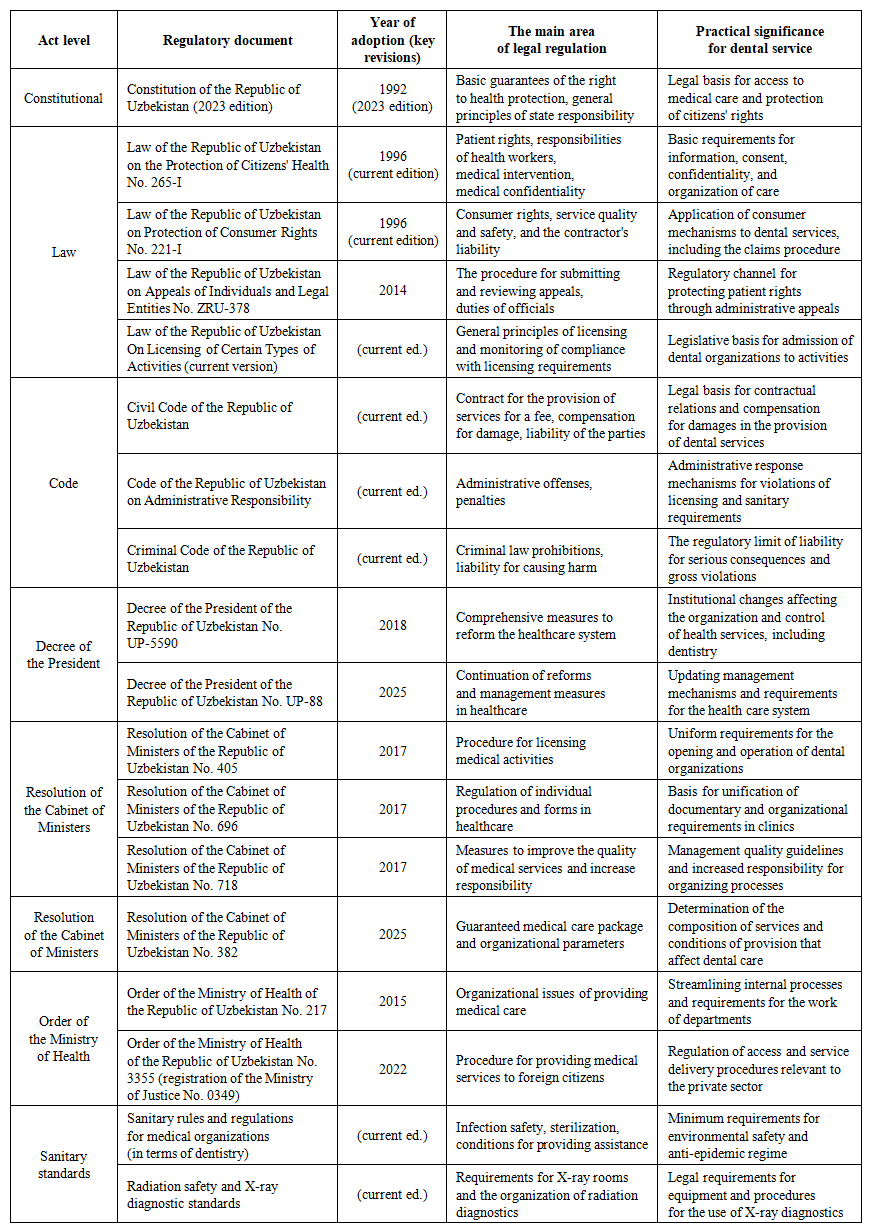 | Table 1. Composition of regulatory legal acts applicable to the regulation of dental services in the Republic of Uzbekistan |
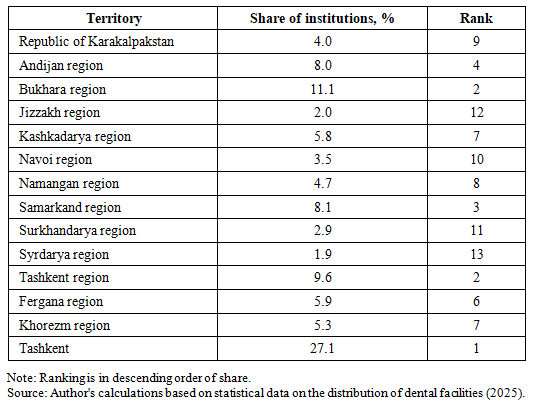 | Table 2. Distribution of dental institutions by administrative territories of the Republic of Uzbekistan, 2025, % |
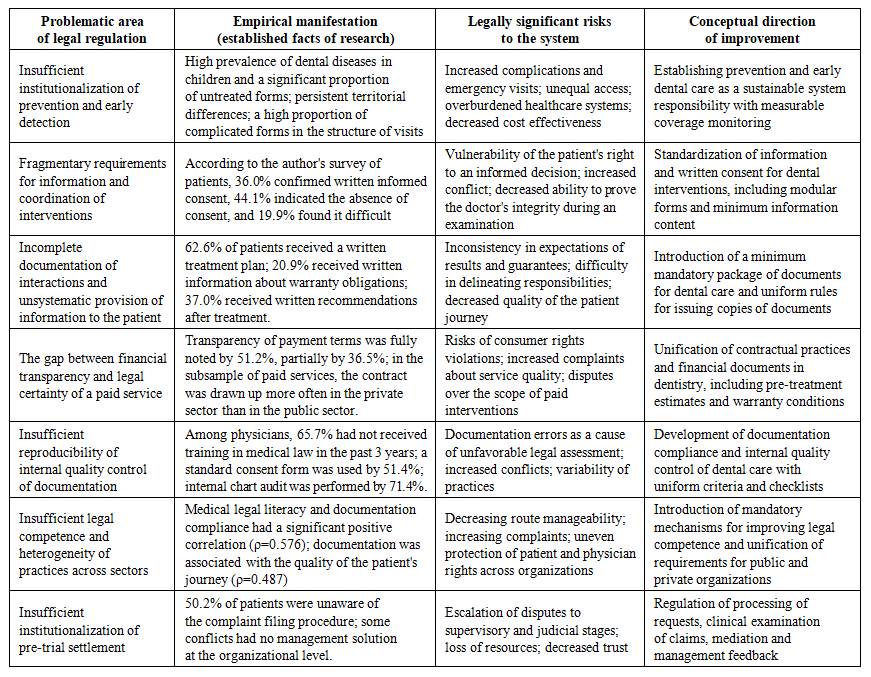 | Table 3. Matrix of problematic nodes of legal regulation of dental care and directions for overcoming them (based on the results of generalization of empirical data and normative analysis) |
2. Conclusions
- This study examines one of the most socially significant and organizationally complex issues facing modern healthcare in the Republic of Uzbekistan: the legal framework for dental services in the context of the high prevalence of oral diseases, a significant share of paid interventions, and a significant structural transformation of the dental services market. The widespread incidence of dental diseases, the material-intensive nature of treatment, and the prevalence of multi-stage procedures create a situation in which the quality and safety of dental care are determined not only by the physician's clinical competence but also by the legal stability of the interactions between the parties: complete information, verifiable consent, reproducible documentation, transparency of financial terms, protection of personal data, and the availability of effective pre-trial settlement mechanisms. In this logic, a dental service is simultaneously a medical intervention and a legally significant event, and the legal framework becomes not an external, oversight "superstructure" element, but an internal mechanism for managing the patient's journey, reducing conflict, and increasing trust in the system.
ACKNOWLEDGEMENTS
- The authors express their sincere gratitude to the administration of the Bukhara State Medical Institute and the Samarkand State Medical University for their continuous support and for creating a conducive environment for scientific research. Special thanks are extended to the dental practitioners and patients who voluntarily participated in the sociological surveys and provided valuable insights that significantly enriched this study. The authors also acknowledge the contributions of colleagues from the Department of Public Health and Healthcare Management for their constructive discussions on the legal aspects of dental service regulation in Uzbekistan.
Financial and Sponsorships
- This research received no specific grant from any funding agency in the public, commercial, or not-for-profit sectors. The study was entirely self-funded by the authors, who bore all costs related to data collection, analysis, and manuscript preparation.
Author’s Contribution
- All authors made substantial contributions to the conception, design, and execution of this study. Shukurov Akobir Furkatovich was responsible for the overall study design, data collection, statistical analysis, and drafting of the manuscript. Inoyatov Amrillo Shodiyevich contributed to the critical revision of the legal framework analysis, interpretation of regulatory documents, and supervision of the research. Shukurova Nodira Tillayevna participated in the literature review, data validation, and preparation of tables and the reference list. All authors reviewed and approved the final version of the manuscript and agree to be accountable for all aspects of the work.
Conflict of Interest
- The authors declare that there is no conflict of interest regarding the publication of this paper. No financial, personal, or professional relationships with any organizations or individuals could inappropriately influence or bias the findings presented in this study.