
-
Paper Information
- Previous Paper
- Paper Submission
-
Journal Information
- About This Journal
- Editorial Board
- Current Issue
- Archive
- Author Guidelines
- Contact Us
American Journal of Medicine and Medical Sciences
p-ISSN: 2165-901X e-ISSN: 2165-9036
2026; 16(5): 2287-2292
doi:10.5923/j.ajmms.20261605.14
Received: Apr. 8, 2026; Accepted: May 2, 2026; Published: May 9, 2026

Pharmacological and Toxicological Evaluation of 5-(p-Aminophenyl)-1,3,4-oxadiazole-2-thione Potassium Salt: Acute Toxicity and Anxiolytic Activity in Experimental Models
 Abstract
 Reference
 Full-Text PDF
 Full-text HTML
Sultanov S. A.1, 2, Sanoyev Z. I.1, 2, Sirov V. N.1, Ismailova D. S.3, Elmuradov B. J.3
1Department of Pharmacology and Toxicology, The Institute of the Chemistry of Plant Substances, Tashkent, Uzbekistan
2Department of Pharmacology, Tashkent State Medical University, Tashkent, Uzbekistan
3Department of Organic Synthesis, The Institute of the Chemistry of Plant Substances, Tashkent, Uzbekistan
Correspondence to: Sultanov S. A., Department of Pharmacology and Toxicology, The Institute of the Chemistry of Plant Substances, Tashkent, Uzbekistan.
| Email: |  |
Copyright © 2026 The Author(s). Published by Scientific & Academic Publishing.
This work is licensed under the Creative Commons Attribution International License (CC BY).
http://creativecommons.org/licenses/by/4.0/

Anxiety disorders are among the most prevalent neuropsychiatric conditions worldwide, affecting a significant proportion of the population and substantially impairing quality of life. Although benzodiazepines and other anxiolytic agents are widely used in clinical practice, adverse effects such as sedation, tolerance, dependence, and withdrawal symptoms limit their therapeutic application. Therefore, the search for novel anxiolytic compounds with improved safety and efficacy profiles remains an important objective in modern pharmacology. Heterocyclic compounds containing the 1,3,4-oxadiazole ring have attracted considerable interest due to their broad spectrum of biological activities and potential central nervous system effects.
Keywords: Heterocyclic compounds, 1,3,4-oxadiazole, Anxiolytic effect, Behavioural models, Acute toxicity, Experimental pharmacology
Cite this paper: Sultanov S. A., Sanoyev Z. I., Sirov V. N., Ismailova D. S., Elmuradov B. J., Pharmacological and Toxicological Evaluation of 5-(p-Aminophenyl)-1,3,4-oxadiazole-2-thione Potassium Salt: Acute Toxicity and Anxiolytic Activity in Experimental Models, American Journal of Medicine and Medical Sciences, Vol. 16 No. 5, 2026, pp. 2287-2292. doi: 10.5923/j.ajmms.20261605.14.
Article Outline
1. Introduction
- Anxiety disorders represent one of the most prevalent groups of neuropsychiatric conditions worldwide and constitute a significant medical and social problem. According to epidemiological studies, anxiety-related disorders affect a substantial proportion of the global population and are associated with impaired cognitive function, decreased productivity, and reduced quality of life [1-3]. Current anxiolytic drugs are effective in reducing symptoms of anxiety; however, their clinical use is frequently limited by significant adverse effects. Benzodiazepines, although widely prescribed, may cause sedation, cognitive impairment, tolerance, dependence, and withdrawal symptoms after prolonged administration. Selective serotonin reuptake inhibitors and serotonin–norepinephrine reuptake inhibitors have a delayed onset of action and are often associated with gastrointestinal disturbances, insomnia, and sexual dysfunction. Barbiturates produce marked central nervous system depression and possess a high risk of respiratory suppression and toxicity. Therefore, the development of novel anxiolytic agents with improved efficacy and safety remains an important objective in modern pharmacology [2,17].
 “These limitations justify the search for novel anxiolytic agents with improved safety profiles.”In recent years, heterocyclic compounds have attracted considerable attention due to their diverse biological activities and favourable pharmacodynamic characteristics. The 1,3,4-oxadiazole ring system is known to confer a wide spectrum of pharmacological effects, including antimicrobial, anti-inflammatory, anticonvulsant, antidepressant, and central nervous system–modulating activities. Structural modification of this heterocyclic nucleus allows the design of molecules with enhanced lipophilicity, metabolic stability, and the ability to penetrate the blood–brain barrier [4-6].Several experimental studies have suggested that 1,3,4-oxadiazole derivatives may exhibit potential anxiolytic properties while demonstrating reduced sedative effects compared to classical benzodiazepines. However, the pharmacological and toxicological characteristics of many newly synthesized oxadiazole derivatives remain insufficiently investigated, particularly regarding their safety profile and behavioural effects. These findings indicate that the 1,3,4-oxadiazole scaffold represents a promising platform for the development of safer anxiolytic agents [4-6].In this context, the present study focuses on 5-(p-amino phenyl)-1,3,4-oxadiazole-2-thione potassium salt, a heterocyclic compound with a potentially promising neuropharmacological profile. The selection of 5-(p-aminophenyl)-1,3,4-oxadiazole-2-thione potassium salt (D-360) for the present study was based on several structural considerations. The p-aminophenyl substituent may enhance the affinity of the molecule toward central nervous system targets involved in anxiety regulation. In addition, the presence of the 2-thione group is known to increase the pharmacological activity of heterocyclic compounds through stronger interactions with receptor binding sites. Transformation of the compound into its potassium salt form was expected to improve water solubility, bioavailability, and consequently its pharmacological potential [19-22].Despite the growing interest in oxadiazole-containing compounds, the pharmacological profile of D-360 has not yet been sufficiently investigated. To the best of our knowledge, no previous study has comprehensively evaluated both the acute toxicity and anxiolytic activity of this compound in vivo. Therefore, the present work aimed to determine the acute toxicity of the compound and to investigate its anxiolytic activity using established experimental models.
2. Materials and Methods
- Experimental AnimalsThe study was conducted on adult white laboratory mice weighing 20–25 grams. The animals were housed under standard laboratory conditions, with free access to food and water, and maintained on a 12-hour light/dark cycle. All experimental procedures were conducted in accordance with internationally accepted principles for the care and use of laboratory animals.
3. Experimental Design
- The animals were randomly divided into experimental groups (n = 10 per group). The study included:- Control group (received physiological saline)- Est compound groups administered at doses ranging from 0.1 to 60 mg/kg- Reference drug groups (two dose levels)The compound D-360 was administered orally which dissolve with Twin solution. The reference drug was administered at therapeutically relevant doses. The compound 5-(p-amino phenyl)-1,3,4-oxadiazole-2-thione potassium salt, synthesized in our laboratory, was used in the present study and is hereafter designated as D-360.Acute Toxicity Study - acute toxicity was evaluated by determining the median lethal dose (LD₅₀) following single-dose administration. Animals were observed for behavioural changes, signs of intoxication, and mortality during the first 24 hours and for an additional observation period. LD₅₀ values were calculated using standard statistical methods [14,15]. Behavioural StudiesOpen Field Test - the Open Field test was used to assess locomotor and exploratory activity. The number of crossed squares, rearing episodes, and grooming behaviour were recorded during the observation period [8,16].Elevated Plus Maze (EPM) TestAnxiolytic activity was evaluated using the Elevated Plus Maze model. The following parameters were recorded: time spent in open arms, number of entries into open and closed arms, and total locomotor activity. An increase in time spent in open arms was interpreted as an anxiolytic-like effect [7].Statistical AnalysisData were expressed as mean ± standard error of the mean (M ± SEM). Statistical analysis was performed using Student’s t-test. Differences were considered statistically significant at P < 0.05.
4. Results
- Determination of acute toxicity (LD₅₀) by the Kerber method. Acute toxicity was assessed after a single administration of the test compound at graded dose levels in mice (n = 10 per group). Mortality was recorded during the first 24 h (and throughout the observation period, if applicable). The median lethal dose (LD₅₀) was calculated using the Kerber method that was 1975 mg/kg. The compound demonstrated moderate acute toxicity according to standard toxicity classification criteria. Open Field TestIn the Open Field test, administration of the test compound produced dose-dependent changes in behavioural activity. In the Open Field test, D-360 at moderate doses (1–10 mg/kg) increased exploratory and locomotor activity, as evidenced by a higher number of crossed squares and rearing episodes, while reducing the number of defecation acts. These changes indicate an anxiolytic-like effect. Importantly, locomotor activity was not markedly suppressed, suggesting that the compound did not produce significant sedative effects. The most pronounced activity was observed at doses between 1 and 10 mg/kg, whereas higher doses were less effective.(Table 1. Effects of the compound on behavioural parameters in the Open Field test).
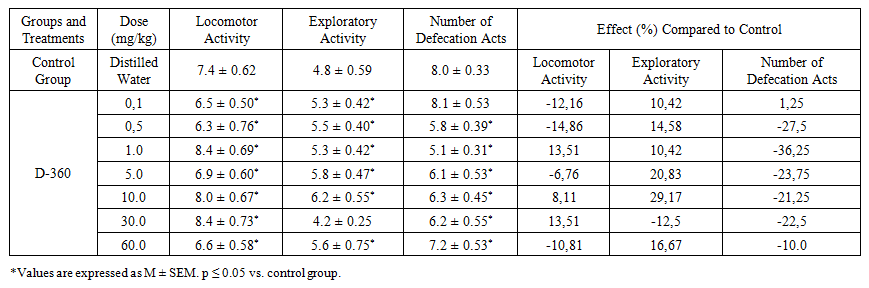 | Table 1. Assessment of the anxiolytic activity of D-360 substance in the Open field test |
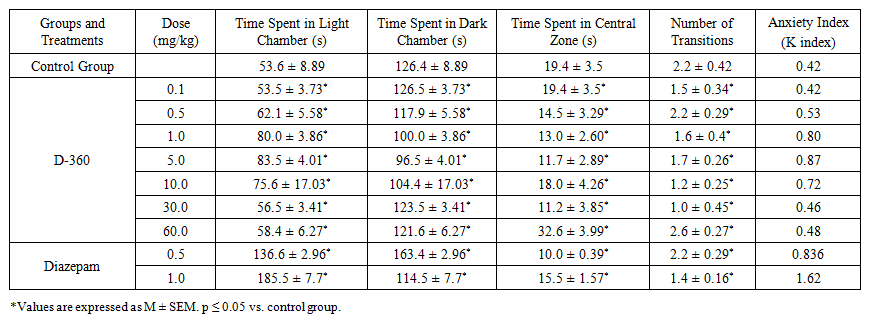 | Table 2. Assessment of the anxiolytic activity of D-360 substance in the Elevated plus maze |
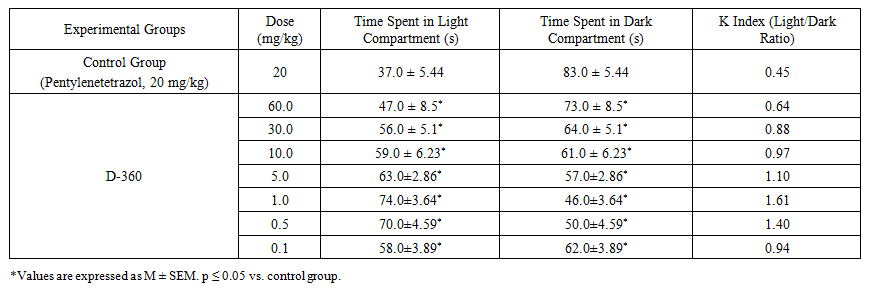 | Table 3. Assessment of the anxiolytic activity of D-360 on Anxiety-like Behaviour in the Pentylenetetrazol Model |
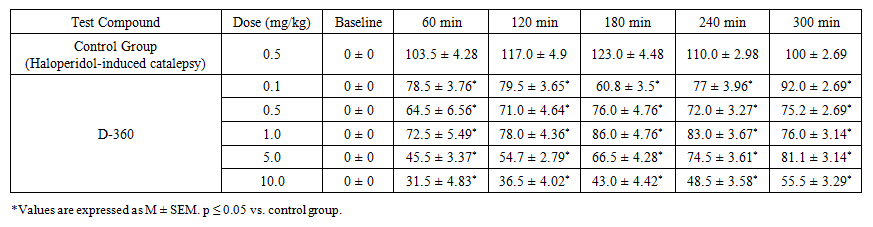 | Table 4. Effect of D-360 on Haloperidol-Induced Catalepsy |
5. Discussion
- The present study comprehensively evaluated the pharmacological profile of D-360, including its acute toxicity and neurobehavioral effects in several experimental models.The acute toxicity assessment demonstrated a relatively wide safety margin, as reflected by the LD₅₀ value. This finding indicates that the compound possesses moderate to low acute toxicity, which is an important prerequisite for further pharmacological development [14,15].In the Open Field test, D-360 produced dose-dependent alterations in locomotor and exploratory activity. Moderate doses increased exploratory behaviour without pronounced suppression of motor activity. The reduction in defecation acts at several dose levels suggests decreased anxiety-related autonomic responses. Importantly, the absence of marked locomotor inhibition indicates that the observed behavioural effects are unlikely to be attributable to sedation.In the Elevated Plus Maze model, D-360 increased time spent in the light/open compartment and elevated the K index at moderate doses, indicating a significant anxiolytic-like effect. Notably, the dose–response relationship demonstrated an inverted U-shaped pattern, with optimal effects observed at intermediate doses, while higher doses showed reduced efficacy. Such a pattern is frequently observed in central nervous system–active compounds.In the pentylenetetrazol-induced anxiety model, D-360 attenuated PTZ-induced anxiety-like behaviour, as evidenced by increased time in the light compartment and elevated light/dark ratio. These findings further support the compound’s anxiolytic potential under chemically induced stress conditions [9-11].Additionally, D-360 significantly reduced haloperidol-induced catalepsy. Since haloperidol-induced catalepsy is primarily associated with dopaminergic blockade in the nigrostriatal pathway, attenuation of this effect suggests that D-360 may modulate dopaminergic neurotransmission or exert neuroprotective properties without inducing extrapyramidal side effects [12,13].Taken together, the results obtained across multiple behavioural paradigms consistently indicate that D-360 exhibits pronounced anxiolytic activity with a favourable safety profile. The absence of significant motor suppression and the ability to counteract haloperidol-induced catalepsy further highlight its potential advantages over classical anxiolytic agents.Although the precise mechanism of action remains to be elucidated, the behavioural profile observed in this study suggests possible involvement of GABAergic and/or dopaminergic pathways. Further biochemical and receptor-binding studies are warranted to clarify the underlying mechanisms.
6. Conclusions
- The present study demonstrated that D-360 exhibits significant anxiolytic activity across multiple experimental models. The compound produced dose-dependent behavioural effects in the Open Field and Elevated Plus Maze tests, as well as in the pentylenetetrazol-induced anxiety model.Moderate doses showed the most pronounced anxiolytic effects without marked suppression of locomotor activity, indicating the absence of significant sedative properties. Additionally, D-360 attenuated haloperidol-induced catalepsy, suggesting a modulatory effect on dopaminergic pathways and a potentially favourable neurological safety profile.The calculated LD₅₀ value indicates a relatively wide therapeutic window, supporting the compound’s safety in acute exposure conditions.Overall, the obtained findings suggest that D-360 may represent a promising candidate for further pharmacological investigation as a potential anxiolytic agent [17,18].