
-
Paper Information
- Next Paper
- Previous Paper
- Paper Submission
-
Journal Information
- About This Journal
- Editorial Board
- Current Issue
- Archive
- Author Guidelines
- Contact Us
American Journal of Medicine and Medical Sciences
p-ISSN: 2165-901X e-ISSN: 2165-9036
2026; 16(4): 2022-2025
doi:10.5923/j.ajmms.20261604.94
Received: Mar. 24, 2026; Accepted: Apr. 15, 2026; Published: Apr. 25, 2026

Hepatic Antioxidant System in Experimental Paracetamol-Induced Toxic Hepatitis Under Conditions of Dehydration
 Abstract
 Reference
 Full-Text PDF
 Full-text HTML
Rajabova Nilufar Boymurod qizi, Axmedov Kamoliddin Hakimovich, Eshniyozov Sanjar Sirojiddin o’g’li, Suyunova Tumaris Abror qizi
Termez Branch of Tashkent State Medical University, Uzbekistan
Correspondence to: Rajabova Nilufar Boymurod qizi, Termez Branch of Tashkent State Medical University, Uzbekistan.
| Email: |  |
Copyright © 2026 The Author(s). Published by Scientific & Academic Publishing.
This work is licensed under the Creative Commons Attribution International License (CC BY).
http://creativecommons.org/licenses/by/4.0/

In an experimental study, the state of the hepatic antioxidant system was investigated in laboratory rats with paracetamol-induced toxic hepatitis under conditions of dehydration. It was found that paracetamol administration was accompanied by a decrease in superoxide dismutase activity, reflecting the development of oxidative stress. Dehydration led to an increase in enzyme activity as a compensatory response to hypovolemia and tissue hypoxia. When toxic exposure was combined with water deficit, an intermediate pattern of changes in antioxidant activity was observed. The obtained results confirm the important role of oxidative stress in the pathogenesis of toxic liver injury.
Keywords: Paracetamol, Toxic hepatitis, Dehydration, Oxidative stress, Superoxide dismutase, Antioxidant system, Experimental study, Liver
Cite this paper: Rajabova Nilufar Boymurod qizi, Axmedov Kamoliddin Hakimovich, Eshniyozov Sanjar Sirojiddin o’g’li, Suyunova Tumaris Abror qizi, Hepatic Antioxidant System in Experimental Paracetamol-Induced Toxic Hepatitis Under Conditions of Dehydration, American Journal of Medicine and Medical Sciences, Vol. 16 No. 4, 2026, pp. 2022-2025. doi: 10.5923/j.ajmms.20261604.94.
1. Introduction
- Drug-induced liver injury remains one of the most pressing problems in modern hepatology. Among numerous pharmacological agents, paracetamol occupies a special place due to its widespread use in clinical practice as an analgesic and antipyretic drug. When therapeutic doses are exceeded or in the presence of unfavorable factors, paracetamol can cause pronounced toxic liver damage associated with the formation of the reactive metabolite N-acetyl-p-benzoquinone imine (NAPQI), which initiates oxidative stress and hepatocellular injury [5].In the pathogenesis of paracetamol-induced toxic hepatitis, a key role is played by the imbalance between the generation of reactive oxygen species and the antioxidant defense system. One of the principal enzymes of the antioxidant system is superoxide dismutase (SOD), which ensures the neutralization of superoxide anion radicals and prevents free radical damage to cellular structures [3]. A decrease in the activity of this enzyme is considered an important marker of oxidative liver injury.In recent years, increasing attention has been paid to factors capable of modifying the course of toxic liver injury. One such factor is dehydration, which is accompanied by impaired microcirculation, hemoconcentration, and increased tissue hypoxia, potentially contributing to the activation of free radical oxidation processes and a reduction in the efficiency of the body’s antioxidant defense mechanisms [7].Experimental studies have shown that toxic exposure to paracetamol is associated with pronounced changes in the activity of antioxidant enzymes, including superoxide dismutase, catalase, and components of the glutathione system, reflecting the development of oxidative stress in hepatic tissue [8;10]. However, the influence of dehydration on the state of the antioxidant system in paracetamol-induced toxic hepatitis remains insufficiently investigated.In this regard, studying the activity of superoxide dismutase under conditions of combined exposure to paracetamol and dehydration is of considerable scientific and practical interest, as it may deepen the understanding of the mechanisms underlying toxic liver injury and contribute to the development of new approaches to its pathogenetic correction.Aim of the studyTo investigate the effect of dehydration on superoxide dismutase activity in paracetamol-induced toxic hepatitis.
2. Materials and Methods
- The study was conducted on laboratory white rats weighing 250–290 g, maintained under standard vivarium conditions: in metal cages at a temperature of 23 ± 1°C, relative humidity of 30–70%, and a 12/12 h light–dark cycle, with free access to standard laboratory feed in accordance with GLP requirements [1,2]. The animals were randomized into experimental groups consisting of six rats each.A model of paracetamol-induced toxic hepatitis was reproduced by intraperitoneal administration of paracetamol in increasing doses of 200, 300, and 600 mg/kg body weight for three consecutive days [4]. The control group received an equivalent volume of solvent according to the same protocol. Dehydration in the corresponding groups was initiated on the first day of the experiment and continued for three days, allowing the evaluation of the effect of water deficit on the severity of toxic liver injury. The experimental animals were divided into the following groups:1. Intact group — animals were maintained under standard conditions without paracetamol administration or dehydration modeling.2. Dehydration group (control-1) — animals were subjected to dehydration without paracetamol administration.3. Paracetamol group (PCM, control-2) — animals received paracetamol at the indicated doses without restriction of the water regimen.4. Paracetamol + dehydration group (experimental group) — animals received paracetamol in combination with experimentally induced dehydration.Immediately after the final administration of paracetamol, animals from all experimental groups were placed in metabolic cages for 24 hours to collect daily urine samples. At the end of this period, on the fourth day of the experiment, urinalysis was performed, after which blood samples were collected for subsequent laboratory analysis.At the end of the experimental period, the animals were euthanized under inhalation anesthesia, and the liver, kidneys, and spleen were excised. For biochemical analysis, tissue samples weighing 50 mg were homogenized in 30 μL of RIPA buffer on ice, followed by centrifugation at 10,000 g for 10–15 minutes at 4°C. The supernatant was collected and used for further analyses. Protein concentration was determined using the BCA assay, with subsequent normalization of enzymatic activity per mg of protein.The activity of total superoxide dismutase (T-SOD) was determined using the Servicebio® Total Superoxide Dismutase (T-SOD) Activity Assay Kit (WST-1 Method, Cat. No. G4306). The method is based on the inhibition of WST-1 reduction by superoxide anions in the presence of SOD; the intensity of the color reaction was measured at 450 nm. After incubation at 37°C, optical density was measured using a microplate reader ELMR-112. Enzyme activity was expressed as U/mg of protein.Statistical analysis of the obtained results was performed using analysis of variance (ANOVA) with a significance level of p = 0.05 using GraphPad Prism software version 8.0.0 for Windows (GraphPad Software, San Diego, CA, USA; www.graphpad.com) [12].
3. Results and Discussion
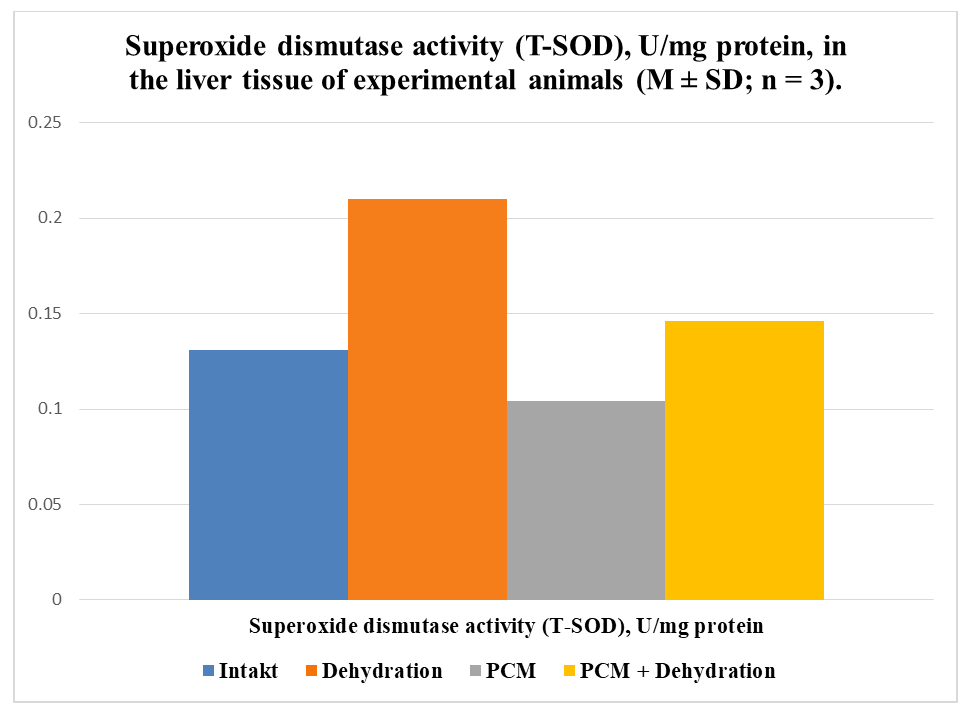
- The activity of superoxide dismutase (T-SOD) in liver tissue (Table 1) differed among the experimental groups. In the control group, the value was 0.131 ± 0.045 U/mg protein. In the dehydration group, an increase in T-SOD activity to 0.210 ± 0.025 U/mg protein was observed, which may reflect compensatory activation of the antioxidant system in response to water-deficit stress.
|

 | Figure 1 |
4. Conclusions
- The obtained results indicate that paracetamol-induced toxic liver injury is accompanied by pronounced disturbances in the antioxidant system, manifested by a decrease in superoxide dismutase activity in liver tissue. This reflects the development of oxidative stress associated with the formation of the reactive metabolite N-acetyl-p-benzoquinone imine (NAPQI) and the subsequent depletion of cellular antioxidant mechanisms.Under conditions of dehydration, an increase in T-SOD activity was observed, which may be considered a compensatory adaptive response of the organism to the enhanced generation of reactive oxygen species under hypovolemia and tissue hypoxia.When paracetamol-induced toxic hepatitis was combined with dehydration, an intermediate pattern of enzyme activity changes was detected. This finding suggests a complex interaction between toxic and stress-related factors influencing the state of the hepatic antioxidant defense system. The obtained data confirm the significant role of oxidative stress in the pathogenesis of toxic liver injury and demonstrate the modifying effect of dehydration on the severity of metabolic disturbances.Conclusions:1. Paracetamol-induced toxic liver injury is accompanied by a decrease in superoxide dismutase activity in liver tissue, indicating impairment of antioxidant defense and the development of oxidative stress.2. Dehydration leads to an increase in T-SOD activity, reflecting compensatory activation of antioxidant mechanisms in response to hypovolemia and enhanced production of reactive oxygen species.3. The combination of paracetamol-induced hepatitis with dehydration results in intermediate changes in enzyme activity, indicating the interaction between toxic liver injury and stress factors associated with water deficit.