American Journal of Medicine and Medical Sciences

p-ISSN: 2165-901X    e-ISSN: 2165-9036

2026;  16(4): 1983-1988

doi:10.5923/j.ajmms.20261604.86

Received: Apr. 3, 2026; Accepted: Apr. 20, 2026; Published: Apr. 23, 2026

 

Results from Analysis of Effectiveness of Modified TAPP Hernioplasty in Inguinal Hernia

Obidov Sh. Kh., Mamarajabov S. E.

Samarkand State Medical University, Samarkand, Uzbekistan

Correspondence to: Obidov Sh. Kh., Samarkand State Medical University, Samarkand, Uzbekistan.

Email:

Copyright © 2026 The Author(s). Published by Scientific & Academic Publishing.

This work is licensed under the Creative Commons Attribution International License (CC BY).
http://creativecommons.org/licenses/by/4.0/

Abstract

Inguinal hernia is one of the most prevalent ones in abdominal surgery, characterized by a high level of clinical and socioeconomic impact on pain, poor quality of life, and the risk of complications. The purpose of the study was to assess the relative effectiveness of modified transabdominal preperitoneal (TAPP) hernioplasty compared to the conventional TAPP and open Lichtenstein repair. An observational study was planned between 2022 and 2025, and comprised 252 patients with inguinal hernia, including three groups of patients with traditional TAPP (n=72), modified TAPP (n=70), and Lichtenstein repair (n=110). The baseline demographic and clinical variables, such as age, sex, body mass index, hernia size and type based on the EHS classification, were found to be similar across groups and therefore validity of the comparative analysis. The findings showed that modified TAPP technique exhibited a significant improvement in intraoperative performance as compared to traditional TAPP method, with a short operative time (69.8 vs 78.6 min), less intraoperative blood loss (9 vs 14 ml), and less peritoneal closure time. The Lichtenstein method was the least invasive in terms of operative time (58.7±14.8 min), yet, had much more blood loss (47 [28-74] ml), indicating more invasiveness. Intraoperative complications, such as peritoneal injury and conversion rates did not vary significantly. To sum up, the modified TAPP method is an enhanced form of the TAPP technique, which is more efficient and minimally invasive without compromising patient safety in comparison to other well-established methods.

Keywords: Inguinal hernia, TAPP, Modified TAPP, Lichtenstein repair, Intraoperative outcomes

Cite this paper: Obidov Sh. Kh., Mamarajabov S. E., Results from Analysis of Effectiveness of Modified TAPP Hernioplasty in Inguinal Hernia, American Journal of Medicine and Medical Sciences, Vol. 16 No. 4, 2026, pp. 1983-1988. doi: 10.5923/j.ajmms.20261604.86.

1. Introduction

Inguinal hernia is a type of surgery of the anterior abdominal wall, where the contents of the abdomen are pushed through the inguinal canal by the weakening of the anatomic structures of the abdominal wall congenitally or acquired [1,2]. It is a very common condition and it poses a serious clinical and socio-economic problem as well as pain, discomfort, diminished physical activity, impaired quality of life and the threat of imprisonment or even being strangled [3,4]. An inguinal hernia never goes away on its own and evolves to start as a small reducible bulge, which gradually grows to a symptomatic size and finally needs an operation to repair it [5,6].
Clinically, an inguinal hernia is defined by a specific group of symptoms, including the development of an inguinal bulge, pain or discomfort, the feeling of heavy, and the exacerbation of symptoms during physical activities, coughing, and straining. Sometimes, the pain can extend to the scrotum or thigh [7,8]. Difficult types of hernia can be accompanied with acute pain, irreducibility, intestinal obstruction or ischaemia, which necessitates immediate surgery [9]. Therefore, earlier surgical intervention is deemed better than wait-and-see intervention.
Instead, the standard evaluation of inguinal hernias is often performed according to the European Hernia Society (EHS) classification as it permits the assessment of the type of anatomy, location and size of the defect [10,11]. According to this classification inguinal hernias may be classified into lateral (indirect), medial (direct) and mixed hernias, each of which is different in anatomy, clinical implication, and surgical planning implications [11,12]. The lateral hernias run through the deep inguinal ring and are usually oblique, but medial hernias occur because of the weakness of the transverse fascia and are, therefore, able to enter through the posterior wall of the inguinal canal. The combination of the two mechanisms (pantalon hernias) means that the tissue weakness is more severe [12,13]. Moreover, the magnitude of the defect, according to the classification of the EOG, is of utility importance, as it determines the surgical procedure, mesh fixation plan and the probability of recurrence [14].
The special focus is on modified TAPP techniques that have been designed to optimize intraoperative practices, decrease the length of the surgery, decrease the time to close the abdominal cavity, decrease blood loss, and enhance long-term and postoperative results [11-13]. The perceived benefits of the modified TAPP procedure could be linked to the ability to better dissect the tissues, better fixation of the mesh, less manipulation in the inguinal area, and less likely to injure the nerve [15]. Therefore, a comparative evaluation of standard and modified TAPP techniques and their comparison with the Lichtenstein technique are of great clinical interest.
Accordingly, inguinal hernia could still be regarded as a burning problem of contemporary abdominal surgery, and the rationalisation of the methods is still a significant topic of study [16]. Evaluating the comparative effectiveness of modified TAPP hernioplasty in patients with inguinal hernias, one can not only determine its position among current surgical methods but also recognize some possible benefits in terms of postoperative pain reduction, decreased recovery period, a lower rate of complications, less risk of chronic pain and higher patient satisfaction rates [17-20]. The issue of which method proves to be more efficient i.e. modified TAPP or the traditional TAPP and the Lichtenstein technique, is a research question that is valid and important to the clinical sphere.

2. Materials and Methods

This potential observational clinical trial was to compare the efficacy of various surgical techniques in the management of inguinal hernia, both traditional and modified transabdominal preperitoneal (TAPP) hernioplasty, open tension-free hernioplasty as per Lichtenstein. The researchers carried out the study on the surgical departments of Samarkand State Medical University clinic in Samarkand during the period 2022-2025. The participants in the study were 252 patients who had a clinically confirmed diagnosis of inguinal hernia. The patients were separated into three clinical groups, depending on the surgical method applied. The main group consisted of 70 patients who underwent modified TAPP hernioplasty. The first group of comparison consisted of 72 patients who had been operated under the traditional TAPP technique and the second group of comparison consisted of 110 patients who had undergone open Lichtenstein hernioplasty. All of the patients were dynamically followed. All the patients were subjected to regular clinical examinations to determine the degree of pain syndrome, the character of clinical manifestations, the size and type of hernial defect, and the functional condition of the patient.
Inclusion criteria: Confirmed diagnosis of inguinal hernia; Age over 18 years; Principal or recurrent inguinal hernia; Signs of elective surgical treatment; Written consent to take part in the study.
Exclusion criteria: Incarcerated inguinal hernia; Severe decompensated comorbidities; Coagulation disorders; Malignant neoplasms; Failure to comply with an examination procedure; Declined to take part in the study.
Instrumental research methods. In clinical examination, the inguinal area was examined by inspecting and palpating it with evaluation of the size of the hernial protrusion, its reducibility, the availability of cough impulse, and whether it was unilateral or bilateral. To standardize the assessment of hernias, the European Hernia Society (EHS) classification was used.
Ultrasound of the inguinal areas was carried out as required to explain the size of the hernial defect, the appearance of the hernial contents and the appearance of the surrounding tissues. The accuracy of diagnosis improved with the application of this method particularly in clinical cases that were doubtful. Patients were evaluated in terms of functional status through the use of standardized scales. The visual analog scale (VAS) was used to measure pain intensity.
The parameters used intraoperative parameters were the length of surgery, the amount of blood loss, the rate of intraoperative complications, and the characteristics of mesh implant fixation. Such technical aspects of the intervention as the way of mesh fixation and the details of the work with the peritoneum during laparoscopic hernioplasty were analyzed independently.
Laboratory research methods. Lab tests were done to objectively determine the somatic condition of patients and preoperative risk. Samples were taken in the morning on an empty stomach (812 hours of fasting) in 57 ml venous blood with the consideration of the standard preanalytical conditions. Complete blood count was done using an automatic hematology analyzer and included the level of hemoglobin (130160 g/L in men and 120140 g/L in women), leukocytes (4.090x10⁹/L), and platelets (150400x109/L). Biochemical blood analysis was performed on an automatic analyzer and measured glucose (3.95mmol/L), creatinine (62106mmol/L), urea (2.583mmol/L), total protein (6585g/L), bilirubin (521mmol/L) and ALT, AST (<40U/L). In addition, prothrombin time (11-15 s), INR (0.8-1.2), and APTT (25-35 s) were determined in all patients.
Statistical analysis. Variation statistics was used to evaluate the obtained results. The method of moments was used to obtain the arithmetic mean and the standard error. The Shapiro-Wilk test was used to check the hypothesis of normal distribution of the random variable. Student t -test was used to compare the quantitative variables that have normal distribution in two groups. For non-normally distributed data or ordinal variables, non-parametric tests such as ANOVA, Kruskal-Wallis, and Mann-Whitney U tests were used. All statistical calculations were carried out in R Studio version 4.3.2, Windows 10, with a significance level of p<0.05. The R packages that were used were epiDisplay, qwraps2, tidyverse, rstatix, ggpubr, and ggplot2. The 95% confidence intervals were used to present the results.

3. Results

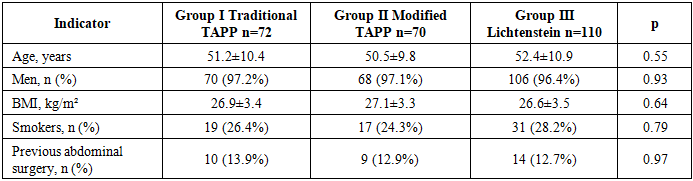
The comparative demographic characteristics of patients across the study groups are presented in Table 1. The analysis demonstrated no statistically significant differences between the groups, confirming their homogeneity and supporting the validity of subsequent comparative evaluation of surgical outcomes.
Table 1. Comparative demographic characteristics of patients with inguinal hernia in study groups
     
The traditional TAPP group (51.2±10.4 years), the modified TAPP group (50.5±9.8 years), and the Lichtenstein group (52.4±10.9 years) did not have statistically significant differences in the age distribution in each group (p=0.55). This shows that the age profile of the patients at the baseline was the same in all the cohorts. The gender composition was also similar with majority of the patients in all groups being male with 97.2, 97.1 and 96.4 % in groups I, II, and III, respectively. The lack of considerable differences (p=0.93) proves the homogeneity of the sample and indicates the familiar epidemiological trend of inguinal hernia.
There was no significant difference in the body mass index of the groups with mean BMI of 26.9+3.4kg/m2, 27.1+3.3kg/m2 and 26.6+3.5kg/m2 of group I, II and III respectively (p=0.64). This shows that there is no great difference in the nutritional status of the study populations. Similarly, there were no significant differences in prevalence of smoking among the groups with 26.4, 24.3 and 28.2 in group I, II and III respectively (p=0.79). This factor can be compared, which makes it possible to exclude smoking as the possible confounder affecting postoperative outcomes.
The number of prior abdominal surgeries was also comparable that reached 13.9% in the traditional TAPP group, 12.9 in the modified TAPP group and 12.7 in the Lichtenstein group (p=0.97). This also validates equal allocation of surgical history and reduces the effect of surgical history on the study findings. The baseline clinical characteristics were also similar among the groups. There were no significant differences in the distribution of the hernia defect size in the EHS classification, and medium and large hernias were found in 27.8, 27.1, and 30.0% of patients in the group I, II, and III, respectively (p=0.89), which showed similar anatomical severity. Moreover, the %age of patients at low anesthetic risk (ASA I-II) was also consistently high in all the groups, with 84.7, 85.7 and 82.7 being the %ages of patients who were at low anesthetic risk, respectively (p=0.86), indicating a similar baseline clinical condition.
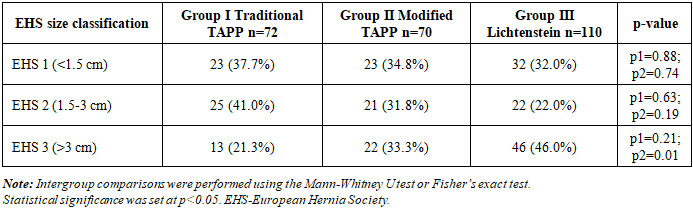
The comparison showed that there were no statistically significant differences in the distribution of small hernia defects (EHS less than 1.5 cm) in the groups (table 2).
Table 2. Comparative analysis of defect size according to EHS classification across study groups
     
In particular, in 37.7% of the patients in the traditional TAPP group, 34.8% in the modified TAPP group, and 32.0% in the Lichtenstein group, there were insignificant differences between groups in the number of small defects (p one = 0.88; p two = 0.74). The same tendency was noted in the case of medium-sized defects (EHS 1.5-3 cm). In the traditional TAPP group, the percentage of patients with medium defects was 41.0% versus 31.8% and 22.0% in the modified TAPP and Lichtenstein groups respectively. Although these differences were numbically different, they were not statistically significant (p 1=0.63; p 2=0.19), which means that the distributions were similar in the groups. On the whole, the results indicate that the study groups were mostly similar in respect of the size distribution of hernia defects, which substantiates the validity of additional comparative analysis of the results of surgical processes.
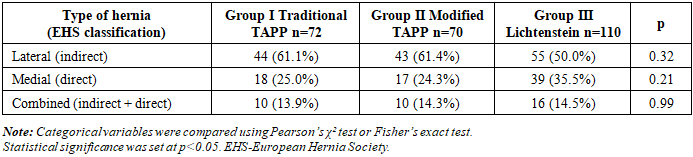
Table 3 presents the comparative analysis of clinical types of inguinal hernia as per EHS classification among the study groups. The findings indicate that there are homogenous morphological features of the hernia process before surgical intervention in all groups. The distribution of lateral (indirect) inguinal hernias, that occur anatomically lateral to the inferior epigastric vessels and run through the deep inguinal ring, did not differ significantly among the groups.
Table 3. Classification of clinical types of inguinal hernia in study groups according to EHS
     
The hernias were found in 61.1 percent of patients who were in the traditional TAPP group, 61.4 percent in the modified TAPP group and 50.0 percent in the Lichtenstein group with no statistically significant differences (p=0.32). The same tendency was found in the case of medial (direct) hernias, which originate medial to the inferior epigastric vessels because of the weakness of the posterior wall of the inguinal canal in the Hesselbach triangle. Direct hernia was 25.0 in the traditional TAPP group, 24.3 in the modified TAPP group, and 35.5 in the Lichtenstein group with no statistically significant differences (p=0.21). The proportion of combined hernias, the presence of both lateral and medial elements on both sides of the inferior epigastric vessels, was also comparable in the groups.
This type was seen in 13.9 percent of patients in group I, 14.3 percent in group II and 14.5 percent in group III with no significant differences (p=0.99). These results demonstrate similar structural patterns of hernia process, but mixed forms are generally connected with more severe tissue weakness which demands extensive reinforcement of the posterior wall of inguinal canal. In general, the lack of statistically significant differences proves that the groups of study were homogeneous regarding clinical types of inguinal hernia, which makes the comparative evaluation of methods of surgery after it valid.
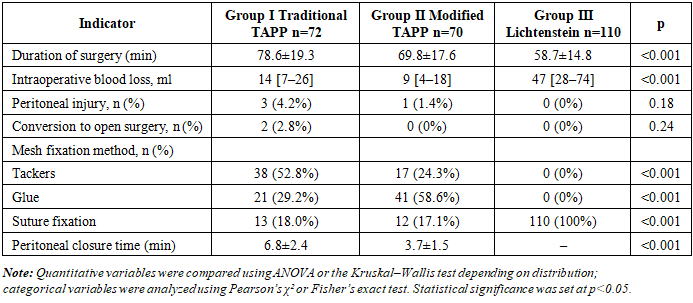
Table 4 presents the comparative analysis of the intraoperative parameters in the patients with inguinal hernia, reflecting the technical aspects and invasiveness of the various methods of hernioplasty. There was a significant difference in the length of surgery between the groups. The average time spent operating in the traditional TAPP group and modified TAPP group were 78.6 ±19.3 minutes and 69.8 ±17.6 minutes, respectively, and the Lichtenstein procedure was carried out much faster, the average time being 58.7 ±14.8 minutes (p<0.001). The modified TAPP method saved about 9.6 minutes of time than the traditional method but the open Lichtenstein repair was the shortest time-consuming method.
Table 4. Comparative analysis of intraoperative parameters in study groups
     
There were also statistically significant differences in intraoperative blood loss. The median blood loss was 14 [726] ml in the traditional TAPP group and 9 [418] ml in the modified TAPP group, and the maximum blood loss was recorded between the Lichtenstein groups of 47 [2874], (p<0.001). These results show that laparoscopic surgeries especially the modified TAPP technique are linked with a greatly reduced intraoperative blood loss as compared to open surgery. There was no significant difference in the incidence of intraoperative peritoneal injury in the traditional and modified TAPP groups (4.2 and 1.4 cases, respectively), but none in the Lichtenstein group (p=0.18). Correspondingly, conversion to open surgery was only noted in the conventional TAPP group in 2.8% of cases, and not in the other groups, but this was not statistically significant (p=0.24).
Conversely, the fixation techniques of mesh were found to differ significantly. Tackers were more common in the traditional TAPP group (52.8) than in the modified TAPP group (24.3) and no use in the Lichtenstein group (p<0.001). On the other hand, the use of glue fixation was more frequently used in the modified TAPP group (58.6) compared to the traditional TAPP (29.2) (p<0.001), which is indicative of a change in surgery. Traditional and modified TAPP groups had 18.0% and 17.1% cases of suture fixation respectively, compared to the Lichtenstein group (p<0.001) which had 100% cases. Peritoneal closure time was also significantly different with an average of 6.8±2.4 minutes in the traditional TAPP and 3.7±1.5 minutes in the modified TAPP (p=0.001) which was considered to optimize this step in the surgery.

4. Conclusions

The comparison of the study groups was based on similar baseline demographic and clinical features, which provided methodological validity of the outcomes comparison. Compared to the conventional TAPP, the modified TAPP technique exhibited a better intraoperative performance, with decreased operation time, reduced blood losses, and superior peritoneal closure. The Lichtenstein technique had the shortest length of operation, however, it was also accompanied by a much higher level of blood loss which means it was more invasive. The safety profiles of all surgical methods were similar, and there was no significant difference in the intraoperative complications.

References

[1]  Zidan MH, AlSayed M, Maged M, Altabbaa H, Hadhoud AM, Hussein MA, et al. Short-term outcomes of robotic versus laparoscopic TAPP for inguinal hernia repair: a systematic review, meta-analysis, and GRADE assessment. J Robotic Surg. 2026 Apr 6; 20(1): 419. doi: 10.1007/s11701-026-03335-3.
[2]  Verheij M, Abdalla AE, Chandran P. Comparative review of outcomes of totally extraperitoneal (TEP) and transabdominal preperitoneal (TAPP) primary inguinal hernia repair. Cureus [Internet]. 2023 [cited 2026 Apr 10]; 15(12). Available from: https://www.cureus.com/articles/211132-comparative-review-of-outcomes-of- totally-extraperitoneal-tep-and-transabdominal-preperitoneal-tapp-primary-inguinal-hernia-repair.pdf.
[3]  Rasador ACD, Da Silveira CAB, Ballecer C, Mazzola Poli De Figueiredo S. Transabdominal Preperitoneal (TAPP) versus intraperitoneal onlay Mesh (IPOM) for ventral hernia repair – an updated systematic review and meta-analysis. Hernia. 2025 Feb 15; 29(1): 93. doi: 10.1007/s10029-025-03271-5.
[4]  Oliveira Carneiro A, Rocca WRC, Gonçalves LB, Mazzola Poli De Figueiredo S. Laparoscopic totally extraperitoneal (TEP) versus laparoscopic transabdominal preperitoneal (TAPP) for bilateral inguinal hernia repair: a systematic review and meta-analysis. Hernia. 2026 Jan 9; 30(1): 59. doi: 10.1007/s10029-025-03515-4.
[5]  Morales-Conde S, Balla A, Navarro-Morales L, Moreno-Suero F, Licardie E. Is laparoscopic TAPP the preferred approach for the treatment of inguinal hernia? Technique, indications and future perspectives. Cirugía Española (English Edition). 2023; 101: S11–8.
[6]  Iossa A, Traumueller Tamagnini G, De Angelis F, Micalizzi A, Lelli G, Cavallaro G. TEP or TAPP: who, when, and how? Frontiers in surgery. 2024; 11: 1352196.
[7]  Coco D, Leanza S. Outcomes of Transabdominal Preperitoneal (TAPP) Inguinal Hernia Repair: A Narrative Review: TAPP. British Journal Of Surgical Science [Internet]. 2026 [cited 2026 Apr 10]; 6(1). Available from: https://www.britishjournalofsurgicalscience.uk/index.php/bjoss/article/view/34.
[8]  Andresen K, Rosenberg J. Transabdominal pre-peritoneal (TAPP) versus totally extraperitoneal (TEP) laparoscopic techniques for inguinal hernia repair. Cochrane Database of Systematic Reviews [Internet]. 2024 [cited 2026 Apr 10]; (7). Available from: https://www.cochranelibrary.com/cdsr/doi/10.1002/14651858.CD004703.pub3/abstract.
[9]  Aiolfi A, Cavalli M, Micheletto G, Lombardo F, Bonitta G, Morlacchi A, et al. Primary inguinal hernia: systematic review and Bayesian network meta-analysis comparing open, laparoscopic transabdominal preperitoneal, totally extraperitoneal, and robotic preperitoneal repair. Hernia. 2019 Jun; 23(3): 473–84. doi: 10.1007/s10029-019-01964-2.
[10]  Abdelsamad A, Khalil I, Mohamed KA, Ahmed Said Serour AS, Mohammed MK, Mostafa N, et al. “Comparative safety and efficacy of robotic TAPP and IPOM techniques in ventral hernia repair: a systematic review and meta-analysis of Short-term Outcomes.” Hernia. 2025 Aug 19; 29(1): 255. doi: 10.1007/s10029-025-03454-0.
[11]  Usmani SUR, Sultan SMMB, Islam MB, Abbas S, Choudhry MS. TAPP versus lichtenstein techniques for bilateral inguinal hernia repair: A systematic review and meta-analysis. Updates Surg. 2024 Nov; 76(7): 2583–91. doi: 10.1007/s13304-024-02012-0.
[12]  Scheuermann U, Niebisch S, Lyros O, Jansen-Winkeln B, Gockel I. Transabdominal Preperitoneal (TAPP) versus Lichtenstein operation for primary inguinal hernia repair – A systematic review and meta-analysis of randomized controlled trials. BMC Surg. 2017 Dec; 17(1): 55. doi: 10.1186/s12893-017-0253-7.
[13]  Riemenschneider KA, Lund H, Pommergaard HC. No evidence for fixation of mesh in laparoscopic transabdominal preperitoneal (TAPP) inguinal hernia repair: a systematic review and meta-analysis of randomized controlled trials. Surg Endosc. 2023 Nov; 37(11): 8291–300. doi: 10.1007/s00464-023-10237-0.
[14]  Maatouk M, Kbir GH, Mabrouk A, Rezgui B, Dhaou AB, Daldoul S, et al. Can ventral TAPP achieve favorable outcomes in minimally invasive ventral hernia repair? A systematic review and meta-analysis. Hernia. 2022 Nov 15; 27(4): 729–39. doi: 10.1007/s10029-022-02709-4.
[15]  Delgado LM, Pompeu BF, Magalhães CM, Pasqualotto E, Barbosa WS, Poli De Figueiredo SM. Shouldice Versus TAPP for Inguinal Hernia Repair: A Systematic Review and Meta‐Analysis of Randomized Controlled Trials. World j surg. 2025 Apr; 49(4): 859–67. doi: 10.1002/wjs.12514.
[16]  Correia De Sá T, Jácome F, Basto T, Costa M, Gonçalves Á, Teixeira N, et al. Transabdominal preperitoneal (TAPP) repair for emergency groin hernia: a systematic review. Hernia. 2024 Mar 24; 28(4): 1005–15. doi: 10.1007/s10029-024-03018-8.
[17]  Bittner R, Schwarz J. Primary unilateral not complicated inguinal hernia: our choice of TAPP, why, results and review of literature. Hernia. 2019 Jun; 23(3): 417–28. doi: 10.1007/s10029-019-01959-z.
[18]  Andreou C, Maksimovic S, Riboni C, Eisner L, Kudsi OY, Dietz UA. Laparoscopic TAPP to treat inguinal hernia. Is the robot preferable? A review and cohort-study on anatomical landmarks of robotic-assisted transabdominal preperitoneal groin hernia repair (r-TAPP). Cirugía Española. 2023; 101: S3–10.
[19]  Aiolfi A, Cavalli M, Del Ferraro S, Manfredini L, Lombardo F, Bonitta G, et al. Total extraperitoneal (TEP) versus laparoscopic transabdominal preperitoneal (TAPP) hernioplasty: systematic review and trial sequential analysis of randomized controlled trials. Hernia. 2021 Oct; 25(5): 1147–57. doi: 10.1007/s10029-021-02407-7.
[20]  Aiolfi A, Cavalli M, Del Ferraro S, Manfredini L, Bonitta G, Bruni PG, et al. Treatment of inguinal hernia: systematic review and updated network meta-analysis of randomized controlled trials. Annals of surgery. 2021; 274(6): 954–61.