
-
Paper Information
- Next Paper
- Previous Paper
- Paper Submission
-
Journal Information
- About This Journal
- Editorial Board
- Current Issue
- Archive
- Author Guidelines
- Contact Us
American Journal of Medicine and Medical Sciences
p-ISSN: 2165-901X e-ISSN: 2165-9036
2026; 16(4): 1931-1934
doi:10.5923/j.ajmms.20261604.76
Received: Mar. 2, 2026; Accepted: Mar. 28, 2026; Published: Apr. 18, 2026

Hygienic Assessment of Daily Diet of Workers
 Abstract
 Reference
 Full-Text PDF
 Full-text HTML
Ermatov Nizom Jumakulovich1, Ortikov Bobomurod Baymamatovich2
1DSc, Professor Department of Hygiene of Children, Adolescents and Nutrition, Tashkent State Medical University, Tashkent, Uzbekistan
2PhD, Associate Professor Department of Hygiene of Children, Tashkent State Medical University, Tashkent, Uzbekistan
Correspondence to: Ermatov Nizom Jumakulovich, DSc, Professor Department of Hygiene of Children, Adolescents and Nutrition, Tashkent State Medical University, Tashkent, Uzbekistan.
| Email: |  |
Copyright © 2026 The Author(s). Published by Scientific & Academic Publishing.
This work is licensed under the Creative Commons Attribution International License (CC BY).
http://creativecommons.org/licenses/by/4.0/

This study examined seasonal variations in workers’ dietary intake and their adequacy in terms of essential macronutrients, including proteins, fats, and carbohydrates. The findings revealed significant seasonal differences in nutrient composition. Protein intake remained below physiological requirements throughout the year, with the lowest level recorded in spring (98.4 g). Fat consumption demonstrated seasonal variability, exceeding recommended levels in winter (139.5 g) while remaining below the norm during summer and autumn. Daily energy intake reached its highest value in winter (3303.4 kcal) and its lowest in spring (3096.2 kcal); however, in all seasons it failed to meet established physiological standards. Carbohydrate intake was below the recommended level in winter and spring (563.7–583.7 g) but exceeded it in summer and autumn (661.3–674.9 g).
Keywords: Mine workers, Seasonal diet, Protein, Fat, Carbohydrate, Energy value
Cite this paper: Ermatov Nizom Jumakulovich, Ortikov Bobomurod Baymamatovich, Hygienic Assessment of Daily Diet of Workers, American Journal of Medicine and Medical Sciences, Vol. 16 No. 4, 2026, pp. 1931-1934. doi: 10.5923/j.ajmms.20261604.76.
1. Introduction
- The rational organization of workers’ nutrition plays a crucial role in maintaining their health status, improving labor efficiency, and sustaining overall productivity. Employees engaged in hazardous industrial environments are particularly exposed to elevated physical and psychological strain, which consequently increases their physiological requirements for essential nutrients, including proteins, fats, carbohydrates, vitamins, and minerals [1,4,10].Within occupational health studies, evaluating the seasonal adequacy of macronutrient intake is of significant importance. Nutritional imbalances or deficiencies may adversely affect workers’ physical performance, fatigue resistance, immune function, and productivity levels. Therefore, assessing dietary macronutrient composition in comparison with established physiological standards enables the identification of nutritional shortcomings and supports the development of season-specific dietary recommendations [17].Effective prevention of occupational diseases related to industrial exposure largely depends on well-structured medical and preventive strategies. Among these, continuous nutritional monitoring and quality improvement are particularly essential. In contemporary practice, comprehensive approaches aimed at optimizing workers’ diets are increasingly recognized as important tools for minimizing the harmful effects of occupational risk factors. In this regard, the development and application of functional foods represent a promising direction for reducing the negative impact of workplace hazards [3,11,13].Furthermore, evidence indicates that despite awareness of healthy eating principles, many workers fail to consistently follow dietary recommendations. Studies conducted in the United States demonstrate that sustained educational and behavioral support is necessary to promote healthier nutritional practices and reduce the burden of chronic diseases [5,9,12].Across Europe, more than one-fifth of the workforce is involved in shift work, which is associated with an increased risk of chronic health conditions. However, adherence to a healthy lifestyle may alleviate some of these risks. Research has shown that working schedules significantly influence dietary patterns independently of socio-demographic characteristics such as educational attainment. Given the heightened vulnerability of shift workers, integrating nutrition counseling and lifestyle guidance into occupational health programs is essential [7,14,16].Studies carried out in Uzbekistan have revealed that the dietary patterns of industrial workers are often characterized by excessive consumption of fats and carbohydrates alongside insufficient intake of vitamins and minerals. Such imbalances may lead to decreased work capacity, greater fatigue, and an elevated likelihood of both chronic and occupation-related diseases [2,6,8].The aim of the study The objective of this research is to perform a hygienic assessment of the daily dietary patterns of workers engaged in potassium production.
2. Materials and Methods
- Within the framework of this study, the daily dietary intake of workers employed at the mining complex of a potassium plant was assessed across the cold (winter–spring) and warm (summer–autumn) seasons during 2023–2025 using specially designed survey questionnaires. The collected data were analyzed statistically using the Statistica for Windows 7.0 software package.
3. Results
- The hygienic composition of the daily dietary intake—including protein, fat, carbohydrate content, and total energy value—was evaluated among 528 workers employed at the mining complex of the Potassium Plant located in Dehqonobod district, Qashqadaryo region. The findings of the assessment are presented in Figure 1.
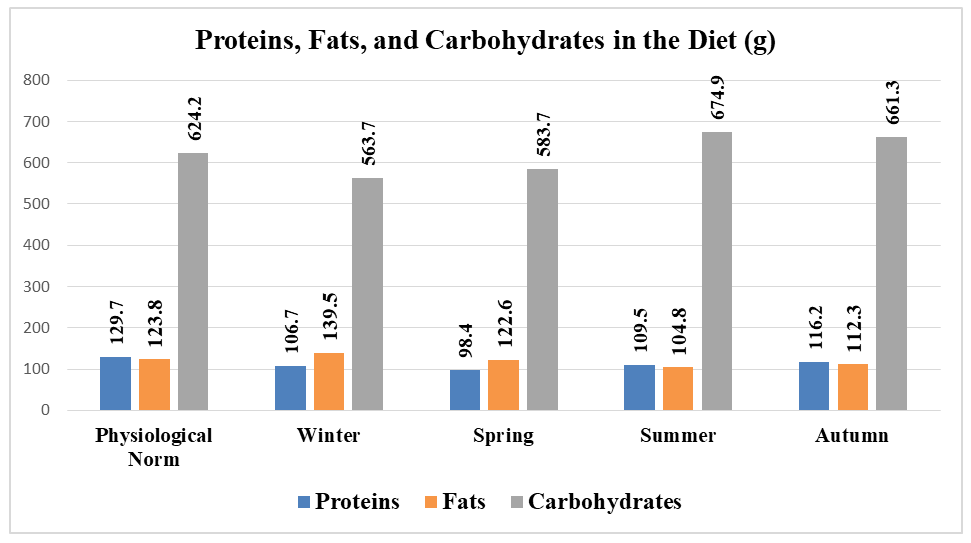 | Figure 1. Average Daily Intake of Key Vitamins in Workers’ Diets |
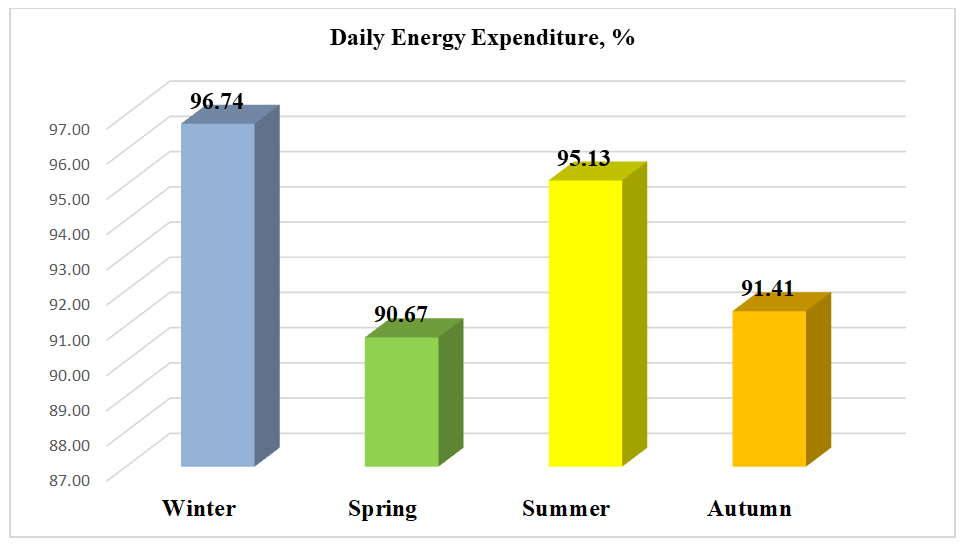 | Figure 2. Seasonal Daily Energy Expenditure of Workers |
4. Conclusions
- The findings of the study demonstrate a seasonal imbalance in the dietary patterns of workers. Protein intake remained consistently below physiological requirements across all seasons, indicating a persistent deficiency. Fat consumption exceeded recommended levels during winter but fell below the norm in summer and autumn. Carbohydrate intake surpassed physiological standards in summer and autumn, whereas it was insufficient in winter and spring. Furthermore, the analysis of energy intake revealed that daily caloric consumption did not fully meet physiological demands, ranging from 90.67% to 96.74% of the recommended level, with the most significant deficits observed in spring and autumn.Overall, the workers’ diets were characterized by both macronutrient inadequacy and seasonal imbalance. These results underscore the need to optimize nutritional provision to ensure adequate intake of essential nutrients and energy throughout the year.
5. Recommendations
- To improve the nutritional adequacy of workers’ diets, it is essential to increase the intake of protein-rich foods while ensuring a balanced consumption of fats and carbohydrates. In particular, during the spring and autumn seasons, dietary energy content should be enhanced to compensate for identified caloric deficits. Furthermore, nutrition planning should account for seasonal variations by increasing the inclusion of foods rich in vitamins and minerals. Strengthening dietary monitoring systems and promoting healthy eating practices are also necessary to support optimal nutritional status among workers.