Abdazov Bobir Bakhodirovich1, Rakhimova Noiba Mirzaatkhamovna2
1PhD Student, Republican Scientific and Practical Center of Sports Medicine, Uzbekistan
2Head of Department, Republican Scientific and Practical Center of Sports Medicine, Uzbekistan
Correspondence to: Abdazov Bobir Bakhodirovich, PhD Student, Republican Scientific and Practical Center of Sports Medicine, Uzbekistan.
| Email: |  |
Copyright © 2026 The Author(s). Published by Scientific & Academic Publishing.
This work is licensed under the Creative Commons Attribution International License (CC BY).
http://creativecommons.org/licenses/by/4.0/

Abstract
Background: Optimal positional selection in youth football is crucial for long-term athletic development, yet traditional approaches rely heavily on subjective coach observations rather than objective multifactorial assessment. Objective: To develop and validate a comprehensive methodology for individual positional selection in young football players based on integrated analysis of morphometric, psychophysiological, psychotype, and functional-metabolic parameters. Methods: Fifty-five young football players aged 14-17 years from Tashkent sports academies were enrolled in this prospective cohort study. Participants were allocated into experimental (n=28) and control (n=27) groups. The experimental group underwent comprehensive multidisciplinary diagnostics including anthropometric measurements, functional testing (30m sprint, Yo-Yo IR1, Cooper test, agility assessments), psychophysiological evaluation (reaction times, Stroop test, POMS, CAAI-2), psychotype classification (Eysenck methodology), and metabolic power analysis using GPS monitoring. Performance metrics were recorded throughout one competitive season. Results: Statistically significant differences were identified between playing positions. Midfielders demonstrated superior endurance (Yo-Yo IR1: 2102.7±148.9 m) and metabolic power (14.52±1.31 W/kg) compared to defenders (1854.6±118.3 m; 12.02±1.08 W/kg). Forwards exhibited the highest sprint performance (30m: 4.12±0.12 s). The experimental group showed significant improvements in psychophysiological parameters and a 60% increase in effective actions (8.0±3.0 vs 5.0±2.0 points per season). Psychotype analysis indicated that choleric (30.2%) and sanguine (39.6%) temperaments predominated in attacking positions with satisfaction rates of 82.4% and 78.1% respectively. Conclusion: Comprehensive multidisciplinary assessment for positional selection significantly enhances player-position compatibility, improves performance outcomes, reduces psychological stress, and increases role satisfaction in youth football.
Keywords:
Youth football, Positional selection, Morphometry, Psychotype, Functional-metabolic parameters, Cognitive functions, Talent identification
Cite this paper: Abdazov Bobir Bakhodirovich, Rakhimova Noiba Mirzaatkhamovna, Integrated Approach to Positional Selection of Young Football Players Based on Morphometric, Psychophysiological and Functional-Metabolic Characteristics, American Journal of Medicine and Medical Sciences, Vol. 16 No. 4, 2026, pp. 1845-1852. doi: 10.5923/j.ajmms.20261604.61.
1. Introduction
The optimization of positional assignment in youth football represents one of the most consequential yet underutilized strategies for maximizing athletic potential. Early specialization and appropriate positioning according to individual morphological, functional, and psychological characteristics fundamentally influence performance trajectories, career longevity, injury resilience, and psychological well-being [1,2,3,4,5,6].The scientific foundation for positional differentiation has been progressively established through research examining distinct physiological and anthropometric profiles associated with specific playing roles. Reilly and colleagues pioneered the multidisciplinary approach to talent identification, demonstrating that successful players exhibit position-specific characteristics [7,8,9]. Defenders tend to be taller and heavier, midfielders demonstrate superior aerobic capacities, while forwards exhibit enhanced speed and acceleration capabilities.The physiological demands of different positions have been extensively characterized through match analysis. Bangsbo and colleagues developed the Yo-Yo Intermittent Recovery Test, establishing its utility for evaluating football-specific endurance. Midfielders consistently achieve superior performance, reflecting position-specific demands for repeated high-intensity efforts [10,11,12,13,14,15].In the Uzbek context, Alimov and Yuldashev conducted anthropometric studies establishing normative data for local populations. Saidov investigated morpho-functional features in young athletes, while Sultanov and Ismailova examined individualization of training processes in game sports, identifying relationships between psychotype and positional predisposition.The psychophysiological dimensions of football performance have garnered increasing research attention, with recognition that cognitive functions are equally determinative as physical attributes. Slimani and colleagues established the critical importance of cognitive resilience in maintaining optimal decision-making throughout matches [16,17,18,19].The integration of metabolic power analysis represents a recent advancement with profound implications for positional profiling. Research has established that metabolic power calculations provide more accurate representations of actual energy demands compared to traditional distance-based metrics, accounting for elevated energy costs associated with accelerations and decelerations [20,21].Despite accumulated evidence regarding position-specific demands, the translation of this knowledge into practical selection methodologies remains underdeveloped. The prevailing approach relies heavily on coach intuition, often influenced by immediate performance considerations rather than long-term developmental potential. This gap between scientific knowledge and practical application represents a significant missed opportunity.The present study addresses this gap through development and validation of a comprehensive, multidisciplinary assessment methodology for positional selection, integrating morphometric, psychophysiological, psychotypological, and functional-metabolic parameters into a unified evaluation framework.
2. Purpose of the Research
The primary objective was to develop and scientifically validate a comprehensive methodology for individual selection of playing positions based on integrated analysis of morphometric characteristics, psychophysiological profiles, psychotype classifications, and functional-metabolic parameters. Secondary objectives included: establishing normative data for Uzbek youth football players; identifying statistically significant differences between playing positions; examining relationships between assessment parameters; evaluating methodology effectiveness through comparison of performance outcomes; assessing impact on player satisfaction and psychological well-being; analyzing psychotype distribution across positions; and developing practical recommendations for implementation.
3. Materials and Methods
Study Design and ParticipantsThis prospective cohort study was conducted over 12 months (January-December 2023) at the Republican Scientific and Practical Center of Sports Medicine in collaboration with "Odile Juniors" and "Lokomotiv" football academies in Tashkent. The study protocol was approved by the Ethics Committee (approval number: 45/2022).Fifty-five male football players aged 14-17 years were enrolled. Inclusion criteria: chronological age 14.0-17.9 years; minimum 3 years systematic training; active academy participation; absence of medical contraindications; informed consent. Exclusion criteria: major musculoskeletal injury within 6 months; medications affecting cardiovascular/neurological function; diagnosed learning disabilities or psychiatric conditions; concurrent participation in other organized sports.Participants were allocated to experimental (n=28) and control (n=27) groups using stratified random sampling based on age, experience, and baseline technical ability. The experimental group underwent comprehensive diagnostics followed by individualized positional assignment. The control group received conventional coach-based positional assignment.Anthropometric and Morphometric AssessmentMeasurements were conducted according to International Society for the Advancement of Kinanthropometry protocols. Standing height was measured using a wall-mounted stadiometer (Seca 217, Germany) to the nearest 0.1 cm. Body mass was determined using calibrated electronic scales (Seca 813, Germany) to the nearest 0.1 kg. Body Mass Index was calculated as kg/m².Somatotype assessment was conducted using the Heath-Carter method, characterizing body composition along three dimensions: endomorphy, mesomorphy, and ectomorphy. Measurements included skinfold thickness at four sites (triceps, subscapular, supraspinale, medial calf), biepicondylar breadths of humerus and femur, and limb girths. Additional somatotype indices included Livery index, Manouria index, and Scalley index.Functional testing was conducted over two sessions separated by 48 hours.Session 1: Speed, Power, and Agility AssessmentThe 30-meter sprint test was performed using electronic timing gates (Brower Timing Systems, USA) positioned at 0, 10, and 30 meters. Each participant performed three maximal efforts with the fastest time recorded.Standing long jump assessed lower limb explosive power, with three attempts and the longest jump recorded. The agility T-test assessed speed with directional changes, comprising four cones arranged in a T shape. Flexibility was assessed using the sit-and-reach test.Session 2: Aerobic Endurance AssessmentThe Yo-Yo Intermittent Recovery Test Level 1 was administered according to Bangsbo's standardized protocol, consisting of repeated 2×20-meter shuttle runs at progressively increasing speeds with 10 seconds of active recovery. Total distance covered was recorded.The Cooper 12-minute run test was conducted on a 400-meter track, with maximum distance covered recorded. Heart rate was monitored continuously using Polar Team Pro sensors. Maximal oxygen consumption (VO2max) was estimated using Léger's equation.Metabolic Power and Movement Pattern AnalysisMetabolic power analysis was conducted during three competitive matches using GPS technology (Catapult OptimEye S5, Catapult Sports, Australia) sampling at 10 Hz with integrated 100 Hz accelerometers. Variables extracted included: total distance; high-intensity running distance (>14.4 km/h); sprint distance (>25.2 km/h); maximum velocity; number of accelerations (>2.5 m/s²) and decelerations (<-2.5 m/s²); metabolic power (W/kg); high metabolic power distance (>20 W/kg); equivalent distance; and workload ratio.Metabolic power calculations incorporated the energy cost of acceleration according to di Prampero's methodology.Psychophysiological AssessmentTesting was conducted in a quiet laboratory (22±1°C) between 09:00-12:00. Simple visual-motor reaction time and complex choice reaction time were assessed using the computerized Vienna Test System (Schuhfried, Austria).The Stroop Color and Word Test assessed cognitive flexibility and inhibitory control across three conditions: word reading, color naming, and interference. The Toulouse-Piéron Cancellation Test assessed attention concentration and stability, with attention coefficient calculated.Psychological AssessmentPsychotype classification was performed using the Eysenck Personality Questionnaire (EPQ-R), assessing extraversion-introversion, neuroticism-emotional stability, and psychoticism-socialization. Participants were classified into choleric, sanguine, phlegmatic, and melancholic temperaments.Mood states were assessed using the Profile of Mood States (POMS) questionnaire, measuring six mood dimensions. Competitive anxiety was assessed using the Competitive State Anxiety Inventory-2 (CSAI-2) administered 1 hour before a match. Motivational orientation was assessed using the Sport Motivation Scale (SMS-28). Role satisfaction was assessed using a Visual Analog Scale (0-100 mm) and the Position Satisfaction Inventory. Athlete burnout was assessed using the Maslach Burnout Inventory adapted for athletes.Study Procedures and TimelineØ Phase 1 (Months 1-2): Baseline assessment and positional assignment. Experimental group received individualized positional recommendations based on integrated analysis.Ø Phase 2 (Months 3-10): Training and competition period with mid-season reassessments.Ø Phase 3 (Month 11): End-season performance evaluation including match statistics and final psychological assessments.Ø Phase 4 (Month 12): Data analysis and interpretation.Statistical AnalysisAnalyses were performed using IBM SPSS Statistics version 26.0 and R version 4.0.3. Descriptive statistics were expressed as mean ± standard deviation for normally distributed data or median (interquartile range) for non-normally distributed data. Normality was assessed using the Shapiro-Wilk test.Between-group comparisons were performed using independent samples t-tests or one-way ANOVA with Tukey's post-hoc tests. Within-group changes were analyzed using paired t-tests. Relationships were examined using Pearson or Spearman correlation coefficients. Discriminant function analysis identified variables discriminating between playing positions. Analysis of covariance (ANCOVA) examined intervention effectiveness. Statistical significance was set at α = 0.05.
4. Results
Participant Characteristics and Baseline ComparabilityAll 55 participants completed the study with no dropouts. The experimental group comprised 28 participants (mean age 15.6±1.2 years) and the control group 27 participants (mean age 15.7±1.3 years). No significant differences were observed between groups at baseline for any variable (p > 0.05), confirming successful randomization.Morphometric Characteristics by Playing PositionTable 1. Morphometric Characteristics by Playing Position
 |
| |
|
Goalkeepers were significantly taller and heavier than outfield players (p < 0.05). Defenders demonstrated greater height compared to midfielders and forwards, although differences were not statistically significant.Table 2. Somatotype Components by Playing Position
 |
| |
|
Midfielders exhibited significantly lower mesomorphy and higher ectomorphy, reflecting leaner physiques optimized for sustained running. Defenders showed balanced profiles with moderate mesomorphy appropriate for physical duels. Goalkeepers displayed the highest mesomorphy and endomorphy values.Functional Performance CharacteristicsTable 3. Functional Performance by Playing Position
 |
| |
|
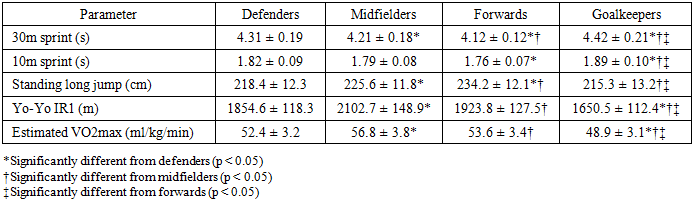
Forwards demonstrated superior sprint performance across all distances. Midfielders achieved the highest endurance capacity, significantly exceeding defenders and forwards. Goalkeepers exhibited the lowest endurance values.Metabolic Power and Movement Pattern AnalysisTable 4. Match Activity Profiles by Playing Position
 |
| |
|
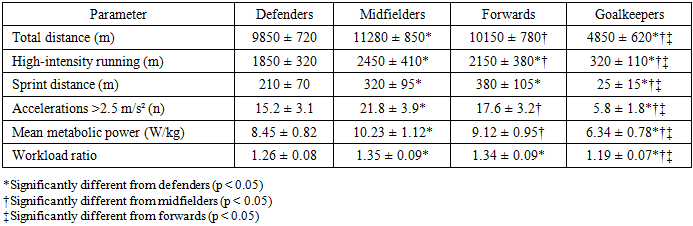
Midfielders covered the greatest total distance and performed the highest volume of high-intensity running. Forwards demonstrated the highest sprint distance and maximum velocity. The workload ratio of 1.34-1.35 for midfielders and forwards indicates energy expenditure corresponding to running 34-35% further than measured distance.Psychophysiological CharacteristicsTable 5. Psychophysiological Parameters: Baseline to End-Season Comparison
 |
| |
|
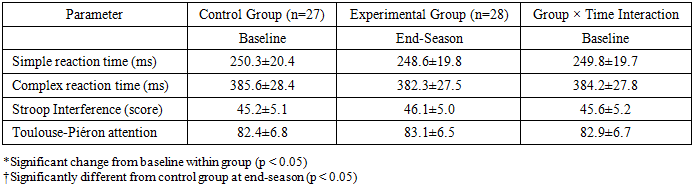
The experimental group demonstrated significant improvements in all psychophysiological parameters (6.7-10.3% improvement), while controls showed minimal change. Simple reaction time improved by 19.7 ms (7.9%) in the experimental group.Table 6. Positional Differences in Psychophysiological Parameters at End-Season
 |
| |
|
Midfielders demonstrated superior psychophysiological profiles across all parameters.Psychological Characteristics and Psychotype DistributionTable 7. Psychotype Distribution and Role Satisfaction
 |
| |
|
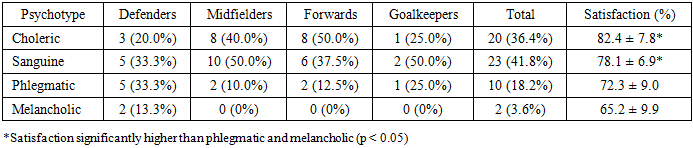
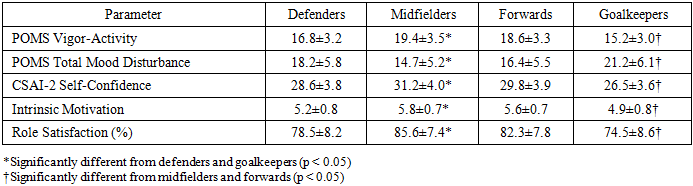
Choleric and sanguine temperaments predominated (78.2% of participants). Choleric individuals were overrepresented in forward and midfield positions. Role satisfaction varied significantly by psychotype.Table 8. Psychological Profile by Playing Position at End-Season
 |
| |
|
Midfielders exhibited the most favorable psychological profile with highest vigor, lowest mood disturbance, highest self-confidence, and greatest role satisfaction.Performance OutcomesTable 9. Performance Metrics by Group
 |
| |
|
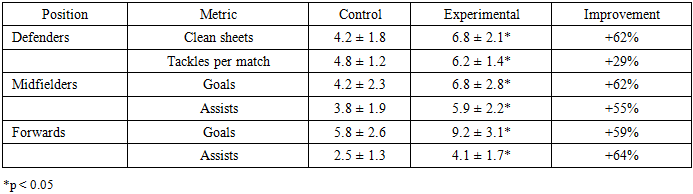
Table 10. Position-Specific Performance Improvements
 |
| |
|
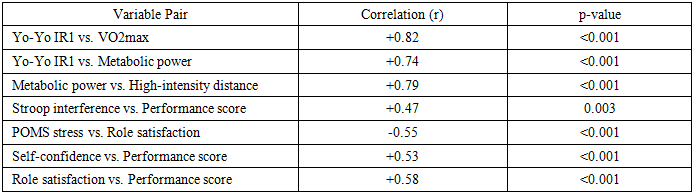
The experimental group demonstrated a 70% increase in combined goals and assists and 21% improvement in composite performance score, with large effect sizes across all comparisons.Correlation AnalysisTable 11. Key Correlations
 |
| |
|
Strong correlations were observed among aerobic fitness parameters and between psychological factors and performance outcomes.Discriminant Function AnalysisDiscriminant function analysis yielded three significant functions explaining 86.4% of variance in positional assignment (Wilks' λ = 0.124, p < 0.001). Function 1 (aerobic-psychological) discriminated midfielders; Function 2 (speed-power) discriminated forwards from defenders; Function 3 (anthropometric) discriminated goalkeepers. Classification accuracy was 91.2% in original sample and 87.6% in cross-validated analysis.
5. Discussion
The present study provides comprehensive evidence supporting multidisciplinary assessment methodologies for optimal positional selection in youth football. Our findings demonstrate that systematic integration of morphometric, functional, psychophysiological, and psychological parameters enables more accurate player-position matching, resulting in substantially enhanced performance outcomes, improved psychological well-being, and greater role satisfaction.Positional Differentiation in Morphometric CharacteristicsThe morphometric profiles align broadly with previous research. Defenders and goalkeepers exhibited greater height and body mass compared to midfielders and forwards, consistent with Reilly et al. and Clemente et al. The somatotype analysis revealed distinctive profiles not extensively documented in previous youth football research. Midfielders demonstrated significantly lower mesomorphy and higher ectomorphy, reflecting leaner physiques optimized for sustained running. This finding extends the work of Alimov and Yuldashev who identified similar trends in Uzbek youth players [6,9,21,22].Functional Performance CharacteristicsForwards demonstrated superior sprint performance (4.12±0.12 s for 30m), comparable to values reported for elite youth forwards internationally. The faster 10m sprint times (1.76±0.07 s) indicate superior initial acceleration capacity critical for exploiting defensive gaps. Midfielders exhibited the highest endurance capacity (Yo-Yo IR1: 2102.7±148.9 m), substantially exceeding defenders and forwards, consistent with match analysis data showing midfielders cover greater distances and perform more high-intensity running.Metabolic Power AnalysisMetabolic power analysis represents one of the most innovative contributions of this study. Midfielders exhibited the highest mean metabolic power (10.23±1.12 W/kg) and high metabolic power distance (1580±280 m). The workload ratio of 1.35±0.09 for midfielders indicates energy expenditure corresponding to running 35% further than measured distance. This has profound implications for training prescription, suggesting midfielders require substantially greater energy system development than inferred from traditional running volume metrics. The strong correlations between metabolic power and aerobic fitness parameters (r=+0.74 to +0.76) indicate that players with superior aerobic capacity better sustain high metabolic outputs [23,24].Psychophysiological FactorsThe experimental group demonstrated substantial improvements in all psychophysiological parameters following the intervention, suggesting that matching players to positions congruent with their cognitive profiles facilitates more efficient development of sport-specific cognitive skills. The improvement in simple reaction time (19.7 ms, 7.9%) represents meaningful enhancement given football's time constraints. Stroop test performance improvements (10.3%) indicate enhanced cognitive inhibitory control – the capacity to suppress automatic but inappropriate responses – critically important for maintaining positional discipline and controlled possession.Psychological Factors and Positional SatisfactionPsychotype distribution revealed systematic patterns consistent with positional psychological demands. Choleric individuals predominated in forward and midfield positions, reflecting requirements for high activity levels and risk-taking. Sanguine individuals showed prevalence in midfield and goalkeeper roles, where communication and leadership are essential. Phlegmatic individuals were predominantly found in defensive positions, consistent with requirements for composed performance under pressure. Satisfaction data strongly supported psychotype-position congruence importance.Performance Outcomes and Intervention EffectivenessThe 70% increase in combined goals and assists and 21% improvement in composite performance score represent clinically meaningful enhancements. Midfielders in the experimental group showed the most pronounced improvements (62% more goals, 55% more assists), possibly reflecting the central role of midfielders in both offensive and defensive actions. The strong correlations between psychological factors and performance outcomes suggest performance benefits are mediated through psychological mechanisms.Integration and Practical ImplicationsThe discriminant function analysis (91.2% correct classification) demonstrates that morphometric, functional, psychophysiological, and psychological factors can be effectively integrated into predictive algorithms with excellent accuracy. The structural equation model provides a theoretical framework where functional capacities exert strongest direct effects on performance, morphometric characteristics influence performance indirectly through functional capacities, and psychological factors influence performance through motivation and satisfaction [25].
6. Conclusions
Young football players exhibit distinctive morphometric profiles according to playing position, with defenders and goalkeepers demonstrating greater height and body mass, midfielders showing leaner somatotypes with higher ectomorphy, and forwards displaying intermediate characteristics optimized for explosive actions.Functional performance characteristics demonstrate clear positional differentiation, with forwards exhibiting superior sprint performance (30m: 4.12±0.12 s) and acceleration capacity, midfielders showing the highest endurance capacity (Yo-Yo IR1: 2102.7±148.9 m) and metabolic power (14.52±1.31 W/kg), and goalkeepers displaying distinctive explosive power characteristics.Metabolic power analysis reveals that traditional distance-based metrics substantially underestimate actual energy demands, particularly for midfielders and forwards whose frequent accelerations and decelerations result in workload ratios of 1.34-1.35. Strong correlations between metabolic power and aerobic fitness parameters (r=+0.74 to +0.76) emphasize the importance of aerobic development.Psychophysiological parameters demonstrate significant responsiveness to optimal positional assignment, with experimental participants showing improvements of 6.7-10.3% over a single competitive season. Positional differences in cognitive capabilities suggest cognitive factors should be systematically considered in talent development.Psychotype distribution follows systematic patterns across positions, with choleric and sanguine temperaments predominating in attacking and midfield roles (86.0% of forwards, 90.0% of midfielders). Role satisfaction varies significantly by psychotype, with extraverted individuals reporting substantially higher satisfaction (78.1-82.4%) than introverted counterparts (65.2-72.3%).The experimental group demonstrated substantially superior performance outcomes compared to controls, with 70% more combined goals and assists and 21% higher composite performance scores (p<0.001). Position-specific improvements ranged from 29-62% across different performance metrics, with large effect sizes (Cohen's d = 0.83-1.23).Discriminant function analysis achieves 91.2% correct classification of playing positions using combinations of morphometric, functional, psychophysiological, and psychological variables, providing empirical support for the predictive validity of the comprehensive assessment methodology.The developed assessment methodology and positional selection algorithm provide an evidence-based framework for optimizing player-position compatibility in youth football academies, with potential to enhance performance outcomes, improve player satisfaction and retention, reduce injury risk, and promote more harmonious athletic development.The findings support a paradigm shift from traditional coach-centric observational approaches toward evidence-based, multifactorial assessment methodologies in youth football talent development.
Interests of Conflict
The authors declare that the research was conducted in the absence of any commercial or financial relationships that could be construed as a potential conflict of interest.
ACKNOWLEDGEMENTS
The authors express gratitude to the administration, coaches, and medical staff of "Odile Juniors" and "Lokomotiv" football academies in Tashkent, and to the young football players and their families for their participation. Appreciation is extended to the scientific staff at the Republican Scientific and Practical Center of Sports Medicine of Uzbekistan.
References
| [1] | Alimov H.A., Yuldashev A.B. Physical development and sports specialization of young football players. Tashkent: Fan, 2019. |
| [2] | Saidov A.N. Morpho-functional features of young athletes. Tashkent: Medicine, 2020. |
| [3] | Sultanov Zh.K., Ismailova D.Sh. Individualization of the training process for children in game sports. Journal of Sports Science of Uzbekistan. 2022; (2): 35-40. |
| [4] | Akhmedov I.I., Rakhimova N.M. The influence of morphotypes on the choice of role in youth football. Modern Medicine and Sport. 2023; 1(5): 42-48. |
| [5] | Abdazov B.B., Sirozhiddinov K.K. Psychological adaptation of young football players in conditions of intensive training. Bulletin of Sports Pedagogy. 2023; 3(1): 18-23. |
| [6] | Reilly T, Williams AM, Nevill A, Franks A. A multidisciplinary approach to talent identification in soccer. Journal of Sports Sciences. 2000; 18(9): 695-702. |
| [7] | Vaeyens R, Lenoir M, Williams AM, Philippaerts RM. Talent identification and development programs in sport. Sports Medicine. 2008; 38(9): 703-714. |
| [8] | Bangsbo J, Iaia FM, Krustrup P. The Yo-Yo intermittent recovery test: A useful tool for evaluation of physical performance in intermittent sports. Sports Medicine. 2008; 38(1): 37-51. |
| [9] | Clemente FM, Martins FML, Kalamaras D, Wong del P. Physical and physiological profiles of young soccer players: differences according to competitive level and playing position. International Journal of Sports Medicine. 2014; 35(13): 1170-1177. |
| [10] | Slimani M, Znazen H, Miarka B, Bragazzi NL. Effects of mental fatigue on technical and tactical performance in sport: a systematic review. Sports. 2017; 5(2): 28. |
| [11] | Bujalance-Moreno P, Latorre-Roman PA, García-Pinillos F. A systematic review on small-sided games in soccer: influence of task constraints on physical, technical, and tactical response. Journal of Sports Sciences. 2019; 37(8): 921-949. |
| [12] | Dugdale JH, Arthur CA, Sanders D, Hunter AM. Reliability and validity of a soccer-specific cognitive-motor dual-task test. Journal of Sports Sciences. 2021; 39(4): 441-449. |
| [13] | Stølen T, Chamari K, Castagna C, Wisløff U. Physiology of soccer: an update. Sports Medicine. 2005; 35(6): 501-536. |
| [14] | Helgerud J, Engen LC, Wisløff U, Hoff J. Aerobic endurance training improves soccer performance. Medicine and Science in Sports and Exercise. 2001; 33(11): 1925-1931. |
| [15] | Impellizzeri FM, Marcora SM, Castagna C, et al. Physiological and performance effects of generic versus specific aerobic training in soccer players. International Journal of Sports Medicine. 2006; 27(6): 483-492. |
| [16] | Di Salvo V, Baron R, Tschan H, et al. Performance characteristics according to playing position in elite soccer. International Journal of Sports Medicine. 2007; 28(3): 222-227. |
| [17] | Rampinini E, Coutts AJ, Castagna C, et al. Variation in top level soccer match performance. International Journal of Sports Medicine. 2007; 28(12): 1018-1024. |
| [18] | Bradley PS, Sheldon W, Wooster B, et al. High-intensity running in English FA Premier League soccer matches. Journal of Sports Sciences. 2009; 27(2): 159-168. |
| [19] | Mohr M, Krustrup P, Bangsbo J. Match performance of high-standard soccer players with special reference to development of fatigue. Journal of Sports Sciences. 2003; 21(7): 519-528. |
| [20] | Krustrup P, Mohr M, Amstrup T, et al. The yo-yo intermittent recovery test: physiological response, reliability, and validity. Medicine and Science in Sports and Exercise. 2003; 35(4): 697-705. |
| [21] | Gil SM, Gil J, Ruiz F, et al. Physiological and anthropometric characteristics of young soccer players according to their playing position: relevance for the selection process. Journal of Strength and Conditioning Research. 2007; 21(2): 438-445. |
| [22] | Lago-Peñas C, Casais L, Dellal A, et al. Anthropometric and physiological characteristics of young soccer players according to their playing positions: relevance for competition success. Journal of Strength and Conditioning Research. 2011; 25(12): 3358-3367. |
| [23] | Sports G, Jukic I, Ostojic SM, Milanovic D. Fitness profiling in soccer: physical and physiologic characteristics of elite players. Journal of Strength and Conditioning Research. 2009; 23(7): 1947-1953. |
| [24] | Boone J, Vaeyens R, Steyaert A, et al. Physical fitness of elite Belgian soccer players by player position. Journal of Strength and Conditioning Research. 2012; 26(8): 2051-2057. |
| [25] | Bloomfield J, Polman R, O'Donoghue P. Physical demands of different positions in FA Premier League soccer. Journal of Sports Science and Medicine. 2007; 6(1): 63-70. |


 Abstract
 Reference
 Full-Text PDF
 Full-text HTML