R. Ya. Hayaliev, S. A. Tadjiev
Republican Scientific and Practical Center of Sports Medicine, Tashkent State Medical University, Multidisciplinary International Clinic "Surgemed", Uzbekistan
Copyright © 2026 The Author(s). Published by Scientific & Academic Publishing.
This work is licensed under the Creative Commons Attribution International License (CC BY).
http://creativecommons.org/licenses/by/4.0/

Abstract
The aim of the study was to evaluate the efficacy and safety of high-energy yellow laser photocoagulation compared with conventional electrocautery in the surgical treatment of laryngeal and tracheal papillomatosis. Background. Laryngeal and tracheal papillomatosis (LTP), a manifestation of recurrent respiratory papillomatosis caused mainly HPV types 6 and 11, is characterized by a chronic relapsing course requiring repeated surgical interventions. Conventional surgical techniques, including electrocautery, are associated with thermal tissue damage, bleeding, and scar formation, potentially compromising functional outcomes. Materials and Methods. The study included an experimental and a clinical phase. Experimental investigations were conducted on animal models (rabbits and minipigs) to determine optimal laser parameters and assess tissue response using histological analysis. The clinical study involved 45 patients with primary or recurrent LTP treated between 2022 and 2026. Patients were divided into two groups: electrocautery (n=25) and laser photocoagulation using a 580 nm high-energy yellow laser (n=20). Surgical outcomes, postoperative course, complications, recurrence rates, and recurrence-free survival were analyzed. Results. Laser photocoagulation significantly reduced operative time (18.6±3.4 vs. 24.3±4.1 min; p<0.01), intraoperative bleeding (5% vs. 16%; p<0.05), and the need for additional hemostasis (5% vs. 24%; p<0.05). Patients in the laser group demonstrated a more favorable postoperative course, with lower rates of pain (20% vs. 44%), mucosal edema (25% vs. 48%), and dysphonia (15% vs. 36%) (p<0.05). Hospital stay was significantly shorter (2.3±0.5 vs. 3.1±0.7 days; p<0.01). At 24 months, recurrence rates were significantly lower in the laser group (10% vs. 20%; p<0.05). Kaplan–Meier analysis showed longer recurrence-free survival (median 18.4 vs. 14.1 months; p<0.05). The incidence of postoperative scarring was also reduced. Conclusion. High-energy yellow laser photocoagulation provides superior clinical outcomes compared to electrocautery in the treatment of LTP. The technique ensures precise tissue ablation, improved hemostasis, reduced postoperative morbidity, and prolonged recurrence-free intervals. These findings support the broader clinical implementation of high-energy laser technologies in airway papillomatosis surgery.
Keywords:
Laryngeal papillomatosis, Tracheal papillomatosis, Laser surgery, Photocoagulation, HPV, Recurrence
Cite this paper: R. Ya. Hayaliev, S. A. Tadjiev, High-Energy Yellow Laser in the Treatment of Laryngeal and Tracheal Papillomatosis, American Journal of Medicine and Medical Sciences, Vol. 16 No. 4, 2026, pp. 1745-1749. doi: 10.5923/j.ajmms.20261604.41.
1. Introduction
Laryngeal and tracheal papillomatosis (LTP), a clinical manifestation of recurrent respiratory papillomatosis, is a rare yet clinically significant disease characterized by the growth of multiple benign epithelial tumors within the airway, predominantly associated with human papillomavirus (HPV) types 6 and 11 [1-2]. The disease affects both pediatric and adult populations and is notable for its recurrent and often aggressive clinical course, necessitating repeated surgical interventions [3].Despite being histologically benign, LTP can lead to substantial morbidity, including progressive airway obstruction, voice impairment, and, in rare cases, malignant transformation [4-5]. The recurrent nature of the disease significantly impacts patients’ quality of life and imposes a considerable burden on healthcare systems.Surgical excision remains the cornerstone of treatment. Traditional techniques, such as electrocautery, although widely available, are associated with several limitations, including collateral thermal injury, intraoperative bleeding, and postoperative scarring, which may impair laryngeal function [6-7].In recent years, laser technologies have gained increasing attention due to their ability to provide precise and controlled tissue ablation with minimal damage to surrounding structures [8]. Of particular interest are yellow-spectrum lasers (≈580 nm), which exhibit strong absorption by hemoglobin, enabling selective photothermolysis of vascularized lesions. This property allows effective coagulation of papilloma vasculature while preserving adjacent tissues [9].Several studies have demonstrated that laser-based approaches reduce recurrence rates and improve functional outcomes compared to conventional methods [10-12]. Additionally, laser photocoagulation is associated with reduced postoperative inflammation and faster recovery [13].However, despite promising results, clinical data on the use of high-energy yellow lasers remain limited, and the optimal surgical approach for LTP continues to be debated [14-15].The aim of this study was to evaluate the efficacy and safety of high-energy yellow laser photocoagulation compared to conventional electrocautery in patients with laryngeal and tracheal papillomatosis.
2. Materials and Methods
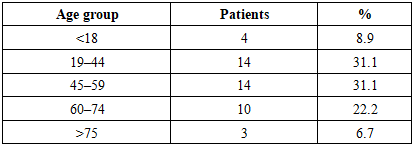
To investigate the possibilities of mucosal destruction in the larynx and trachea using lasers of different spectral ranges and to determine optimal exposure parameters preventing scarring and recurrence, an initial experimental study was conducted.The experimental part was performed in 2024 at the Laboratory of Experimental Surgery of the Republican Specialized Scientific and Practical Medical Center of Surgery named after Academician V. Vakhidov. Outbred rabbits and minipigs were used as experimental animals. The animals were maintained under controlled vivarium conditions with ventilation and temperature regulation (21–23°C).The study evaluated laser radiation in two spectral ranges: infrared (1.46 μm) and visible yellow light (580 nm). Tissue response, depth of injury, and healing dynamics were assessed. Histological analysis allowed determination of optimal laser parameters ensuring effective tissue destruction with minimal risk of scarring.This prospective clinical study was conducted at the SurgeMed clinic between January 2022 and April 2026. A total of 45 patients diagnosed with laryngeal or tracheal papillomatosis were included.Inclusion criteria• confirmed diagnosis of papillomatosis• age >14 years• availability for long-term follow-upExclusion criteria• malignant transformation• severe comorbidities preventing surgery• incomplete follow-up dataPatient characteristics. The mean patient age was 33.2±1.5 years (range 14–76 years) (Table 1).Table 1. Age distribution
 |
| |
|
Patients were divided into two groups:Control group (n=25) - Papillomas removed using electrocautery.Laser group (n=20) - Papillomas removed using high-energy yellow laser (DENAVE OPTISCAN, 580 nm) (Figure 1).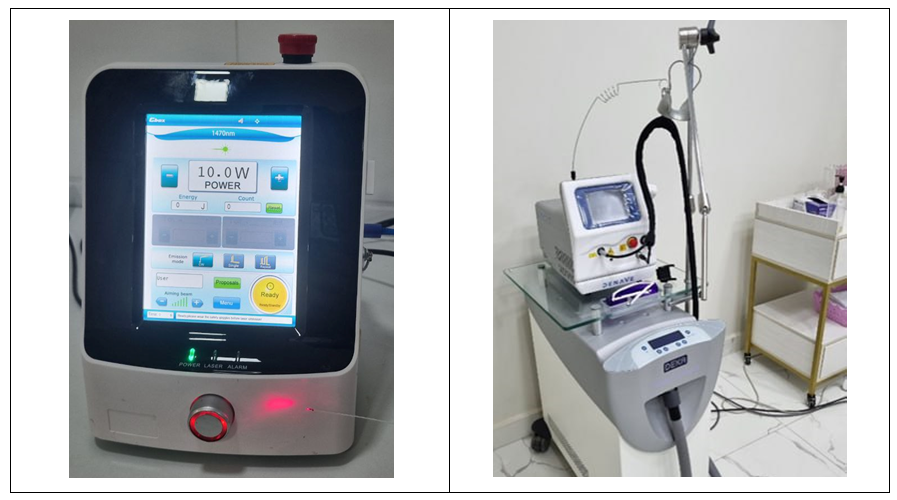 | Figure 1. DENAVE OPTISCAN |
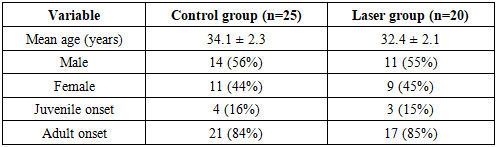
All procedures were performed under general anesthesia with endotracheal intubation using flexible laryngotracheobronchoscopy.Laser parametersLaser photocoagulation was performed using the following parameters:• Power: 3–4 W• Pulse duration: 30–100 ms• Fiber diameter: 400 μmThe laser fiber was inserted through the working channel of the bronchoscope.Statistical analysisStatistical analysis was performed using standard statistical methods.Quantitative variables were expressed as mean ± standard deviation (SD).Comparisons between groups were performed using:• Student’s t-test• Chi-square test• Kaplan–Meier survival analysis• Log-rank testStatistical significance was defined as p<0.05.Patients demographic characteristics is performed in Table 2.Table 2. Patients demographic characteristics
 |
| |
|
3. Results
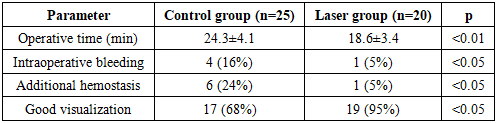
In the main group, laser energy was delivered via a 400 μm optical fiber inserted through the bronchoscope channel. The exposure parameters were adjusted individually depending on lesion size and location.Laser photocoagulation resulted in characteristic blanching of papillomatous tissue, indicating protein coagulation and tissue destruction. Intraoperative bleeding was minimal or absent, which significantly improved visualization of the surgical field.In the control group, electrocautery achieved adequate tissue destruction; however, moderate bleeding and more pronounced thermal damage were observed, complicating visualization and prolonging the procedure.Analysis of intraoperative parameters demonstrated that laser use significantly reduced operative time and intraoperative bleeding (p<0.05) (Table 3).Table 3. Intraoperative parameters
 |
| |
|
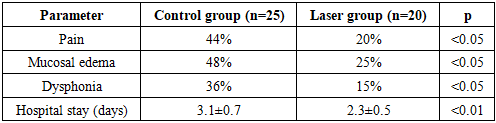
In the early postoperative period, patients in the laser group experienced less pain, reduced mucosal edema, and lower incidence of dysphonia. Hospital stay was also shorter in this group (Table 4).Table 4. Early postoperative outcomes
 |
| |
|
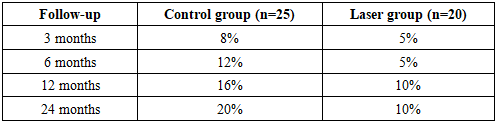
Patients treated with laser photocoagulation experienced significantly faster postoperative recovery. Long-term follow-up (24 months) revealed a recurrence rate of 10% in the main group compared to 20% in the control group (Table 5, Figure 2).Table 5. Recurrence rate
 |
| |
|
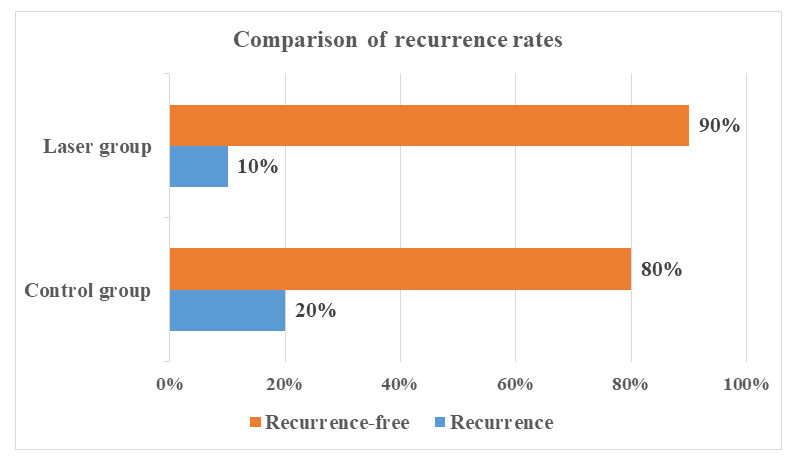 | Figure 2. Comparison of recurrence rates between treatment groups after 24 months of follow-up |
Mean recurrence-free survival:Control group — 14.1 monthsLaser group — 18.4 monthsKaplan–Meier analysis showed a significantly longer recurrence-free survival in the laser group (median 18.4 months vs. 14.1 months; p<0.05) (Figure 3).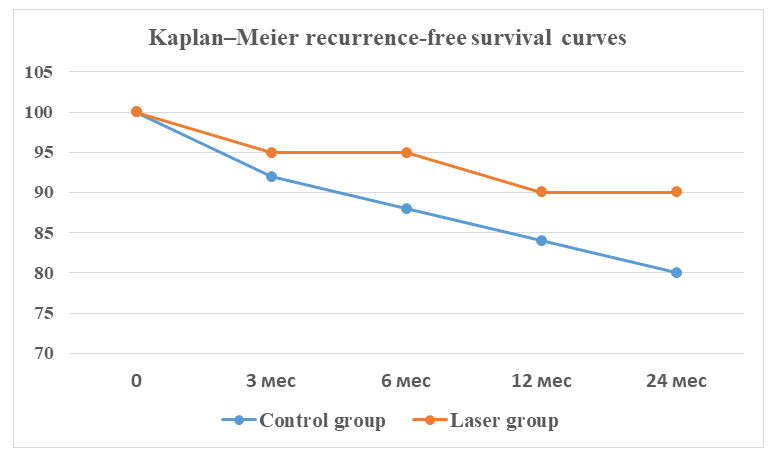 | Figure 3. Kaplan–Meier recurrence-free survival curves in patients with laryngeal and tracheal papillomatosis treated with electrocautery and high-energy yellow laser photocoagulation |
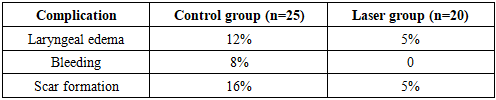
Log-rank test: p < 0.05Kaplan–Meier analysis demonstrated significantly longer recurrence-free survival in patients treated with high-energy yellow laser photocoagulation compared with conventional electrocautery.Log-rank test confirmed statistically significant differences (p < 0.05).Postoperative complications were as follows (Table 6, Figure 4):Table 6. Complications
 |
| |
|
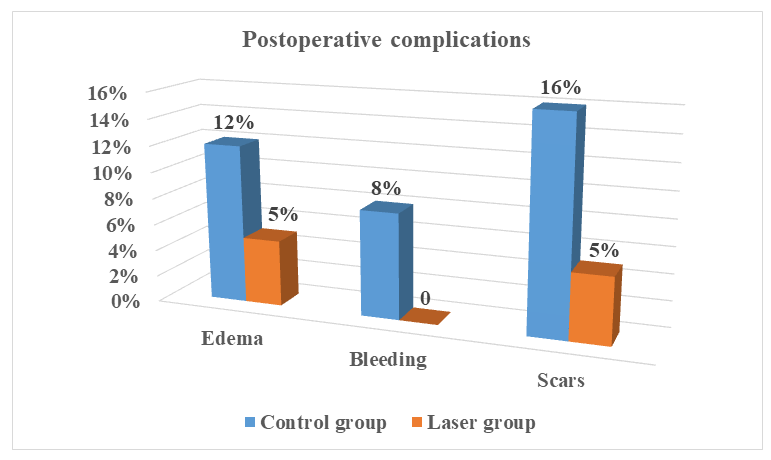 | Figure 4. Postoperative complications following electrocautery and laser photocoagulation |
Laser treatment significantly reduced postoperative scarring.
4. Discussion
The results of this study demonstrate significant advantages of high-energy yellow laser photocoagulation compared with electrocautery.Selective absorption of laser energy by hemoglobin enables effective coagulation of papilloma vasculature while preserving surrounding tissues. This mechanism explains the reduction in intraoperative bleeding and improved visualization of the surgical field.Furthermore, reduced thermal damage leads to decreased postoperative inflammation and a lower risk of scar formation.The observed decrease in recurrence rate is consistent with previous studies demonstrating the effectiveness of laser technologies in RRP management.
5. Conclusions
High-energy yellow laser photocoagulation is an effective and safe method for the surgical treatment of laryngeal and tracheal papillomatosis. The technique reduces operative trauma, decreases recurrence rates, and improves postoperative outcomes.
Conflict of Interests’ Statement
The authors declare no conflict of interest. This study does not include the involvement of any budgetary, grant or other funds. The article is published for the first time and is part of a scientific work.
ACKNOWLEDGEMENTS
The authors express their gratitude to the management of the multidisciplinary clinic of Tashkent State Medical University, Multidisciplinary international clinic "Surgemed" for the material provided for our study.
Ethical Approval and Consent to Participate
The Research Ethics Board of our institution does not require review or approval of case reports. Our research was carried out in accordance with the World Medical Association Code of Ethics (Declaration of Helsinki).
References
| [1] | Armstrong L., et al. Recurrent respiratory papillomatosis: a review. Otolaryngol Clin N Am. 2020; 53(2): 245–256. doi: 10.1016/j.otc.2019.11.004. |
| [2] | Derkay C.S., Wiatrak B. Recurrent respiratory papillomatosis. Laryngoscope. 2008; 118(7): 1236–1247. doi: 10.1097/MLG.0b013e31816c64ae. |
| [3] | Gelbard A., et al. Recurrent respiratory papillomatosis. Front Pediatr. 2018; 6: 191. doi: 10.3389/fped.2018.00191. |
| [4] | Cohen J.I., et al. Recurrent respiratory papillomatosis: epidemiology and treatment. Clin Microbiol Rev. 2018; 31: e00096-17. |
| [5] | Malhotra R., et al. Epidemiology of respiratory papillomatosis. Int J Pediatr Otorhinolaryngol. 2016; 87: 50–55. |
| [6] | Ferlito A., et al. Recurrent respiratory papillomatosis: review of treatment modalities. Acta Otolaryngol. 2017. |
| [7] | Forsyth R.J., et al. Management of adult-onset RRP. Clin Otolaryngol. 2018. |
| [8] | Gerein V., et al. Laser treatment of laryngeal papillomatosis. Lasers Med Sci. 2017. |
| [9] | Karatayli-Ozgursoy S., et al. Laser surgery outcomes. Lasers Surg Med. 2017. |
| [10] | Klussmann J.P., et al. Laser therapy outcomes. Eur Arch Otorhinolaryngol. 2019. |
| [11] | Lawson L., et al. CO₂ vs KTP laser. J Laryngol Otol. 2019. |
| [12] | Pagella F., et al. Photocoagulation laser therapy. Int J Pediatr Otorhinolaryngol. 2017. |
| [13] | Osborn H., et al. Laser-assisted treatment. Head Neck. 2020. |
| [14] | Hwang S.J., et al. Yellow laser in RRP. Laryngoscope. 2020. |
| [15] | Kerscher A., et al. Yellow laser photocoagulation. Lasers Surg Med. 2020. |


 Abstract
 Reference
 Full-Text PDF
 Full-text HTML