
-
Paper Information
- Next Paper
- Previous Paper
- Paper Submission
-
Journal Information
- About This Journal
- Editorial Board
- Current Issue
- Archive
- Author Guidelines
- Contact Us
American Journal of Medicine and Medical Sciences
p-ISSN: 2165-901X e-ISSN: 2165-9036
2026; 16(4): 2148-2150
doi:10.5923/j.ajmms.20261604.121
Received: Mar. 23, 2026; Accepted: Apr. 21, 2026; Published: Apr. 29, 2026

Ethnic Variability of Plantar Dermatoglyphic Patterns and Their Forensic Significance in Human Identification
 Abstract
 Reference
 Full-Text PDF
 Full-text HTML
Ismailov Ravshanbek Alimbaevich1, Hakimov Sarvar Abduazimovich2
1PhD., Associate Professor, Urgench State Medical Institute, Urgench, Uzbekistan
2PhD., Associate Professor of the Department of Forensic Medicine and Medical Law, Tashkent State Medical University, Uzbekistan
Correspondence to: Ismailov Ravshanbek Alimbaevich, PhD., Associate Professor, Urgench State Medical Institute, Urgench, Uzbekistan.
| Email: |  |
Copyright © 2026 The Author(s). Published by Scientific & Academic Publishing.
This work is licensed under the Creative Commons Attribution International License (CC BY).
http://creativecommons.org/licenses/by/4.0/

Identification of individuals is one of the most important tasks in law enforcement and forensic practice. This process is carried out through operational-search activities, criminological investigations, and forensic medical examinations. The greatest difficulty arises in cases involving unknown individuals whose bodies are severely altered, dismembered, or represented only by separate parts, as well as in situations involving biological traces such as blood, fingerprints, hair, and barefoot impressions. The identification of a person, as an exact determination of identity, remains a critical challenge for forensic experts. In this context, there is an increasing need for simple, reliable, and effective methods. Dermatoglyphics, which studies the papillary ridge patterns of the skin, has become one of the most convenient approaches for analyzing the complex of external human features. Dermatoglyphic characteristics are stable, genetically determined, and highly individual, making them valuable markers in forensic identification. They can be preserved even in cases of significant postmortem or traumatic changes, thereby providing important information when traditional identification methods are limited or unavailable. In Uzbekistan, the number of such forensic cases involving unidentified individuals and biological traces continues to increase annually, highlighting the relevance of developing and applying additional diagnostic approaches.
Keywords: Forensic identification, Dermatoglyphics, Unknown individuals, Biological traces, Papillary patterns, Forensic medicine
Cite this paper: Ismailov Ravshanbek Alimbaevich, Hakimov Sarvar Abduazimovich, Ethnic Variability of Plantar Dermatoglyphic Patterns and Their Forensic Significance in Human Identification, American Journal of Medicine and Medical Sciences, Vol. 16 No. 4, 2026, pp. 2148-2150. doi: 10.5923/j.ajmms.20261604.121.
1. Introduction
- Identification of unknown individuals remains a critical task in forensic practice, particularly in cases involving dismembered, decomposed, or severely damaged human remains. In such conditions, traditional identification methods are often limited, which necessitates the use of additional reliable and informative approaches [3].Dermatoglyphics, which studies papillary ridge patterns of the skin, represents a stable and genetically determined system of morphological features that remain unchanged throughout life. Due to their high individuality and resistance to postmortem changes, dermatoglyphic traits serve as valuable markers in forensic identification.While dermatoglyphic analysis has been widely applied in fingerprint identification, its potential extends beyond this scope. In particular, plantar dermatoglyphics has attracted increasing attention due to its relative preservation under adverse conditions and its applicability in complex forensic cases involving fragmented remains [5].However, despite its potential, plantar dermatoglyphics remains insufficiently studied, especially in terms of its role in forensic identification. Therefore, further research is required to evaluate its diagnostic value and to integrate it into modern forensic methodologies.
2. Materials and Methods
- The study was conducted on a sample of 90 living individuals aged 18–30 years. Anthropometric and dermatoglyphic examination records of the participants were analyzed.Dermatoglyphic data were obtained using standard methods for recording papillary ridge patterns. The analysis included evaluation of plantar dermatoglyphic features, such as pattern types, ridge characteristics, and their distribution.Anthropometric parameters were assessed according to conventional measurement techniques. The collected data were systematized and subjected to comparative analysis to identify relationships between dermatoglyphic features and individual characteristics.
3. Result and Discussion
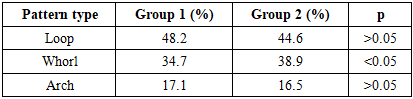
- Plantar dermatoglyphic patterns demonstrated noticeable variability between the studied ethnic groups, reflecting both genetic and population-specific characteristics. These differences may be explained by the influence of hereditary factors as well as intrauterine developmental conditions affecting the formation of dermal ridge patterns.Analysis of the main pattern types revealed that loop patterns were predominant in both groups (48.2% and 44.6%, respectively), which corresponds to general biological regularities of dermatoglyphic systems and confirms previously established data on the dominance of loop configurations in human populations. However, whorl patterns were significantly more frequent in the second group (38.9%) compared to the first group (34.7%) (p < 0.05), indicating a statistically significant intergroup difference. This finding may reflect specific embryological features of dermal ridge morphogenesis and population-related genetic variability. In contrast, arch patterns showed no statistically significant differences between the groups (p > 0.05), suggesting their relative stability and lower sensitivity to ethnic variation.
|
|
|

4. Conclusions
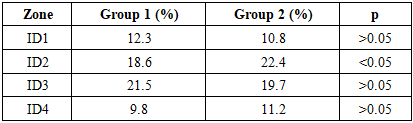
- The present study demonstrated that plantar dermatoglyphic features exhibit measurable variability between ethnic groups, reflecting the influence of genetic and population-specific factors on the formation of papillary ridge patterns. At the same time, the general structural organization of dermatoglyphic patterns remains consistent, confirming their biological stability and universality.It was established that loop patterns are predominant in both studied groups, while whorl patterns show statistically significant intergroup differences. Interdigital zone analysis revealed that most regions are relatively stable; however, certain локал zones (particularly ID2) demonstrate significant variability, indicating their sensitivity to developmental and genetic influences [1,3].Morphometric analysis showed that total ridge count (TRC) is a highly informative and statistically significant parameter, with higher values observed in the second group. This finding confirms that quantitative dermatoglyphic indicators have greater diagnostic value compared to qualitative pattern characteristics and may serve as reliable criteria in forensic analysis.The results of the study indicate that plantar dermatoglyphics can be effectively used as an additional diagnostic tool in forensic identification. Due to their high resistance to postmortem changes and preservation under adverse conditions, these features are particularly valuable in cases involving fragmented, decomposed, or severely damaged human remains, where traditional identification methods are limited [2].Furthermore, the combined use of morphological and morphometric approaches significantly increases the reliability and accuracy of dermatoglyphic analysis. Integration of plantar dermatoglyphic data into комплекс forensic identification systems may enhance the effectiveness of expert conclusions and support the development of new diagnostic algorithms.Thus, plantar dermatoglyphic features represent a promising direction in forensic science. Their application can contribute not only to individual identification but also to the assessment of ethnic affiliation and biological characteristics. Further studies with larger sample sizes and advanced statistical methods are recommended to expand the scientific basis and practical application of dermatoglyphics in forensic medicine.