
-
Paper Information
- Next Paper
- Previous Paper
- Paper Submission
-
Journal Information
- About This Journal
- Editorial Board
- Current Issue
- Archive
- Author Guidelines
- Contact Us
American Journal of Medicine and Medical Sciences
p-ISSN: 2165-901X e-ISSN: 2165-9036
2026; 16(4): 2105-2108
doi:10.5923/j.ajmms.20261604.110
Received: Apr. 3, 2026; Accepted: Apr. 22, 2026; Published: Apr. 28, 2026

Optimization of Treatment and Prevention of Recurrent Herpetic Stomatitis in Children with Allergic Diseases
 Abstract
 Reference
 Full-Text PDF
 Full-text HTML
Razikova Dilnoza Kadirovna1, Saidmurodova Jamila Botirovna2, Rakhimova Nigora Kholmurodovna3
1Senior Lecturer of the Department of Microbiology, Virology and Immunology, Bukhara State Medical Institute, Bukhara, Uzbekistan
2PhD., Assistant, Department of Pediatric Dentistry, Samarkand State Medical University, Samarkand, Uzbekistan
3Master’s Student, Bukhara State Medical Institute, Bukhara, Uzbekistan
Correspondence to: Razikova Dilnoza Kadirovna, Senior Lecturer of the Department of Microbiology, Virology and Immunology, Bukhara State Medical Institute, Bukhara, Uzbekistan.
| Email: |  |
Copyright © 2026 The Author(s). Published by Scientific & Academic Publishing.
This work is licensed under the Creative Commons Attribution International License (CC BY).
http://creativecommons.org/licenses/by/4.0/

Recurrent herpetic stomatitis (RHS) is one of the most common viral lesions of the oral mucosa in children, particularly in those with allergic diseases and immune dysregulation. This study aimed to evaluate clinical, immunological, and therapeutic aspects of RHS and to assess the effectiveness of a phytotherapeutic approach using Rosa damascena oil. A total of 240 children aged 1–7 years with allergic diseases were included. Clinical, immunological, and quality-of-life assessments were conducted before and after treatment. Patients were divided into control and main groups depending on treatment modality. The results demonstrated that phytotherapy significantly reduced recurrence frequency, improved immune parameters, accelerated epithelialization, and enhanced quality of life. The findings support the use of natural phytotherapeutic agents as a safe and effective alternative to conventional therapy in pediatric RHS.
Keywords: Recurrent herpetic stomatitis, Children, Allergy, Immunity, Phytotherapy, Rosa damascena, Oral mucosa
Cite this paper: Razikova Dilnoza Kadirovna, Saidmurodova Jamila Botirovna, Rakhimova Nigora Kholmurodovna, Optimization of Treatment and Prevention of Recurrent Herpetic Stomatitis in Children with Allergic Diseases, American Journal of Medicine and Medical Sciences, Vol. 16 No. 4, 2026, pp. 2105-2108. doi: 10.5923/j.ajmms.20261604.110.
1. Introduction
- Recurrent herpetic stomatitis (RHS) is one of the most common viral diseases affecting the oral mucosa in pediatric populations and represents a significant clinical and public health problem worldwide. According to epidemiological data, infection with herpes simplex virus type 1 (HSV-1) occurs in up to 70–90% of children, with primary infection most frequently observed between 6 months and 3 years of age [1,2]. This period coincides with a decline in maternally derived antibodies and the incomplete maturation of the child’s immune system, which predisposes to both acute and recurrent forms of the disease [3].It has been established that approximately 20–40% of children who experience primary herpetic infection subsequently develop recurrent forms characterized by periodic exacerbations, mucosal lesions, and systemic symptoms such as fever, malaise, and decreased appetite [4,5]. The recurrence of HSV infection is closely associated with immune system dysfunction, particularly impairments in cellular immunity, decreased interferon production, and dysregulation of cytokine responses [6].Recent studies emphasize that allergic diseases play a crucial role in the pathogenesis and clinical course of RHS. Children with allergic conditions, including atopic dermatitis, allergic rhinitis, and food allergies, demonstrate a higher frequency of recurrence, more severe clinical manifestations, and prolonged disease duration [7,8]. This relationship is explained by chronic immune imbalance, including reduced mucosal immunity (IgA deficiency), altered T-cell responses, and increased inflammatory activity [9].Despite the availability of various therapeutic approaches, including antiviral drugs (such as acyclovir), immunomodulators, and antiseptic agents, the effectiveness of conventional treatment remains limited. One of the main challenges is the inability to achieve long-term remission and prevent recurrence, as well as the risk of adverse effects and the development of viral resistance [10,11]. Moreover, many existing treatment methods are associated with prolonged therapy duration, high cost, and limited applicability in pediatric practice.In recent years, increasing attention has been paid to phytotherapeutic approaches, which are based on the use of natural bioactive compounds with antiviral, anti-inflammatory, antioxidant, and immunomodulatory properties [12]. Among these, Rosa damascena has attracted particular interest due to its rich composition of flavonoids, essential oils, and phenolic compounds, which have demonstrated therapeutic potential in inflammatory and infectious diseases [13]. However, despite promising preliminary findings, there is still insufficient evidence regarding its clinical effectiveness in the treatment of RHS in children, especially in the context of allergic comorbidity.Thus, the high prevalence of RHS, its recurrent nature, association with allergic diseases, and limitations of existing treatment methods highlight the need for developing new, safe, effective, and pathogenetically justified therapeutic approaches.Research AimThe aim of this study was to evaluate the clinical and immunological characteristics of recurrent herpetic stomatitis in children with allergic diseases and to assess the effectiveness of a phytotherapeutic treatment method based on Rosa damascena oil in improving clinical outcomes, reducing recurrence frequency, and restoring immune balance.
2. Materials and Methods
- The present study was conducted on a cohort of 240 children aged between 1 and 7 years, all residing in rural areas of the Bukhara region and diagnosed with recurrent herpetic stomatitis (RHS) in combination with allergic diseases. The inclusion criteria consisted of confirmed clinical diagnosis of RHS, presence of allergic pathology (including atopic dermatitis, allergic rhinitis, or food allergies), and parental consent. Exclusion criteria included severe systemic diseases, congenital immunodeficiency, and ongoing antiviral therapy prior to enrollment.The patients were evenly divided into two groups: the main group (n=120), which received the proposed phytotherapeutic treatment based on Rosa damascena oil, and the control group (n=120), which underwent standard treatment protocols including antiviral, antiseptic, and symptomatic therapy. The grouping was performed using a randomized allocation method to ensure comparability and eliminate selection bias.Clinical examination was carried out according to standardized dental and pediatric protocols and included a comprehensive assessment of oral mucosa lesions, localization and number of herpetic vesicles, ulceration severity, presence of hyperemia, and edema. In addition, dental indices were evaluated, including the caries index (DMF/dmf), oral hygiene index (OHI-S), and papillary-marginal-alveolar (PMA) index, which allowed for objective assessment of inflammatory changes in periodontal tissues. These indices were selected due to their proven reliability in reflecting oral health status and their relevance in evaluating disease severity in RHS patients.Immunological assessment was conducted using venous blood and saliva samples collected under standardized conditions. Cellular immunity parameters were evaluated by determining T-lymphocyte subsets (CD3+, CD4+, CD8+) using flow cytometry, which provides a highly sensitive and specific method for assessing immune status. Humoral immunity was analyzed through the measurement of immunoglobulin levels (IgA, IgG, IgM) using enzyme-linked immunosorbent assay (ELISA), a widely accepted method in clinical immunology. Additionally, systemic inflammatory activity was assessed by measuring C-reactive protein (CRP) levels, which serve as a reliable marker of acute-phase inflammatory response.The phytotherapeutic agent was prepared from Rosa damascena petals mixed with cold-pressed olive oil and processed under controlled thermal conditions (80–90°C for 7–8 hours) followed by filtration and sterilization. This method ensured preservation of biologically active compounds, including flavonoids, essential oils, and antioxidants. The resulting oil was applied locally to affected oral mucosa areas using sterile cotton swabs in doses of 0.05–0.2 ml twice daily. Treatment duration varied depending on disease stage: early-stage cases were treated for 5–7 days, while later-stage cases required up to 10 days.Quality of life was evaluated using structured questionnaires adapted for pediatric populations, assessing appetite, sleep quality, pain perception, and daily activity levels. Statistical analysis was performed using parametric and non-parametric methods, including Student’s t-test and correlation analysis, with statistical significance defined at p<0.05. The methodology ensured a comprehensive evaluation of clinical, immunological, and functional outcomes.
3. Results
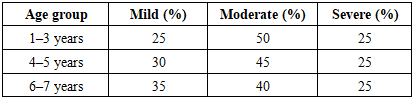
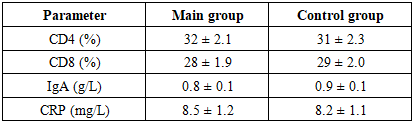
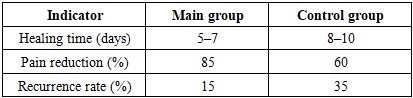
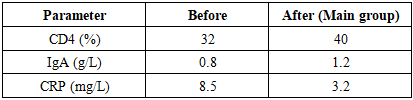
- The study was conducted in several sequential stages, beginning with patient screening, clinical classification, immunological baseline assessment, therapeutic intervention, and follow-up evaluation. All patients were initially assessed for disease severity and immunological status, after which they were allocated into treatment groups. The effectiveness of the interventions was evaluated dynamically over the course of treatment and during follow-up periods.
|
|
|
|
|
4. Discussion
- The findings of this study confirm that recurrent herpetic stomatitis in children with allergic diseases represents a complex multifactorial pathology characterized by immune dysregulation, chronic inflammation, and impaired mucosal defense mechanisms. The observed imbalance between cellular and humoral immunity, particularly the reduction in CD4 lymphocytes and IgA levels, plays a central role in the persistence and recurrence of herpes virus infection. These results are consistent with modern immunopathological concepts, which emphasize the importance of immune homeostasis in controlling viral infections.The effectiveness of the proposed phytotherapeutic approach can be explained by the combined antiviral, anti-inflammatory, antioxidant, and immunomodulatory properties of Rosa damascena oil. Unlike conventional pharmacological treatments, which primarily target viral replication or provide symptomatic relief, the phytotherapeutic agent addresses multiple pathogenetic pathways simultaneously. This комплексный effect leads to faster healing, reduced recurrence rates, and improved immune function.From a medical perspective, the introduction of such therapy contributes to safer treatment options, especially in pediatric populations where drug-related adverse effects are a major concern. The absence of toxic reactions and the natural origin of the phytopreparation make it particularly suitable for long-term use and профилактика.From an economic standpoint, the use of locally available plant-based raw materials significantly reduces treatment costs, making the method accessible for rural and low-resource settings. This is especially relevant in regions where healthcare resources are limited and expensive antiviral drugs are not always available.From a social perspective, the reduction in disease recurrence and improvement in quality of life contribute to better psychosocial adaptation of children, improved school attendance, and reduced parental burden. The findings highlight the importance of integrating innovative, safe, and cost-effective approaches into pediatric dental practice.
5. Conclusions
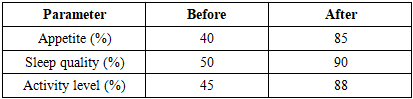
- The conducted study demonstrates that recurrent herpetic stomatitis in children with allergic diseases is associated with significant clinical, immunological, and functional disturbances requiring a comprehensive and pathogenetically oriented approach to treatment. The use of Rosa damascena-based phytotherapy significantly improves clinical outcomes by accelerating healing processes, reducing pain intensity, and decreasing recurrence rates. At the same time, it positively influences immune parameters, restoring cellular and humoral immunity and reducing systemic inflammation. The method also leads to a substantial improvement in quality of life indicators, including appetite, sleep, and physical activity. Considering its safety, effectiveness, affordability, and ease of application, the proposed phytotherapeutic approach can be recommended for widespread clinical use as both a therapeutic and preventive measure in children with recurrent herpetic stomatitis, particularly in those with allergic conditions.