
-
Paper Information
- Next Paper
- Previous Paper
- Paper Submission
-
Journal Information
- About This Journal
- Editorial Board
- Current Issue
- Archive
- Author Guidelines
- Contact Us
American Journal of Medicine and Medical Sciences
p-ISSN: 2165-901X e-ISSN: 2165-9036
2026; 16(4): 1605-1607
doi:10.5923/j.ajmms.20261604.11
Received: Jan. 31, 2026; Accepted: Feb. 26, 2026; Published: Apr. 1, 2026

Molecular-Genetic Aspects of Resistance to Antifungal Drugs
 Abstract
 Reference
 Full-Text PDF
 Full-text HTML
Khasanov U. S., Khudjanov Sh. K., Djurayev J. A., Soatov I. O., Mardonov X. A.
Tashkent State Medical University, Tashkent, Uzbekistan
Correspondence to: Soatov I. O., Tashkent State Medical University, Tashkent, Uzbekistan.
| Email: |  |
Copyright © 2026 The Author(s). Published by Scientific & Academic Publishing.
This work is licensed under the Creative Commons Attribution International License (CC BY).
http://creativecommons.org/licenses/by/4.0/

This scientific research was conducted with patients treated at the Adult ENT Department of the Multidisciplinary Clinic of Tashkent State Medical University. Pathogenic fungi causing otomycosis were isolated from the external auditory canal and subjected to molecular-genetic analysis. The study investigated resistance to therapeutic concentrations of the drug, which arises from an increased concentration of the ERG11 product due to gene amplification, an increased transcription rate, or a decrease in product utilization. Similar to several other mechanisms, our method observed that high expression of ERG11 confers resistance to short-chain azoles, particularly fluconazole, while the activity of itraconazole and posaconazole was found to be preserved.
Keywords: Gene, Durability, Resistance, Expression
Cite this paper: Khasanov U. S., Khudjanov Sh. K., Djurayev J. A., Soatov I. O., Mardonov X. A., Molecular-Genetic Aspects of Resistance to Antifungal Drugs, American Journal of Medicine and Medical Sciences, Vol. 16 No. 4, 2026, pp. 1605-1607. doi: 10.5923/j.ajmms.20261604.11.
1. Introduction
- This research conducted a molecular-genetic analysis, which revealed a possible link to the presence of common regulatory elements and transcription factors that control gene expression. These factors can be activated in response to exogenous influences, primarily an increase in the concentration of azole-class antifungal drugs, which in turn triggers the adaptive mechanisms of the fungal cell. Furthermore, the possibility of mutations in the genes that encode the transcription regulators themselves cannot be ruled out. This would lead to their constitutive activation and, consequently, a consistently high transcription level of the efflux transporter genes under their control. However, the ineffective use of antifungal drugs in the prevention and treatment of superficial candidiasis can lead to the emergence of resistant strains. Such strains pose a risk of spreading among the population, a situation that also requires separate study. Resistant strains can cause serious difficulties in treating invasive forms of candidiasis. This necessitates studying the molecular mechanisms of resistance, searching for methods to combat it, and ensuring its timely detection. At the same time, a review of the cited literature shows that the mechanisms of acquired resistance to antifungal drugs were most often identified in individual strains, and rarely in small groups of strains isolated from different categories of patients.
2. Research Materials and Methods
- Patients treated in the Adult ENT Department of the Multidisciplinary Clinic of Tashkent Medical Academy were selected for the study. In the molecular genetic analysis, resistance to therapeutic concentrations of the drug was examined by assessing the increase in ERG11 product concentration through gene amplification, an increased rate of transcription, or decreased product utilization. Increased ERG11 expression may occur as a result of aneuploidy and the formation of an isochromosome from the two left arms of chromosome 5, which houses the ERG11 gene and the transcription regulator TAC1, affecting the expression of CDR1 and CDR2 [2].Data on resistance to antifungal drugs indicate the prevalence of resistant strains of Candida spp. among HIV-infected patients. This, in turn, necessitates microbiological monitoring of susceptibility to antifungal drugs. According to most local and international recommendations, fluconazole is considered one of the effective agents for the prevention and treatment of candidiasis.
3. Results
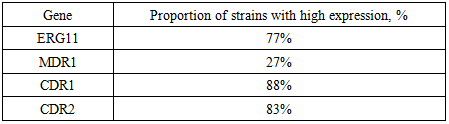
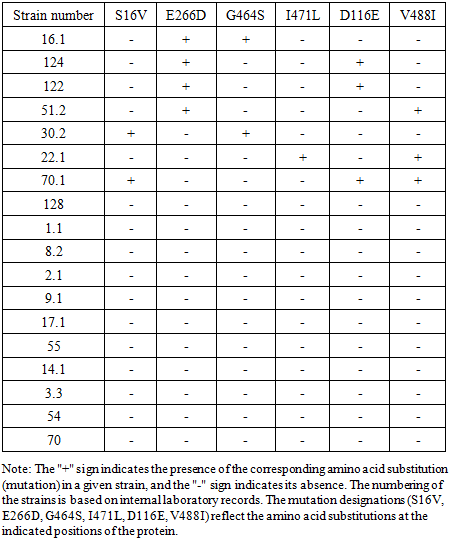
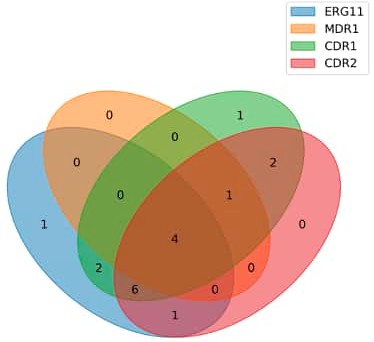
- In the patient group studied, *C. albicans* remained the dominant species, detected in approximately 53-55% of patients. Concurrently, the majority of isolated strains of this species (about 70-75%) demonstrated resistance to fluconazole and voriconazole, indicating the widespread prevalence of acquired resistance mechanisms. The proportion of *C. tropicalis* and *C. parapsilosis* species, which are capable of developing secondary resistance, was relatively small. The remaining isolates consisted of *C. glabrata* and *C. krusei*, species characterized by low initial sensitivity to azole antimycotics. In this regard, the in-depth study of the molecular mechanisms of acquired resistance was primarily focused on *C. albicans* strains resistant to azole preparations.For molecular genetic analysis, a sample of 25 *C. albicans* strains was formed. It included 17-19 isolates with phenotypic resistance to fluconazole and voriconazole, along with 6-8 sensitive strains used as a control group to determine reference expression levels. The study assessed the relative RNA expression levels of the genes encoding the CDR1, CDR2, and MDR1 efflux pumps, as well as the RNA expression of the ERG11 gene [1,7].During the study, it was found that all analyzed C. albicans strains with phenotypic resistance to azole group antifungal drugs were characterized by a statistically significant increase (p<0.01) in the expression of at least one of the studied genes associated with the development of drug resistance [2,8]. Concurrently, the activation of several molecular resistance mechanisms was observed in the majority of isolates.In most cases, an increase in the transcription level of the ERG11 gene was recorded in combination with the hyperexpression of ABC family efflux transporters - the CDR1 and/or CDR2 genes. The proportion of such strains was approximately 65-75%, and the identified changes were statistically significant (p<0.05). This indicates that these mechanisms play a leading role in the development of C. albicans resistance to azole-class drugs (Table 2).
|
|
 | Figure 1 |
4. Conclusions
- It should be noted that in the studied groups, no strains were found with an isolated increase in MDR1 expression, nor were strains with simultaneous activation of only the MDR1 and ERG11 genes detected. However, a simultaneous increase in the expression levels of MDR1, CDR1, and CDR2 was detected in 4-6 strains, representing approximately 18-22% of the samples. Furthermore, simultaneous activation of all studied genes was recorded in another 3-4 strains (approximately 15-18%). Thus, all cases of increased MDR1 expression were accompanied by the co-activation of at least one gene from the CDR family (100%, n≈4-5) and, in most cases, the ERG11 gene (approximately 85-90%; p<0.05). Conversely, an inverse relationship was not identified, meaning a mandatory increase in MDR1 expression against the background of CDR1, CDR2, or ERG11 activation was not observed.