Ismoilov Azizbek Oktamboevich, Yakubov Farkhod Radzhabovich
Urgench State Medical Institute, Uzbekistan
Copyright © 2026 The Author(s). Published by Scientific & Academic Publishing.
This work is licensed under the Creative Commons Attribution International License (CC BY).
http://creativecommons.org/licenses/by/4.0/

Abstract
The results of examination and treatment of 341 patients with acute cholecystitis were analyzed. In the context of the Charlson polymorbidity index (3.20 - 3.31) for acute cholecystitis in elderly and senile patients age high surgical and anesthetic the risk of P3, P4 reaches 76.2% (according to the ASA scale) and 69.8% (according to the APACHE scale) II), which dictates the priority of minimally invasive interventions at the treatment stages. The use of minimally invasive puncture-drainage, laparoscopic and endoscopic techniques taking into account the surgical and anesthetic risk according to ASA, APACHE II and the Charlson comorbidity index, allows for timely implementation of necessary treatment procedures, reducing the number of postoperative complications from 19.7% to 6.4%, postoperative mortality from 6.7% to 1.9%, A Also reduce deadlines stationary treatment V average on 5.5 bed- day.
Keywords:
Acute cholecystitis, Surgical and anesthetic risk, Surgical tactics
Cite this paper: Ismoilov Azizbek Oktamboevich, Yakubov Farkhod Radzhabovich, Contemporary Aspects of Surgical Tactics in Acute Cholecystitis in Patients with High Surgical and Anesthetic Risk, American Journal of Medicine and Medical Sciences, Vol. 16 No. 4, 2026, pp. 1580-1585. doi: 10.5923/j.ajmms.20261604.07.
1. Introduction
Despite the improvement in the quality of surgical care over the past two decades, acute cholecystitis remains one of the most common abdominal diseases, particularly in elderly and geriatric patients with high surgical and anesthetic risks [1,2,3]. Overall mortality has remained relatively stable over the past 10 years, fluctuating between 5-8% depending on the prevalence of destructive forms of the disease [4,5,6]. However, mortality in severe forms of acute cholecystitis remains very high, reaching 12-15%.A common feature of almost all elderly and senile patients is the presence of comorbidities, often systemic in nature [7,8]. As acute inflammation develops, it compounds the underlying condition, further increasing surgical and anesthetic risk [9,10]. The underlying and comorbid conditions often mutually aggravate each other, competing with each other. Cardiovascular pathology predominates, and 50-60% of patients have a history of respiratory disease. More than half of patients have a history of diabetes mellitus, and a similar proportion (30-60%) are overweight, often at grade 3 or 4 [11,12,13].The above indicates the need for timely diagnosis of gallbladder destruction, further study and improvement surgical treatment of acute cholecystitis in patients elderly and senile age using minimally invasive surgery, which will reduce postoperative mortality in this group of patients.The aim of the study was to improve treatment outcomes for patients with acute cholecystitis with high surgical and anesthetic risk by selectively selecting surgical correction methods with a focus on minimally invasive interventions.
2. Material and Methods
The results of examination and treatment of 341 patients with acute cholecystitis treated in the surgical departments of the multidisciplinary clinic of the Urgench State Medical Institute from 2016 to 2023 were analyzed. One hundred thirty-seven patients (the comparison group) underwent surgery through a laparotomy approach, and 204 (the main group) underwent minimally invasive surgical interventions. Of these, 53 patients underwent ultrasound-guided puncture and drainage interventions, 105 laparoscopic interventions, and 46 cholecystectomy through a minilaparotomy approach.All patients were over 60 years of age and were divided into the age categories 60-74 years (elderly) – 296 (86.8%) and 75 years and older (senile age) – 45 (13.2%). There were no centenarians (90 years and older) in the study. Patients had a history of 2 to 5 concomitant general medical conditions.The criteria for the study were clinical and ultrasound signs of acute cholecystitis, the presence of signs of systemic inflammatory response syndrome (fever, leukocytosis, etc.), the presence of surgical and anesthetic risk (class P2, P3, P4 according to the ASA classification), and the absence of a positive effect from conservative therapy within 48 hours.All patients in the study had comorbidities, both compensated and mutually aggravating. (comorbidity), which aggravated the course of the underlying disease, complicated acceptance solutions in plan volume operations, as well as the course of the postoperative period.The comorbidity index in the comparison group was 3.31, while in the main study group it was 3.20, meaning the indicators are identical. This index allows one to calculate the probability of a fatal outcome in the presence of comorbidity. At a score of 3-4, the probability, according to the Charlson index, is up to 52% in this age group, confirming the high surgical and anesthetic risk.All 341 patients diagnosed with acute cholecystitis underwent sonographic examination of the gallbladder, surrounding tissues, organs of the hepatopancreatoduodenal zone, and abdominal cavity within 2 hours of hospitalization. According to the ultrasound examination results, the average gallbladder dimensions were as follows: length - 119 ± 14.5 mm, width 38.6 ± 8.3 mm, in these cases there was an increase in the wall of more than 4 mm. In subsequent ultrasound examinations, special attention was paid to changes in the size of both the gallbladder itself and its wall. When assessing the nature of the contents, the appearance of a worrisome feature was "hepatization" of it, that in all cases testified O availability infection V clearing gallbladder.Gray scale ultrasound was performed in 100% of our patients, It was found that signs of acute cholecystitis were observed in 296 patients (86.8%), including 178 (87.2%) of the 204 in the main study group.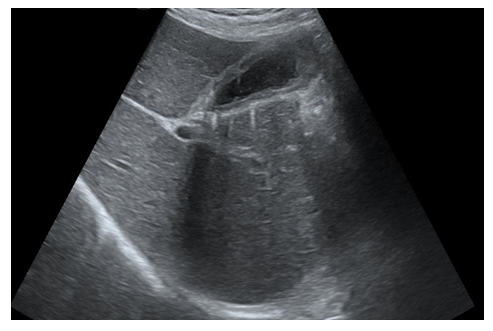 | Figure 1. Patient S., 46 years old. Sonogram: Acute destructive cholecystitis without extravesical complications. "Double contour" of the gallbladder wall |
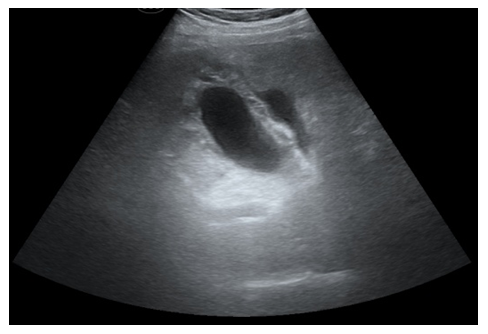 | Figure 2. Patient A., 63 years old. Sonogram: Acute destructive cholecystitis with perivesical abscess |
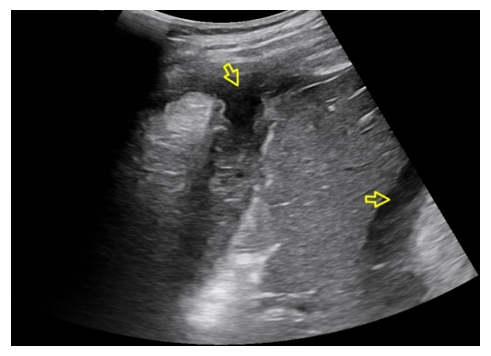 | Figure 3. Patient G., 51 years old. Sonogram: Gallbladder perforation with widespread peritonitis. Free fluid in the Morrison sinus |
In 16.8% of cases in the main study group, the signs of acute cholecystitis were questionable, and therefore 26 patients underwent ultrasound Doppler imaging using color Doppler mapping and power Doppler in the unpaired branches of the aorta: the celiac trunk, the common and proper hepatic arteries, and the cystic artery. This allowed us to clarify the presence of an inflammatory process in the gallbladder and more precisely determine the surgical approach. Moreover, in patients without ultrasound signs of acute destructive cholecystitis in the "gray scale" mode, there were changes in the linear velocities of blood flow in the celiac trunk basin towards an increase, which indicated a systemic inflammatory reaction in destructive cholecystitis in the toxemia stage.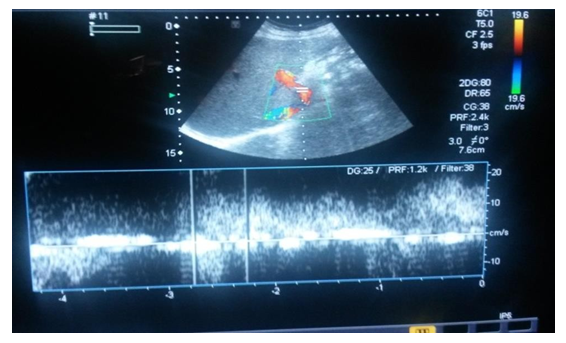 | Figure 4. Patient S., 68 years old. Ultrasound triplex scanning at acute phlegmonous cholecystitis |
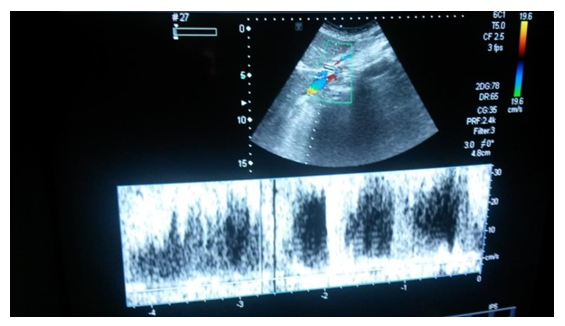 | Figure 5. Patient A., 72 years old. Ultrasound triplex scanning at island gangrenous cholecystitis |
So, if the normal diameter of the celiac trunk is 7.13±1.32; V.vol 1258.35±14.41; V.max min 100-105 m/s, then with destructive cholecystitis these indicators increased accordingly: diameter 8.55±1.0; V.vol 1965.1±27.24; V.maxmin 150-110 m/s.The diagnostic algorithm for acute cholecystitis, supplemented by ultrasound in gray-scale mode and color ultrasound Doppler imaging, increased the information content to 92.3% and made it possible to limit the use of expensive X-ray radiological research methods.
3. Results and Discussion
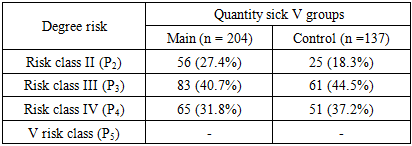
To determine surgical tactics, forecasting And prevention of complications in the treatment of acute cholecystitis, a comprehensive assessment of the general condition of the patient was carried out. Use classifications ASA it is appropriate at forecast outcomes All types of surgical interventions and patients according to the degree of surgical and anesthetic risk were distributed as follows.Table 1. Distribution of patients according to the ASA classification
 |
| |
|
Risk class III included 40.7% of patients in the study group and 44.5% of patients in the control group. Risk class IV corresponded to 31.8% of patients in the study group and 37.2% of patients in the control group, i.e., comorbidities and their complications were poorly controlled and posed a potential threat to life. Therefore, taking into account polymorbidity, the majority of patients in both groups were classified as classes P3 and P4 (76.2%).To calculate the possible development of a fatal outcome, the severity of patients was assessed in accordance with the APACHE-II scoring system.The proportion of patients with a score of more than 20 in the main group was 49.5%, in the control group – 53.3% with a mortality probability of up to 30% according to the APACHE scale. II. The proportion of patients with a score of 30 or more was 8.8% in the main group and 8.6% in the comparison group, with a mortality rate of 65%, which dictated the priority of minimally invasive interventions at the treatment stages.The main group included 204 patients with acute cholecystitis, who underwent both minimally invasive radical laparoscopic surgeries from a mini-access and puncture-drainage interventions under ultrasound control in order to improve treatment results, against the background of high surgical and anesthetic risk.Minimally invasive puncture and drainage interventions under ultrasound control performed sick sharp cholecystitis with a high surgical-anesthesiological risk, for whom radical surgical intervention in the amount of cholecystectomy was impossible due to the severity of the physical condition (P3, P4).These interventions were performed in 53 (25.9%) patients, of whom 15 (7.3%) underwent ultrasound-guided percutaneous transhepatic gallbladder puncture (PTCP), and 38 (18.6%) underwent percutaneous transhepatic gallbladder drainage (PTCD). Gallbladder puncture was performed in patients in critical condition.The effectiveness of the PPC in the primary operation was 88.5%. The final efficacy rate, taking into account repeat punctures, was 96.1%. In this group of patients, one complication was observed: gallbladder wall perforation, which required laparotomy, cholecystectomy, debridement, and abdominal drainage.38 patients underwent PCD (Fig. 6, 7).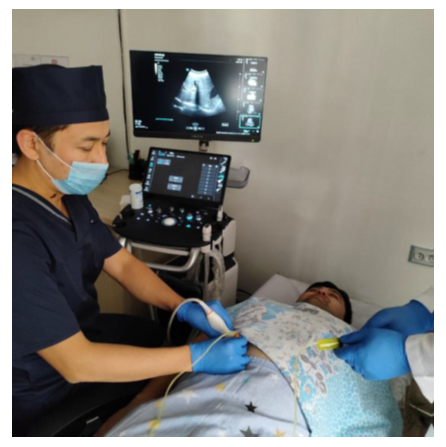 | Figure 6. One-stage installation of drainage into the gallbladder cavity |
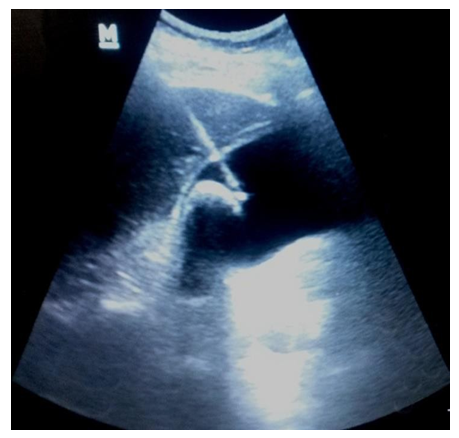 | Figure 7. Echogram (the moment of gallbladder puncture) |
In this group, patients with an ASA score of P4 predominated, which corresponds to the presence of severe concomitant pathology with signs of decompensation of organs or body systems. The majority of patients (61%) had 3 And more concomitant diseases. At this prevailed Diseases of the cardiovascular, respiratory, central nervous, and endocrine systems. According to the Charlson Comorbidity Index, 86.5% had a score of 7 or more, indicating high transnosological comorbidity among patients.In 11 cases (28.9%), PCD was performed as the only intervention, without resorting to radical surgery in patients with high surgical risk.The effectiveness of PCD was assessed based on the degree of relief of both local and systemic inflammatory manifestations, as well as changes in the gallbladder itself. It should be noted that relief of clinical symptoms (pain, nausea, vomiting, etc.) of acute cholecystitis occurred, on average, within 2-3 days after drainage placement.By days 3-5, a decrease in the severity of the systemic inflammatory response syndrome was noted, and by the time of discharge, which occurred on average on the 18th day, complete relief of inflammatory changes was observed in the laboratory. If pronounced leukocytosis was noted upon admission (14.8 ± 1.7 x 10⁹ / L), then on the 3rd day after the intervention, it decreased to 11.6 ± 1.9 x 10⁹ / L. By the fifth day after the PCD, normalization of leukocytosis in the blood was noted (9.5 ± 1.2 x 10⁹ / L). In the postoperative period, 2 patients (5.3%) experienced complications in the form of bleeding along the drainage (spontaneous hemostasis), drainage migration from the lumen of the gallbladder (no additional interventions were required), inflammatory changes in the soft tissues around the drainage tube. The most common complications were inflammatory changes in the soft tissues in the drainage area.Complications requiring emergency surgery occurred in two cases: one case of parenchymal bleeding into the abdominal cavity, and one case of gallbladder wall perforation with bile leakage into the abdominal cavity. There were no fatalities among patients with PCD.IN planned In the order after PCP, relief of acute cholecystitis and correction of concomitant diseases, radical operations were performed in 27 patients using laparoscopy (16) and mini-access (11).Thus, puncture-drainage surgical interventions under ultrasound control were performed in patients with a high surgical-anesthetic risk (P3 and P4), in the absence of signs of diffuse peritonitis, in 16 (30.2%) patients these procedures turned out to be final, and in 37 (69.8%) as the first stage before radical surgery.Endoscopic papillotomy was performed in 12 patients in the form of EPST. elderly patients according to the ASA scale R3 and R4 . EPST was performed in the presence of mechanical jaundice due to choledocholithiasis. This procedure was the second stage after PCHD (9), PCHP (3).Execution in this The introduction of laparoscopic cholecystectomy and the use of a mini-access significantly expanded treatment options for this patient group. Radical minimally invasive surgeries were performed in 151 (74.0%) patients.Laparoscopic surgeries were performed in 105 (51.5%) patients, according to ASA scale, they corresponded (P2-P3). In patients with high surgical-anesthetic risk (P3) Performing laparoscopic cholecystectomy under conditions of tense carboxyperitoneum leads to serious consequences, such as myocardial infarction, pulmonary embolism, and respiratory failure. To mitigate these effects, in our study, laparoscopic cholecystectomy was performed at a minimum pressure of 6-8 mmHg. In this group of patients presumptive risk death corresponded 10.5%. Despite this, we did not observe any consequences of pneumoperitoneum during the operation.46 (22.5%) patients were operated using the minilaparotomy method. execution minilaparotomy operations used specialized biliary kit Mini Assistant tools.A total of 137 patients (comparison group) were operated on through a wide laparotomy approach. Of these, 116 (84.6%) underwent cholecystectomy and 21 (15.3%) cholecystostomy. Urgent operations were performed in 53 patients (38.7%). In 84 patients (61.3%), delayed surgical interventions were performed on days 2-3 after hospitalization due to the progression of intoxication and the appearance of peritonitis symptoms. The severity in this group of patients increased by an average of 6-8 points, while the surgical and anesthetic risk according to the ASA system did not decrease. All patients operated conventionally showed an increase in severity in the first day of the postoperative period by 12 points, followed by a decrease on days 2-3. In the postoperative period, various complications were observed in 19.7% of patients.Repeated interventions were performed in 11 cases (8.0%) and were associated with eventration (2), bile leakage (5), and the development of purulent complications (2), including drainage of a subhepatic abscess in 1 case. Nine patients (6.7%) died. The causes of death were thromboembolic complications, pneumonia, sepsis, and pancreatic necrosis.Thus, In elderly and senile patients with high surgical and anesthetic risks, laparotomy was a necessary procedure, resulting in a significant number of postoperative complications (19.7%) and postoperative mortality (6.7%). The average hospital stay for traditional surgeries was 10.1±2.3 days. This prompted a revision of surgical tactics and the scope of surgical interventions for acute cholecystitis, with an emphasis on minimally invasive, high-tech procedures in this patient population.To compare the effectiveness of various methods of treating acute cholecystitis in elderly and senile patients with high surgical and anesthetic risk The following criteria were used: conversion, relaparotomy, duration of surgery (min), number of postoperative complications and deaths, length of patient stay in hospital.When studying postoperative complications one can note a significantly lower number of them overall after radical minimally invasive operations, How at puncture-drainage, endovideosurgical, and minilaparotomic (total 6.3%), compared to traditional ones (19.7%).The lowest number of postoperative complications (3.8%) is observed when performing puncture-drainage operations, despite the fact that these interventions were carried out patients with the highest degree of surgical and anesthetic risk (P4).Table 2. The effectiveness of various methods of surgical treatment of acute cholecystitis (M±m)
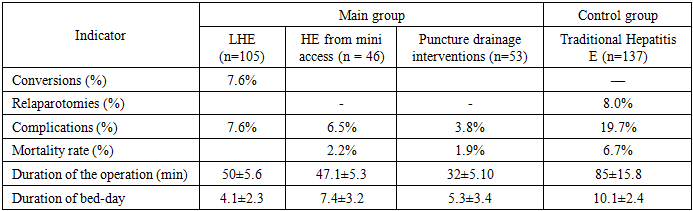 |
| |
|
Taking into account the severity of patients with acute cholecystitis according to the ASA scale, an algorithm for surgical treatment has been developed. In the absence of peritonitis and when evaluating the patient's condition as P4, radical surgery, taking into account the severity of patients with acute cholecystitis in accordance with the ASA scale, determined the most optimal method of surgical treatment. In the absence of peritonitis and when evaluating the patient's condition as P4, radical surgery is accompanied This carries an extremely high risk. Therefore, it is advisable to limit decompressive interventions to percutaneous transhepatic interventions (PTTIs), such as percutaneous transhepatic cholangiopancreatography (PTCA), or percutaneous transhepatic cholangiopancreatography (PTCA). In these patients, if obstructive jaundice due to choledocholithiasis is present, endoscopic stenting (EPS) is indicated after gallbladder decompression. This approach combines the benefits of both techniques, alleviating inflammation in the gallbladder and successfully resolving jaundice.
4. Conclusions
1. Puncture-drainage interventions under ultrasound control in acute cholecystitis in patients with high surgical-anesthetic risk (P4) allow in 67.9% of cases to prepare patients for radical surgery (with a reduction in the risk class to P2, P3) using a minimally invasive laparoscopic method, and in 32.1% cases are final method treatment.2. The use of minimally invasive puncture-drainage, laparoscopic and endoscopic techniques taking into account the surgical and anesthetic risk according to ASA, APACHE II and the Charlson comorbidity index, allows for timely implementation of necessary treatment procedures, reducing the number of postoperative complications from 19.7% to 6.4%, postoperative mortality from 6.7% to 1.9%, A Also reduce deadlines stationary treatment V average on 5.5 bed- day.
References
| [1] | Minimally invasive technologies in the treatment of acute cholecystitis with high surgical and anesthetic risk / A. S. Ermolov, A. A. Gulyaev, P. A. Ivanov [et al.] // Surgery. Journal named after N. I. Pirogov. - 2014. - No. 8. -P. 4-8. |
| [2] | Ultrasound and clinical laboratory diagnostics of true morphological forms of acute cholecystitis: the need to change the classification / I. M. Buriev, G. G. Melkonyan, N. S. Malyuga [et al.] // Annals of surgical hepatology. - 2020. - Vol. 25, No. 3. - P. 55-62. |
| [3] | Khrupkin, V. I. Comparative analysis of ultrasound-diapeutic decompression interventions in acute obstructive cholecystitis in patients with high surgical and anesthetic risk / V. I. Khrupkin, A. N. Afanasyev, N. S. Glagolev // Bulletin of Novgorod State University. - 2015. - Vol. 85, No. 2. - P. 62-67. |
| [4] | Yaroslavtsev, M. I. Features of the diagnosis of acute cholecystitis in different patients / M. I. Yaroslavtsev, M. A. Pakhomov, A. M. Morozov // Forcipe. - 2020. - V. 3, No. S. - P. 913-914. |
| [5] | Acute cholecystitis: predictive clinico-radiological assessment for conversion of laparoscopic cholecystectomy / YR Jiang, SJ Ahn, SJ Choi [et al.]. - DOI 10.1177/0284185120906658 // Acta Radiologica. - 2020. - Vol. 61, No. 11. - P. 1452-1462. |
| [6] | Factors that Predict the Need for Subtotal Cholecystectomy / A. Tang, CM Cohan, J. Beattie [et al.]. - DOI 10.1177/0003134820979783 // The American Surgeon. - 2020. - Vol. 87, No. 8. - P. 1245-1251. |
| [7] | Handra-Luca A. Luschka Ducts of the Gallbladder in Adults: Case Series Report and Review of the Medical Literature / A. Handra-Luca, H. M. Ben Romdhane, S.-M. Hong. - DOI 10.1177/1066896920901334 // International Journal of Surgical Pathology. - 2020. - Vol. 28, No. 5. - P. 482-489. |
| [8] | Open Cholecystectomy Under Local Anesthesia for Acute Cholecystitis in the Elderly and High-Risk Surgical Patients / EM Slama, M. Hosseini, RM Staszak, VR Setya. - DOI 10.1177/00031348211050593 // Am Surg. - 2022. -Vol. 88(3). - P. 434-438. |
| [9] | Open Cholecystectomy Under Local Anesthesia for Acute Cholecystitis in the Elderly and High-Risk Surgical Patients / EM Slama, M. Hosseini, RM Staszak, VR Setya. - DOI 10.1177/00031348211050593 // Am Surg. - 2022. -Vol. 88(3). - P. 434-438. |
| [10] | Percutaneous cholecystostomy for grade III acute cholecystitis is associated with worse outcomes / Y. Sanaiha, Y.-Y. Juo, S. E Rudasill [et al.]. - DOI 10.1016/j.amjsurg.2019.11.025 // Am. J. Surg. - 2020. - Vol. 220(1). - P. 197202. |
| [11] | Single port laparoscopic cholecystectomy: technical aspects and results / ML Favaro, S. Gabor, RFP Pedroso [et al.]. - DOI 10.1590/0102-672020180001e1388 // Arq. Bras. Cir. Dig. (Säo P ulo). - 2018. - Vol. 31, No. 3. - P. e1388. |
| [12] | Steel P. A D. Acute Cholecystitis and Biliary Colic / P. A D. Steel, BE Brenner // Me dsckape: website. - URL: https://emedicine. medscape.com/article/1950020-overview. |
| [13] | The Accuracy of Point-of-Care Ultrasound in the Diagnosis of Acute Cholecystitis / C.J. Wehrle, A. Talukder, L. Tien [et al.]. -DOI 10.1177/0003134821989057 // The American Surgeon. - 2022. - Vol. 88, No. 2. - P. 267-272. |
| [14] | Treatment of Acute Cholecystitis at Safety-Net Hospitals: Analysis of the National Inpatient Sample / S. Singh, SJ Armenia, A. Merchant [et al.] // The American Surgeon. - 2020. - Vol. 86, No. 1. - P. 28-34. |


 Abstract
 Reference
 Full-Text PDF
 Full-text HTML