
-
Paper Information
- Next Paper
- Previous Paper
- Paper Submission
-
Journal Information
- About This Journal
- Editorial Board
- Current Issue
- Archive
- Author Guidelines
- Contact Us
American Journal of Medicine and Medical Sciences
p-ISSN: 2165-901X e-ISSN: 2165-9036
2026; 16(4): 1575-1579
doi:10.5923/j.ajmms.20261604.06
Received: Feb. 23, 2026; Accepted: Mar. 19, 2026; Published: Apr. 1, 2026

Clinical Features of Chronic Tonsillitis on the Background of Dental Caries
 Abstract
 Reference
 Full-Text PDF
 Full-text HTML
Khodjaeva N. Kh., Shamsiev D. F.
Tashkent State Medical University, Uzbekistan
Copyright © 2026 The Author(s). Published by Scientific & Academic Publishing.
This work is licensed under the Creative Commons Attribution International License (CC BY).
http://creativecommons.org/licenses/by/4.0/

Scientific studies analyzing the relationship between chronic tonsillitis and dental caries show that pathogenic microorganisms on the teeth contribute to the onset and development of infectious processes in the tonsils, which leads to an exacerbation of tonsillitis. The purpose of the study is to study the clinical features of chronic tonsillitis on the background of dental caries. The study materials were patients with dental caries aged 18 to 65 years who were treated as inpatients with chronic tonsillitis in the department of “Otorhinolaryngology” during 2022-2024. Thus, it can be concluded that the analysis of clinical-biochemical indicators in predicting the recurrence of chronic tonsillitis in patients with dental caries and their assessment according to the course of the disease allows to reduce the recurrence and improve the quality of life of patients.
Keywords: Chronic tonsillitis, Dental caries, Clinical course, Immunological examination, Biochemical examination
Cite this paper: Khodjaeva N. Kh., Shamsiev D. F., Clinical Features of Chronic Tonsillitis on the Background of Dental Caries, American Journal of Medicine and Medical Sciences, Vol. 16 No. 4, 2026, pp. 1575-1579. doi: 10.5923/j.ajmms.20261604.06.
Article Outline
1. Introduction
- Chronic tonsillitis is a common infectious-allergic disease, manifested by persistent chronic inflammation of the tonsils. Chronic tonsillitis is a common infectious-allergic disease, characterized by chronic inflammation of the tonsils in our republic. Chronic tonsillitis is a common infectious-allergic disease, characterized by chronic inflammation of the tonsils [1,8,15]. Chronic tonsillitis is the most common of upper respiratory tract diseases, occurring in 4-10% of adults and 12-15% of children. The disease is becoming increasingly widespread among the population and, as a result, has the potential to cause negative consequences and lead to disability, which is becoming increasingly important socially [2,4,10,16]. Despite the great achievements we have made in medicine today, the number of patients with chronic tonsillitis in otorhinolaryngology remains relatively high. This problem remains one of the most pressing problems in modern medicine. Chronic tonsillitis has become a problem not only for otolaryngologists, but also for pediatricians, cardiologists, neurologists, rheumatologists, therapists and other specialists. This problem requires consideration not only from a clinical, but also from a general biological point of view. Taking into account the above, improving the methods of early detection, diagnosis and treatment of chronic tonsillitis remains one of the urgent problems of modern otolaryngology [1,5,8,12,17].Scientific studies that have analyzed the relationship between chronic tonsillitis and dental caries show that pathogenic microorganisms in the teeth contribute to the initiation and development of infectious processes in the tonsils, which leads to the exacerbation of tonsillitis [4,7,13]. Studies confirm that pathogens of infection in the teeth exacerbate inflammatory processes in the tonsils, as a result of which chronic tonsillitis develops. Dental caries and chronic tonsillitis are two important and widespread pathologies of the human body. Both diseases have a significant impact on the immune system, microflora and the general condition of the body. Therefore, the coexistence of dental caries and chronic tonsillitis creates complex clinical and biochemical issues for patients. This literature review is aimed at analyzing the pathogenesis, clinical manifestations and treatment methods of this problem [2,3,9,11,15].Despite the widespread use of conservative methods in the treatment of chronic tonsillitis today, their effectiveness is not always high. The world literature has widely documented the impact of chronic tonsillitis on all internal organs, including the cardiovascular, nervous, endocrine and other systems [6,7,14]. Therefore, one of the important problems is the assessment of the clinical and biochemical characteristics of the course of chronic tonsillitis in patients with dental caries.The purpose of the study is to study the clinical features of the course of chronic tonsillitis against the background of dental caries.
2. Material and Methods
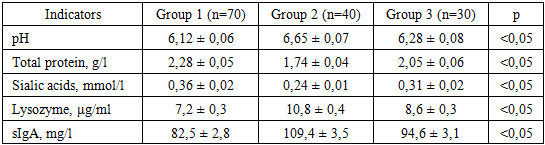
- were patients with dental caries aged 18 to 65 years who were treated as inpatients with chronic tonsillitis in the department of “Otorhinolaryngology” of the Multidisciplinary Clinic of the Tashkent Medical Academy during 2022-2024. The control group consisted of 20 practically healthy children. In order to achieve the set task, 140 patients treated at the Multidisciplinary Clinic of the Tashkent Medical Academy and the clinic of the Tashkent State Institute of Dentistry during 2022-2024 and 20 healthy people in the control group were involved in the study. In order to assess the course of the disease, the patients were divided into 3 groups: group 1 consisted of 70 patients with chronic tonsillitis against the background of dental caries. Group 2 consisted of 40 patients with chronic tonsillitis only. Group 3 was made up of only 30 patients with dental caries. Study design and participants. All patients underwent a comprehensive examination. This examination included collecting a complete medical history from patients, conducting an examination of ENT organs, administering questionnaires to patients, clinical and laboratory examination, functional examination methods, ENT endoscopy, 3D or multispiral computed tomography examination, microbiological examination, biochemical examination. All results were evaluated using statistical analysis. When analyzing the age and gender of patients, in group 1 there were 30 patients aged 18-44, 28 patients aged 45-59, and 12 patients aged 60-74. In group 2 there were 19 patients aged 18-44, 16 aged 45-59, 5 patients aged 60-74, in group 3 there were 14 patients aged 18-44, 12 aged 45-59, and 4 patients aged 60-74. In general, patients of working age, that is, patients aged 18-44, made up the majority, which indicates the social importance of the disease. The average age was 42.8±0.8 years in group 1, 41.9±0.9 years in group 2, and 41.5±0.8 years in group 3. It follows that there was almost no difference in age and gender in all groups. Clinical observation in dynamics of patients with chronic tonsillitis, general clinical and special functional examinations, methods of statistical processing of the obtained materials allowed us to solve the tasks set before us. Data analysis. The assessment of the reliability of the differences in relative and mean values was carried out using Student's standard criteria. In the absence of a normal distribution, Pearson's chi-square median test was used.
3. Research Results and Their Discussion
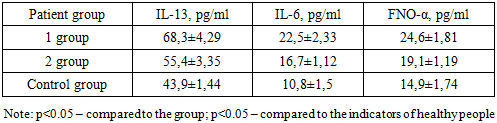
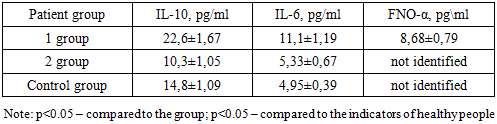
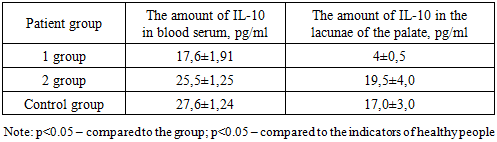
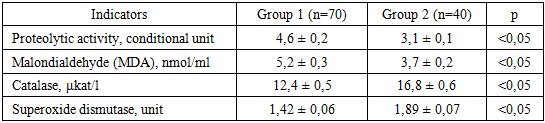
- The distribution of patients with chronic tonsillitis by clinical forms of the disease is reflected. According to the results obtained, toxic-allergic forms of chronic tonsillitis predominate in both groups. In particular, in the first group, the toxic-allergic form of the 1st degree accounted for the majority of patients, which indicates general intoxication and the activity of immune-allergic reactions in the body. A significant share of this form in the second group confirms that the systemic effect of the chronic infection is preserved.The relatively low incidence of the simple form in both groups indicates that the disease often proceeds as a general pathological process, not limited to local symptoms. The fact that the toxic-allergic form of the 2nd degree is more often detected in the first group than in the second group indicates that severe forms of chronic tonsillitis prevail in this group and the risk of developing complications is high.Thus, it has been scientifically proven that the division of patients by the form of chronic tonsillitis is of great importance in assessing the severity of the disease, individualizing treatment tactics, and choosing surgical or conservative treatment methods.During pharyngoscopy examination of chronic tonsillitis, local changes were detected: caseous-purulent congestion in 17 cases (85%), liquid pus in the lacunae in 19 cases (95%), cicatricial adhesions in the tonsils in 8 cases (40%), hyperplasia in the anterior and posterior arches in 16 cases (80%), hyperemia in the anterior arches in 14 cases (70%), and swelling of the upper part of the anterior arches in 13 cases (65%). Chronic course of the focal infectious-inflammatory process leads to a deterioration in the general condition of the body. Chronic infectious-allergic conditions lead to changes in regional lymph nodes. In many patients, it was found that the maxillary and cervical lymph nodes are enlarged and painful on palpation. Chronic tonsillitis is widespread among ENT diseases and has important clinical significance as a constant focus of infection in the body. Oral infections, especially dental caries, play an important role in the course and complications of chronic tonsillitis. Microbiological and biochemical changes associated with dental caries can negatively affect the functioning of the immune system and cause tonsillitis to become chronic. In this regard, it is important to study the clinical and biochemical characteristics of chronic tonsillitis in patients with dental caries.In response to the initial entry of an infectious agent, an inflammatory process develops. Activation of nonspecific defense factors leads to increased vascular permeability, increased blood flow, and increased activity of macrophages and polymorphonuclear cell elements. Activated macrophages produce more than 60 mediators, including immunocytokines and free radicals. Cytokines have pleiotropic (i.e., multifaceted) biological effects on various cell types and are mainly involved in the formation and regulation of the body's defense responses. Local defense is achieved by the formation of a characteristic inflammatory response after the interaction of pathogens with pattern-recognition receptors (membrane Toll-like receptors). In this process, proinflammatory cytokines synthesized in the inflammatory focus affect almost all cells involved in inflammation - granulocytes, macrophages, fibroblasts, endothelial and epithelial cells, and then T- and B-lymphocytes. Cytokines are produced by lymphocytes and macrophages, located in the epithelium of the mucous membrane. Serum transudate and salivary glands have been noted as sources of cytokines in saliva. Epithelial cells also produce cytokines when they come into contact with microorganisms. It is known that interleukin-10 (IL-10) plays a leading role in a number of chronic and autoimmune diseases. IL-10 was first described as a factor inhibiting the synthesis of cytokines (cytokine synthesis inhibitory factor, CIF). It has the property of suppressing several inflammatory cytokines (IL-1, IL-6, IL-8, GM-CSF, FNO-α), therefore it is among the anti-inflammatory mediators. The balance between pro-inflammatory and anti-inflammatory cytokines is the basis for the formation of the correct immune response to the antigen of the microorganism.Immunomodulatory drugs occupy one of the main places in the complex treatment of children with chronic tonsillitis. There is no doubt that this group of drugs should be used both during the period of exacerbation and during remission. However, such drugs should be selected in accordance with the immune status of each patient and should affect the impaired link of immunopathogenesis in this disease. Because the main factors regulating the activity of cells involved in the pathogenesis of chronic tonsillitis are cytokines. Therefore, it is advisable to assess the correlation between the main groups of cytokines during remission and relapse in children with chronic tonsillitis.
|
|
|
|
|
4. Summary
- 1. In patients with dental caries, the simple form of chronic tonsillitis was found in 40.0% of patients, toxic-allergic form 1 degree in 42.9% of patients, toxico-allergic form 2 degree in 17.1% of patients, according to the prevalence of dental caries, the severity of chronic tonsillitis was proved to be proportional;2. When studying biochemical changes in patients with chronic tonsillitis against the background of dental caries, it was found that cytokine IL-13 was 68.3±4.29 pg/ml, IL-6 22.5±2.33 pg/ml, FNO-α 24.6±1.81 pg/ml, and it was 1.5 times higher than the comparison group and 2 times higher than the control group. it was proved that IL-10 was 22.6±1.67 pg\ml, IL-6 11.1±1.19 pg\ml, and FNO-a 8.68±0.79 pg\ml;3. Analyzing clinical-biochemical indicators in predicting the recurrence of chronic tonsillitis in patients with dental caries and evaluating them according to the course of the disease allows to reduce the recurrence and improve the quality of life of patients.
Conflict of Interests
- The authors declare the absence of obvious and potential conflicts of interest related to the publication of this article.
Sources of Funding
- The authors state that there is no external funding for the study.
Availability of Data and Materials
- All data generated or analysed during this study are included in this published article.
Authors’ Contributions
- All authors contributed to the design and interpretation of the study and to further drafts. All authors read and approved the final manuscript.
Ethics Approval and Consent to Participate
- All applicable international, national, and/or institutional guidelines for the care and use of animals were followed.