
-
Paper Information
- Next Paper
- Previous Paper
- Paper Submission
-
Journal Information
- About This Journal
- Editorial Board
- Current Issue
- Archive
- Author Guidelines
- Contact Us
American Journal of Medicine and Medical Sciences
p-ISSN: 2165-901X e-ISSN: 2165-9036
2026; 16(3): 1307-1310
doi:10.5923/j.ajmms.20261603.94
Received: Feb. 17, 2026; Accepted: Mar. 11, 2026; Published: Mar. 23, 2026

Development of the Index of Adaptation of Foreign Medical Students
 Abstract
 Reference
 Full-Text PDF
 Full-text HTML
Kalim Muhammad Raza1, Jasur Alimzhanovich Rizaev2, Malika Ilkhomovna Kamalova3
1Assistant, Department of Human Anatomy, Samarkand State Medical University, Samarkand, Uzbekistan
2Doctor of Medical Sciences, Professor, Department of Public Health and Healthcare Management, Samarkand State Medical University, Samarkand, Uzbekistan
3Doctor of Medical Sciences, Associate Professor, Department of Human Anatomy, Samarkand State Medical University, Samarkand, Uzbekistan
Copyright © 2026 The Author(s). Published by Scientific & Academic Publishing.
This work is licensed under the Creative Commons Attribution International License (CC BY).
http://creativecommons.org/licenses/by/4.0/

The globalization of medical education has led to an unprecedented increase in international student mobility, with medical schools worldwide enrolling students from diverse cultural, linguistic, and educational backgrounds. International medical students (IMS) face unique challenges in adapting to new academic environments, healthcare systems, and cultural contexts that significantly differ from their home countries. Unlike domestic students, IMS must navigate complex adaptation processes that extend beyond traditional academic adjustment to encompass linguistic proficiency, cultural competence, clinical practice variations, and social integration.
Keywords: Foreign students, Adaptation, Adaptation index, Medical education, Socio-psychological adaptation
Cite this paper: Kalim Muhammad Raza, Jasur Alimzhanovich Rizaev, Malika Ilkhomovna Kamalova, Development of the Index of Adaptation of Foreign Medical Students, American Journal of Medicine and Medical Sciences, Vol. 16 No. 3, 2026, pp. 1307-1310. doi: 10.5923/j.ajmms.20261603.94.
1. Introduction
- Current approaches to supporting international medical students rely primarily on generalized orientation programs and standardized academic metrics that fail to capture the multidimensional nature of adaptation challenges. Existing assessment tools predominantly focus on academic performance indicators such as examination scores and clinical evaluations, while neglecting crucial psychosocial, cultural, and professional adaptation factors that significantly impact student success and well-being.Adapting foreign medical students to the conditions of medical education presents a pressing problem. The lack of standardized adaptation assessment tools makes it difficult to identify students in the risk group. In this article, we developed the index of socio-psychological adaptation (ISPA) of foreign medical students. Based on the leading medical university (2022-2024), 320 1-2 year foreign students (average age 21.4±2.3) from 32 countries and 80 local students were examined. An original ISPA index (10 questions, maximum 25 points) has been developed. Significant differences were found in the level of adaptation between foreign and local students (average index 15.2±5.8 versus 23.1±1.8 points, p<0.001). Only 13.1% of foreign students had excellent adaptation compared to 81.3% of local students. Differences were identified by countries of origin: Azerbaijan (21.4±3.2 points), Turkey (20.8±3.5), India (15.8±5.6), Pakistan (14.2±6.1). Thus, the ISPA Index is a valid instrument (α=0.782, test-retest r=0.841) for assessing adaptation and identifying 46.9% of students requiring intervention.The internationalization of higher education has led to a significant increase in the number of foreign students in medical universities. The adaptation of these students represents a multi-level process that includes psychological, social, cultural, and academic components [1,2].Studies show that 35-45% of foreign students experience significant adaptation difficulties that affect academic performance and mental health [7,8]. The main barriers include: language barrier, cultural differences, social isolation, high study load, and financial difficulties.The lack of a standardized tool for assessing adaptive potential makes it difficult to systematically identify students in the risk group.The internationalization of higher education is one of the key trends in the modern education system of the 21st century. According to the International Organization for Education (UNESCO), the number of foreign students studying abroad exceeded 6 million people, while in Central Asian countries, including Uzbekistan, there is a significant increase in this indicator. In the structure of foreign students entering higher educational institutions of Uzbekistan, medical students occupy one of the leading positions, which emphasizes the relevance of researching the problems of their adaptation to the educational environment [1,2].The process of adapting foreign medical students to new learning conditions is a complex, multi-level phenomenon that includes psychological, social, cultural, and academic components. Adaptation in this context is considered not only as adaptation to new living and learning conditions, but also as a process involving the active interaction of the individual with the environment, overcoming various obstacles, and forming a new way of life in a foreign language and non-social environment [3,4].Studies conducted in various countries indicate that between 35% and 50% of foreign students experience significant difficulties adapting to higher education conditions. These difficulties often lead to decreased academic performance, development of psychosomatic disorders, disruption of social interaction, and in some cases, premature expulsion from university. According to departmental statistics, the percentage of foreign students in CIS countries varies from 15% to 30%, which is significantly higher than the local student population [5,6].The main factors hindering the successful adaptation of foreign medical students can be conditionally divided into several groups:1. Linguistic barriers: Insufficient knowledge of the language of instruction (Russian, Uzbek) is one of the most significant obstacles. Students experience difficulties not only in mastering general educational material but also in mastering medical terminology, in written and oral communication with teachers and fellow students.2. Cultural-adaptive problems: Differences in cultural values, traditions, lifestyle, climatic conditions, organization of life and nutrition often cause cultural shock and psychological stress. This phenomenon is especially pronounced in the initial period of learning and manifests not only in a negative attitude towards the new environment, but also in a number of psychosomatic symptoms [7].3. Social isolation: Lack of a developed network of social contacts, lack of friendly interactions with local students, and difficulty in joining the student community are factors contributing to the development of feelings of loneliness, alienation, and psychological discomfort.4. Financial difficulties: Limited budget, high expenses for accommodation, meals, and educational materials create additional stress, especially for students from low-income countries.5. Academic challenges: Differences in education systems, teaching methods, learning requirements, and exam format require significant adaptation efforts and reorientation of learning skills.6. Psychological factors: Nostalgia, homesickness, anxiety about the future, self-doubt, increased anxiety, and depressive states often accompany the adaptation process.Despite the relevance of the problem, there are insufficient standardized, valid tools in world practice that allow for a systematic and comprehensive assessment of the adaptation level of foreign medical students. Most existing methodologies are either developed for the general student population without considering the specifics of medical education, or can only be applied in specific national and cultural contexts. The lack of an effective tool for early diagnosis of adaptation problems hinders the timely identification of students in the risk group and the implementation of preventive and corrective measures. This leads to the fact that adaptation difficulties are often identified only after they have already led to negative consequences for the student's health and academic performance.Analysis of domestic and foreign literature shows that a unified, universal, scientifically based approach to assessing the adaptive potential of foreign medical students has not yet been developed. Moreover, most research focuses on individual aspects of adaptation (psychological, social, or academic), without considering the adaptation process as an integral phenomenon. Considering the above, developing a comprehensive, valid, reliable adaptation index specifically designed to assess the level of socio-psychological adaptation of foreign medical students is a timely and necessary task. Such an index will allow:• Conduct an objective assessment of the adaptation level at different stages of learning• Identify students with an increased risk of adaptation disorders• Develop personalized support programs• Optimize the work of foreign student support services• Predict learning success and reduce deductions• Contribute to improving the quality of medical education as a wholeThese considerations served as the basis for conducting this study, the purpose of which was to develop and validate the index of socio-psychological adaptation (ISPA) of foreign medical students, which allows for a comprehensive assessment of the adaptation process and identification of risk groups.The purpose of the study is to develop an adaptation index for foreign medical students.
2. Research Materials and Methods
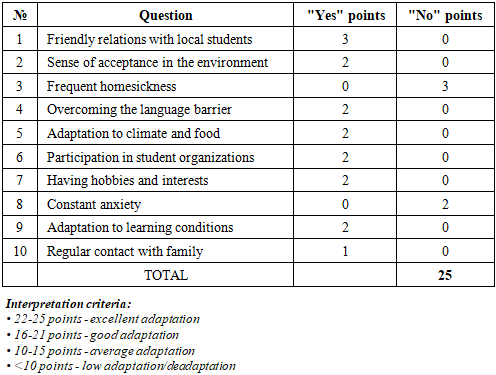
- We conducted a prospective cohort study in the period from September 2023 to May 2025. The main group consisted of 320 foreign students of the 1st and 2nd years of study (21.4±2.3 years old). The control group included 80 local students (aged 20.8±2.1 years). The study involved 156 students from Pakistan, 140 from India, 10 from Azerbaijan, and 14 from Turkey. We developed the ISPA index, which includes 10 questions across three adaptation spheres: social (questions 1, 2, 6), psychological (questions 3, 8, 10), and cultural-academic (questions 4, 5, 7, 9).
|
3. Results
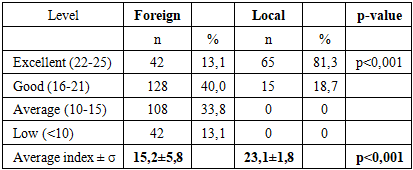
- We conducted a comparative analysis of adaptation levels between foreign and local students. The distribution by adaptation levels was distributed as follows: excellent adaptation (22-25 points): only 13.1% of foreign students (42 people) showed excellent adaptation, while among local students, this indicator was 81.3% (65 people). Good adaptation (16-21 points): 40.0% of foreign students (128 people) versus 18.7% of local students (15 people). Average adaptation (10-15 points): 33.8% of foreign students (108 people), while none were found among local students. Low adaptation (<10 points): 13.1% of foreign students (42 people), none among local students. The average adaptation index was 15.2±5.8 points for foreign students and 23.1±1.8 points for local students. The difference is statistically significant (p<0.001). Thus, foreign students demonstrate a significantly lower level of adaptation compared to local students (p<0.001). It is crucial to note that 46.9% of foreign students (150 people) have medium or low adaptation, which requires targeted intervention. These results indicate significant differences in adaptation capabilities between groups and emphasize the need to develop special support programs for foreign students.
|
|
4. Conclusions
- Thus Significant lag in adaptation: The gap between foreign and local students is 7.9 points (31.6% of the maximum), indicating the need for comprehensive support. A high proportion of the risk group, almost half (46.9%) of foreign students, requires targeted intervention. Students from geographically and culturally close countries show better adaptation results, confirming the importance of cultural integration. The most influential are social integration (r=0.687), academic adaptation (r=0.721) and overcoming the language barrier (r=0.658). Students with excellent adaptation have a GPA of 1.5 points higher than students with low adaptation.