
-
Paper Information
- Next Paper
- Previous Paper
- Paper Submission
-
Journal Information
- About This Journal
- Editorial Board
- Current Issue
- Archive
- Author Guidelines
- Contact Us
American Journal of Medicine and Medical Sciences
p-ISSN: 2165-901X e-ISSN: 2165-9036
2026; 16(3): 1276-1279
doi:10.5923/j.ajmms.20261603.88
Received: Feb. 22, 2026; Accepted: Mar. 16, 2026; Published: Mar. 23, 2026

Clinical Characteristics of Postoperative Complications in Patients with Diffuse Toxic Goiter and Recurrent Disease
 Abstract
 Reference
 Full-Text PDF
 Full-text HTML
Yusupova Shaxnoza Kadirjonovna1, Botirova Dilorom Rustamjon qizi2
1Head of the Department of Hospital Therapy and Endocrinology, Doctor of Medical Sciences, Professor, Andijan State Medical Institute, Uzbekistan
2Free Applicant for the Department of Hospital Therapy and Endocrinology, Andijan State Medical Institute, Uzbekistan
Copyright © 2026 The Author(s). Published by Scientific & Academic Publishing.
This work is licensed under the Creative Commons Attribution International License (CC BY).
http://creativecommons.org/licenses/by/4.0/

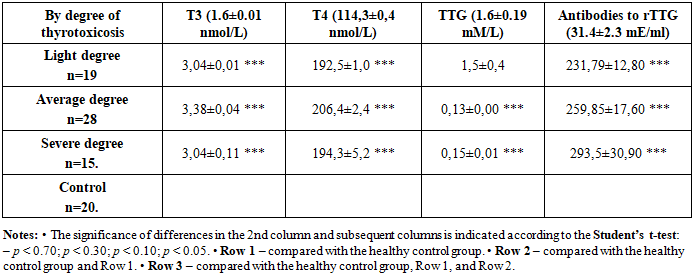
The aim of the study was to investigate the characteristics of postoperative complications in patients with diffuse toxic goiter and disease recurrence.Clinical data were collected at the City Clinical Hospital No. 1 in Andijan. A total of 62 patients were examined, including 42 women and 20 men. The mean age was 49.2 ± 1.62 years (47 ± 1.76 years in women and 42 ± 2.6 years in men). Among the 62 patients with diffuse toxic goiter (DTG) who received conservative treatment, 47 patients achieved complete remission. Of these 62 patients, 19 (30.6%) had mild thyrotoxicosis, 28 (45.2%) had moderate thyrotoxicosis, and 15 (24.2%) had severe thyrotoxicosis. In 15 patients (24.2%), disease recurrence was observed two years after conservative treatment. Due to recurrence, these patients underwent total strumectomy. Thus, 47 patients formed the main group (drug therapy), while 15 patients constituted the recurrence group (drug therapy plus strumectomy). The control group consisted of 20 healthy individuals (10 women and 10 men), whose hormonal parameters were used to assess the reliability of the obtained results. Research methods included general clinical, biochemical tests (bilirubin – total, direct and indirect, ALT, AST, prothrombin index, coagulogram, C-reactive protein), hormonal tests (TSH, free thyroxine, antibodies to TSH receptors, and prolactin in blood), anthropometric measurements (height (cm), weight (kg), body mass index (BMI, kg/m²), waist circumference, hip circumference), and instrumental methods such as ECG, echocardiography, ultrasound examination of the thyroid gland and internal organs, and chest X-ray. The study demonstrated that the most pronounced immunohormonal disturbances were observed in patients with severe thyrotoxicosis. This group included patients with disease recurrence during conservative treatment who subsequently underwent surgical treatment. In patients of the recurrence group, one month after total strumectomy in the postoperative period, as well as in patients of the conservative treatment group, compensation of the condition and the development of postoperative hypothyroidism were observed. After traditional treatment in the main group, remission was achieved in 47 (75.4%) patients, whereas after the use of a comprehensive conservative method remission was achieved in 15 (26.2%) patients. Changes in the titers of antibodies to TSH receptors during treatment may be useful for predicting relapse after treatment with antithyroid drugs in patients who had positive antibodies to TSH receptors at the time of diagnosis.
Keywords: Diffuse toxic goiter, Strumectomy, Postoperative complications
Cite this paper: Yusupova Shaxnoza Kadirjonovna, Botirova Dilorom Rustamjon qizi, Clinical Characteristics of Postoperative Complications in Patients with Diffuse Toxic Goiter and Recurrent Disease, American Journal of Medicine and Medical Sciences, Vol. 16 No. 3, 2026, pp. 1276-1279. doi: 10.5923/j.ajmms.20261603.88.
1. Introduction
- Treatment options for Graves’ disease or diffuse toxic goiter (DTG) after a course of antithyroid therapy remain a challenging task for individualized patient management. Currently, there is no single index to determine which patients respond better to antithyroid therapy and achieve remission after treatment. Due to their active pathogenic role, the measurement of antibodies to the thyroid-stimulating hormone receptor (TRAb) at the time of discontinuation of antithyroid therapy is used as a predictor of relapse in Graves’ disease; however, published data remain contradictory [1].Graves’ disease (GD) is an autoimmune disorder of the thyroid gland caused by antibodies that stimulate the thyroid-stimulating hormone (TSH) receptor on thyroid follicular cells [1]. One of the standard treatment approaches for GD is the administration of antithyroid drugs (ATDs) for 12–18 months [2]. This treatment may lead to remission of the disease without the development of subsequent hypothyroidism. However, the risk of relapse remains high, and patients may experience adverse effects [2].Antithyroid drugs may also exert immunomodulatory effects associated with normalization of TSH receptor antibody (TRAb) levels over time, which may be important for achieving remission after therapy [3]. In addition, changes in thyroid peroxidase antibodies (TPOAb) and thyroglobulin antibodies (TgAb) during ATD treatment have also been reported [4]. The remission rate varies depending on ethnicity and geographical region [5]. In patients with normalized TRAb levels, the relapse rate ranges from 20% to 30% during 3–5 years of follow-up [1]. Overall, the risk of relapse after a 1–2-year course of ATD therapy is approximately 50% [6,7].Previously identified predictors of relapse include young age, larger goiter size, smoking, male sex, severe hyperthyroidism, higher antibody concentrations, and the presence of Graves’ ophthalmopathy [2,7,8,9]. The usefulness of measuring TRAb at the time of ATD withdrawal for predicting subsequent relapse of hyperthyroidism has been extensively studied [10–13]. However, the influence of TPOAb on the course of Graves’ disease after discontinuation of ATD therapy remains unclear.The aim of this study was to investigate the effect of autoimmune antibodies on the risk of recurrence of Graves’ disease in patients treated with antithyroid drugs.Aim of the study: to investigate the characteristics of postoperative complications in patients with diffuse toxic goiter and disease recurrence.
2. Materials and Methods
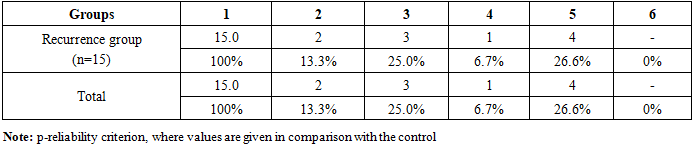
- Clinical data were collected at the City Clinical Hospital No. 1 in Andijan. A total of 62 individuals were examined, including 42 women and 20 men. The mean age of the participants was 49.2 ± 1.62 years (47 ± 1.76 years in women and 42 ± 2.6 years in men).Among the 62 patients with diffuse toxic goiter (DTG) who received conservative treatment, 47 patients achieved complete remission. Of the total number of patients, 19 (30.6%) had mild thyrotoxicosis, 28 (45.2%) had moderate thyrotoxicosis, and 15 (24.2%) had severe thyrotoxicosis. In the remaining 15 patients (24.2%), disease recurrence was observed two years after conservative treatment, and therefore these patients underwent total strumectomy.Thus, 47 patients constituted the main group (drug therapy), while 15 patients formed the recurrence group (drug therapy combined with strumectomy).The control group consisted of 20 healthy individuals (10 women and 10 men), whose hormonal parameters were used to assess the reliability of the obtained results.Inclusion criteriaDiffuse toxic goiter; male and female patients.Exclusion criteriaPatients with carbohydrate metabolism disorders, ischemic heart disease, heart defects, idiopathic cardiomyopathies, as well as patients with a history of cerebrovascular accidents were not included in the study.Research methodsThe study included general clinical, biochemical, hormonal, anthropometric, and instrumental methods.Biochemical tests included total, direct, and indirect bilirubin, alanine aminotransferase (ALT), aspartate aminotransferase (AST), prothrombin index (PTI), coagulogram, and C-reactive protein (CRP).Hormonal tests included thyroid-stimulating hormone (TSH), free thyroxine (fT4), antibodies to TSH receptors (TRAb), and prolactin levels in blood.Anthropometric measurements included height (cm), weight (kg), body mass index (BMI, kg/m²), waist circumference, and hip circumference.Instrumental examinations included electrocardiography (ECG), echocardiography (Echo-ECG), ultrasound examination of the thyroid gland and internal organs, and chest X-ray.The baseline examination of patients included medical history collection (patient complaints, time of their first appearance, possible causes according to the patient, time of first medical consultation, time of diagnosis, type of therapy received and its effectiveness), physical examination (heart rate and blood pressure measurement), and general clinical examinations.Hormonal status was assessed by determining free triiodothyronine (fT3), free thyroxine (fT4), and thyroid-stimulating hormone (TSH). To clarify the autoimmune nature of the disease, the titer of antibodies to TSH receptors (TRAb) was determined. Hormonal levels were measured in blood serum using reagents produced by HUMAN (Germany).The obtained data were statistically processed on a personal computer (Pentium-IV) using the Microsoft Office Excel-2003 software package, including built-in statistical functions. Methods of parametric and non-parametric variation statistics were applied with calculation of the arithmetic mean (M), standard deviation (SD), standard error of the mean (m), and relative values (frequency, %). Statistical significance of differences between mean values was determined using Student’s t-test with calculation of the probability of error (P), after testing the normality of distribution (kurtosis test) and equality of variances (Fisher’s F-test). Differences were considered statistically significant at P < 0.05.
3. Results
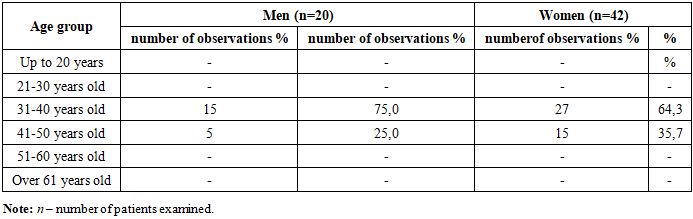
- The distribution of patients by age groups is presented in Table 1.
|
|
|
|
4. Conclusions
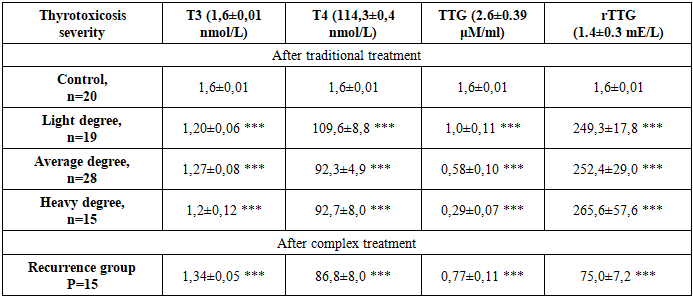
- After traditional treatment in the main group, remission was achieved in 47 (75.4%) patients, whereas after the use of a comprehensive conservative treatment method remission was achieved in 15 (26.2%) patients.Changes in the titers of antibodies to TSH receptors during treatment may be useful for predicting recurrence after antithyroid drug therapy in patients who had positive thyroid peroxidase antibodies at the time of diagnosis.