
-
Paper Information
- Next Paper
- Previous Paper
- Paper Submission
-
Journal Information
- About This Journal
- Editorial Board
- Current Issue
- Archive
- Author Guidelines
- Contact Us
American Journal of Medicine and Medical Sciences
p-ISSN: 2165-901X e-ISSN: 2165-9036
2026; 16(3): 1081-1084
doi:10.5923/j.ajmms.20261603.49
Received: Jan. 28, 2026; Accepted: Feb. 22, 2026; Published: Mar. 7, 2026

The Effectiveness of Natural Ointment "As-DF" in the Treatment of Vitiligo
 Abstract
 Reference
 Full-Text PDF
 Full-text HTML
B. Kh. Tashpulatov
Andijan State Medical Institute, Andijan, Uzbekistan
Correspondence to: B. Kh. Tashpulatov, Andijan State Medical Institute, Andijan, Uzbekistan.
| Email: |  |
Copyright © 2026 The Author(s). Published by Scientific & Academic Publishing.
This work is licensed under the Creative Commons Attribution International License (CC BY).
http://creativecommons.org/licenses/by/4.0/

Vitiligo is a chronic skin disorder characterized by depigmented patches resulting from the loss of melanin. Despite various modern treatments, the search for safe and effective therapeutic options continues. This study investigates the effectiveness of the natural ointment “As-DF,” formulated with St. John’s wort (Hypericum perforatum) and garlic (Allium sativum) bulbs, in the treatment of vitiligo. A total of 60 patients aged 4–60 years with scattered vitiligo lesions were treated with the ointment twice daily for three months. Clinical evaluation using the Vitiligo Area Scoring Index (VASI) revealed remission in 36% of patients, significant improvement in 44%, partial improvement in 10%, and no change in 10%. St. John’s wort contributes to increased skin sensitivity to ultraviolet light via hypericin, while garlic promotes skin regeneration. The findings suggest that As-DF ointment is a promising adjunct therapy for vitiligo, potentially enhancing repigmentation and preventing relapse.
Keywords: Vitiligo, St. John’s wort, Hypericin, Garlic, As-DF ointment, Skin depigmentation, Herbal therapy
Cite this paper: B. Kh. Tashpulatov, The Effectiveness of Natural Ointment "As-DF" in the Treatment of Vitiligo, American Journal of Medicine and Medical Sciences, Vol. 16 No. 3, 2026, pp. 1081-1084. doi: 10.5923/j.ajmms.20261603.49.
1. Introduction
- Vitiligo (Latin: Vitiligo - "skin disease", pes) is a type of skin disease characterized by the loss of natural pigmentation of the dermis against the background of the breakdown of melanin, as a result of which the skin in certain areas loses color, which is manifested by the formation of white spots.According to the World Health Organization (WHO), about 1-2% of the world's population suffers from vitiligo. As the number of people suffering from vitiligo increases, so do the methods and types of treatment for this disease. Prevention, elimination of causes and treatment of diseases are priority areas of medicine.The article provides brief information about the importance of the ointment “As-DF”, prepared with the addition of St. John's wort and garlic, in medicine, especially in the treatment of vitiligo.The relevance of the problem Vitiligo is a chronic skin disease in which well-defined milky-white depigmented or hypochromic patches appear on various areas of the body, and the hair becomes discolored. Hypochromia occurs spontaneously, without the participation of inflammatory reactions, and manifests itself in the form of complete congenital acromia - albinism or the acquired form - vitiligo.The average incidence is 0.5-1% of the total population [6, p. 473]. This disease occurs in China (0.093%) [6, p. 491], Northern European countries (Denmark - 0.38%) [12, p. 47] and often in some states of India (8.8%) [8, p. 47].The etiology of vitiligo is unknown. Genetics plays a particularly significant role in the disease's pathogenesis, as an autosomal recessive inheritance pattern has been established due to the absence of the enzyme tyrosinase, which catalyzes pigment formation in melanocytes and melanosomes. In patients with vitiligo, multi-glandular endocrine diseases with increasing functional insufficiency of the pituitary-adrenal system and thyroid gland are detected.Today, there are many modern methods of treating vitiligo, we will list some of them: - Systemic therapy; - Local therapy; - Photo- and laser therapy; - Surgical method; - Camouflage; - Traditional medicine method; Medicinal plants from different regions are used differently in herbal medicine. For example, our research has demonstrated the effectiveness of an ointment made from St. John's wort and garlic bulbs in the treatment of vitiligo.St. John's wort contains flavonoids (hyperoside, rutin, quercetin, quercitrin, isoquercitrin), essential oils containing terpenes, sesquiterpenes (azulene), naphthodianthrones (hypericin, pseudohypericin, hyperin or hypericin, close to hematoporphyrin, sensitive to sunlight; is a catalyst for some intracellular reactions, a regulator of vital processes, affects biochemical processes in patients with tumor diseases of organs, increases the sensitivity of the skin to ultraviolet rays) [7, p. 403].In traditional Eastern medicine, garlic is considered a food that improves metabolism and stimulates digestion. In folk medicine, there are many recipes for garlic-based masks, but to avoid burns and allergic reactions, it is advisable to use them only after consulting a dermatologist.St. John's wort's ability to increase skin sensitivity to ultraviolet rays (due to the hypericin contained in St. John's wort) and garlic's ability to improve skin regeneration are useful in the treatment of vitiligo.The aim of the study was to determine the effectiveness of treating vitiligo with As-DF ointment prepared with the addition of St. John's wort and garlic bulbs.
2. Materials and Methods
- The study involved 60 patients diagnosed with vitiligo who were undergoing treatment at the Andijan regional branch of the Republican Specialized Scientific and Practical Center for Dermatovenereology and Cosmetology. Of these, 42 patients were aged 17 to 60 years (20 men, 22 women) and 18 patients were aged 4 to 16 years (8 boys, 10 girls).The diagnosis of vitiligo was confirmed after a comprehensive anamnesis, laboratory tests and special examinations (using a Wood's lamp). The study focused on a simple type of vitiligo characterized by numerous scattered white spots.To obtain the cosmetic ointment “As-DF”, St. John’s wort and garlic were thoroughly washed, peeled, crushed in a mortar and passed through a sieve with a mesh size of 1 mm. A cosmetic petroleum jelly (paraffin) was obtained. The above products were weighed and mixed on a Radwag AS 220/C/2 analytical balance for 4-6 hours in a muffle furnace (Nabertherm SNA 341295, Germany) at 600°C until the optimum consistency was achieved. The finished ointment mixture was packaged in 25-gram plastic bottles. Below (Scheme I.1) is a basic flow chart of the production process for the cosmetic ointment "As-DF."
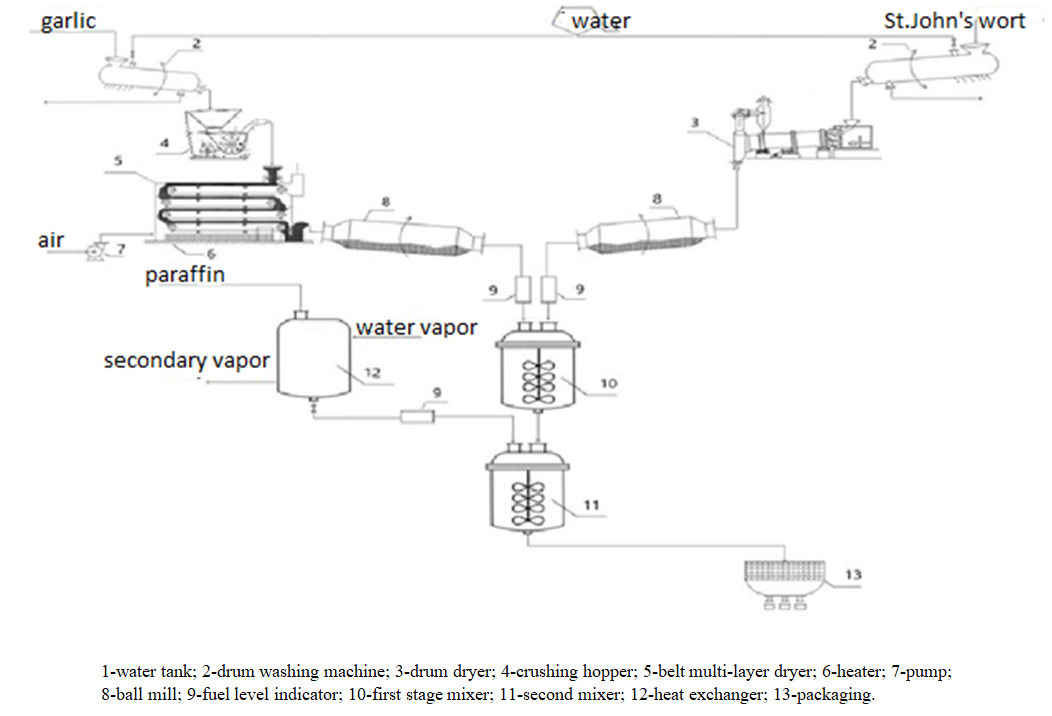 | Scheme I.1. Basic technological scheme for obtaining cosmetic ointment As-DF |
3. Results and Discussion
- More recently, various St. John's wort formulations have been developed in the form of gels, ointments, creams, lotions, sprays, and bath oils, which may provide easier handling and greater stability than oils. Some of them were clinically tested and eventually made available for sale. However, the declarations on the marketed products are incomplete because they are not registered medicinal products, and relevant information on the composition, content of active ingredients and stability of the products under investigation is provided only in a few publications. Kacerovskaya et al. [16] investigated the efficacy of St. John's wort extract in photodynamic therapy (PDT) of non-melanoma skin cancer with a viscous formula consisting of 36% glycerol, 17% water, and 47% dry material ethanol extract of dry material. The corresponding compounds, which absorb light at the wavelengths of the light source used, were quantified in the final product as 0.15–0.25% hypericin and pseudohypericin in a 1:2 ratio. According to the authors, hypericins were stable under light protection at room temperature for 12 months. Tardivo et al. [17] used a 10% ethylene glycol solution of the extract with 1% hypericin and 0.5% chlorophyll for phototherapy of herpes simplex. A lipophilic ointment containing only 0.003% hypericin and 0.0024% hyperforin was able to protect human skin from sun-induced inflammation [18]. Liquid CO2 extraction has been used to obtain very high (up to 30%) concentrations of hyperforin; a cream containing an extract free of hypericin and flavonoids but rich in hyperforin (1.5% in the final product) was used by Schempp et al. [19] for the treatment of atopic dermatitis [20]. K. M. Schempp, R. Lüdtke, B. Winghofer, J. K. Simon achieved this result in their experiments: To date, there are no reports of photosensitizing capacity of topical application of St. John's wort.K. M. Schempp, R. Lüdtke, B. Winghofer, J. K. Simon achieved this result in their experiments: To date, there are no reports of photosensitizing capacity of topical application of St. John's wort. Here, we investigated the effects of St. John's wort oil (hypericin 110 μg/ml) and St. John's wort ointment (hypericin 30 μg/ml) on skin sensitivity to simulated solar radiation. The results indicate no significant phototoxic potential for St. John's wort oil or St. John's wort ointment, as measured by the clinically relevant visual erythema scale. However, the tendency towards increased photosensitivity observed with more sensitive photometric measurements may become relevant in individuals with fair skin, damaged skin, or after prolonged sun exposure [21].Throughout treatment, remission was observed in 22 patients, and significant improvement was observed in 27 patients. Additionally, improvement was observed in 5 patients, and no changes were observed in 5 patients. The original image shows the disease status before and after treatment (Figure 1).
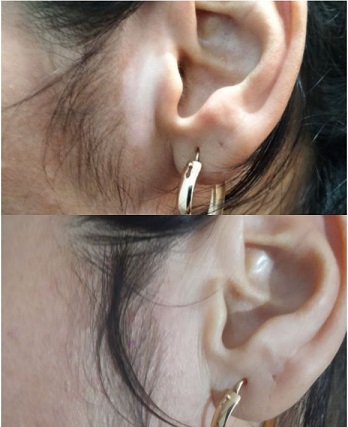 | Figure 1. Vitiligo on the eyelids of an eight-year-old girl (courtesy of B. Toshpulatova, assistant). Before and after treatment |
4. Conclusions
- The study results show that clinical remission was achieved in 36% of patients, with 44% experiencing significant improvement. Furthermore, 10% of patients experienced improvement, while 10% showed no change. These results indicate that the developed method holds promise for the effective treatment of vitiligo and the potential prevention of relapse.