
-
Paper Information
- Next Paper
- Previous Paper
- Paper Submission
-
Journal Information
- About This Journal
- Editorial Board
- Current Issue
- Archive
- Author Guidelines
- Contact Us
American Journal of Medicine and Medical Sciences
p-ISSN: 2165-901X e-ISSN: 2165-9036
2026; 16(3): 1070-1072
doi:10.5923/j.ajmms.20261603.46
Received: Jan. 15, 2026; Accepted: Feb. 6, 2026; Published: Mar. 7, 2026

Results of Evaluating Early Diagnostic Indicators at the Primary Level of the Armed Forces
 Abstract
 Reference
 Full-Text PDF
 Full-text HTML
Muyassar Mukhamedova1, Oybek Ashurov2, Obidjon Jalolov3
1Deputy Head of the Military Medical Institute, Military Medical Institute, Tashkent, Uzbekistan
2Independent Researcher, Military Medical Institute, Tashkent, Uzbekistan
3Combane Assissent of the EMU Department, Euroasian medical university, Tashkent, Uzbekistan
Correspondence to: Muyassar Mukhamedova, Deputy Head of the Military Medical Institute, Military Medical Institute, Tashkent, Uzbekistan.
| Email: |  |
Copyright © 2026 The Author(s). Published by Scientific & Academic Publishing.
This work is licensed under the Creative Commons Attribution International License (CC BY).
http://creativecommons.org/licenses/by/4.0/

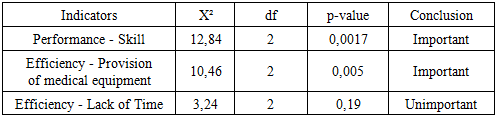
Today, the medical support system in military units is organized in a multi-level form, in which the correspondence of the processes of prevention, diagnosis, treatment, and rehabilitation is of great importance. From this point of view, analyzing the needs of military personnel in medical provision, assessing the level of their satisfaction, is considered important in assessing the state of medical provision in the military unit. The results of statistical analysis show a clear correlation between the factors influencing the effectiveness of diagnostics in the primary level, and it was established that the qualification of personnel (p=0.0017) and the state of provision with medical equipment (p=0.005) have a statistically significant influence on the effectiveness of diagnostics, while the lack of time (p=0.19) does not show a statistically significant correlation. These results, obtained during our research, confirm that in order to improve the quality of diagnostics at the primary level, the main attention should be paid to improving the qualifications of medical personnel and providing them with modern diagnostic equipment.
Keywords: Primary health care level, Diagnostic effectiveness, Quality of medical services, Satisfaction estimate, Qualification of medical personnel, Provision of medical equipment
Cite this paper: Muyassar Mukhamedova, Oybek Ashurov, Obidjon Jalolov, Results of Evaluating Early Diagnostic Indicators at the Primary Level of the Armed Forces, American Journal of Medicine and Medical Sciences, Vol. 16 No. 3, 2026, pp. 1070-1072. doi: 10.5923/j.ajmms.20261603.46.
Article Outline
1. Introduction
- The results of numerous global studies in this field have demonstrated that the diagnostic process at the primary healthcare level has a hierarchical structure [3,5,6,7], with the variation in clear effectiveness emerging as the main trend. In this context, the application of clinical examinations, laboratory tests, and instrumental diagnostics (ECG, ultrasound) is significant due to their relatively high effectiveness. It is acknowledged that these methods are primarily used for military personnel presenting with specific pathologies [1]. While the use of psychophysiological tests and telemedicine methods in the army is also crucial for improving diagnostics at the primary level, the current neglect of these areas, the shortage of qualified specialists in these fields, and their developed potential and role in specific clinical situations are having an impact [4,2,8,9].
2. Purpose of the Research
- The purpose of this study is to evaluate early diagnostic indicators at the primary care level.
3. Materials and Method
- The study employed analytical, retrospective, sociological, organizational-experimental, medical-statistical, and statistical methods.
4. Results and Discussion
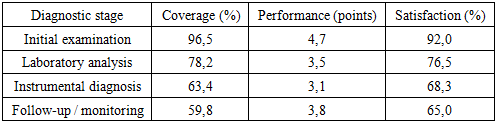
- Early diagnosis is one of the important areas in the system of protecting the health of military personnel at the tactical level. This system is crucial not only for diagnosing diseases but also for reducing the risk of their development, implementing preventive measures, and increasing the effectiveness of treatment. Of course, the ability to quickly and accurately perform diagnostic processes in the activities of medical centers at this level largely depends on the qualifications of medical personnel, the level of provision with medical equipment, and the effectiveness of the information exchange system. Therefore, an in-depth analysis of early diagnostic indicators and assessment of their effectiveness is an important part of our research.We assessed the diagnostic processes carried out at the primary level using statistical and scientific methods, and analyzed the diagnostic indicators of medical centers. In particular, the coverage, effectiveness, and level of satisfaction of military personnel with the stages of diagnostics at the primary level were analyzed (Table 1).
|
|
5. Conclusions
- Thus, the results of statistical analysis reveal clear correlations between factors influencing the effectiveness of diagnostics at the primary care level. It was established that the qualifications of personnel (p=0,0017) and the availability of medical equipment (p=0,005) have a statistically significant impact on diagnostic effectiveness, while time constraints (p=0,19) do not demonstrate a statistically significant correlation. These findings from our research confirm that to enhance the quality of diagnostics in primary care, the main focus should be on improving the qualifications of medical personnel and providing them with modern diagnostic equipment.