
-
Paper Information
- Next Paper
- Previous Paper
- Paper Submission
-
Journal Information
- About This Journal
- Editorial Board
- Current Issue
- Archive
- Author Guidelines
- Contact Us
American Journal of Medicine and Medical Sciences
p-ISSN: 2165-901X e-ISSN: 2165-9036
2026; 16(3): 934-937
doi:10.5923/j.ajmms.20261603.18
Received: Jan. 25, 2026; Accepted: Feb. 20, 2026; Published: Mar. 4, 2026

Trace Element Imbalance Assessed by Hair Analysis and Its Impact on Myopia Progression in Children of Karakalpakstan
 Abstract
 Reference
 Full-Text PDF
 Full-text HTML
Muratbay Kurbanazarov1, Nuriya Abdullaeva2
1PhD, Head of Ophthalmology Department, Karakalpakstan Medical Institute, Nukus, Uzbekistan
2Senior Lecturer, Department of Ophthalmology, Karakalpakstan Medical Institute, Nukus, Uzbekistan
Correspondence to: Muratbay Kurbanazarov, PhD, Head of Ophthalmology Department, Karakalpakstan Medical Institute, Nukus, Uzbekistan.
| Email: |  |
Copyright © 2026 The Author(s). Published by Scientific & Academic Publishing.
This work is licensed under the Creative Commons Attribution International License (CC BY).
http://creativecommons.org/licenses/by/4.0/

To comprehensively assess trace element status in children with myopia living in environmentally disadvantaged regions of Karakalpakstan and to evaluate its association with clinical and functional ocular parameters. A total of 173 children aged 4–17 years were enrolled in this cross-sectional study. The main group included 113 children with myopia residing in ecologically unfavorable areas of the Southern Aral Sea region, while the control group consisted of 60 age- and sex-matched emmetropic children from an environmentally favorable region. All participants underwent comprehensive ophthalmological examination, including visual acuity assessment, objective and subjective refraction, and axial length measurement. Trace element concentrations (Zn, Se, Cu, Fe, Mg) were determined in hair samples using instrumental neutron activation analysis. Children with myopia demonstrated a significant imbalance of trace elements compared to controls. Mean hair zinc concentration in the myopia group was significantly lower than in controls (75.3 ± 9.8 µg/g vs. 98.7 ± 7.5 µg/g, p < 0.01). Selenium levels were also reduced (0.48 ± 0.09 µg/g vs. 0.69 ± 0.06 µg/g, p < 0.01), as were copper levels (9.4 ± 1.2 µg/g vs. 12.2 ± 1.0 µg/g, p < 0.01). The most pronounced deficiencies were observed in children with high-degree myopia. A significant inverse correlation was found between zinc levels and axial length (r = –0.58, p < 0.01), as well as between selenium levels and myopia severity (r = –0.47, p < 0.05). Children with myopia living in environmentally adverse regions exhibit a pronounced Zn–Se-deficient trace element profile, which may contribute to oxidative stress and scleral remodeling underlying myopia progression. Zinc and selenium may serve as potential biomarkers and therapeutic targets for preventing myopia progression in pediatric populations exposed to environmental risk factors.
Keywords: Zinc, Selenium, Progressive myopia, Children, Ecological factors
Cite this paper: Muratbay Kurbanazarov, Nuriya Abdullaeva, Trace Element Imbalance Assessed by Hair Analysis and Its Impact on Myopia Progression in Children of Karakalpakstan, American Journal of Medicine and Medical Sciences, Vol. 16 No. 3, 2026, pp. 934-937. doi: 10.5923/j.ajmms.20261603.18.
1. Introduction
- Myopia is one of the most common forms of refractive pathology among children and adolescents. According to the latest epidemiological data, the prevalence of myopia is increasing at an alarming rate worldwide, and, according to World Health Organization experts, by 2050, more than half of the planet's population will suffer from this pathology. [1]. The pediatric population is of particular importance, as myopia typically develops and progresses during childhood, when the visual system is still undergoing active growth and remodeling [2].Although refractive correction with spectacles, contact lenses, or refractive surgery can compensate for visual impairment, progressive and high-degree myopia remains a significant clinical problem. High myopia is associated with an increased risk of serious ocular complications, including retinal detachment, glaucoma, myopic maculopathy, cataract, and irreversible vision loss, making it one of the leading causes of visual disability worldwide [3]. Despite extensive research, the mechanisms underlying myopia onset and progression are not fully understood.The pathophysiology of myopia is considered multifactorial, involving complex interactions between genetic predisposition, environmental exposure, and lifestyle factors. Recent studies suggest that environmental conditions, such as near-work activities, reduced outdoor exposure, and nutritional factors, play an important role in the development and progression of myopia, particularly in children [2,3]. Increasing attention has been paid to the role of oxidative stress and metabolic disturbances as potential contributors to abnormal ocular growth.Environmental factors are especially relevant in regions exposed to chronic ecological stress. The Republic of Karakalpakstan is recognized as one of the most environmentally disadvantaged regions in Central Asia due to the Aral Sea crisis, which has resulted in severe contamination of air, soil, water sources, and food products with salts, pesticides, heavy metals, and other toxicants [4,5].In the Republic of Karakalpakstan, where the consequences of the Aral Sea crisis are manifested in the pollution of air, soil, and water, a chronic microelement imbalance is formed in children. The accumulation of toxic elements in the body intensifies the course of myopia, turning it into a complicated form. According to M. Kurbanazarov and N. Abdullaeva (2019), the frequency of complicated myopia among children in the Aral Sea region is 1.8 times higher than in other regions of Uzbekistan. Moreover, visual impairment due to complicated myopia in Karakalpakstan accounts for up to 28% of all childhood disabilities due to ophthalmological pathology. Complicated myopia leads not only to a decrease in the child's quality of life but also to significant social and economic losses.Children living in such conditions constitute a vulnerable group of the population, as their organisms are in the phase of intensive growth and development, including the formation of visual structures. It is known that the chronic impact of environmental pollutants leads to a disruption of mineral metabolism and the development of persistent deficiency of essential trace elements such as zinc, selenium, iron, copper, and magnesium. These elements play a critical role in antioxidant defense systems, regulation of cellular metabolism, and maintenance of connective tissue integrity, including scleral remodeling processes involved in ocular growth. Deficiency of trace elements may therefore create unfavorable metabolic conditions that promote axial elongation of the eyeball and progression of myopia.Oxidative stress has been increasingly implicated in the pathogenesis of myopia and other ocular diseases. Excessive production of reactive oxygen and nitrogen species can alter retinal neurotransmission, disrupt dopamine and nitric oxide signaling, and induce structural damage to ocular tissues, including the retina, sclera, and lens [6]. Experimental and clinical evidence suggests that oxidative stress contributes not only to the development of myopia but also to its progression and associated complications.Zinc is a critical structural and catalytic cofactor for numerous enzymes and transcription factors and plays a key role in antioxidant defense. Although zinc itself is not redox-active, its deficiency is associated with increased oxidative stress, enhanced lipid peroxidation, and oxidative damage to proteins and DNA. Zinc exerts its antioxidant effects through several mechanisms, including the stabilization of protein thiol groups, competition with transition metals such as iron and copper, and reduction of hydroxyl radical formation. [7]. The eye, particularly the retina and retinal pigment epithelium–choroid complex, contains high concentrations of zinc, and disturbances in zinc homeostasis have been linked to various ocular pathologies, including age-related macular degeneration [8]. Selenium, another essential trace element, is a component of selenoproteins involved in antioxidant defense and redox regulation, and its deficiency may further exacerbate oxidative damage in ocular tissues.Despite growing interest in the role of trace elements and oxidative stress in ocular diseases, data on trace element imbalance in pediatric myopia, particularly in environmentally disadvantaged regions, remain limited. The interaction between environmental exposure, trace element status, and myopia progression in children has not been sufficiently studied [6,7].Therefore, the present study aimed to comprehensively assess trace element status in children with myopia living in ecologically unfavorable regions of Karakalpakstan and to evaluate its association with clinical and functional parameters of the eye. Understanding the contribution of trace element imbalance to myopia progression may help identify potential biomarkers and preventive strategies for children at increased environmental risk [4,5,9].
2. Materials and Methods
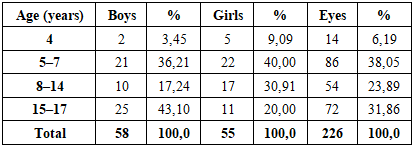
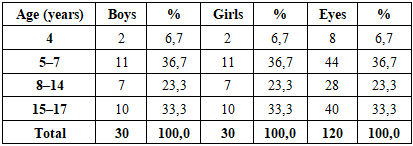
- This study was designed as a cross-sectional observational study. A total of 173 children aged 4–17 years. Participants were divided into two groups based on refractive status and environmental conditions of residence.The main group included 113 children (226 eyes) diagnosed with myopia who permanently resided in environmentally disadvantaged areas of the Republic of Karakalpakstan (Southern Aral Sea region). The control group consisted of 60 age- and sex-matched children (120 eyes) with emmetropia and no history of refractive disorders, living in an environmentally favorable region. (Samarkand) age between 4 and 17 years. The children of the control group were comparable in age and gender to the children of the main groups, which ensured the correctness of the intergroup comparative analysis.The control group was used exclusively to establish reference values for trace element status and was not included in the analysis of myopia severity or its clinical structure.Ophthalmological ExaminationAll participants underwent a comprehensive ophthalmological examination, which included:• assessment of best-corrected visual acuity;• objective and subjective refraction;• slit-lamp biomicroscopy;• fundus examination;• measurement of axial length using ocular biometry.The degree of myopia was classified according to spherical equivalent refraction as follows:• mild myopia: ≤ −3.0 diopters;• moderate myopia: −3.25 to −6.0 diopters;• high myopia: > −6.0 diopters.In the main group, distribution of myopia severity was as follows: mild myopia — 120 eyes (53.1%), moderate myopia — 54 eyes (23.9%), and high myopia — 52 eyes (23.0%).Demographics:
|
|
3. Discussion
- The present study demonstrates that children with myopia living in ecologically disadvantaged regions of Karakalpakstan exhibit a significant imbalance in essential trace elements, particularly zinc and selenium, compared to emmetropic controls. Our findings indicate that 4 out of 5 children with myopia in the affected region have reduced levels of Zn and Se, suggesting that deficiency of these elements may play a key role in myopia progression. Copper, iron, and magnesium also showed moderate but statistically significant reductions.Mineral deficiency in children living in areas with high environmental pollution levels is likely the result of a combination of factors, including reduced food intake, soil and water pollution, and increased oxidative stress caused by environmental toxins. The observed inverse correlations between zinc and axial length (r = –0.58; p < 0.01) and selenium and degree of myopia (r = –0.47; p < 0.05) suggest that Zn–Se deficiency may contribute to abnormal ocular growth and scleral remodeling, providing a potential mechanistic link between environmental exposure and myopia progression.Our results are consistent with previous studies highlighting the role of oxidative stress and micronutrient imbalance in ocular pathology. Zinc and selenium are critical components of antioxidant defense systems, and their deficiency can exacerbate oxidative damage in retinal and scleral tissues, potentially promoting axial elongation and refractive error development [6–8]. The finding that children in ecologically favorable regions had significantly higher Zn and Se levels reinforces the impact of environmental conditions on trace element status and ocular health.While copper, iron, and magnesium deficiencies were less pronounced, their moderate reduction may further contribute to oxidative stress and tissue vulnerability. The overall pattern of multi-element deficiency observed in our study indicates that myopia in environmentally challenged regions is associated not only with isolated micronutrient deficits but with a broader metabolic imbalance, which may be a target for preventive interventions.The study underscores the importance of evaluating trace element status in pediatric populations at risk of environmental exposure. Monitoring and correcting Zn–Se deficiency may represent a feasible strategy for slowing myopia progression, particularly in regions affected by ecological degradation. Further longitudinal studies are needed to establish causal relationships and assess the efficacy of targeted nutritional interventions.Limitations of this study include its cross-sectional design, which does not allow assessment of causal relationships, and the reliance on hair samples as a surrogate for systemic trace element status. Despite these limitations, the large sample size, inclusion of a well-matched control group, and use of a validated analytical method (INAA) strengthen the reliability of the findings.In conclusion, our study provides evidence that trace element imbalance, particularly Zn–Se deficiency, is strongly associated with myopia progression in children from ecologically disadvantaged regions of Karakalpakstan. These findings highlight the need for preventive strategies focusing on nutritional supplementation and environmental health interventions to mitigate the risk of progressive myopia in vulnerable pediatric populations.
4. Conclusions
- Our study demonstrates a widespread trace element imbalance in children with myopia living in the ecologically disadvantaged region of Southern Aral Karakalpakstan, with zinc (Zn) and selenium (Se) deficiency being the most pronounced. Among children with myopia, 80.7% exhibited Zn–Se deficiency, compared to 23.7% in the control group (p < 0.001), confirming a statistically significant disparity. Copper (Cu), iron (Fe), and magnesium (Mg) levels were moderately reduced (ΔCu = 32.7%, ΔFe = 24.3%, ΔMg = 16.2%) but remained statistically significant (p < 0.05).Correlation analysis revealed a strong inverse relationship between Zn concentration and axial length of the eye (r = –0.58, p < 0.01), and between Se concentration and myopia severity (r = –0.47, p < 0.05), indicating a direct involvement of trace element deficiency in scleral remodeling and axial elongation, key processes in myopia progression.The observed trace element deficiency is strongly influenced by environmental and dietary factors. Chronic exposure to dust-salt aerosols, pesticides, and heavy metals, coupled with insufficient Zn and Se intake from food and water, low soil content, and elevated oxidative stress, contributes to a sustained oxidative-metabolic stress, creating conditions favorable for myopia progression.Our findings support the concept of a Zn–Se deficiency pattern as the leading component of a broader multi-element imbalance in children with myopia. Moderate reductions in Cu, Fe, and Mg further highlight the complex nature of mineral metabolism disruption, which may compromise antioxidant defense and influence biochemical mechanisms of ocular growth.From a clinical perspective, Zn and Se can serve as key biomarkers for assessing the risk of myopia progression. Early detection of Zn-Se deficiency provides a rationale for targeted corrective interventions aimed at restoring antioxidant defenses, particularly in children living in environmentally stressed regions. These results provide a scientific foundation for the development of preventive strategies and nutraceutical approaches to mitigate myopia progression in pediatric populations.In conclusion, children with myopia in ecologically compromised areas exhibit a stable multi-element deficiency, dominated by Zn–Se depletion, which correlates with clinical indicators of disease severity. The data underscore the critical role of environmental and nutritional factors in myopia pathogenesis and highlight the importance of region-specific trace element monitoring and early intervention for children at high risk of progressive myopia.