
-
Paper Information
- Next Paper
- Previous Paper
- Paper Submission
-
Journal Information
- About This Journal
- Editorial Board
- Current Issue
- Archive
- Author Guidelines
- Contact Us
American Journal of Medicine and Medical Sciences
p-ISSN: 2165-901X e-ISSN: 2165-9036
2026; 16(3): 1452-1455
doi:10.5923/j.ajmms.20261603.126
Received: Feb. 4, 2026; Accepted: Mar. 2, 2026; Published: Mar. 27, 2026

Evaluation of the Neuroprotective and Antioxidant Activity of "Asqov-1" and "Asataqov" Food Supplements in a Model of Perinatal Encephalopathy in Children
 Abstract
 Reference
 Full-Text PDF
 Full-text HTML
Ibragim Askarov1, Nasrulla Khakimov2, Manzura Madaminova2, Madina Atabaeva2
1Andijan State University, Andijan, Uzbekistan
2Andijan State Medical Institute, Andijan, Uzbekistan
Correspondence to: Ibragim Askarov, Andijan State University, Andijan, Uzbekistan.
| Email: |  |
Copyright © 2026 The Author(s). Published by Scientific & Academic Publishing.
This work is licensed under the Creative Commons Attribution International License (CC BY).
http://creativecommons.org/licenses/by/4.0/

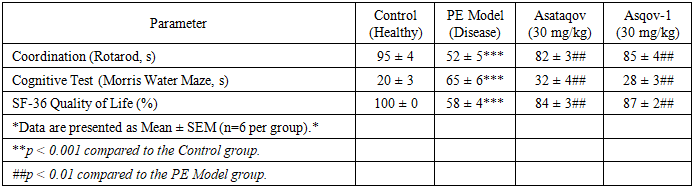
Perinatal encephalopathy (PE) is a pressing neurological issue in pediatrics, affecting 10-40% of newborns. It results from central nervous system damage due to hypoxic, ischemic, or toxic factors leading to oxidative stress and neuronal degeneration. This study evaluated the antioxidant and neuroprotective activity of two plant-based food supplements, Asqov-1 and Asataqov, in a rat model of perinatal hypoxic encephalopathy. Experiments were conducted on 30 male rats (150-200 g) divided into five groups: control, PE model (10% AlCl₃-induced hypoxia), Asataqov-treated (30 mg/kg), Asqov-1-treated (30 mg/kg), and a conditional control (hypoxia + saline). Biochemical parameters—malondialdehyde (MDA), superoxide dismutase (SOD), and catalase (CAT)—were measured spectrophotometrically. Functional outcomes were assessed using rotarod (coordination), Morris water maze (cognitive), and SF-36 quality of life tests. In the PE model group, MDA levels increased 2.7-fold (p < 0.001), while SOD and CAT activities decreased by 56% and 54%, respectively (p < 0.001). Administration of Asqov-1 and Asataqov significantly reduced MDA levels by approximately two-fold and restored antioxidant enzyme activity to near-normal values (p < 0.01). Treated animals showed significant improvements in coordination (from 52±5 s to 85±4 s, p < 0.01) and cognitive performance (latency decreased from 65±6 s to 28±3 s, p < 0.001), with the SF-36 index increasing from 58% to 87%. These findings demonstrate that Asqov-1 and Asataqov are effective natural agents capable of reducing oxidative stress, protecting neuronal cells, and restoring cognitive function in a PE model, suggesting their potential for use in prevention and rehabilitation strategies.
Keywords: Perinatal encephalopathy, Asqov-1, Asataqov, Antioxidant, Neuroprotector, MDA, SOD, Catalase, Cognitive function
Cite this paper: Ibragim Askarov, Nasrulla Khakimov, Manzura Madaminova, Madina Atabaeva, Evaluation of the Neuroprotective and Antioxidant Activity of "Asqov-1" and "Asataqov" Food Supplements in a Model of Perinatal Encephalopathy in Children, American Journal of Medicine and Medical Sciences, Vol. 16 No. 3, 2026, pp. 1452-1455. doi: 10.5923/j.ajmms.20261603.126.
Article Outline
1. Introduction
- Perinatal encephalopathy (PE) represents a complex of neurometabolic syndromes of the central nervous system (CNS) arising during the perinatal period due to hypoxia, ischemia, or toxic exposure. With an incidence of 10-40% in newborns, PE is characterized by disturbances in neuronal energy metabolism, heightened oxidative stress, and increased lipid peroxidation, which activate cellular apoptosis and can lead to long-term neurodevelopmental delays. While synthetic neuroprotectors are commonly used, their potential for toxicity and side effects has driven interest in safer, natural alternatives [1,2,3,4,5,6,7,8].Biologically active supplements based on plant extracts, such as "Asqov-1" and "Asataqov," are of particular interest. These supplements are enriched with B-group vitamins (B₁, B₃, B₆), vitamins A and C, and essential minerals like zinc, magnesium, and iron. Additionally, they contain polyphenols and flavonoids, which are known to neutralize free radicals, inhibit lipid peroxidation, and reduce inflammation. The key pathogenic mechanism in perinatal hypoxic encephalopathy is oxidative stress, marked by elevated malondialdehyde (MDA) and reduced activity of antioxidant enzymes like superoxide dismutase (SOD) and catalase (CAT). Therefore, this study aimed to comprehensively evaluate the antioxidant and neuroprotective effects of "ASQOV-1" and "ASATAKOV" in an AlCl₃-induced hypoxia rat model of PE, assessing their impact on oxidative stress markers, neuromotor and cognitive functions [9,10,11,12,13,14,15,16,17,18].
2. Materials and Methods
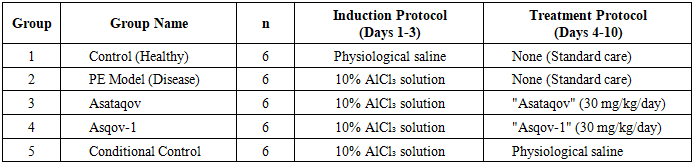
- Thirty male Wistar rats weighing 150–200 g were used in this study. The animals were housed under standard laboratory conditions with a 12-hour light/dark cycle and free access to food and water. All experimental procedures were approved by the Institutional Animal Ethics Committee. The rats were randomly divided into five groups (n=6 per group) (Table 1).
|
3. Results
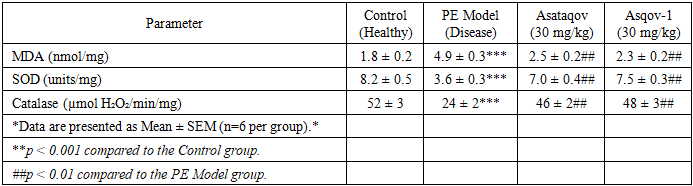
- As shown in Table 1, induction of PE with AlCl₃ caused significant oxidative stress. In the PE model group, MDA levels increased 2.7-fold compared to the healthy control group (p < 0.001), indicating enhanced lipid peroxidation. Concurrently, the activities of the antioxidant enzymes SOD and CAT were significantly reduced by 56% and 54%, respectively (p < 0.001), reflecting a compromised antioxidant defense system.Treatment with both "Asataqov" and "Asqov-1" significantly mitigated these changes. MDA levels were reduced by approximately 49% and 53% in the Asataqov and Asqov-1 groups, respectively, compared to the untreated PE model group (p < 0.01). Furthermore, SOD and CAT activities in both treatment groups were restored to levels that were not statistically different from the healthy control group (p > 0.05), indicating a powerful antioxidant effect (Table 2).
|
|
4. Discussion
- The results of this study robustly confirm the antioxidant and neuroprotective properties of the "Asqov-1" and "Asataqov" supplements in a preclinical model of perinatal encephalopathy. The significant reduction in MDA levels in the treatment groups directly demonstrates their capacity to inhibit lipid peroxidation, a key downstream effect of oxidative stress. Simultaneously, the restoration of SOD and CAT activities suggests that these supplements do not just act as direct free radical scavengers but also help to rejuvenate the brain's endogenous enzymatic antioxidant defense system. These neurochemical improvements translated into meaningful functional recovery, as evidenced by the enhanced performance in both coordination and cognitive tests. This indicates that the supplements are capable of protecting the neural substrates underlying motor control, learning, and memory from hypoxic damage.The observed effects are likely due to the synergistic action of the supplements' bioactive constituents. The presence of flavonoids like quercetin and apigenin in "Asataqov" is known to contribute to anti-inflammatory and neuroprotective effects by modulating cellular signaling pathways. In "Asqov-1," the combination of B-group vitamins and minerals such as magnesium, zinc, and phosphorus likely supports neuronal health by acting as cofactors for ATP synthesis, neurotransmitter production, and maintaining synaptic plasticity. The slightly better performance of the "Asqov-1" group may be attributable to its specific mineral composition. The safety profile of these supplements, with an LD₅₀ > 5000 mg/kg placing them in the practically non-toxic class (hazard class VI), further supports their potential for use in vulnerable populations like children.
5. Conclusions
- This study provides compelling experimental evidence that the food supplements "Asataqov" and "Asqov-1" possess significant antioxidant and neuroprotective activities. In a rat model of perinatal encephalopathy, they effectively reduced oxidative stress, restored the activity of key antioxidant enzymes, and improved motor coordination and cognitive function. Their high biological activity, coupled with a demonstrated low toxicity profile, positions them as promising and safe natural adjuncts for the prevention and rehabilitation of perinatal encephalopathy and potentially other hypoxic or neurodegenerative conditions. Further clinical investigations are warranted to confirm their efficacy and safety in children with PE.
ACKNOWLEDGEMENTS
- The authors would like to thank the staff of the biochemical laboratories at Andijan State University and Andijan State Medical Institute for their technical support.
Conflict of Interest
- The authors declare no conflicts of interest.