
-
Paper Information
- Next Paper
- Previous Paper
- Paper Submission
-
Journal Information
- About This Journal
- Editorial Board
- Current Issue
- Archive
- Author Guidelines
- Contact Us
American Journal of Medicine and Medical Sciences
p-ISSN: 2165-901X e-ISSN: 2165-9036
2026; 16(2): 807-810
doi:10.5923/j.ajmms.20261602.87
Received: Feb. 5, 2026; Accepted: Feb. 22, 2026; Published: Feb. 27, 2026

Study of Epidemiological Indicators of the Dental Health of Children Living in Rural Areas as the Basis of Preventive Medicine
 Abstract
 Reference
 Full-Text PDF
 Full-text HTML
Safonova Anastasia Vladimirovna1, Nazarov Ulugbek Kahramonovich2, Olimov Siddiq Sharifovich2
1Assistant, Department of Preventive and Pediatric Dentistry, Tyumen State Medical University, Russian Federation
2DSc, Professor, Department of Orthopedic Dentistry and Orthodontics of the Bukhara State Medical Institute named after Abu ali Ibn sino, Uzbekistan
Correspondence to: Safonova Anastasia Vladimirovna, Assistant, Department of Preventive and Pediatric Dentistry, Tyumen State Medical University, Russian Federation.
| Email: |  |
Copyright © 2026 The Author(s). Published by Scientific & Academic Publishing.
This work is licensed under the Creative Commons Attribution International License (CC BY).
http://creativecommons.org/licenses/by/4.0/

A priority task for researchers in the field of dentistry in Russia, in particular within the borders of the Tyumen region, is the systematic monitoring of the incidence of dental ailments. However, despite the importance of this topic, there is a pronounced lack of empirical work focusing on identifying patterns of dental disorders among the inhabitants of rural settlements concentrated in the southern part of the region.
Keywords: Disease prevention, Analysis of the epidemiological situation, Southern regions of the Tyumen region, Countryside, Population of children
Cite this paper: Safonova Anastasia Vladimirovna, Nazarov Ulugbek Kahramonovich, Olimov Siddiq Sharifovich, Study of Epidemiological Indicators of the Dental Health of Children Living in Rural Areas as the Basis of Preventive Medicine, American Journal of Medicine and Medical Sciences, Vol. 16 No. 2, 2026, pp. 807-810. doi: 10.5923/j.ajmms.20261602.87.
1. Introduction
- Studying the impact of environmental factors on the dental system is one of the most pressing areas of scientific research in the epidemiology of dental diseases, given that the scale of the adverse impact of modern industrial production has reached critical levels [1,5].Changing environmental conditions particularly impact health in childhood. The child's body's high sensitivity to environmental factors is due to critical periods of organ and system development, the characteristics of metabolic processes in the growing body, the immaturity of several detoxification enzyme systems, the limited functional capacity of the liver and kidneys, the incomplete development of the immune system, and the potential for accumulation of xenobiotics and radionuclides [3].Studies by a number of authors [2,4,6,7] have demonstrated that adverse environmental factors influence the development of dental pathologies in children. This reduces the caries resistance of dental tissue, disrupts the mineralizing function of saliva, and increases the frequency and severity of non-carious lesions and periodontal diseases. Oral diseases are an important global public health problem [1,2] with large socioeconomic implications. A recently published report on oral pathological conditions, based on the Global Burden of Disease 2017 [3,4] study covering 195 countries and territories, showed that dental diseases remain a major public health problem. Notably, 3.5 billion people had oral disease in 2017, of which 2.3 billion and 532 million had untreated caries on their permanent and temporary teeth, respectively. The age-standardized prevalence of permanent dental caries was 29.4%, while that of milk teeth was 7.8% [5].Dental caries, the most common chronic oral disease, is described as a biofilm-mediated, diet-dependent, multifactorial, noninfectious, dynamic disease resulting in complete loss of minerals by tooth solids. Its etiology involves biological, behavioral, psychosocial and environmental factors [6,7,8].The aim of the study is to determine the severity and frequency of the most significant dental pathologies among children permanently residing in rural settlements of the Berdyuzhsky district of the Tyumen region.Accurate, reliable and up-to-date data on dental morbidity are fundamental to the prevention and treatment of dental caries. Regular disease surveillance and epidemiological monitoring, including data on associated risk factors, allow the development of appropriate prevention activities and programmes [9]. Systematically collected data should be available for research, analysis and informed policy decisions, and used to develop an oral health action plan. Thus, resources can be rationally allocated to regions and districts where they are most needed [10].
2. Research Methodology
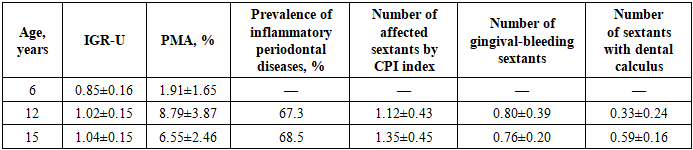
- During the dental examination, 148 schoolchildren aged 6 [n = 45], 12 [n = 49] and 15 [n = 54] years living in the Berdyuzhsky district of the Tyumen region, the prevalence and intensity of dental caries (kpu and KPU), signs of inflammatory periodontal diseases (PMA and CPI indices), the level of oral hygiene (IGR-U index) were assessed. The presence of non-carious lesions of the hard tissues of the teeth, malocclusions, signs of dysfunction of the temporomandibular joint (TMJ) was also detected, and the level of dental care (USP) provided to the children and adults was determined. The exclusion criterion was the presence of a physical, mental or behavioral disorder preventing cooperation in oral examination. Informed consent was obtained from all participants in the examination. In the course of the work, a disposable spatula, a dental mirror, a periodontological probe and tweezers were used. The data obtained were entered into an individual dental examination card in accordance with the recommendations of the World Health Organization (WHO) for 1995 and 2013. All parameters were statistically processed using the analytical program "Vortex 10.7.3."
3. Results and Discussion
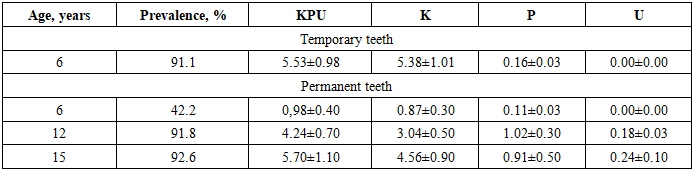
- In the course of a study of the condition of teeth in children aged six years living in the Berdyuzhsky district, it was found that more than 90% of them (the exact figure is 91.1%) suffer from caries of milk teeth. The assessment of the kpu indicator characterizing the intensity of morbidity reached an average value of 5.53 ± 0.98. Permanent teeth in 42.2% of 6-year-olds are susceptible to caries. It is noteworthy that the KPU coefficient for this group reaches: 0.98 ± 0.40 (table 1).
|
|
|
 | Table 4. Structure of maxillofacial anomalies in children of key age groups of the Berdyuzhsky district |
 | Table 5. Prevalence of signs of TMJ dysfunction in children of key age groups of Berdyuzhsky district, % |
4. Conclusions
- A study of the dental and oral health in general in children living in rural areas of the Berdyuzhsky district of the Tyumen region clearly demonstrates the need to study the causes contributing to the manifestations of major dental diseases; shows the importance of creating a set of preventive measures that provide for the features of the studied area.