
-
Paper Information
- Next Paper
- Previous Paper
- Paper Submission
-
Journal Information
- About This Journal
- Editorial Board
- Current Issue
- Archive
- Author Guidelines
- Contact Us
American Journal of Medicine and Medical Sciences
p-ISSN: 2165-901X e-ISSN: 2165-9036
2026; 16(2): 583-587
doi:10.5923/j.ajmms.20261602.42
Received: Jan. 2, 2026; Accepted: Jan. 25, 2026; Published: Feb. 7, 2026

The Impact of Hemostatic Alterations in Manifest and Subclinical Hypothyroidism on Endothelial Dysfunction
 Abstract
 Reference
 Full-Text PDF
 Full-text HTML
Nazokat Bekchanova1, Shaira Babadjanova2
1PhD Student, Department of Hematology, Transfusiology and Laboratory Work, Tashkent State Medical University, Uzbekistan
2DSc., Professor, Department of Hematology, Transfusiology and Laboratory Work, Tashkent State Medical University, Uzbekistan
Correspondence to: Nazokat Bekchanova, PhD Student, Department of Hematology, Transfusiology and Laboratory Work, Tashkent State Medical University, Uzbekistan.
| Email: |  |
Copyright © 2026 The Author(s). Published by Scientific & Academic Publishing.
This work is licensed under the Creative Commons Attribution International License (CC BY).
http://creativecommons.org/licenses/by/4.0/

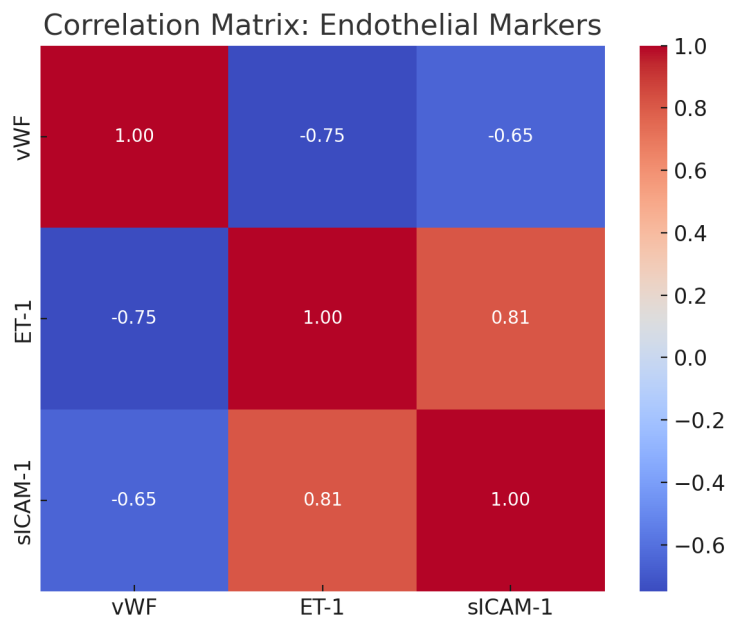
Autoimmune thyroiditis (AIT) with progression to hypothyroidism is frequently accompanied by systemic vascular and hemostatic abnormalities that contribute to increased cardiovascular risk. This study aimed to explore the relationship between endothelial dysfunction and hemostasis alterations in patients with subclinical and manifest hypothyroidism. A total of 87 participants were enrolled, including 20 healthy controls, 38 with subclinical hypothyroidism, and 29 with manifest hypothyroidism. Laboratory assessment comprised classical coagulation markers such as prothrombin index (PTI), activated partial thromboplastin time (APTT), fibrinogen, platelet count, and D-dimer, along with endothelial indicators including von Willebrand factor (vWF), endothelin-1 (ET-1), and soluble intercellular adhesion molecule-1 (sICAM-1). The results revealed progressive endothelial dysfunction in hypothyroid groups, manifested by a decline in vWF levels and significant elevation of ET-1 and sICAM-1. Concurrently, hemostatic imbalance was evident, with prolonged APTT, increased fibrinogen concentration, and higher D-dimer values compared with controls. Correlation analysis demonstrated strong positive associations between endothelial and coagulation parameters, most notably between ET-1 and sICAM-1 (r = 0.81, p < 0.001). These findings indicate that both subclinical and manifest hypothyroidism are characterized by distinct but interconnected vascular and coagulation disturbances. Importantly, alterations emerge even at the subclinical stage, underscoring the need for early identification and monitoring to reduce thrombotic risk in autoimmune thyroid disease.
Keywords: Autoimmune thyroiditis, Hypothyroidism, Subclinical hypothyroidism, Endothelial dysfunction, Hemostatic abnormalities, von Willebrand factor (vWF), Endothelin-1 (ET-1), Soluble intercellular adhesion molecule-1 (sICAM-1), Thrombotic risk, Cardiovascular complications
Cite this paper: Nazokat Bekchanova, Shaira Babadjanova, The Impact of Hemostatic Alterations in Manifest and Subclinical Hypothyroidism on Endothelial Dysfunction, American Journal of Medicine and Medical Sciences, Vol. 16 No. 2, 2026, pp. 583-587. doi: 10.5923/j.ajmms.20261602.42.
1. Introduction
- Autoimmune thyroiditis (AIT) constitutes one of the most prevalent organ-specific autoimmune disorders and is recognized as the primary etiology of hypothyroidism within iodine-sufficient populations [9,20]. In addition to the traditional consequence of compromised thyroid hormone production, AIT has increasingly been acknowledged as a systemic disorder exerting significant influence on vascular biology and hemostatic processes [14,17].The presence of hypothyroidism, whether manifest or subclinical, exhibits a strong correlation with cardiovascular complications, wherein endothelial dysfunction (ED) and hemostatic irregularities function as pivotal mediators of vascular risk [6,8]. The vascular endothelium operates as a fundamental regulatory interface, preserving a delicate balance between vasodilation and vasoconstriction, antithrombotic and prothrombotic signaling pathways, as well as inflammatory and anti-inflammatory responses [7,12].Disruption of this intricate equilibrium leads to impaired release of vasoactive mediators, altered expression of adhesion molecules, and abnormalities in endothelial biomarkers such as von Willebrand factor (vWF), endothelin-1 (ET-1), and soluble intercellular adhesion molecule-1 (sICAM-1) [7,11,14]. Concurrently, hypothyroid states have been associated with disturbances in the coagulation cascade, characterized by reduced prothrombin activity, prolonged activated partial thromboplastin time (APTT), hyperfibrinogenemia, and increased D-dimer generation, collectively contributing to a prothrombotic or hemorrhagic tendency depending on disease severity [2,4,5,6,13].Despite the proposed pathophysiological association between thyroid dysfunction, endothelial injury, and coagulation abnormalities, the extent and stage-dependent nature of these alterations remain insufficiently clarified [8,16]. Most previous investigations have focused primarily on overt hypothyroidism or on patients with advanced cardiovascular comorbidities [4,5,6]. In contrast, only a limited number of studies have examined endothelial and hemostatic interactions during the early, subclinical phase of autoimmune hypothyroidism, a stage in which vascular impairment may already be developing but remains clinically silent [1,6,14].This gap in knowledge is of particular importance, as early endothelial and coagulation abnormalities may precede overt cardiovascular disease and provide an opportunity for timely risk stratification and preventive intervention [8,12]. Therefore, the present study was undertaken to comprehensively evaluate endothelial function alongside key coagulation parameters in patients with both subclinical and manifest autoimmune hypothyroidism.By assessing classical hemostatic indices—including prothrombin index (PTI), APTT, fibrinogen concentration, platelet count, and D-dimer levels—together with endothelial markers (vWF, ET-1, and sICAM-1), this investigation aims to generate novel insights into the interrelated vascular and hemostatic disturbances associated with autoimmune hypothyroidism [1,6,8,14]. Understanding these early alterations is essential for improving cardiovascular risk assessment and may contribute to more informed clinical decision-making in patients with autoimmune thyroid disease.
2. Materials and Methods
- This observational cross-sectional study was designed to evaluate endothelial dysfunction and hemostatic alterations in patients with different thyroid functional states. A total of 107 participants were enrolled and stratified into three groups according to thyroid hormone status. The control group consisted of 30 euthyroid individuals with normal thyroid function tests. The subclinical hypothyroidism group included 53 patients characterized by elevated thyroid-stimulating hormone (TSH) levels with normal free thyroid hormone concentrations, while the manifest hypothyroidism group comprised 54 patients with increased TSH and reduced free thyroid hormone levels.Endothelial function was assessed by measuring circulating biomarkers associated with endothelial activation and dysfunction, including vWF, ET-1 and sICAM-1.In addition, a comprehensive evaluation of the hemostatic system was performed. This included assessment of the prothrombin index (PI), APTT, plasma fibrinogen concentration, platelet count, and D-dimer levels, providing insight into both coagulation and fibrinolytic activity.Statistical analysis was conducted using appropriate parametric methods. Differences between the study groups were analyzed using one-way analysis of variance (ANOVA). Pearson’s correlation coefficient (r) was applied to determine the strength and direction of associations between thyroid function parameters and endothelial or hemostatic biomarkers. Statistical significance was defined as a p-value of less than 0.05.
3. Result and Discussion
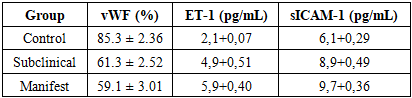
- Endothelial dysfunction markers showed significant differences among the study groups (Table 1). In the control group vWF levels were within normal range, averaging 85.3 ± 2.36%, whereas a marked reduction was observed in both the subclinical and manifest hypothyroidism groups, with values of 61.3 ± 2.52% and 59.1 ± 3.01%, respectively. This decrease was statistically significant compared to controls (p<0.05), indicating impaired endothelial hemostatic function in hypothyroid states.
|
|
 | Figure 1. Correlation matrix: vWF, ET-1, sICAM-1 |
4. Conclusions
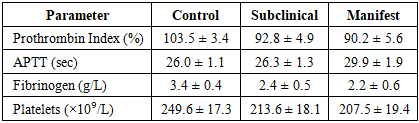
- The present study demonstrates that autoimmune thyroiditis complicated by both subclinical and manifest hypothyroidism is accompanied by pronounced and interrelated disturbances in endothelial function and hemostatic balance. Our findings provide compelling evidence that endothelial dysfunction develops early in the course of autoimmune hypothyroidism and progressively worsens with increasing thyroid hormone deficiency.A consistent reduction in von Willebrand factor levels alongside a marked elevation of endothelin-1 and sICAM-1 reflects a shift toward endothelial inflammation, vasoconstriction, and impaired endothelial hemostatic capacity. These endothelial alterations are paralleled by significant changes in the coagulation system, including a decrease in prothrombin index, prolongation of activated partial thromboplastin time, reduced fibrinogen concentration, and a decline in platelet count, indicating a complex dysregulation of both primary and secondary hemostasis.Importantly, correlation analysis revealed strong and biologically meaningful associations between endothelial and coagulation markers, particularly the robust positive relationship between endothelin-1 and sICAM-1, underscoring the central role of endothelial activation and inflammation in the pathogenesis of hemostatic disturbances in autoimmune hypothyroidism. The inverse correlations involving von Willebrand factor further suggest that endothelial injury and inflammatory activation occur through interconnected but partially divergent regulatory pathways.Notably, similar directional changes were observed already at the subclinical stage of hypothyroidism, highlighting that vascular and hemostatic abnormalities precede overt clinical manifestations. This emphasizes the necessity for early identification of endothelial and coagulation dysfunction in patients with autoimmune thyroiditis, even before the development of manifest hypothyroidism.In conclusion, autoimmune hypothyroidism should be regarded as a systemic disorder characterized by early endothelial dysfunction and hemostatic imbalance. Integrated assessment of endothelial markers and coagulation parameters may enhance cardiovascular risk stratification and support timely preventive strategies aimed at reducing thrombotic and vascular complications in patients with autoimmune thyroid disease.