
-
Paper Information
- Next Paper
- Previous Paper
- Paper Submission
-
Journal Information
- About This Journal
- Editorial Board
- Current Issue
- Archive
- Author Guidelines
- Contact Us
American Journal of Medicine and Medical Sciences
p-ISSN: 2165-901X e-ISSN: 2165-9036
2026; 16(2): 444-447
doi:10.5923/j.ajmms.20261602.13
Received: Jan. 3, 2026; Accepted: Jan. 21, 2026; Published: Feb. 3, 2026

Cytokine Profile in Children with Infectious Mononucleosis Epshtein's Barb-Viral – Etiology
 Abstract
 Reference
 Full-Text PDF
 Full-text HTML
Narzullayev Nuriddin Umarovich
Bukhara State Medical Institute named After Abu Ali Ibn Sino, Bukhara, Uzbekistan
Correspondence to: Narzullayev Nuriddin Umarovich, Bukhara State Medical Institute named After Abu Ali Ibn Sino, Bukhara, Uzbekistan.
| Email: |  |
Copyright © 2026 The Author(s). Published by Scientific & Academic Publishing.
This work is licensed under the Creative Commons Attribution International License (CC BY).
http://creativecommons.org/licenses/by/4.0/

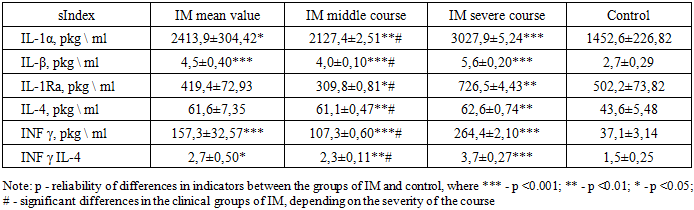
A comparative study of cytokines in clinically similar groups of patients requiring differential diagnostic search revealed significant differences in the level of indicators. At the height of the disease, the serum of children with infectious Epstein-Barr mononucleosis of viral etiology is characterized by an increase in the content of proinflammatory cytokines IL-1α (1.7 times), IL-β (1.6 times) and INF-γ (4.3 times). In severe infectious mononucleosis, there was a twofold increase in the level of IL-1α and IL-β, a 7-fold increase in the concentration of INF-γ, an increase in the content of IL-1Ra (2.3 times) in the blood serum and the INF-γ/IL-4 coefficient (1.6 times). Correlations were also found between the levels of IL-1α and IL-1Ra (0.49), IL-1a and IL-4 (0.45), IL-1α and INF - γ, (0.64), INF - γ, and IL-4 (0.47), INF - γ, and the number of atypical mononuclears (0.37). Acute bacterial tonsillitis is characterized by a twofold increase in levels of IL-1β and INF - γ, and acute viral hepatitis В - much more significant increase in the concentration of IL-Vetta (18 times), increased INF - γ, (2.3 fold) and increased levels of IL-1Ra (1.3 times).
Keywords: Infectious mononucleosis, Bacterial tonsillitis, Hepatitis B
Cite this paper: Narzullayev Nuriddin Umarovich, Cytokine Profile in Children with Infectious Mononucleosis Epshtein's Barb-Viral – Etiology, American Journal of Medicine and Medical Sciences, Vol. 16 No. 2, 2026, pp. 444-447. doi: 10.5923/j.ajmms.20261602.13.
1. Introduction
- Infectious mononucleosis is a widespread infectious disease among children and adults, caused by the Epstein-Barr virus (EBV). The virus is not eliminated from the body, has a tropism for lymphoid and reticular tissues, causing a kind of immune-pathological process, which makes EBV similar to the human immunodeficiency virus. In connection with the introduction of the virus into lymphoid cells, structural changes are formed that affect all parts of the immune system [1,6,7,8,12]. Active proliferation of virus-infected lymphocytes in all organs with lymphoid tissue promotes infiltration and histological changes in these organs (lymph nodes, liver, spleen, etc.). This causes polymorphism of clinical symptoms and complications in EBV infection [2,5,13].Immune disorders in infectious mononucleosis are complex in nature, they relate to both the cellular and humoral links, entail an aggravation of the course, an increase in complications of the disease, which reflects the essence of infectious mononucleosis as a disease of the immune system [3,4,9,11,14,15]. The analysis of the state of the immune status in relation to changes in the cytokine spectrum in children with infectious mononucleosis has not yet been carried out in the literature available to us, which served as the basis for setting the goal of the study.The importance of the problem of studying infectious mononucleosis Epstein-Barr-viral etiology is due to the high prevalence, specific tropism of the pathogen to immunocompetent cells, difficulties in differential diagnosis, peculiarities of the course of infection, lack of specific prophylaxis and etiotropic therapy [10]. To date, these issues have been widely studied in children of all age categories and have not been practically studied in adults. Given the variety of clinical forms of the disease, the presence of oncological pathology, the formation of immunodeficiencies of varying severity, in the genesis of which the Epstein-Barr virus plays a key role, the diagnosis of active infection is of particular importance in modern healthcare.The aim of the research was to study the immunological features of infectious mononucleosis Epstein-Barr virus etiology in children.
2. Materials and Methods
- A retrospective analysis of a hospital cohort of patients (a total of 176 sick children) with a diagnosis of "Epstein-Barr virus infection" was carried out, including 72 children with a diagnosis of "infectious mononucleosis Epstein-Barr virus etiology" were included in this study who were treated Bukhara Children's Infectious Diseases Hospital "Specialized Clinical Infectious Diseases Hospital" of Bukhara region for the period 2020-2025.In the period from 2020 to 2025, on the basis of the Bukhara Children's Infectious Diseases Hospital, data on patients with diagnoses of Epstein-Barr infectious mononucleosis of viral etiology, acute bacterial tonsillitis and acute viral hepatitis B were analyzed, the features of the course of the disease were studied and clinical and laboratory indicators. Studies of the immune status in patients with infectious mononucleosis were carried out in the laboratory of immunocytokines of the Republican Immunological Scientific Center, the profiles of immunological parameters of the main clinical groups and the control group were studied.Patient inclusion criteria for the study:1. age - 12 years and older;2. clinically and then laboratory-confirmed diagnoses: Epstein-Barr infectious mononucleosis of viral etiology (ELISA, PCR), acute bacterial tonsillitis (bacteriological examination), acute viral hepatitis B (ELISA, PCR);3. informed consent of the parents of children for the study of immunological parameters.Criteria of exclusion of patients from the study:1. age - up to 18 years;2. the presence of severe concomitant damage to the cardiovascular system, nervous system, urinary system, autoimmune diseases;3. presence of HIV infection;4. the presence of a premorbid background;5. the presence of allergic diseases;6. other acute viral infections caused by CMV, adenovirus, enterovirus (PCR), as well as reactivation of CMV infection (PCR saliva, blood, ELISA).
3. Research Results and Their Discussion
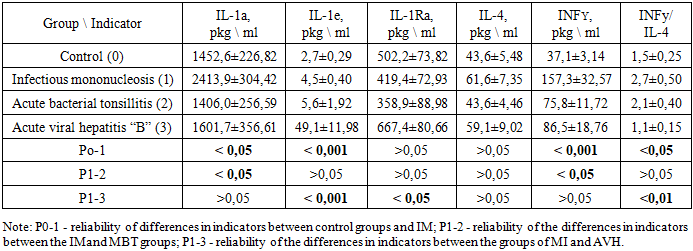
- Content researchof IL-1α, IL-1β, IL-1Ra, IL-4, INF-γconducted in children of patients with infectious Epstein-Barr mononucleosis of viral etiology, acute bacterial tonsillitis, acute viral hepatitis "B" and relatively healthy children.Evaluation of the content of cytokines in the group of patients diagnosed with Epstein-Barr infectious mononucleosis of viral etiology revealed a significant increase in serum levels of pro-inflammatory cytokines, while the content of anti-inflammatory IL-1Ra and IL-4 did not differ from those in the group of clinically healthy children (Table 1, Fig. 1). So, the content of IL-1α and IL-β exceeded the results of the group of healthy donors by 1.7 and 1.6 times, respectively, and the level of content INF-γ exceeded the indicators of the control group by 4.3 times(p<0,05). Coefficientof INF-IL-4was 2,7±0,50 (р<0,05), which is 1.3 times higher than in patients with acute bacterial tonsillitis and 2.5 times in patients with acute viral hepatitis "B".
|
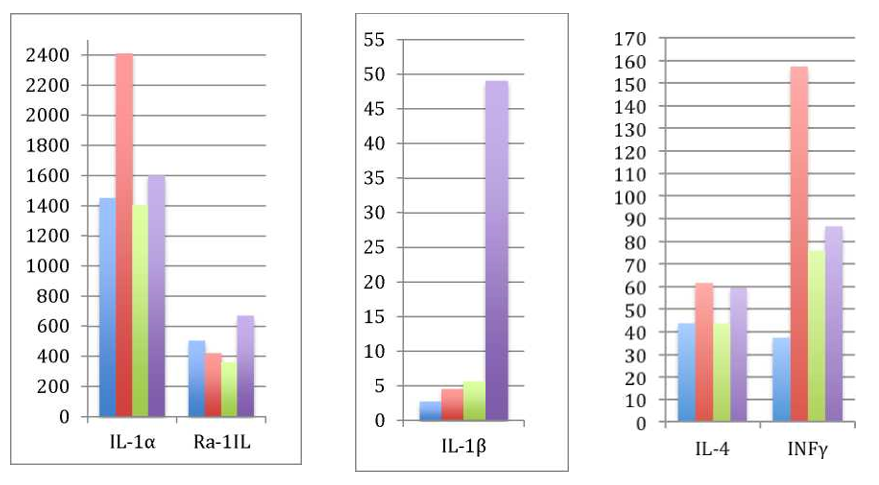 | Figure 1. Changes in pro- and anti-inflammatory cytokine levels in patients with Epstein–Barr virus infectious mononucleosis compared to other clinical groups and healthy controls |
|
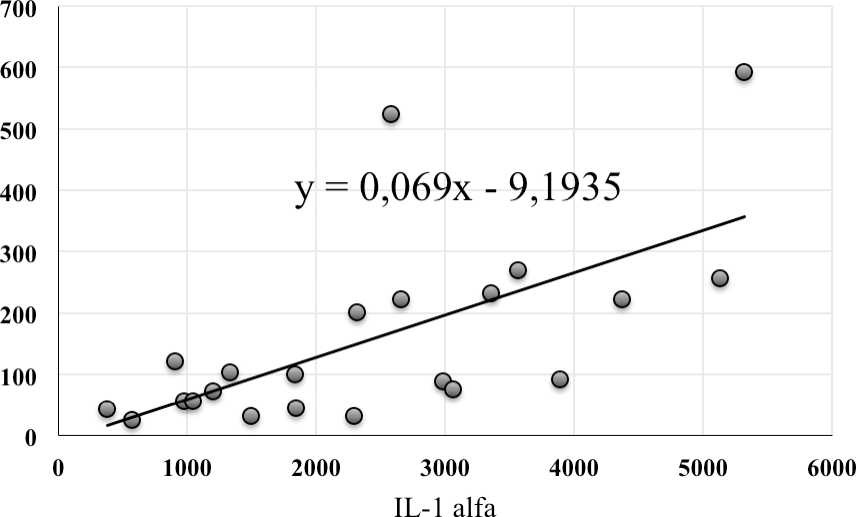 | Figure 2. Correlation between the level of INF-γ and IL-1α in the acute period of infectious mononucleosis |