
-
Paper Information
- Next Paper
- Previous Paper
- Paper Submission
-
Journal Information
- About This Journal
- Editorial Board
- Current Issue
- Archive
- Author Guidelines
- Contact Us
American Journal of Medicine and Medical Sciences
p-ISSN: 2165-901X e-ISSN: 2165-9036
2026; 16(2): 403-405
doi:10.5923/j.ajmms.20261602.02
Received: Jan. 2, 2026; Accepted: Jan. 28, 2026; Published: Feb. 3, 2026

Results of Studying the Periodontal and Hygiene Indices in Patients with Leukemia
 Abstract
 Reference
 Full-Text PDF
 Full-text HTML
Akhmedov S. P.1, Yunuskhodjaeva M. K.2, Xasanova L. E.2
1Samarkand State Medical University, Samarkand, Uzbekistan
2Tashkent State Medical University, Tashkent, Uzbekistan
Copyright © 2026 The Author(s). Published by Scientific & Academic Publishing.
This work is licensed under the Creative Commons Attribution International License (CC BY).
http://creativecommons.org/licenses/by/4.0/

The article presents the results of a study on the periodontal condition and oral hygiene level in patients with various forms of leukemia. Assessment of common indices, including the hygiene index (OHI-S), revealed the features of inflammatory-destructive changes in periodontal tissues and hygiene status disorders in this category of patients. It was established that in patients with leukemia, the index values were significantly higher than in the control group, indicating a pronounced predisposition to the development of inflammatory processes and complications in the oral cavity. The obtained data emphasize the need for comprehensive dental care for leukemia patients, including regular monitoring of indices and implementation of preventive measures aimed at improving the hygiene condition and reducing the risk of complications.
Keywords: Leukemia, Periodontal index, Hygiene index, Periodontium, Oral cavity, Dental prevention, Inflammation
Cite this paper: Akhmedov S. P., Yunuskhodjaeva M. K., Xasanova L. E., Results of Studying the Periodontal and Hygiene Indices in Patients with Leukemia, American Journal of Medicine and Medical Sciences, Vol. 16 No. 2, 2026, pp. 403-405. doi: 10.5923/j.ajmms.20261602.02.
1. Introduction
- Diseases of the blood system, particularly leukemias, are accompanied by pronounced changes in various organs and tissues, including those of the oral cavity. Leukemias are characterized by impaired hematopoiesis, immune response, and a susceptibility to infectious and inflammatory complications [5]. The oral mucosa and periodontal tissues are among the most vulnerable structures, which is attributed to their high vascularization and constant exposure to microbes [6]. A significant clinical manifestation in this category of patients is inflammatory changes in the periodontal tissues, accompanied by bleeding, swelling, hyperplasia of the gingival margin, and deterioration of oral hygiene. The reduction in local protective factors and alterations in the microbiota composition contribute to the development of gingivitis and periodontitis even with relatively low dental plaque accumulation [3]. For an objective assessment of periodontal tissue condition and oral hygiene, indices such as the Simplified Oral Hygiene Index (OHI-S) are widely used. These indicators not only allow evaluation of the severity of inflammatory changes but also enable comparison of data between different patient groups [1,4].Several studies indicate that leukemia patients have significantly higher periodontal and oral hygiene indices compared to healthy individuals [1,7]. This is attributed to both systemic changes (leukopenia, thrombocytopenia, immunodeficiency) and reduced motivation and ability to maintain proper oral hygiene due to severe somatic conditions. Therefore, examining the periodontal condition and oral hygiene status of leukemia patients is a crucial task aimed at timely detection of dental complications and development of preventive measures.
2. Materials and Methods of Research
- The study is based on the examination of 151 patients with acute and chronic forms of leukemia, comprising 62 women and 89 men aged 20 to 70 years.The patients were hospitalized at the Research Institute of Hematology and Blood Transfusion of the Ministry of Health of the Republic of Uzbekistan. The diagnosis was made by a hematologist based on a comprehensive clinical and hematological examination of the patient, including mandatory cytological and cytochemical analysis of the bone marrow.Between September 2020 and October 2024, 151 individuals were examined. Three clinical groups were formed for observation. The clinical facilities of the Research Institute of Hematology and Blood Transfusion provided the opportunity to conduct laboratory and clinical examinations. To assess the severity, the classification by L.S. Lyubimova et al. was employed.The comprehensive examination included: eliciting patients' complaints, collecting medical history, visual inspection of the oral cavity, and index assessment.Patient questioning involved: eliciting the patient's complaints about: discomfort, itching, gum tenderness, bleeding when mechanically irritated (when eating hard food, brushing teeth, or spontaneously), bad breath, presence of lesions in the oral cavity; disease history; family history: presence of systemic diseases. The oral cavity examination was conducted under natural lighting using examination instruments. The condition of the vermillion border of the lips and corners of the mouth, and the oral mucosa was assessed.
3. Research Results
- Mild generalized periodontitis is characterized by the presence of a periodontal pocket up to 4 mm deep, occasionally slightly mobile teeth, and observed gum bleeding. The periodontal index is elevated to 1.42±0.2, with an increase in the hygiene index to 2.67±0.4, and the hematoma formation time is shortened to 18.2±2.1 sec.
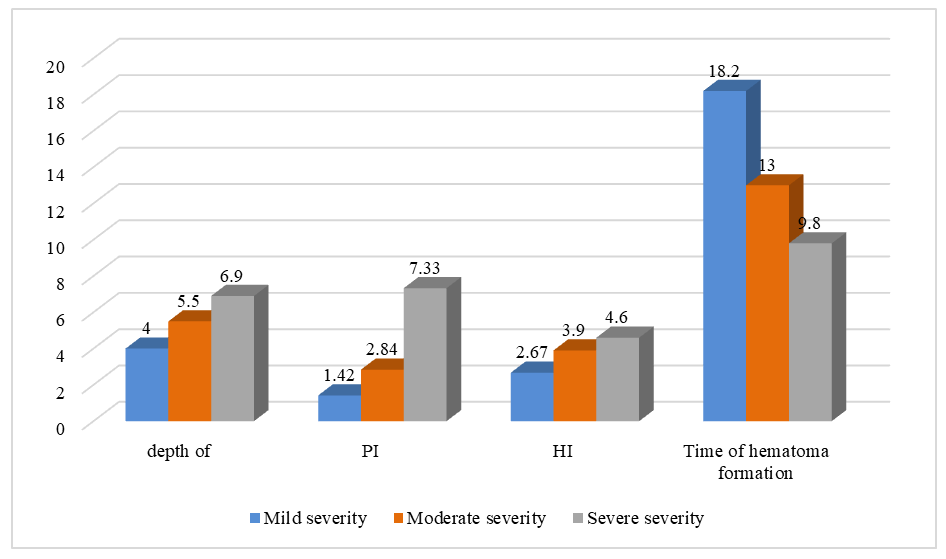 | Figure 1. Indicators of periodontal status in patients with leukemia |
|
4. Conclusions
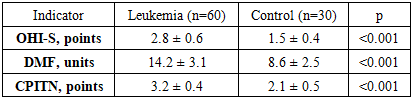
- The obtained data demonstrate that patients with leukemia experience a significant deterioration in oral hygiene, an increase in caries intensity, and more severe periodontal damage compared to individuals without hematological diseases. This confirms the need for early and regular dental monitoring of such patients, starting from the moment of diagnosis, as well as the implementation of individualized prevention and oral cavity sanitation programs.