
-
Paper Information
- Next Paper
- Previous Paper
- Paper Submission
-
Journal Information
- About This Journal
- Editorial Board
- Current Issue
- Archive
- Author Guidelines
- Contact Us
American Journal of Medicine and Medical Sciences
p-ISSN: 2165-901X e-ISSN: 2165-9036
2026; 16(1): 238-240
doi:10.5923/j.ajmms.20261601.52
Received: Dec. 23, 2025; Accepted: Jan. 19, 2026; Published: Jan. 22, 2026

The Role of Internal and External Migration in the Emergence of Leprosy in Certain Regions of Uzbekistan
 Abstract
 Reference
 Full-Text PDF
 Full-text HTML
E. Kh. Eshboyev1, N. M. Shokolonova2
1Republican Specialized Scientific and Practical Center of Dermatovenereology Cosmetology, Uzbekistan
2Andijan State Medical Institute, Andijan, Uzbekistan
Copyright © 2026 The Author(s). Published by Scientific & Academic Publishing.
This work is licensed under the Creative Commons Attribution International License (CC BY).
http://creativecommons.org/licenses/by/4.0/

Background: Leprosy remains a public health concern worldwide despite significant progress in its control. Migration processes may contribute to the emergence of new leprosy foci in non-endemic regions. Objective: To assess the role of internal and external migration in the formation of leprosy foci in certain regions of Uzbekistan. Methods: A retrospective analysis was conducted of leprosy patients treated at the Republican Leprosarium in Samarkand region between 1931 and 2006. Demographic, geographic, age, and sex-related data were analyzed. Results: Of 1,036 hospitalized patients, 53.1% were migrants from other republics of the former Soviet Union and foreign countries. Imported cases predominated during 1931–1960 and significantly influenced the subsequent epidemiological situation in Uzbekistan. The highest incidence was observed among individuals aged 15–29 years (52.0%). Pediatric cases were mainly associated with migration from endemic regions. Male patients predominated (57.9%). Conclusion: Internal and external migration played a significant role in the emergence and persistence of leprosy foci in Uzbekistan. Population movements associated with historical, social, and political events contributed to the spread of the disease and shaped its epidemiological characteristics.
Keywords: Leprosy, Migration, Epidemiology, Uzbekistan, Disease foci
Cite this paper: E. Kh. Eshboyev, N. M. Shokolonova, The Role of Internal and External Migration in the Emergence of Leprosy in Certain Regions of Uzbekistan, American Journal of Medicine and Medical Sciences, Vol. 16 No. 1, 2026, pp. 238-240. doi: 10.5923/j.ajmms.20261601.52.
1. Introduction
- Leprosy (Hansen’s disease) is a chronic infectious disease caused by acid-fast mycobacteria, characterized by progressive skin lesions, peripheral nerve damage, and severe disability if left untreated. Although the disease is weakly contagious, it continues to pose a public health challenge in many parts of the world [1,2,3].Significant progress in leprosy control has been achieved over the past decades. The World Health Organization (WHO) declared the elimination of leprosy as a public health problem by the year 2000, defined as a prevalence of less than one case per 10,000 population. This target was largely achieved; however, new cases continue to be reported globally, particularly in socially disadvantaged populations [3,5,6].Leprosy is predominantly observed in developing countries, including India, Brazil, Indonesia, Nepal, and Bangladesh. Nevertheless, intensification of internal and international migration has raised concerns regarding the emergence of new leprosy foci in previously non-endemic regions [7,8,9]. In this context, Uzbekistan represents a unique historical and epidemiological setting due to large-scale population movements during the 20th century.The aim of this study was to evaluate the role of internal and external migration in the emergence and spread of leprosy in certain regions of Uzbekistan.
2. Materials and Methods
- A retrospective study was conducted based on archival medical records of patients treated at the Republican Leprosarium located in Bulungur district, Samarkand region, which has been operating since 1931.Data from 1,036 patients hospitalized between 1931 and 2006 were analyzed. The following variables were assessed:geographic origin of patients,period of hospitalization,age at disease manifestation,sex distribution,migration history.Descriptive statistical analysis was performed to evaluate trends in morbidity and demographic characteristics.
3. Results
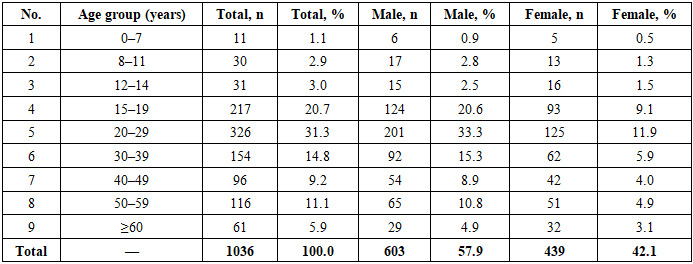
- Between 1931 and 2006, a total of 1,036 patients with leprosy were hospitalized at the Samarkand Leprosarium. The highest numbers of admissions were recorded during 1951–1960 (319 cases), followed by 1941–1950 (238 cases) and 1931–1940 (229 cases).More than half of all patients (554; 53.1%) were migrants from other regions of the former Soviet Union or foreign countries. Among them, 34.1% originated from the Russian Federation, 12.8% from Kazakhstan, 7.5% from Tajikistan, and 31.0% from the Republic of Karakalpakstan. Patients from Turkey, Iran, China, Laos, and Japan were also identified.During 1931–1960, imported cases exceeded locally detected cases by approximately 1.5 times, and during 1941–1950 by nearly three times. Many migrants did not return to their regions of origin after treatment and subsequently integrated into local communities, contributing to the formation of secondary disease foci.Age analysis showed that the highest incidence occurred in the 15–19 year (20.7%) and 20–29 year (31.3%) age groups. Children under 14 years accounted for 7.0% of cases, with 72.2% of pediatric patients being migrants from endemic areas.Male patients predominated (57.9%), while females accounted for 42.1%. Gender differences were minimal in childhood but increased significantly in adulthood.
|
4. Discussion
- The findings of this study demonstrate that migration was a key determinant in the epidemiology of leprosy in Uzbekistan. Large-scale population movements associated with famine, war, deportations, and post-war resettlement facilitated the importation of leprosy cases from endemic regions.The long incubation period of leprosy explains the delayed manifestation of the disease among migrants and contributes to the difficulty of early detection. The predominance of cases among adolescents and young adults reflects infection acquired in childhood under conditions of prolonged household contact.Male predominance observed in this study is consistent with global data and may be explained by occupational exposure, social behavior, and higher mobility among men. The high proportion of single male migrants among imported cases further supports this observation.
5. Conclusions
- Internal and external migration played a decisive role in the emergence and persistence of leprosy foci in Uzbekistan. Historical migration processes significantly influenced the geographic distribution, age structure, and gender characteristics of leprosy morbidity. These findings highlight the importance of considering migration patterns in leprosy surveillance, early detection, and prevention strategies.