
-
Paper Information
- Paper Submission
-
Journal Information
- About This Journal
- Editorial Board
- Current Issue
- Archive
- Author Guidelines
- Contact Us
American Journal of Medicine and Medical Sciences
p-ISSN: 2165-901X e-ISSN: 2165-9036
2026; 16(1): 36-40
doi:10.5923/j.ajmms.20261601.10
Received: Nov. 17, 2025; Accepted: Dec. 12, 2025; Published: Jan. 7, 2026

Association of AGT1 Met235Thr Polymorphism with Intrarenal Hemodynamics in Chronic Kidney Disease
 Abstract
 Reference
 Full-Text PDF
 Full-text HTML
Tursunova Laylo Dilshatovna1, Jabbarov Ozimbay Otaxanovich2
1PhD, Associate Professor, Tashkent State Medical University, Uzbekistan
2DSc, Professor, Tashkent State Medical University, Uzbekistan
Correspondence to: Tursunova Laylo Dilshatovna, PhD, Associate Professor, Tashkent State Medical University, Uzbekistan.
| Email: |  |
Copyright © 2026 The Author(s). Published by Scientific & Academic Publishing.
This work is licensed under the Creative Commons Attribution International License (CC BY).
http://creativecommons.org/licenses/by/4.0/

Chronic kidney disease (CKD) remains a major medical and social problem worldwide due to its progressive course and high risk of cardiovascular complications. Early identification of genetic and hemodynamic predictors is crucial for improving prognosis and developing personalized strategies. The aim of this study was to investigate the association of the angiotensinogen (AGT1) Met235Thr gene polymorphism with renal intrarenal hemodynamic parameters obtained by Doppler ultrasonography in patients with CKD stages 1–3. A total of 124 patients were examined, including individuals without CKD and those with CKD stage 2–3. Doppler indices (Vs, Vd, RI, PI, S/D ratio) were assessed in relation to AGT1 genotypes. The results demonstrated that the Thr allele and Thr/Thr genotype were significantly associated with higher resistive and pulsatility indices, reflecting impaired intrarenal vascular resistance. These findings highlight the potential role of AGT1 genetic variants in the pathogenesis of renal hemodynamic alterations and provide additional evidence for the clinical significance of combined genetic and instrumental diagnostics in early CKD.
Keywords: Chronic kidney disease, AGT1 gene, Met235Thr polymorphism, Renal Doppler ultrasonography, Resistive index, Intrarenal hemodynamics, Genetic markers
Cite this paper: Tursunova Laylo Dilshatovna, Jabbarov Ozimbay Otaxanovich, Association of AGT1 Met235Thr Polymorphism with Intrarenal Hemodynamics in Chronic Kidney Disease, American Journal of Medicine and Medical Sciences, Vol. 16 No. 1, 2026, pp. 36-40. doi: 10.5923/j.ajmms.20261601.10.
1. Introduction
- Chronic kidney disease (CKD) is currently considered not only as an isolated kidney disease but also as one of the leading non-communicable diseases of global medical and social significance. According to international studies, the prevalence of CKD in the general population reaches 10-13% and in some regions can exceed these figures [1,3]. The most serious problem is that the disease is latent for a long time, and its diagnosis is often carried out already at the stages of pronounced loss of kidney function. The progression of CKD is accompanied by an increased risk of developing terminal renal failure, which requires expensive replacement treatment (hemodialysis, peritoneal dialysis, transplantation) [6,9].In addition to direct harm to health, CKD is associated with high cardiovascular mortality. The presence of even early stages of the disease increases the likelihood of developing arterial hypertension, atherosclerosis, coronary heart disease, and stroke [2,12]. That is why the search for reliable early diagnostic markers, as well as prognostic factors for the unfavorable course of the disease, is of exceptional importance.In recent decades, researchers have been paying special attention to genetic factors that can determine individual predisposition to the formation and progression of kidney pathology. One such factor is the polymorphism of the angiotensinogen gene (AGT1 Met235Thr). This gene plays a key role in the functioning of the renin-angiotensin-aldosterone system (RAAS), which regulates blood pressure, water-electrolyte balance, and vascular wall tone [5,14,15].Relevance. Studies have shown that the carriage of certain alleles and genotypes AGT1 Met235Thr can be associated with changes in angiotensinogen synthesis, which in turn leads to the activation of RAAS. As a result, intraglomerular pressure increases, the load on the renal vascular bed intensifies, and a tendency to develop arterial hypertension develops [4,10,16]. Considering that it is hypertension that is one of the key factors in the progression of CKD, identifying genetic predisposition is of practical importance both for early diagnosis and for individualizing preventive measures.On the other hand, Doppler ultrasound of renal vessels is one of the most informative methods for assessing intrarenal hemodynamics. The indicators of maximum and minimum blood flow velocity (Vs, Vd), resistance index (RI), pulsation index (PI), S/D ratio reflect the state of the vessel wall, the level of resistance in arterioles and the microvascular bed. Changes in these parameters allow for the detection of early signs of vascular disorders even before the development of clinically expressed renal failure [7,11,17].The relationship between the patient's genetic characteristics and renal hemodynamics indicators remains insufficiently studied. A combined analysis of the AGT1 Met235Thr polymorphism and dopplerography data opens up new perspectives in understanding the pathogenesis of CKD. This approach allows for the identification of groups of patients with a high risk of disease progression, which is especially relevant in conditions of high prevalence of renal pathology and limited opportunities for expensive treatment [13].Furthermore, the comprehensive study of genetic markers and instrumental methods for assessing blood flow aligns with modern trends in personalized medicine. Including molecular-genetic and functional indicators in a unified forecasting model can serve as a basis for developing new risk stratification algorithms, selecting optimal observation tactics, and preventing complications [13,18].Thus, conducting a study aimed at analyzing the relationship between AGT1 Met235Thr and renal blood flow doppler parameters is relevant, scientifically substantiated, and practically significant. The obtained results can contribute to the development of a comprehensive approach to early diagnosis and prognosis of the course of CKD, which corresponds to the priority areas of modern nephrology and medical genetics.Research objective. Identify the relationship between AGT1 Met235Thr gene polymorphism and intra-renal hemodynamic parameters according to dopplerography data in patients with chronic kidney disease.
2. Materials and Methods
- The study was conducted at the third clinic of the Tashkent Medical Academy and the Republican Specialized Scientific and Practical Medical Center of Nephrology and Kidney Transplantation in the period [2022-2024]. It included 124 patients with stage I-III chronic kidney disease (CKD) diagnosed according to the KDIGO criteria (2024). The control group consisted of healthy volunteers comparable in gender and age. Inclusion criteria: presence of a confirmed diagnosis of CKD, age 18-60 years, voluntary consent to participate. Exclusion criteria: acute inflammatory diseases, malignant tumors, decompensated cardiovascular insufficiency, pregnancy.AGT1 Met235Thr polymorphism was determined by the polymerase chain reaction method with restriction analysis (PCR-RFLP). DNA was isolated from nuclear blood cells according to the standard method, amplification was performed on a Rotor-Gene Q 6plex (Singapore) amplifier, product analysis was carried out by electrophoresis in an agarose gel with subsequent visualization. Ultrasound examination was conducted on an expert-class device with a convex sensor (3.5-5.0 MHz). The interlobular arteries of both kidneys were studied to determine the following indicators: maximum systolic blood flow velocity (Vs, m/s), final diastolic velocity (Vd, m/s), resistance index (RI), pulsation index (PI), and S/D ratio.Data processing was performed using the SPSS Statistics 26.0 package (IBM Corp., Armonk, NY, USA) and MS Excel. The distribution of genotypes was assessed using Pearson's χ2 criterion. Student's t-test was used to compare quantitative variables. Correlation relationships were analyzed using the Spearman coefficient (r). Differences were considered statistically significant at p<0.05.
3. Results
- Analysis of the AGT1 Met235Thr polymorphism revealed significant differences in the distribution of alleles and genotypes between patients with CKD and the control group. In patients with chronic kidney disease, the Thr allele was significantly more common (31.0% versus 13.2% in the control; χ2=21.2; p=0.01), while in individuals without CKD, the Met allele prevailed (86.8% versus 69.0%). According to the genotypic distribution, the most pronounced differences were observed for the heterozygous variant: the Met/Thr genotype was found in 39.5% of patients with CKD and only in 20.9% in the control group (χ2=9.5; p=0.01; OR=2.5; 95% CI: 1.39-4.4). The frequency of the Thr/Thr genotype was also higher in patients of the main group (11.3% versus 2.7%; χ2=6.3; OR=4.5; 95% CI: 1.4-14.73). At the same time, the Met/Met genotype was significantly more common in healthy individuals (76.4% versus 49.2% in patients; χ2=18.3; p=0.01). These data indicate a possible association of Thr allele and especially the Thr/Thr genotype carriage with an increased risk of developing and progressing CKD (Figure 1,2).
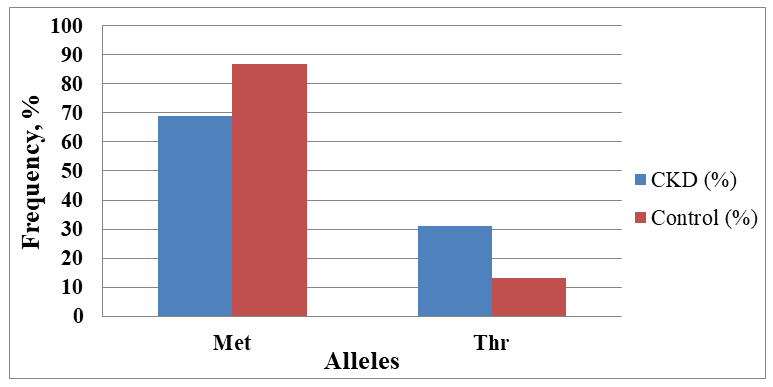 | Figure 1. Distribution of AGT1 Met235Thr alleles in groups |
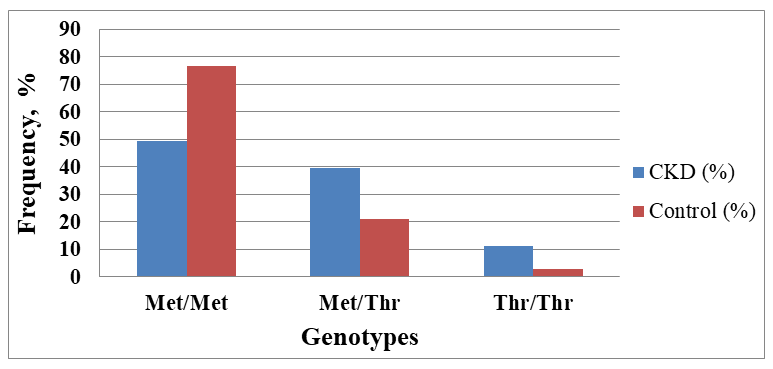 | Figure 2. Distribution of AGT1 Met235Thr genotypes in the studied groups |
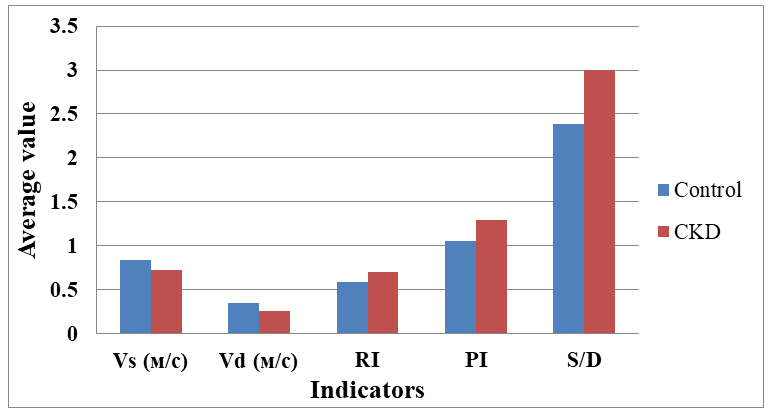 | Figure 3. Kidney vascular dopplerography indicators in the examined groups |
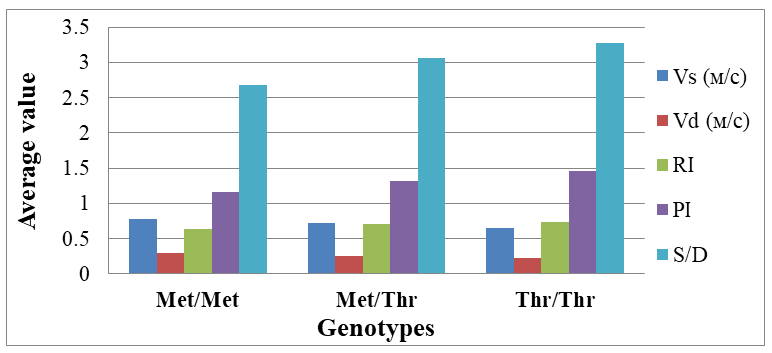 | Figure 4. Dopplerographic indicators for AGT1 Met235Thr genotypes |
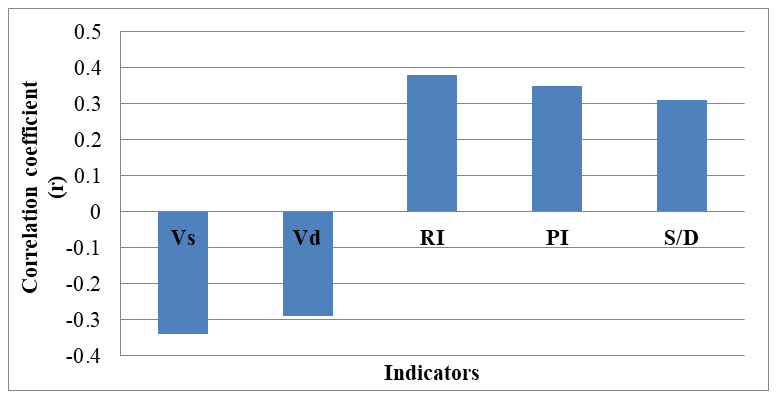 | Figure 5. Thr allele correlation with dopplerography |
4. Discussion
- The obtained results confirmed the presence of pronounced disorders of intrarenal hemodynamics in patients with CKD, which manifested as a decrease in blood flow velocity indicators (Vs and Vd) and an increase in vascular resistance indices (RI, PI, S/D). These changes reflect the loss of vascular wall elasticity and deterioration of renal parenchyma perfusion, which aligns with the notion of the key role of microvascular disorders in the progression of chronic kidney disease [14].The identified relationship between the AGT1 Met235Thr polymorphism and dopplerographic parameters is of particular interest. In carriers of the Thr allele, especially in the homozygous form, more pronounced hemodynamic shifts were noted - a decrease in Vs and Vd and an increase in RI and PI. This indicates that the genetic characteristics of the renin-angiotensin-aldosterone (RAAS) system can determine individual differences in the vascular response and predisposition to the progression of CKD. Similar data were obtained in several studies where Met235Thr polymorphism was associated with arterial hypertension and renal perfusion disorders [8,15].A number of authors note that thr variant carriage is associated with increased angiotensinogen expression and increased RAAS activation, leading to increased intraglomerular pressure, glomerular sclerosis, and accelerated decrease in kidney function [11,12]. In our study, similar patterns were manifested through RI and PI indicators, which further confirms the significance of this polymorphism as a marker of vascular disorders in CKD.It is interesting to note that in patients with the Met/Met genotype, dopplerography indicators were most favorable, while in heterozygotes Met/Thr, they occupied an intermediate position. This aligns with the dose-dependent effect hypothesis of the Thr allele, where the presence of one copy of the gene causes moderate changes, while the homozygous state enhances the pathological phenotype [17].Thus, the research results indicate the need for a comprehensive approach to assessing the risk of CKD progression, including both molecular genetic markers and instrumental methods for assessing hemodynamics. The combined use of genotyping and dopplerography allows for more accurate identification of high-risk groups and can serve as a basis for personalized observation and prevention strategies.
5. Conclusions
- In patients with CKD, characteristic changes in intrarenal hemodynamics were identified, manifested by a decrease in blood flow velocity indicators and an increase in vascular resistance indices; at the same time, the carriage of the Thr allele of the AGT1 Met235Thr polymorphism, especially in the homozygous form, is associated with more pronounced disorders, indicating the possibility of using a combined assessment of genetic markers and Doppler parameters for early detection of patients with a high risk of CKD progression and individualization of preventive measures.