
-
Paper Information
- Next Paper
- Paper Submission
-
Journal Information
- About This Journal
- Editorial Board
- Current Issue
- Archive
- Author Guidelines
- Contact Us
American Journal of Medicine and Medical Sciences
p-ISSN: 2165-901X e-ISSN: 2165-9036
2026; 16(1): 10-14
doi:10.5923/j.ajmms.20261601.03
Received: Nov. 21, 2025; Accepted: Dec. 16, 2025; Published: Jan. 7, 2026

Evaluation of the Noise Protection Properties of the Zeravshan Juniper
 Abstract
 Reference
 Full-Text PDF
 Full-text HTML
Bakhram Z. Khalmuratov1, Guzal A. Tashpulatova1, Modest P. Magay2, Aleksey N. Krasavin1
1Scientific Research Institute of Sanitation, Hygiene and Occupational Diseases of the Ministry of Health of the Republic of Uzbekistan
2Department of Sanitary and Epidemiological Supervision of the Main Medical Department under the Administration of the President of the Republic of Uzbekistan
Correspondence to: Bakhram Z. Khalmuratov, Scientific Research Institute of Sanitation, Hygiene and Occupational Diseases of the Ministry of Health of the Republic of Uzbekistan.
| Email: |  |
Copyright © 2026 The Author(s). Published by Scientific & Academic Publishing.
This work is licensed under the Creative Commons Attribution International License (CC BY).
http://creativecommons.org/licenses/by/4.0/

The article is dedicated to the study of the noise-protective properties of Zeravshan juniper (Juniperus seravschanica) in urban environments as an element of sustainable landscaping. The relevance of the work is determined by the problem of noise pollution in cities and the need to search for evergreen plants with year-round noise protection effectiveness, unlike seasonably effective leafy species. The goal is to evaluate the acoustic effectiveness of juniper in reducing transport noise and to establish the dependence of this effect on crown thickness and sound frequency. The method of simultaneous on-site measurements of the sound pressure level of traffic noise using two noise meters (control and measurement) behind plantations of varying thickness (1.0 m, 2.0 m, 3.0 m) along highways in the cities of Tashkent and Chirchik was used. Spectral analysis of noise was conducted. A direct proportional relationship between the decrease in sound pressure level and the crown thickness has been established. The noise absorption efficiency of a 3.0 meter juniper strip reaches 17 dB, with a maximum decrease at a frequency of 1000 Hz. This indicates a high ability of the dense coniferous crown to absorb medium and high-frequency noise (engines, tires). Additionally, it was found that the noise-protective properties increase by 1-3 dB as the crown grows and becomes denser. Zeravshan juniper (archa) is a highly effective, year-round noise-absorbing barrier, surpassing leafy species in its noise-protective properties and eliminating the problem of seasonality and acoustic clearance under the crown. The obtained data substantiate the recommendations for using dense juniper plantations (especially 2-3 m wide) to enhance acoustic comfort in urban development.
Keywords: Noise protection, Noise pollution, Zeravshan juniper, Juniperus seravschanica, Juniper, Urban greening, Acoustic efficiency, Crown thickness, Transport noise
Cite this paper: Bakhram Z. Khalmuratov, Guzal A. Tashpulatova, Modest P. Magay, Aleksey N. Krasavin, Evaluation of the Noise Protection Properties of the Zeravshan Juniper, American Journal of Medicine and Medical Sciences, Vol. 16 No. 1, 2026, pp. 10-14. doi: 10.5923/j.ajmms.20261601.03.
1. Introduction
- The environmental situation in cities, related to the increase in the number of vehicles and the development of infrastructure, makes noise pollution a pressing issue. According to numerous literature sources, one of the means of combating urban noise is green spaces, which play a significant role in reducing noise levels in residential areas and also have several important ecological and microclimatic functions: they extinguish wind currents, improve air quality by releasing oxygen and utilizing dust, increase relative air humidity and lower its temperature during the summer period, and possess antibacterial and aesthetic properties [1,11,12,13]. According to Russian researchers Azarova O.V. and Bechina D.N. (2016, 2017), when using pyramidal-crowned poplar in optimal planting schemes (together with shrubs, to close the crown space), the average noise reduction reaches 10 dB [2,3]. A comparative assessment of air pollution levels, including road noise, conducted by Swedish scientists in the city landscape of Gothenburg, before and after the appearance of leaves on roadside trees, showed that the presence of leaves significantly reduced noise levels, allowing the authors to conclude that urban green zones are beneficial for the quality of the urban environment and this is important to consider when urban planning [9]. Belgian scientists Renterghem T. V. and Botteldcoren O. (2016) based on research results concluded that even if the physical level of sound pressure decreases insignificantly, viewing green spaces can reduce perceived noise irritation, and according to some estimates, the effect can reach 10 dBA, especially under high noise load conditions [10].However, the main disadvantage of leafy species when used for noise protection purposes is their seasonal effectiveness [2,3]. In the autumn-winter period, due to leaf falling, the noise-protective effect sharply decreases or is completely absent. Additionally, to achieve maximum effect, it is necessary to close the crown space with dense shrubs, which increases plant maintenance costs. This criterion in acoustics is often described by the term "unobservability" of the plantation strip, which directly depends on the crown density [4,5,6]. In the context of the listed disadvantages of deciduous species, the Zeravshan juniper (archa) is of particular interest. Unlike leafy species, juniper has a dense, thick, evergreen crown, which ensures year-round noise absorption. This plant is also characterized by its low demand for urban conditions (noise, dustiness, gas contamination), high growth potential (15-20 m), and durability. The presence of a dense crown from the root itself eliminates the need for additional filling of the crown space with shrubs. It is assumed that with proper care and the formation of dense, continuous plantings, the arch can provide the necessary thickness of the noise barrier. Creating scientifically based optimal placement schemes and selecting resistant plant species for noise protection purposes is a key direction in urban planning ecology.
2. Aim
- Assess the noise protection characteristics of Zeravshan juniper (Juniperus seravschanica) in urban conditions and determine the dependence of noise reduction efficiency on crown thickness and sound frequency.
3. Materials Methods
- The object of the research work was the strips of Zeravshan juniper (Juniperus seravschanica) with varying crown thickness (width), located along highways in Tashkent and Chirchik cities, as well as in a farm in the Tashkent region. Noise and vibration measurements were carried out by a set of "Assistant Combi Total+" No. 229116 (Russia) and "SVAN-943B" No. 11026 soundmeters, which comply with the requirements of GOST 17187-2010 "Summeters. Part 1. General requirements. Measurement conditions and methodology: Measurements were carried out in dry eather with no precipitation and high humidity. The wind speed did not exceed 15m/s. A windbreak device was used to protect the microphone from the wind. Measurements of traffic noise were conducted during peak hours in accordance with the requirements of GOST 20444-2014 "Noise. Traffic flows. Methods for measuring noise characteristics" [8]. Measurements were taken simultaneously by two noise meters: Noise meter 1 (control) was located at a predetermined distance from the noise source (highway) outside the arch screen zone. Noise meter 2 (measuring) was located at the same distance from the source, but directly behind the juniper planting strip. The height of measurement is at the level of the average height of the human ear (1.2 m). Simultaneous measurement made it possible to correctly assess the noise reduction during the maximum load on the main line. Spectral analysis of noise was conducted to determine the effectiveness based on frequency characteristics. At each point, 9-10 measurements of the spectral characteristic of noise were taken.
4. Results and Discussion
- For research, juniper plantations with dense, invisible crowns of varying thickness, height, and age were selected.
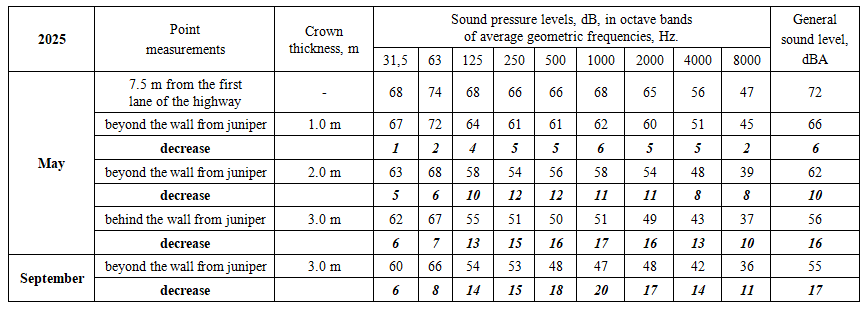 | Table 1. Reduction of the sound pressure level depending on the crown thickness of the Zeravshan juniper in octave bands |
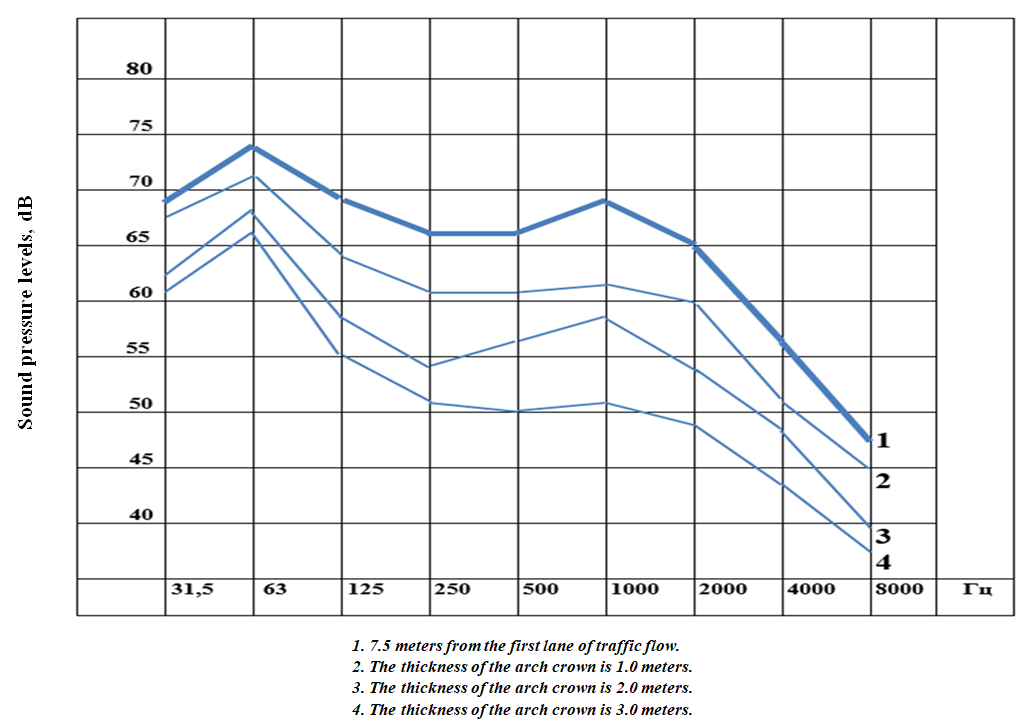 | Figure 1. Reduction of sound pressure levels in octave bands of average geometric frequencies behind the juniper planting strip, depending on the thickness of its crown |
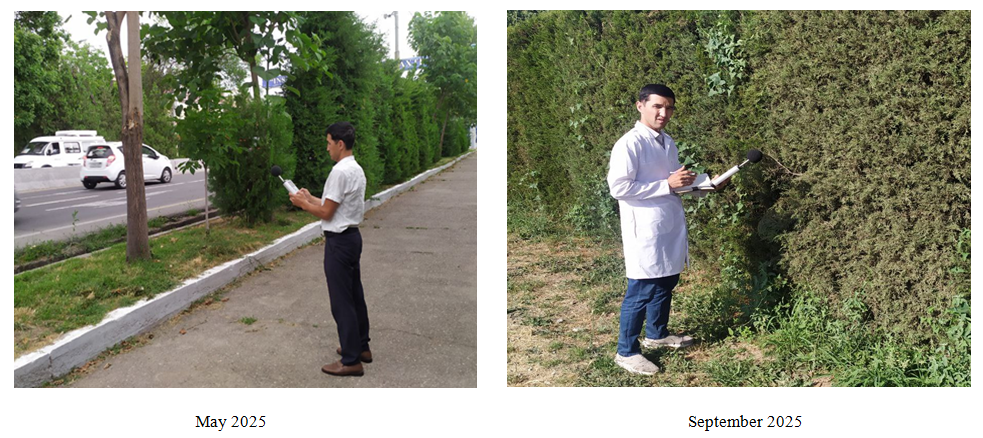 | Figure 2. Processes of measuring the level of sound pressure in octave bands of average geometric frequencies after a strip planted with juniper |