
-
Paper Information
- Next Paper
- Previous Paper
- Paper Submission
-
Journal Information
- About This Journal
- Editorial Board
- Current Issue
- Archive
- Author Guidelines
- Contact Us
American Journal of Medicine and Medical Sciences
p-ISSN: 2165-901X e-ISSN: 2165-9036
2025; 15(12): 4554-4560
doi:10.5923/j.ajmms.20251512.76
Received: Nov. 20, 2025; Accepted: Dec. 17, 2025; Published: Dec. 25, 2025

Clinical and Genetic Features of Cognitive Impairments in Patients with Essential Hypertension in Uzbek Population
 Abstract
 Reference
 Full-Text PDF
 Full-text HTML
Yusupova Khafiza Furkat qizi1, Abdullaeva Guzal Zhaloliddionovna2, Atoeva Munisa Ismoilovna3, Khamidullaeva Gulnoz Abdusattarovna4, Abdullaev Alisher Abdumavlyanovich5, Zakirova Darya Vladimirovna6
1PhD, Senior Researcher of Department of Arterial Hypertension and Molecular-Genetic Research, Republican Specialized Scientific and Practical Medical Center of Cardiology, Tashkent, Uzbekistan
2DSc, Chief of Department of Arterial Hypertension and Molecular-Genetic Research Republican Specialized Scientific and Practical Medical Center of Cardiology, Tashkent, Uzbekistan
3Phd Student, Junior Researcher of Department of Arterial Hypertension and Molecular-Genetic Research, Republican Specialized Scientific and Practical Medical Center of Cardiology, Tashkent, Uzbekistan
4Professor, Department of Arterial Hypertension and Molecular-Genetic Research, Republican Specialized Scientific and Practical Medical Center of Cardiology Republican Specialized Scientific and Practical Medical Center of Cardiology, Tashkent, Uzbekistan
5DSc, Center for Advanced Technologies Tashkent, Uzbekistan
6PhD, Center for Advanced Technologies Tashkent, Uzbekistan
Correspondence to: Yusupova Khafiza Furkat qizi, PhD, Senior Researcher of Department of Arterial Hypertension and Molecular-Genetic Research, Republican Specialized Scientific and Practical Medical Center of Cardiology, Tashkent, Uzbekistan.
| Email: |  |
Copyright © 2025 The Author(s). Published by Scientific & Academic Publishing.
This work is licensed under the Creative Commons Attribution International License (CC BY).
http://creativecommons.org/licenses/by/4.0/

The purpose of the study: to investigate the relationship between the parameters of the daily blood pressure profile and arterial stiffness with cognitive functions, as well as to evaluate the impact of rs2471738 and rs242557 polymorphisms of the MAPT gene on cognitive functions in patients with essential hypertension. Materials and methods: The study included 111 patients with essential hypertension (EH) of grades I-III (according to ESC/ESH 2018), aged 30-75 years, of both sexes. At the pre-treatment stage and after 12 months of therapy, all patients had their daily blood pressure (BP) measured using the Korotkoff method. To study the daily BP profile (DBPP), 24-hour BP monitoring (ABPM) was performed. Arterial stiffness was assessed using the applanation tonometry method. Cognitive functions were evaluated using neuropsychological tests (Montreal Cognitive Assessment – MoCA, Mini-Cog test, and the Hospital Anxiety and Depression Scale – HADS). For genotyping blood samples for the rs2471738 (T as the alternative allele) and rs242557 (A as the alternative allele) polymorphisms of the MAPT gene, genomic DNA was extracted from whole blood using the “ArtDNA MiniSpin” kit (ArtBioTech LLC, Belarus) according to the manufacturer’s standard protocol. Results: This study demonstrated the significant contribution of disturbances in the daily blood pressure profile and pronounced vascular remodeling to the development of cognitive impairments in patients with arterial hypertension, with no influence of the rs2471738 and rs242557 polymorphisms of the MAPT gene on cognitive functions in AH patients. However, the contribution of the G allele of the rs242557 polymorphism of the MAPT gene to the risk of developing essential hypertension in the Uzbek population was noted. Conclusion: The study demonstrated a significant contribution of impaired daily BP profiles and pronounced vascular remodeling to the development of cognitive impairments in patients with hypertension, with no influence of rs2471738 and rs242557 polymorphisms of the MAPT gene on cognitive functions in patients with hypertension. However, the contribution of the G allele of the rs242557 polymorphism of the MAPT gene to the risk of developing EH in the Uzbek population was noted.
Keywords: Arterial hypertension, Daily blood pressure profile, Arterial stiffness, Blood pressure variability, Cognitive impairments, Genetic markers
Cite this paper: Yusupova Khafiza Furkat qizi, Abdullaeva Guzal Zhaloliddionovna, Atoeva Munisa Ismoilovna, Khamidullaeva Gulnoz Abdusattarovna, Abdullaev Alisher Abdumavlyanovich, Zakirova Darya Vladimirovna, Clinical and Genetic Features of Cognitive Impairments in Patients with Essential Hypertension in Uzbek Population, American Journal of Medicine and Medical Sciences, Vol. 15 No. 12, 2025, pp. 4554-4560. doi: 10.5923/j.ajmms.20251512.76.
Article Outline
1. Introduction
- Arterial hypertension (AH) is one of the main factors contributing to the high risk of cardiovascular complications and mortality. According to the ESH/ESC 2018 data, the prevalence of AH ranges from 30% to 45% of the general population, with a sharp increase as people age. Today, the situation worldwide is as follows: 15-40% of the adult population suffers from AH, and among individuals over 65 years old AH is detected in 30-50% of cases. 76% of patients suffering from AH are at risk of dying within 10 years [1]. The existence of a relationship between high blood pressure (BP) and the risk of developing pathology of the central nervous system, primarily stroke and cognitive impairment, has been proven [2]. Cerebral complications of AH occur earliest, dominate, and contribute the most to the mortality structure associated with AH.Among vascular risk factors, chronic AH is the main cause of cognitive disorders [3]. Elevated BP damages the endothelium, increases the risk of stroke, and participates in the multifactorial pathogenesis of dementia development [4,5]. However, data suggest that, regardless of elevated BP, BP variability serves as another very important vascular risk factor [5,6]. There is currently evidence that systolic blood pressure (SBP) variability and diastolic blood pressure (DBP) variability affect different domains of cognitive functions. Zhou et al. [7] found that increased SBP variability is associated with impaired memory function, while increased DBP variability correlates with information processing speed and executive skills in individuals aged 40-75 years. Numerous recent studies demonstrate an independent relationship between arterial stiffness and cognitive disorders [8]. A review of studies published in 2012 noted the existence of a significant association between increased arterial stiffness and cognitive impairment, using a multidimensional analysis that considers age, education level, and other factors affecting cognitive function. Moreover, arterial stiffness is associated with the subsequent progression of cognitive deficits, because of which increased pulse wave velocity is an important predictor of cognitive decline [9]. However, there are also contradictory data. In particular, a group of researchers found that PWV was not associated with cognitive function in people with normal cognitive status in old age [10,11], but increased PWV was associated with impaired general cognitive function and memory only in men [11].Modern medicine has new unique opportunities to study the brain at the molecular-genetic level. At the same time, many technologies remain extremely complex and expensive, and the correct interpretation of the results obtained and the determination of their practical significance within the framework of existing clinical algorithms require data reproduction on independent samples, including various populations of the world. In this regard, we conducted the first pilot study to study the molecular and genetic features of cognitive impairment in patients with AH in the Uzbek population. It should be noted that in AH patients, vascular cognitive impairment (VCI) can most often develop, up to vascular dementia (VD). Various proteomic and genetic markers can most accurately predict who will develop dementia, such as Alzheimer's disease (AD) in the future [12]. Two meta-analyses evaluated the associations of single nucleotide polymorphisms with VCI and VD. One study found an increased risk of developing VCI due to APOEɛ4 (apolipoprotein E) and MTHFR (methylenetetrahydrofolate reductase) polymorphisms [13].Another meta-analysis, which included 69 studies with 4462 patients and 11583 controls, found an association of mutations in APOEɛ2 / ɛ3 / ɛ4, MTHFR C677T, PON1, L55M, TGF-β1 (transforming growth factor β1) + 29 C/T, and TNF-α (tumour necrosis factor-α)-850 C/T genes with VD [14]. Overall, polymorphisms of APOE and MTHFR are the most frequently observed single nucleotide polymorphisms associated with VCI [15]. Historically, the morphological substrate of dementia in AD was previously described in the literature as beta-amyloid peptide (Aβ). However, as it turned out, the accumulation of Aβ alone is not enough to develop pathology in AD – the accumulation of Tau protein deposits is also necessary, playing an important and possibly decisive role in the mechanisms of development of subsequent stages of pathology.Therefore, the purpose of our study was to analyse the influence of daily blood pressure profile parameters and arterial stiffness parameters on cognitive function, as well as to evaluate the effect of rs2471738 and rs242557 polymorphisms of the MAPT gene on cognitive functions in patients with hypertension.
2. Materials and Methods
- According to the protocol, patients with grade I-III essential hypertension (EH) (ESC/ESH 2018), aged 30-75 years, of both sexes, without severe comorbidities or cardiovascular complications (acute myocardial infarction, chronic heart failure, cerebrovascular diseases, cardiac arrhythmias, diabetes mellitus), were included in the study. This research was approved by Ethics Committee at the Republican Specialized Scientific and Practical Medical Center of Cardiology (Approval Number: 9, Date: 01.03.2024), and all study participants provided informed consent. The study was conducted in accordance with the World Medical Association Declaration of Helsinki (WMA, 2013). At the pre-treatment stage, all patients had their office blood pressure measured using the Korotkov method, and daily blood pressure monitoring (DBPM) was performed ("Registrar BR-102 plus" (SCHILLER, Switzerland)). Arterial stiffness was assessed using applanation tonometry with the SphygmoCor device (AtCor Medical, Australia). Cognitive functions were evaluated using neuropsychological tests: the Mini-Cog test (clock drawing, word recall), the Montreal Cognitive Assessment (MoCA), and a questionnaire assessing self-reported memory, attention, thinking, ability to manage daily tasks, and decision-making skills. The Hospital Anxiety and Depression Scale (HADS) was used to assess anxiety and depression levels. To carry out genotyping of blood samples for polymorphisms rs2471738 (T alternative allele) and rs242557 (A alternative allele) of the MAPT gene, genomic DNA was extracted from whole blood using the ArtDNA Mini Spin kit (Artbiotech LLC, Belarus) according to the manufacturer's standard protocol. The quantity and quality of the extracted DNA were evaluated using gel electrophoresis and a Nanodrop spectrophotometer (Thermo Scientific, USA). A Quant Studio 5 Applied Biosystems amplifier was used for PCR. The reaction was carried out in a volume of 10 mcl using the TaqMan® Genotyping Assays kit (Thermo Fisher Scientific, USA) according to the manufacturer's standard protocol. The reaction mixture included 10 ng of genomic DNA, 5 ml of TaqMan Genotyping Master Mix, 0.5 ml of TaqMan Genotyping Assays. The results of the genotyping of the samples were analyzed using the Thermo Fisher Scientific Design & Analysis 2.6.0 2021 program and entered for initial processing in Microsoft Excel-2019. In order to study the relationship of the rs2471738 polymorphism of the MAPT gene with cognitive impairment (CD) in patients with hypertension, 115 patients with hypertension were genotyped, including 74 patients with cognitive dysfunction (CD) (cases) and 41 patients without CD (controls). A similar analysis was performed to study the effect of the rs242557 polymorphism of the MAPT gene on cognitive functions in patients with hypertension, for which 113 patients with hypertension were genotyped, including 73 patients with CD (cases) and 40 patients without CD (controls). To analyze the association of the rs242557 MAPT gene polymorphism with the risk of developing AH in the Uzbek population, 96 patients with essential hypertension (EH) and 67 healthy individuals were included.The control group consisted of 67 healthy individuals from the Uzbek population with no cardiovascular pathology. The healthy group was age-matched with the group of EH patients. Statistical research methods were conducted using Microsoft Office Excel–2010 and Statistics 10.0 for Windows software packages. Linear regression methods and correlation analysis (Spearman correlation coefficient) were used to assess the correlation relationship of quantitative features. Differences and correlations were considered statistically significant at p<0.05. The assessment of hereditary risks was carried out using inheritance models using the online program "Calculator for calculating statistics in case–control studies", created by the State Scientific Center of the Russian Federation GosNII Genetika on the website http://gen-expert.ru/calculator_or.php.
3. The Results of the Study
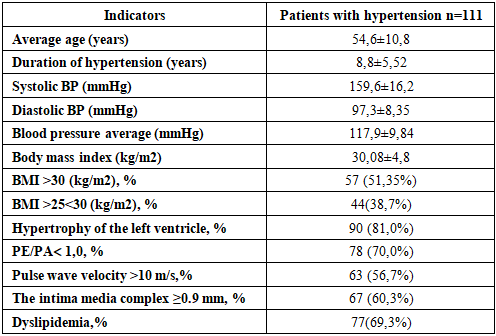
- The study included 111 male and female patients with grade I–III arterial hypertension (AH) according to the ESC/ESH 2018 classification, who were undergoing outpatient treatment at the Republican Specialized Scientific and Practical Medical Center of Cardiology. The clinical characteristics of the AH patients are presented in Table 1. Overall, prior to the start of therapy, the systolic blood pressure (SBP) was 159.6±16.2 mmHg, and the diastolic blood pressure (DBP) was 97.3±8.35 mmHg. The average age of the patients was 54.6±10.8 years, and the mean duration of AH was 8.8±5.52 years. Among the participants, 68 (61.3%) were women, and 43 (38.7%) were men.
|
|
|

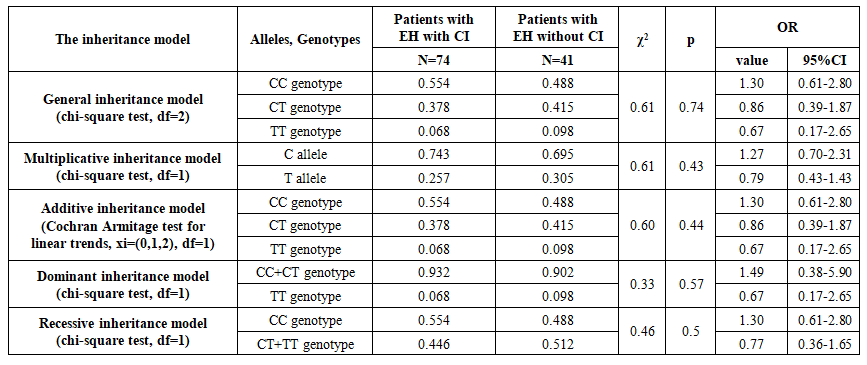 | Table 4. Risk assessment of cognitive impairments in EH patients considering the rs2471738 polymorphism of the MAPT gene in the Uzbek population |
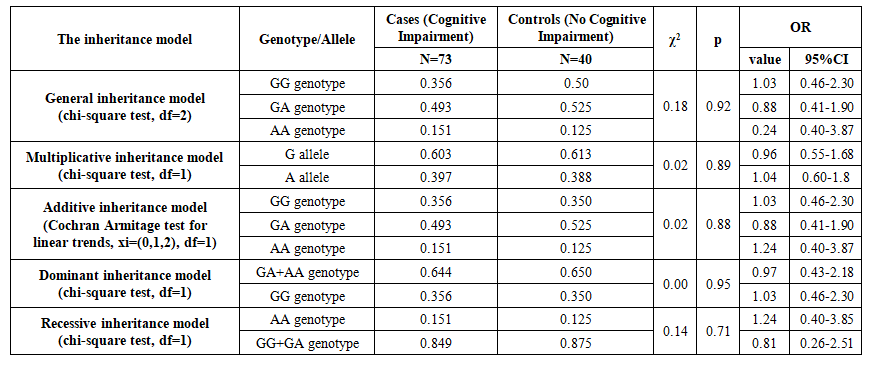 | Table 5. Assessment of the Risk of Cognitive Impairments in Patients with EH Considering the rs242557 Polymorphism of the MAPT Gene |
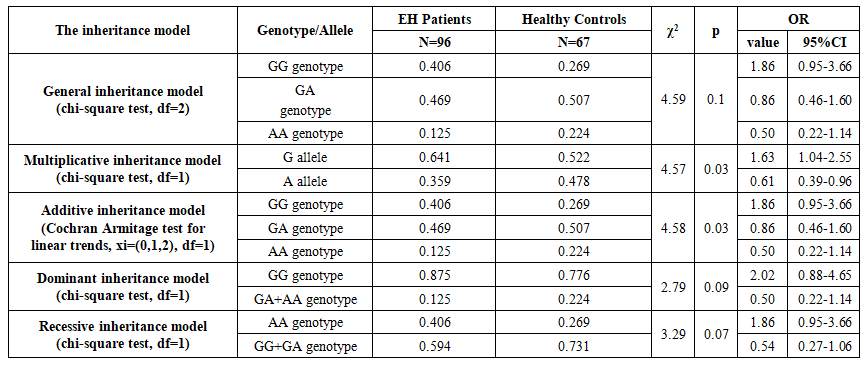 | Table 6. Analysis of the Association Between the rs242557 Polymorphism of the MAPT Gene and the Risk of Developing Essential Hypertension in the Uzbek Population |
4. Discussion
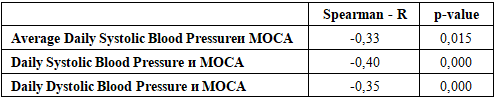
- It has been repeatedly confirmed that ambulatory blood pressure monitoring (ABPM) parameters correlate more closely with target organ damage compared to clinical blood pressure (BP) measured by traditional methods. Additionally, ABPM provides further information on parameters such as increased variability, disrupted circadian BP rhythm, and elevated morning BP surge [16,17,18]. Notably, hypertensive patients who are "non-dippers," i.e., those with insufficient nocturnal BP reduction and elevated BP variability during early morning hours, are at higher risk for cerebrovascular and cardiovascular complications, as well as left ventricular hypertrophy (LVH) [19]. It is important to note that BP variability is an independent predictor of the development of dementia and its subtypes. For instance, Jung Eun Yoo et al. identified a relationship between higher BP variability and dementia incidence [20]. Our study demonstrated a negative correlation between daytime mean systolic BP (SBP), daytime SBP and diastolic BP (DBP) variability, and the total score on the Montreal Cognitive Assessment (MOCA) scale, consistent with the literature.As is well known, central pulse pressure (cPP) and pulse wave velocity (PWV) are independent predictors of cardiovascular diseases, including stroke [21,22,23,24], and are considered markers of subclinical cardiovascular diseases [25]. Both high and low PP predict the onset of Alzheimer’s disease [26]. Furthermore, higher PP has been associated with lower levels of cognitive function among individuals without dementia [27]. In cross-sectional studies, PWV was found to be higher in patients with vascular dementia, Alzheimer’s disease, or mild cognitive impairment than in individuals with normal cognitive function [28]. Higher PWV has also been associated with lower cognitive function levels as measured by the Mini-Mental State Examination (MMSE) [29,30]. The data obtained in presented study align with the literature, particularly the negative correlation found between PWV and cPP values and the total score on the Mini-Cog test. The molecular-genetic analysis we conducted to study the effect of rs2471738 and rs242557 polymorphisms of the MAPT gene on cognitive functions did not reveal a significant association of these polymorphisms with the risk of cognitive impairments in patients with essential hypertension (EH) in the Uzbek population. Our results indicate a significantly higher accumulation of the CC genotype and the C allele of the rs2471738 polymorphism of the MAPT gene among both EH patients with and without cognitive impairments. Additionally, a significantly higher accumulation of the GA genotype and the G allele of the rs242557 polymorphism of the MAPT gene was demonstrated among both EH patients with and without cognitive impairments. It should be noted that the presented results are limited by the small sample size of patients studied. With a larger sample size, it may be possible to establish an association between the studied polymorphisms and the risk of developing cognitive impairments in EH patients. We also performed a molecular-genetic analysis of the distribution of genotypes and alleles of rs2471738 and rs242557 polymorphisms of the MAPT gene among EH patients and healthy individuals in the Uzbek population. This analysis demonstrated a significantly higher accumulation of the CC genotype and the C allele of the rs2471738 polymorphism of the MAPT gene among both EH patients and healthy individuals. A significantly higher accumulation of the G allele of the rs242557 polymorphism of the MAPT gene was demonstrated among EH patients in the Uzbek population. Based on genetic inheritance models, an association of the G allele of the rs242557 polymorphism of the MAPT gene with the risk of developing EH in the Uzbek population was identified.
5. Conclusions
- This study demonstrated a significant contribution of disturbances in the circadian blood pressure profile and pronounced vascular remodeling to the development of cognitive impairments in patients with arterial hypertension. At the same time, no influence of the rs2471738 and rs242557 polymorphisms of the MAPT gene on cognitive functions in patients with essential hypertension (EH) was observed. The molecular-genetic analysis did not reveal a statistically significant association between the studied MAPT polymorphisms and the risk of cognitive impairment in EH patients of the Uzbek population. Nevertheless, the results showed a higher frequency of the CC genotype and C allele of the rs2471738 polymorphism, as well as the GA genotype and G allele of the rs242557 polymorphism, both in EH patients with cognitive impairment and in those without it. Importantly, based on genetic inheritance models, the G allele of the rs242557 MAPT polymorphism was associated with an increased risk of developing essential hypertension in the Uzbek population. These findings, however, are limited by the relatively small sample size. Further studies with larger cohorts are needed to clarify the potential role of the studied polymorphisms in the development of cognitive impairments in essential hypertension.