
-
Paper Information
- Next Paper
- Previous Paper
- Paper Submission
-
Journal Information
- About This Journal
- Editorial Board
- Current Issue
- Archive
- Author Guidelines
- Contact Us
American Journal of Medicine and Medical Sciences
p-ISSN: 2165-901X e-ISSN: 2165-9036
2025; 15(12): 4380-4382
doi:10.5923/j.ajmms.20251512.41
Received: Nov. 9, 2025; Accepted: Dec. 3, 2025; Published: Dec. 9, 2025

Clinical and Neurological Characteristics and Treatment Tactics for Cervical Spine Injuries
 Abstract
 Reference
 Full-Text PDF
 Full-text HTML
Kadirov A. A.
Senior Lecturer, Department of Traumatology, Orthopedics and Neurosurgeryof Andijan State Medical Institute, Andijan, Uzbekistan
Correspondence to: Kadirov A. A., Senior Lecturer, Department of Traumatology, Orthopedics and Neurosurgeryof Andijan State Medical Institute, Andijan, Uzbekistan.
Copyright © 2025 The Author(s). Published by Scientific & Academic Publishing.
This work is licensed under the Creative Commons Attribution International License (CC BY).
http://creativecommons.org/licenses/by/4.0/

The aim of this study was to evaluate the clinical and neurological characteristics of cervical spine injuries and determine treatment tactics depending on the degree of neurological deficit and the nature of the injury. The study included 63 patients treated in the neurosurgical department. The patients' ages ranged from 19 to 74 years. Among them, men of working age predominated. Diagnostics included radiography, computed tomography, and magnetic resonance imaging. Neurological status was assessed using the ASIA scale. Based on the clinical presentation and imaging data, patients were divided into groups receiving either conservative or surgical treatment. Surgical tactics were used for unstable injuries and severe neurological deficit. The analysis identified the main factors influencing the choice of treatment method, the incidence of complications, and the duration of hospitalization. The results obtained emphasize the importance of an individual approach to each patient and the need for comprehensive multidisciplinary management. The presented data can serve as a basis for the development of clinical guidelines for the diagnosis and treatment of cervical spine injuries.
Keywords: Cervical injury, Spine, Neurological deficit, Treatment, Surgery, ASIA, Diagnostics
Cite this paper: Kadirov A. A., Clinical and Neurological Characteristics and Treatment Tactics for Cervical Spine Injuries, American Journal of Medicine and Medical Sciences, Vol. 15 No. 12, 2025, pp. 4380-4382. doi: 10.5923/j.ajmms.20251512.41.
1. Introduction
- Cervical spine injuries represent one of the most severe forms of musculoskeletal and nervous system trauma, associated with high mortality rates, disability, and a significant reduction in patient quality of life. According to global statistics, cervical spine trauma accounts for 20–25% of all spinal injuries, with up to 40% of these resulting in spinal cord injury. Causes include road traffic accidents, falls from height, sports and industrial injuries, and violent impacts, highlighting the wide range of risk factors [1,4,7].The increasing incidence of injuries among people of working age, including young and active individuals, is particularly alarming. This has not only medical but also serious socioeconomic consequences, including long-term treatment, the need for expensive rehabilitation, loss of ability to work, and the need for constant care. Furthermore, even with timely and qualified medical care, a significant proportion of patients experience significant neurological impairments, such as tetraparesis, respiratory distress, and pelvic floor dysfunction [2].The anatomical and physiological characteristics of the cervical spine—high mobility, a narrow spinal canal, and proximity to vital structures—complex diagnosis and treatment. Mechanisms of injury include flexion-extension movements, vertical compression, rotational impacts, and direct blows, each requiring a specific approach to interpreting the clinical picture and selecting a treatment strategy. The absence of pronounced symptoms in the early stages, the frequent association with other injuries (craniocerebral, thoracic, maxillofacial), and the risk of secondary injuries during improper transportation make this problem particularly acute [3,6].Despite the introduction of modern imaging techniques (CT, MRI), stabilization technologies, and intensive care protocols, a standardized approach to managing patients with cervical trauma still does not exist. This requires ongoing analysis of clinical cases, refinement of care algorithms, and the implementation of a multidisciplinary approach and preventive measures [7].
2. Materials and Methods
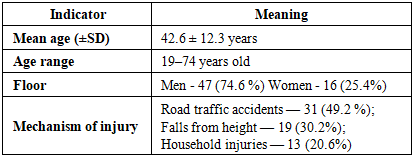
- The study included 63 patients with cervical spine injury treated between January 2015 and December 2024. The patients' ages ranged from 19 to 74 years, with a mean age of 42.6±12.3 years. Among them, there were 47 (74.6%) men and 16 (25.4%) women.
|
|
3. Results
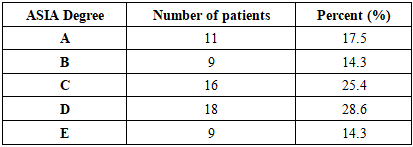
- Of the 63 patients included in the study, men predominated—74.6% (47 individuals), which is consistent with known epidemiological trends in cervical spine injuries. The mean age of patients was 42.6 ± 12.3 years. The most common mechanisms of injury were road traffic accidents (31 patients, 49.2%), falls from height (19, 30.2%), and household injuries (13, 20.6%).Neuroimaging data, the most common types of injuries were:• compression fractures of the vertebral bodies - in 22 patients (34.9%);• dislocations and subluxations - in 15 (23.8%);• unstable fractures and dislocations - in 11 (17.5%);• damage to intervertebral discs without displacement - in 9 (14.3%);• isolated damage to the posterior elements - in 6 (9.5%).The distribution of patients according to the ASIA scale revealed significant neurological deficits in a significant number of victims. Eleven patients (17.5%) were diagnosed with complete transverse spinal cord injury (ASIA A), 9 (14.3%) had a severe incomplete deficit (ASIA B), 16 (25.4%) corresponded to level C, 18 (28.6%) – D, and only 9 patients (14.3%) had no significant neurological deficit (ASIA E).Patients who received surgical treatment (n = 36) more often had unstable injuries and severe neurological impairment (ASIA A–C — 29 of 36; 80.6%). Conservative treatment (n = 27) was performed mainly for stable injuries and minimal neurological manifestations (ASIA D–E — 21 of 27; 77.8%).The average length of hospital stay for patients who underwent surgery was 20.1±4.8 days, while for patients treated conservatively, it was 15.9±3.6 days (p < 0.05). After completion of the inpatient stage of treatment, 39 patients (61.9%) were referred to rehabilitation facilities, 18 (28.6%) were discharged home with recommendations for outpatient treatment, and 6 (9.5%) required follow-up observation by a neurologist at their place of residence.
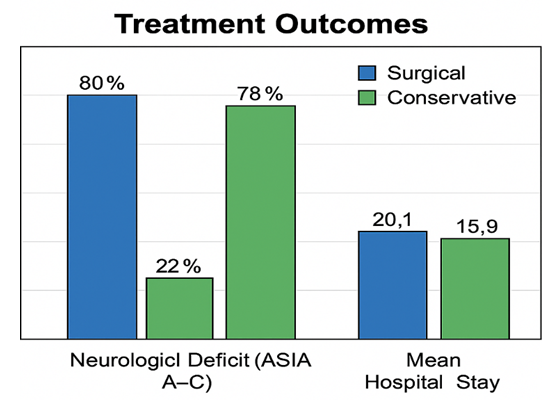 | Figure 1. Results of the treatment |
4. Discussion
- The obtained results confirm the high clinical and social significance of cervical spine injuries. The predominance of male victims and those of active working age is consistent with international literature, where such injuries are more often recorded in men aged 30–50 due to a higher incidence of road traffic accidents and occupational injuries.The distribution of patients according to the ASIA scale demonstrates a significant number of cases with severe neurological deficits. Nearly 58% of patients had levels A–C, confirming the high incidence of spinal cord injury in cervical spine injuries. These data are consistent with a number of studies emphasizing that even in the absence of significant vertebral displacement, severe neurological impairment can develop due to acute vascular, edematous, or ischemic processes in the spinal cord.A comparative analysis of treatment effectiveness revealed that surgical treatment was used primarily for unstable injuries and those with significant neurological deficits. This trend reflects modern approaches to surgical stabilization as the treatment of choice when there is a risk of neurological symptom progression or mechanical instability of the spine. Meanwhile, in patients with less severe injuries (ASIA D–E), particularly those with stable fractures, conservative treatment (including cervical braces, bed rest, and drug therapy) has shown satisfactory results.The average hospital stay for patients undergoing surgery was statistically significantly longer (p<0.05), reflecting both the greater severity of their condition and the need for postoperative observation. The complication rate was 19%, comparable to data from international studies, where the rate of postoperative and neurological complications ranges from 15 to 25%. The absence of fatal outcomes in the study group may be due to the relatively small number of patients, as well as the effectiveness of early diagnosis and timely intervention.
5. Conclusions
- 1. Among 63 patients with cervical spine injuries, men predominated (74.6%), the average age was 42.6 ± 12.3 years. The main causes of injuries were road traffic accidents (49.2%) and falls from height (30.2%).2. Neurological deficits of varying degrees according to the ASIA scale were detected in 85.7% of patients. Complete transverse spinal cord injury (ASIA A) was diagnosed in 17.5%, severe forms (ASIA B–C) in 39.7%, mild forms (ASIA D) in 28.6%, and no deficit (ASIA E) in 14.3%.3. The average hospital stay for patients undergoing surgery was 20.1 ± 4.8 days, compared with 15.9 ± 3.6 days for those receiving conservative treatment (p < 0.05). Complications were reported in 12 patients (19.0%), including infectious (7.9%), pressure ulcers (6.3%), and thromboembolic events (4.8%). No fatal outcomes were recorded.4. The obtained data highlight the need for a differentiated approach to the choice of treatment tactics based on the degree of neurological deficit, the nature of the injury and the general condition of the patient.