
-
Paper Information
- Next Paper
- Previous Paper
- Paper Submission
-
Journal Information
- About This Journal
- Editorial Board
- Current Issue
- Archive
- Author Guidelines
- Contact Us
American Journal of Medicine and Medical Sciences
p-ISSN: 2165-901X e-ISSN: 2165-9036
2025; 15(12): 4364-4367
doi:10.5923/j.ajmms.20251512.36
Received: Nov. 12, 2025; Accepted: Dec. 1, 2025; Published: Dec. 8, 2025

Morphological Features of Placental Structure in Women Who Had COVID-19 Infection and Its Effect on the Condition of the Fetus and Newborn
 Abstract
 Reference
 Full-Text PDF
 Full-text HTML
Dadamukhamedova Kholida Erkinovna, Kholiyeva Nigora Khudayberdiyevna, Maksumxonova Madina Bakhramovna, Dehqonov Shukhratjon Shavkat ugli, Bektemirov Boburmirzo Bakhrom ugli
Tashkent State Medical University, Tashkent, Uzbekistan
Copyright © 2025 The Author(s). Published by Scientific & Academic Publishing.
This work is licensed under the Creative Commons Attribution International License (CC BY).
http://creativecommons.org/licenses/by/4.0/

This article investigates the morphological, histochemical, and ultrastructural alterations occurring in the placentas of pregnant women infected with COVID-19, as well as their impact on fetal and neonatal outcomes. The study was conducted at the Department of Pathological Anatomy of the Tashkent State Medical University and included 120 women (80 with COVID-19 and 40 in the control group). Morphometric analysis revealed a decrease in placental weight and thickness in women with COVID-19, along with a marked increase in stromal fibrosis, fibrinoid necrosis, microthrombi, and inflammatory infiltration. PAS-reaction results demonstrated a reduction in glycoprotein content, while electron microscopy showed mitochondrial damage and deformation of the endoplasmic reticulum. Newborns exhibited low birth weight, hypoxia, and reduced APGAR scores. The findings confirm that COVID-19 infection induces fibrotic, hypoxic, and metabolic changes in the placenta, increasing the risk of perinatal complications. These data are of significant importance for early detection of fetoplacental insufficiency and improving pregnancy monitoring.
Keywords: COVID-19, Placenta, Morphology, Fibrosis, Fibrinoid necrosis, Trophoblast, PAS-reaction, Glycoprotein, Fetal hypoxia, Perinatal complications
Cite this paper: Dadamukhamedova Kholida Erkinovna, Kholiyeva Nigora Khudayberdiyevna, Maksumxonova Madina Bakhramovna, Dehqonov Shukhratjon Shavkat ugli, Bektemirov Boburmirzo Bakhrom ugli, Morphological Features of Placental Structure in Women Who Had COVID-19 Infection and Its Effect on the Condition of the Fetus and Newborn, American Journal of Medicine and Medical Sciences, Vol. 15 No. 12, 2025, pp. 4364-4367. doi: 10.5923/j.ajmms.20251512.36.
Article Outline
1. Introduction
- Last in years world along coronavirus COVID-19 pandemic not only general health storage system, maybe reproductive health serious for to the threat The world has become health storage organization to the information according to, 2020–2023 with COVID-19 during sick 5–10% of women pregnant women organization Therefore, pregnancy during the COVID-19 pandemic the impact study, especially the placenta in the structure morphological changes and their fetus and baby to your health the impact assessment issue current scientific and practical importance profession is doing.Pandemic during take visited epidemiological research with COVID-19 sick pregnant in women preeclampsia, fetus hypoxia, intrauterine growth late, early birth and perinatal death cases increased [3]. In particular, M. Hosier and co-authors (2021) study SARS-CoV-2 virus placenta in tissues piled up, piled up structures necrosis, thrombosis and intervillosis hemorrhages call [4] was determined. Thus together, according to R. Schwartz (2022) according to, with COVID-19 sick women's Fibrinoid deposits in the placenta, syncytiotrophoblast necrosis and lymphocytic infiltration such as changes observed [5].Placenta – mother and fetus between main exchange organ is, not only gas and food substances exchange, maybe immunological also provides protection against the SARS-CoV-2 virus. to the placenta enter to go mechanism mainly ACE2 receptors and TMPRSS2 protease through done increases [6]. This receptors villi in trophoblasts expression of COVID-19 infection placenta straight away to damage take This process as a result microcirculator disorders, villosis stroma edema, capillaries collapse and hemodynamic imbalance to the surface comes [7].C. Shanes and with COVID-19 in the research of co-authors (2020) sick in women placenta maternal vascular in tissues malperfusion changes – spiral arteries thrombosis, intervillous fibrinoid deposits and villi necrosis [8] Such morphological disorders to the fetus oxygen and food of substances enough at the level to not pass reason As a result, the born low birth weight in infants, Apgar score low score on and breath to take disorders record [9].Some authors to the mind according to the placenta observed changes not only of the virus directly impact, maybe organism inflammation and immune answer mechanisms increase [10]. Cytokine storm resulting in interleukin-6, TNF- α, and IL- 1β such as mediators increase placental in tissues endothelial dysfunction and microcirculator violations [11]. This fetus hypoxia and perinatal complications the risk further increases.So so, COVID-19 infection in the placenta serious morphological changes calls, this changes fetus development delay, intrauterine death, childbirth complications and new born babies inconvenient clinical results with closely Therefore, COVID-19 infection from the head forgiven women placenta morphological to oneself characteristics deep study perinatal medicine in practice important importance It has. It is not only disease pathogenesis to understand, maybe from birth previous monitoring, fetus status assessment and prevention strategies also serve to improve does.Placenta — mother and fetus between main physiological bridge gas metabolism, nutrition, immune protection and metabolic detoxification functions does. Any viral or hormonal disorders, particularly SARS-CoV-2 infection, in the placenta microcirculation, stromal changes, capillary of obstacles injury and hypoxic of processes to develop take comes. In the literature with COVID-19 sick in women villi in the stroma fibrosis, trophoblast in the layer degenerative changes, fibrinoid necrosis, microthrombus and choral capillaries contraction such as changes record [1–4].Many foreign research this shows that the SARS-CoV-2 virus straight away placenta to the tissues entrance every not always confirmed, but immune inflammation, endothelium dysfunction and cytokines balance sheet violation as a result placenta barer's morphological status [5]. Therefore, COVID-19 infection from the head forgiven women placenta morphological analysis, microscopic and histochemical changes study through fetus during the prenatal and postnatal stages of development to the surface coming violations forecast possible.Research purposeCOVID-19 infection from the head forgiven in women placenta morphological changes determination and their fetus and new born babies to the state the impact assessment.
2. Materials and Methods
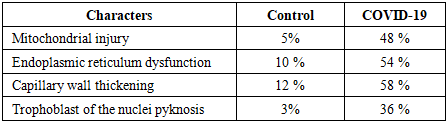
- The study will be conducted in Tashkent state in 2022–2025. medicine university pathological anatomy Department, Republican Perinatal Center and childbirth complexes basically was conducted. The research 120 people in total woman attraction 80 of them have COVID-19 infection. with infected (main) group), 40 people and healthy pregnant women (control) group). COVID-19 diagnosis PCR, serological IgM/IgG tests and blue crack CT images of the chest based on confirmed. Research participants age, pregnancy for the period and somatic to the state looking at to groups distributed.Each from birth then placenta, umbilical cord and amniotic from the bag samples received. Received materials 10% neutral in formalin fixation was done and paraffin blocks prepared, 5 μm thick sections hexaline and eosin using Stained. Stromal fibers and sclerosis level Van- Gison method with mucopolysaccharides and SHIK (PAS) reaction using identified, trophoblasts and in the stroma glycoprotein amount This was evaluated. methods using dystrophic, inflammatory and fibrosis of processes expression level determined.Electronic microscopic in inspections trophoblast and endothelial in cells mitochondrial changes, membrane deformation, vacuoles appearance to be and capillary wall thickening observed. Organometric measurements through placenta weight, diameter, thickness and weight The coefficient (m_pl / m_baby) was calculated. Each 15 indicators in the sample morphometric analysis was done, statistical processing t-student test in the program “Statistica 10.0” based on completed. p < 0.05 value accepted as reliable was done.
3. Research Results
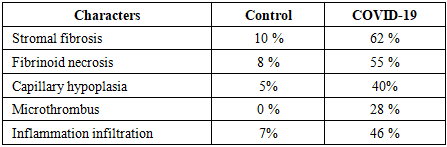
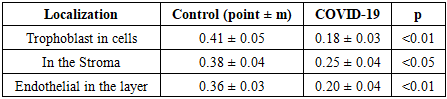
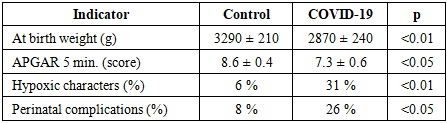
- With COVID-19 sick women placenta morphometric, histological and ultrastructure at the level noticeable changes manifestation The placenta mass, thickness and weight coefficient decrease their functional of possibilities decreased shows.
|

|
|
|
|
4. Discussion
- This research results of SARS-CoV-2 infection placenta morphology complex the impact shows. In the placenta fibrosis, microthrombus and villi dystrophy — COVID-19 infection typical was immunovascular imbalance This is the result of fetoplacental blood of rotation violation and hypoxia to increase reason will be. Hypoxic changes and in the fetus oxygen shortage calling, low birth weight, perinatal complications and baby hypoxia such as clinical to the consequences take is coming.Medical point of view visually, morphologically changes prenatal diagnosis and perinatal risk assessment for new markers as usage possible. Placenta of weight reduction, fibrinoid necrosis level increase and SHIK reaction weakening such as indicators with COVID-19 late during pregnancies hypoxic syndrome early determination opportunity gives. Socio-economic in terms of and so on pregnancies perinatal mortality and neonatal resuscitation circumstances increases, this and health storage system expenses increases. Preventive in terms of and COVID-19 infection from the head forgiven women for expanded screening, dopplerometry, laboratory monitoring and from birth next morphological analysis on the road to put necessary.Also, this research results reproductive health policy in improving, especially during the pandemic under the circumstances mother and child health protection to do programs in formation basis become service does. In the era of COVID-19 pregnant women early detection, isolation and immunomodulator therapy own on time application perinatal risk reduces and economic efficiency increases.
5. Conclusions
- COVID-19 infection pregnant in women placenta morphology noticeable at the level changes. In the study fibrosis, fibrinoid necrosis, microthrombi and glycoprotein shortage it is determined that changes fetus hypoxia, low birth weight weight, perinatal complications and in babies breath to take disorders with directly related that It has been proven that the placenta structure changes due to COVID-19 not only breath to the system, but fetoplacental systematic to the system the impact shows.Morphometric and histochemical analyses complex application fetoplacental shortage early determination opportunity This gives health storage system for medical and economic in terms of important importance has perinatal death reduce, childbirth next rehabilitation the deadline reduction and healthy generation to provide service Therefore, with COVID-19 late during pregnancies placenta deep morphological assessment and individual approach based on preventive measures working exit It is necessary.